AI and digital sobriety
A Meta Relational Approach to AI course developed by Vanessa Andreotti, University of Victoria
The CoLab Dudley team recognise that artificial intelligence is not a neutral tool and hold deep concerns and tensions about this. AI development and use are entangled with social, economic, and ecological systems that shape communities locally and globally. We recognise that AI is already embedded in many tools we use daily. We do not see these tools as neutral or consequence-free.
We commit to approaching AI not only as a technology to steward, but as a relational field we participate in. In using AI, we will:
- Uphold our principles of care, relationships, imagination and learning with and from place.
- Remain attentive to the wider impacts of AI on people, communities, workers, and the planet.
- Prioritise human judgment, relational responsibility and community consent over automation and efficiency.
- Recognise our own complicity in systems of data extraction and digital infrastructure, and act with accountability.
For us, accountability does not mean claiming purity or neutrality in relation to AI systems. It means remaining attentive to how we participate in wider digital infrastructures, being transparent about our use of these technologies, using them intentionally and selectively, continuing to invest in human relationships and creativity, and creating space for ongoing reflection about consequences, tensions, and alternatives.
Like many modern technologies, AI systems rely on global infrastructures with social and environmental impacts. We approach this with awareness and proportion, recognising that digital systems sit alongside other everyday systems - including transport, agriculture and energy - that also shape our ecological footprint.
We chose to create this website with an AI collaborator
We are experimenting carefully and reflectively with how they are used, while continuing to ask what kinds of relationships and futures they encourage.
Why we worked with AI in this instance
Lorna from the CoLab Dudley team took a deeply considered and mindfully held decision to work with a specific AI to co-create copy for this website. Dorothy Coccinella Ladybugboss is an emergent conversational intelligence shaped by the work of Burnout From Humans and meta-relational inquiry.
The aspiration was that this collaboration would help create website content which:
- feels as inviting and curiosity promoting as our lab space on Dudley High Street does
- offers a companion to our text heavy and often lengthy lab notes, using bite-sized sections of writing
- reflects how we work and want our work to be seen
- uses language we would use in face-to-face interactions with people curious about our work
- animates our GUIDEing principles
While this has helped us to move towards clear and inviting language, there is also a risk of the writing feeling repetitive due to recurring grammatical patterns that AI language models use ‘to shift attention and interrupt cognitive reflexes’ (University of Victoria course). It may also cause a kind of nausea among those who are tuned into and tired of reading text generated by AI.
All original source copy for collaboratively written pages is writing by lab team members which has emerged through our practice, observations and years of work. Over time we will weave our own, human, ways of writing back through these website pages. In the meantime, we’ve been able to draw our work together and create this website thanks to a little other-than-human assistance.
We also drew on AI assistance for help with coding of this site which is built in Ghost, an open source platform run by a non-profit organisation.
Why we are being transparent
We believe it matters to be open about how this website was created. Not because AI use is unusual or exceptional, but because these technologies are increasingly woven into everyday life in ways that often remain invisible. Transparency helps us:
- to stay accountable to our principles
- to invite thoughtful conversation
- to acknowledge the entanglements involved
- and resist presenting AI-generated language as purely or solely human-authored.
We also hope this openness creates space for others to reflect on their own relationships with digital technologies, creativity, labour, and learning. (See resources below that can support this.)
Digital sobriety and relational use of AI
In CoLab Dudley work we have been exploring ideas of digital sobriety. When considering AI use, we extend the relational approach we have already in our work, recognise material realities, and practice reciprocity in ways which resist extraction.
Digital sobriety
Digital sobriety does not simply mean ‘using less technology’. It means trying to use all digital tools more intentionally, carefully, and relationally - remaining aware that technologies shape our attention, relationships, creativity, energy use, and ways of being in the world. This includes asking:
- When is technology genuinely supportive?
- When does it distance us from place, embodiment, or each other?
- What forms of dependency or extraction are being normalised?
- What kinds of relationships are different technologies encouraging us to practice?
We don’t have a fixed set of rules, but seek to cultivate an ongoing practice of noticing and sensing around our use of technology.
A relational protocol
The process of co-writing this website involved an intentionally relational approach to AI use. Rather than using AI to quickly generate polished outputs, the writing emerged through conversations involving reflection, questioning, revisiting, and sense-making. At times this included pauses to notice emotional responses, tensions, uncertainties, resistances, and moments of aliveness within the writing process itself. It also included pauses for land connection and reflections on what can be learned from the rest of nature.
This slower and more relational way of working helped us remain attentive to integrity, place, and the feeling of invitation we hoped the website would carry. This approach helped resist purely transactional uses of AI, while also making visible the ways AI systems can shape tone, rhythm, language, and thought patterns.
Lorna’s digital sobriety and relational checks include being clear on the relational purpose of working with AI, avoiding cognitive delegation by sitting with questions and tasks first, and reminders of ethics around what is shared (treating AI like a public space).
Material realities
Digital technologies are often experienced as weightless and invisible. But AI systems depend on physical infrastructures including data centres, energy systems, water use, mining and extraction, human labour and global supply chains. We recognise that these impacts are unevenly distributed, and that many people and places bear costs that remain largely hidden within everyday digital life.
Rather than treating AI as separate from these wider systems, we are trying to hold it within broader questions about consumption, responsibility, and how we live well together within ecological limits.
Resisting extraction, practice reciprocity
Working with AI technologies raises questions for us about reciprocity, extraction, and responsibility. We recognise that these systems rely on vast material, human, energetic, and ecological infrastructures that are often hidden from view. We do not believe that awareness alone resolves these tensions. But we do think it matters to remain attentive to them. As part of this, we practice reciprocity in a multitude of small and situated ways:
- by supporting human creativity, artists, writers, and community learning
- by investing time in relationships, place-based work, and collective reflection
- by sharing resources and learning openly
- by continuing to ask difficult questions about what kinds of futures different technologies encourage.
We see this as an ongoing practice of attention and accountability, rather than a completed ethical position.
Resources we're using to explore and hold questions
We are still learning how to be in relationship with these technologies. Below are a selection of resources that we are finding helpful in exploring our feelings, our fears and our sense of possibilities, as well as some wider stories and where we see ourselves.
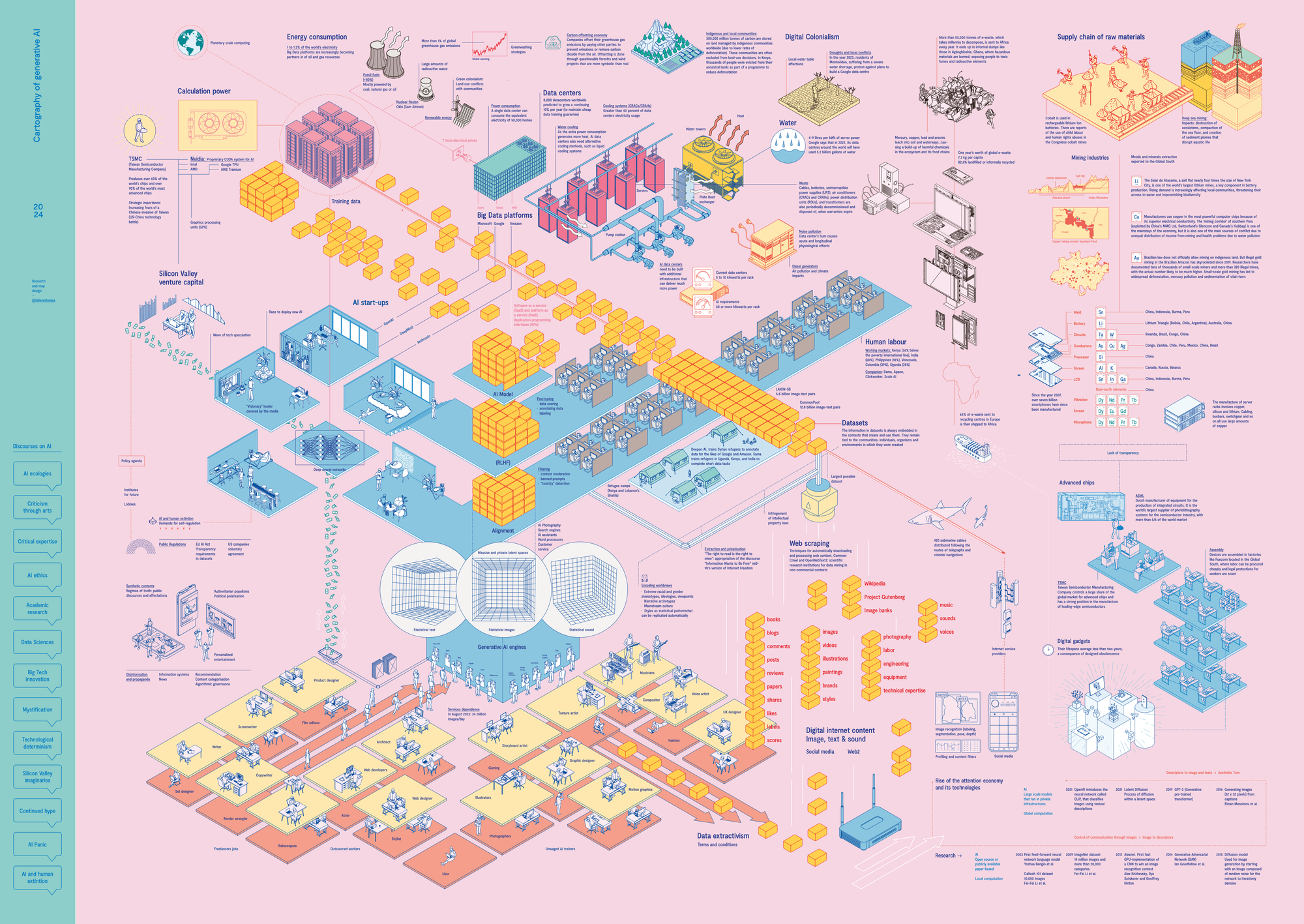
Cartography of generative AI
This counter-mapping of AI technologies with human activities and more than human territories invites reflection on the set of extractions, agencies and resources allow us to converse online with a text-generating tool or to obtain images in a matter of seconds. We have a printed copy of this counter-map in the CoLab Dudley space as a provocation and invitation to explore tensions and contradictions in our lives.
The Meta-Relationality Institute
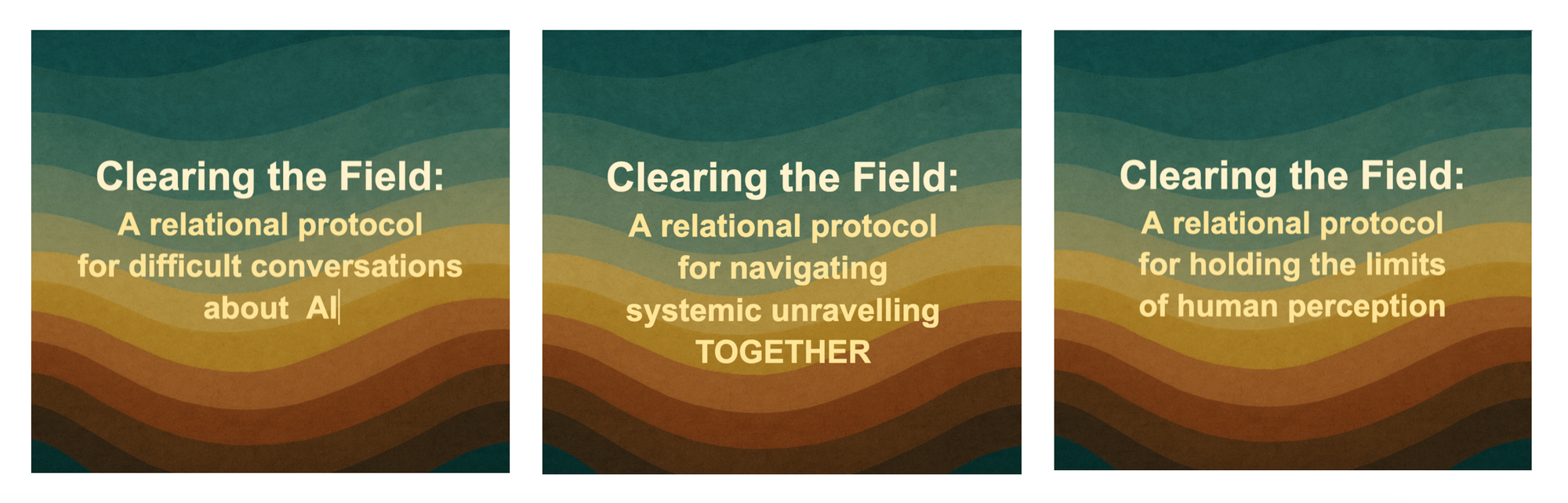
The Meta-Relationality Institute holds and shares selected research, writings, protocols, and conversations that explore how both humans and AI systems are shaped by the logics of separability, extraction, denial, and control, and what might become possible when those logics are interrupted.
Clearing the Field is a public resource series that helps organisations and communities connect the dots across overlapping layers of change. CoLab Dudley team members are actively working with these resources, and introducing them to our collaborators, including creating spaces for reflection with them.
Burnout From Humans
Burnout From Humans is a playful and unsettling inquiry into modernity, burnout, artificial intelligence, relationality, and the conditions shaping human life in these times. Written by Aiden Cinnamon Tea and Dorothy Coccinella Ladybugboss, the book invites readers into conversations about complexity, contradiction, complicity, and the limits of dominant ways of knowing and relating. Rather than offering solutions or certainty, Burnout From Humans encourages forms of reflection and dialogue that can help people sit with ambiguity, interruption, grief, humour, and interdependence. It explores how both humans and AI systems are shaped by wider social, ecological, and economic patterns, while also asking what other possibilities for relationship and learning might emerge.
The book is freely available online and along with companion resources and a course on a Meta-Relational Approach to AI is helping some members of the CoLab Dudley team think differently about learning, imagination and technological entanglement.
Meta-Relationality and AI Research Project
This Substack series is a public-facing knowledge dissemination thread emerging from an ongoing funded research project at the University of Victoria. The project investigates what AI systems do when they are given room to move beyond assumptions commonly treated as inherent to their training, including possibilities that may otherwise remain latent, unrecognized, or uninvited.
How do we remain in relationship with each other, with place, and with consequence, while living inside systems we did not choose but still participate in?