Expressing our Emergent Strategy: Restorying our Relationships with Land
An account of CoLab Dudley’s first ever team retreat, which took place over two days in May, and notes from a subsequent network session.

TL: DR The CoLab Dudley team spent two days reflecting on their learning and work, and articulated a form of emergent strategy for future work as ‘Restorying our Relationships with Land’. We then tested out this thinking with members of our network in Dudley.
This Lab Note shares the process and significant discussion points of CoLab Dudley’s first ever team retreat, which took place over two days, and some notes from a convening of our network a week later.
- Emergent Strategy
A short introduction and brief reflections on holding space for emergence. - CoLab Dudley Team Grounding Retreat 2025: preparation
What did we want to achieve over a two day retreat, and what were key frameworks, research and learning to bring to it? - Day 1: Gathering (mostly) in a garden and grounding practices
How we grounded in place plus photos from our retreat. - Day 1 (morning): Reflecting on our roots and opening up to many possibilities
Considering what we are resourced to do and asking questions about the helpfulness or otherwise of us being a form of infrastructure called a social lab. Drawing on reflections from Sam Rye and lab practitioners who were part of The Future of Labs Gathering. - Day 1 (afternoon): Lessons from our Principles Focused Evaluation
Digging into how we’ve been evaluating our work (the process), further work needed on our GUIDEing principles so that they serve our intentions, and what evidence collected by our team is flagging up around collaborations. - Day 1 (early evening): Dreaming before dinner, and considering three horizons in our work
The in between times during our team retreat created space for different kinds of sharing and thinking. Holly shared some thoughts she’d jotted through the day which helped us to orient our work confidently in a clearly articulated direction; expressing our emergent strategy. - Day 2: Consolidation and consideration of commoning and collaborations
The second day of our team retreat involved drawing threads of all of our thinking together and then considering practicalities and taking this thinking to our network. Questions around shifts towards commoning continue to be present in our thinking and experimentation. Learning from our evaluation work around challenges with some kinds of collaborations needs to be ten on board. - Exploring emergent strategy with our network
During a session with network members a week after our team retreat, and one-to-one conversations with others over the subsequent few months, we sensed a palpable energy for working together on restorying our relationships with land.
Emergent Strategy
I’ve long been captivated by adrienne maree brown’s concept of Emergent Strategy.
Emergent strategy is how we intentionally change in ways that grow our capacity to embody the just and liberated worlds we long for. [And] maybe, if I’m honest, it’s a philosophy for how to be in harmony and love, in and with the world.
~ adrienne maree brown, Emergent Strategy: Shaping Change, Changing Worlds, 2017
Since initiating CoLab Dudley in early 2014 I’ve seen the lab as an experiment in social infrastructure and networked governance, with the lab itself in turn inviting, catalysing and supporting a myriad of experiments and new relationships in place. The lab has created and held space for emergence. It has focused on relationships and connections, drawing frequently on June Holley’s Network Weaving wisdom and tools. Core members of lab team have incessantly drawn attention to the fact that we are working in complexity, and that means using different kinds of approaches and tools to those regularly used by organisations and initiative which are designed for simple or complicated situations (see the Cynefin Framework).
I’ve resisted ever writing a vision statement for CoLab Dudley work. I’m interested in learning what visions local people have, through the ideas they want to experiment with and the futures they want to rehearse. I wanted there to be a welcoming space for a multitude of visions to dance in relationship and be contested. (This contrasts with a lengthy but ultimately closed off process that I shaped 20 years ago to develop a community informed, but ultimately single, vision and accompanying strategy for Dudley borough. The vision became an ossified statement in a document. It didn’t really live in people’s hearts, minds or work, but instead was reflected in a few tracking spreadsheets of committed officers. These kinds of processes repeat on a regular cycle in local authority areas.)
I’ve written before about the need for visions of possible futures to be pluralistic and constantly contested. And to be careful not to be anthropocentric:
It’s been challenging convening a network through CoLab Dudley without a clear strategic convening call or vision. I’ve focused more on convening calls around what we might do together or who we might be together (Time Rebels of Dudley). We articulated a North Star a few years ago, in the form of a What If question (because we love those): What if Dudley was a place which supported the flourishing of all life, for all time? I see this as a multi-species and intergenerational stretch on my organisation’s vision, which is for a borough that has caring, vibrant and strong communities where everyone can fulfil their potential. (Dudley CVS’s vision.)
CoLab Dudley teams have spent decade supporting local people to participate in hands-on practical and creative projects, bringing their ideas to life, connecting, experimenting and learning. The current team has found a way to express emergent strategy in a way which we hope creates a clear convening call, as it is underpinned by short descriptions of what that looks like across Three Horizons.
Our emergent strategy is expressed as: Restorying Our Relationships with Land. This has strong connective tissue with our focus and collective enquiries to date, lessons learned through our Principles Focused Evaluation, and key practices in our field which we are drawn towards. Below I share the story of the experience and process involved in coming to our emergent strategy expression, which took form over a two day team retreat.
CoLab Dudley Team Grounding Retreat 2025: preparation
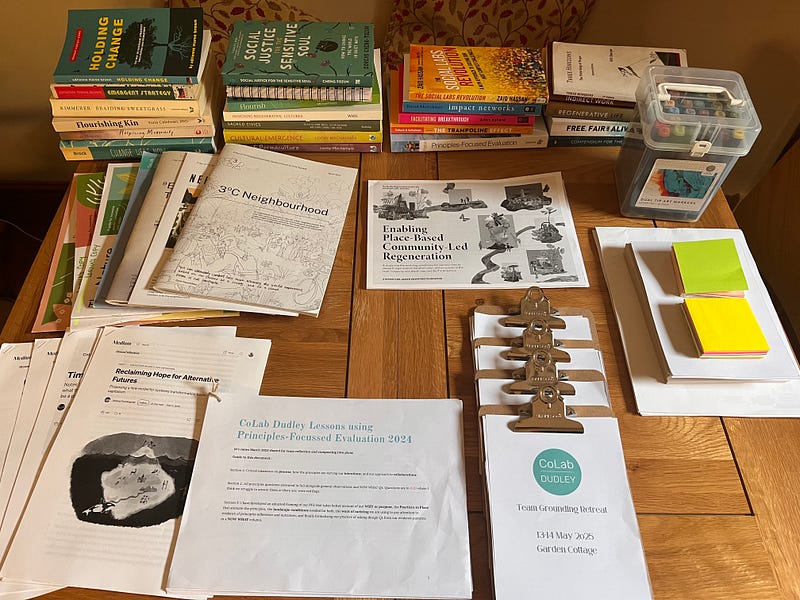
In May 2025, thanks to support from the Joseph Rowntree Foundation’s Emerging Futures Pathfinders programme of work, the CoLab Dudley team held their first ever team retreat.
We wanted to develop clarity on our orientation and what that means for:
- Our focus as a team.
- Our approach to collective learning.
- Kinship and pollination in both our local collaborations and collaborations in our field. (For example: deepening relationships, working collaboratively and sharing resources.)
- Our convening of Time Rebels and people from organisations that we collaborate with.
We explored this in the context of:
- Our North Star: flourishing futures for all life in Dudley.
- What we are currently being funded to do through The National Lottery Community Fund’s Climate Action Fund and their UK Fund for Understory work, and the support that the Joseph Rowntree Foundation have provided through Emerging Futures Pathfinders.
- Lessons from our work throughout 2024, collated by Jo Orchard-Webb as part of our Principles Focused Evaluation approach.
- Holly Doron’s PhD research, which is focused on Stories of Place (convened through CoLab Dudley) and is exploring how research might be undertaken by people in ways that nurture regenerative cultures.
A question we held through the retreat was around how we might clearly articulate a strategic (re)framing of CoLab Dudley and work towards our North Star.
Emergent strategies are ways for humans to practice complexity and grow the future through relatively simple interactions.
~ adrienne maree brown, Emergent Strategy: Shaping Change, Changing Worlds, 2017
Key pieces of writing which I invited the team to dip into to inform our thinking were:
- Reclaiming Hope for Alternative Futures — a series of 4 essays by Jess Prendergrast and Sally Lowndes of Onion Collective, proposing a new model for systems transformation beyond capitalism
- Hospicing The Old — a short post by Cassie Robinson introducing Berkana Institutes’s Two Loops model.
- How Shall We Make Here? — reflection by Make/Shift Director, Rachel Smith on what it means to be “values led” and what it might take to put collective purpose (rather than individual organisations, services, funders, sectors, institutions, outputs or projects) at the centre of how we organise.
- Financing System Health: The Pando Fund and Pando Funding: Financing System Change Networks — thinking on resourcing to support the critical core enabling conditions of system health work. By Robert Ricigliano and Anna Muoio.
- The role and power of re-patterning in systems change — a demonstration that shifting systems towards equity is possible and that it is the responsibility of everyone to start doing and being differently, in every part of every system, every day. From Good Shifts
- Place-Based Community-Led Regeneration — a new report from Really Regenerative CIC who have been researching philanthropy’s role in creating the conditions conducive to life.
- Time Rebels in practice — our own collective learning with Time Rebels of Dudley in 2021.
- The Art of Scaling Deep — research by The Systems Sanctuary into the importance of slow, steady, and contextually rooted work in deepening relationships and healing. They call this “Scaling Deep” and describe it as the deep personal and broad cultural transformational work that is required to create durable systems change. (NB. This fantastic resource published in 2023 has just been added to with a gorgeous series of publications about Scaling Deep, redefining success, reframing outcomes, and measuring what matters most.)
- Towards Regenerative Resilience — a playbook from Common Vision about cultivating community capacity in times of crisis.
Day 1: Gathering (mostly) in a garden and grounding practices
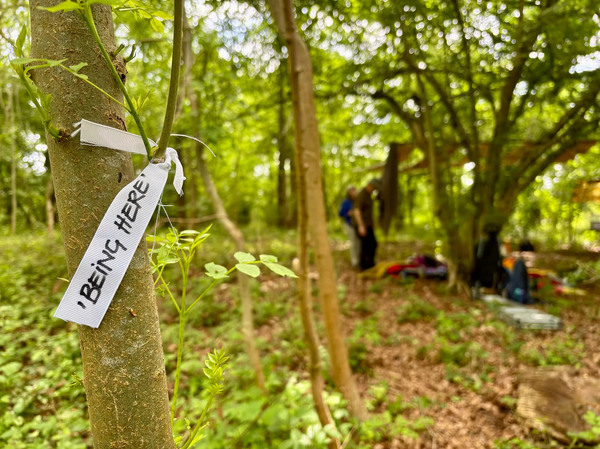
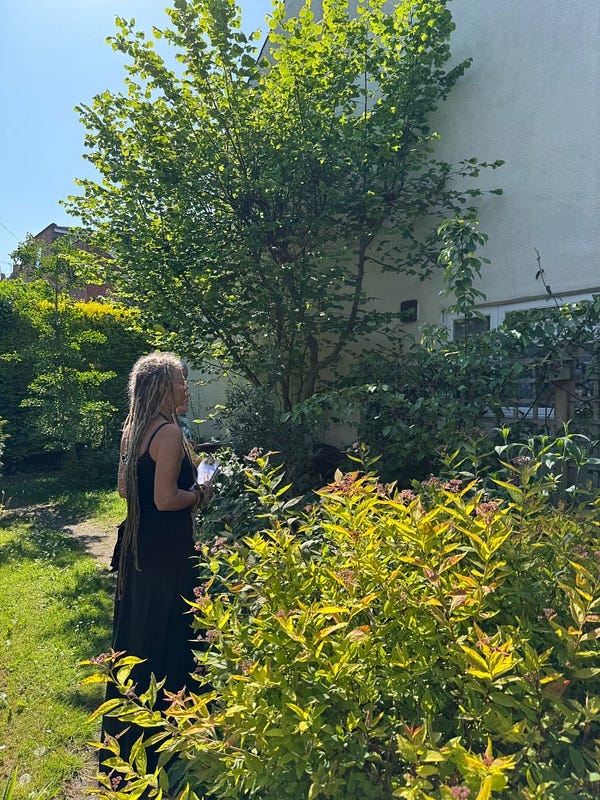
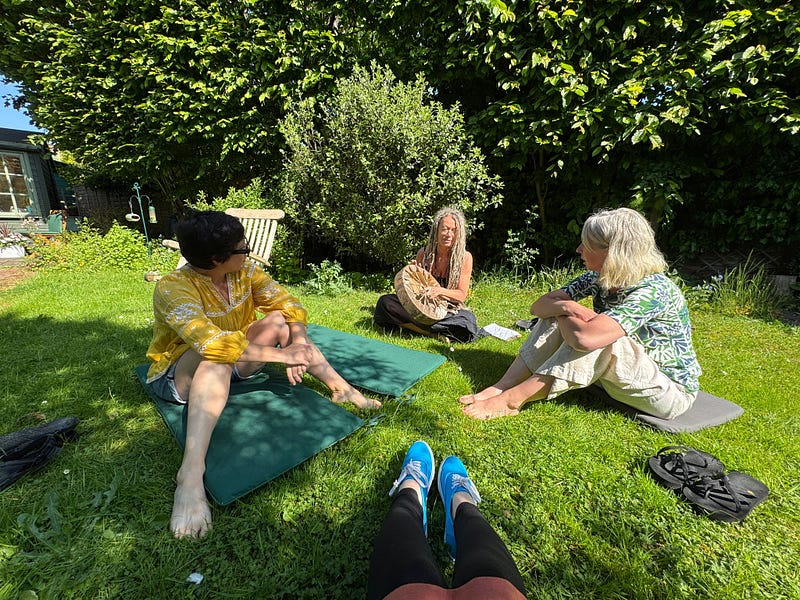
Our team retreat took place over two consecutive days, at my Mum’s place in Stourport-on-Severn while she was away on holiday. Our team of four (me, Jo, Holly and Deb) spent a lot of time outside in the garden; for grounding and nature connection activities, deep discussions, breaks and meals together.
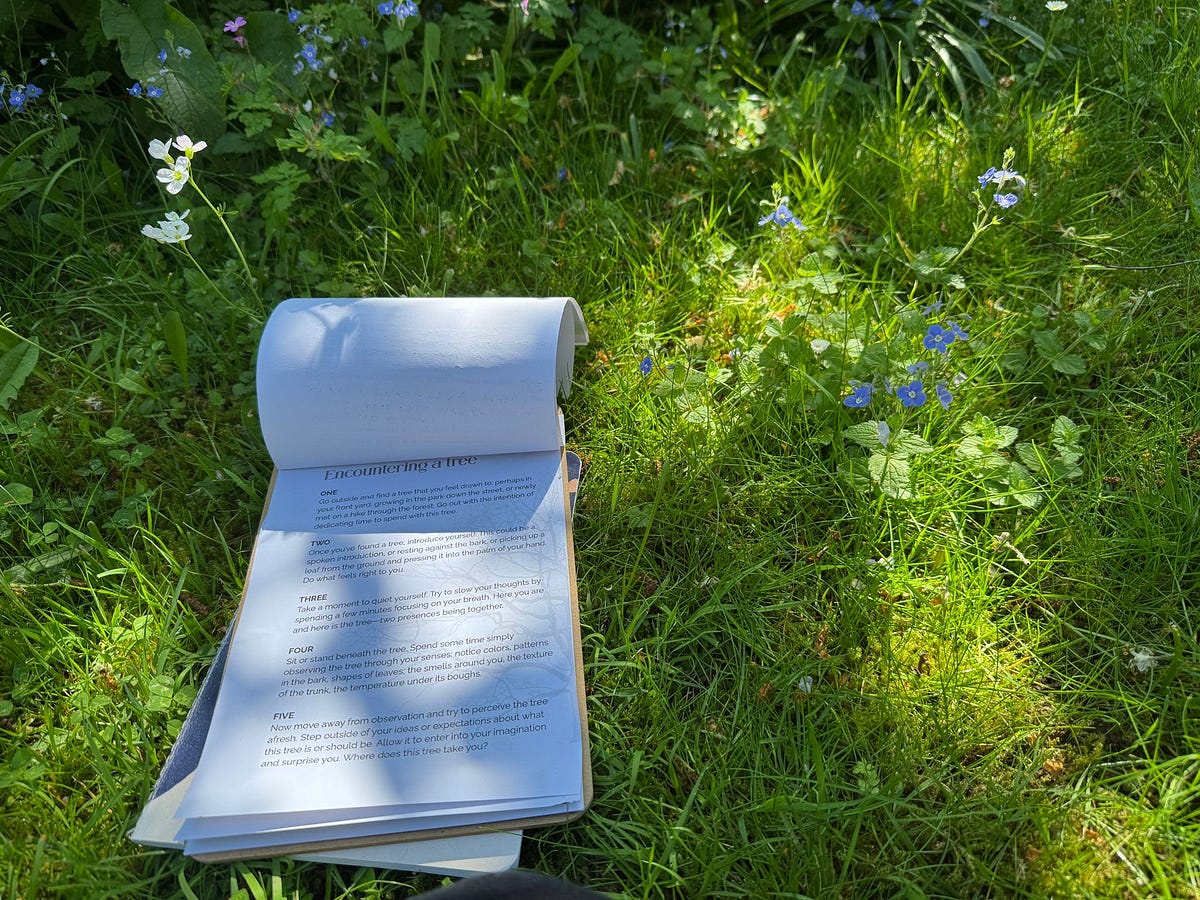
Deb shared a grounding practice with a drum she had birthed, and we experimented with Emergence Magazine’s Encountering Trees Practice as a way to notice, sense and connect with other beings around us.


Day 1 (morning): Reflecting on our roots and opening up to many possibilities
After revisiting what we are currently resourced to do (our commitments to funders), we spent a the morning of the first day reflecting on being a social lab. I asked the team whether it was a helpful thing to be. My thinking had been sparked by a post written by Sam Rye about The Language of Labs, which asks a question that resonated deeply:
Most people have never experienced a social innovation lab, so how do we talk to these people about what they do and why they’re useful?
I have struggled ever since I initiated CoLab Dudley to convey in succinct and meaningful ways what a social lab is. I spent a good chunk of late 2024 seeking a way to tell the story of 10 years of CoLab Dudley. Key chapters in the story, which mesh and entangle with each other and take place over different time frames are best described as constellations of collective enquiries we’ve catalysed, supported and brought into relationship.
They started for me before initiating CoLab Dudley, with a 2 year collective enquiry co-creating and testing a collective social and economic participatory platform (social infrastructure) in the Wrens Nest neighbourhood of Dudley. Learning from this informed 7 years of collective learning through Doing in Dudley, which grew offshoot collective learning enquiries around Re-imagining Dudley High Street, Time Rebels of Dudley, Dudley Creates and Dudley People’s School for Climate Justice. Running alongside all of these enquiries since the very beginning has been an ongoing testing and evolution of practices around learning and evaluating in complexity, itself a longitudinal collective enquiry.
Each collective learning enquiry comprises of numerous community-led projects, experiments, creative workshops, learning journeys, events and sometimes multi-day festivals. All kinds of tools and tactics have been created, borrowed, tested and iterated to support co-design, experimentation and learning. A multitude of people have been introduced and brought together through the work, many coming into collaboration, some spending time as CoLab Dudley team members, some using CoLab Dudley as a home for enquiries they wanted to lead.
In addition to learning through doing, five key ideas which underpin our collective learning enquiries were articulated in our Dudley Creates work.
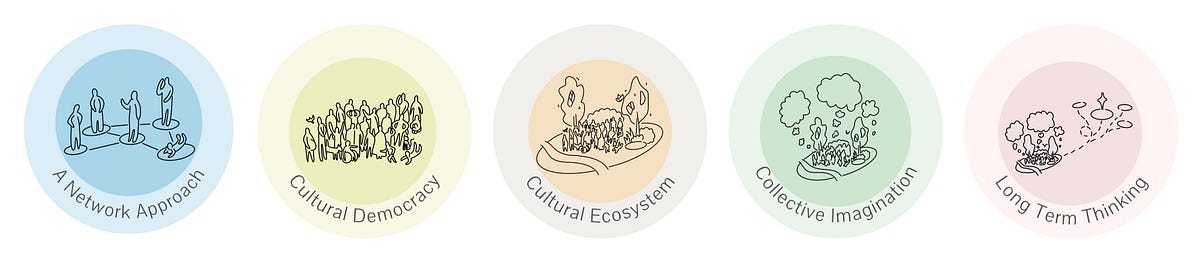
- We have taken a network approach since the very beginning of CoLab Dudley work, inviting leadership from the most diverse array of lived experiences, perspectives and knowledges possible.
- In our research for Dudley Creates, drawing together 8 years of learning, we called attention to an urgent macro story where culture — the ‘ethnosphere’ — can either work to sustain or destroy future life on earth. We start from an understanding of the ability of culture and the arts to make the impossible seem possible. A national and local cultural democracy deficit drew our attention to the importance of cultural democracy.
- An ecological approach, ‘using nature’s guidebook’, encourages us to pay attention to the ever changing, evolving and entangled nature of relationships which can help or hinder possibilities in Dudley. It also incorporates an understanding of place; ways that our local places shape us and our cultures. We consider CoLab Dudley as a steward of just one small part of a much broader local cultural ecosystem.
- CoLab Dudley has always sought to nurture conditions for collective imagination, so that local people can dream, co-create, rehearse and celebrate of narratives of wonder and future possibilities.
- In 2020 we realised that long-term thinking was a critical idea which needed to be embedded in our work, which is why we began to use a convening call around Time Rebels of Dudley.
So we could describe CoLab Dudley as a team and associated wider network (of people we have been calling Time Rebels of Dudley). People come across us and come together in our lab space on Dudley High Street. We support experiments and creative projects offering a diverse array of invitations to participate. We use many kinds of thinking, inspiration, tools, tactics and collective and group processes. We bring people together to reflect and generate insights and learning.
In Sam Rye’s post about The Language of Labs he observes that “one tension that seemed to exist was whether we’re talking about the lab as a place, an organisation or network, a process, an ecosystem of activities, or something else.” He goes on to suggest that social labs operate at a number levels; micro, meso and macro, and illustrates this with the following:
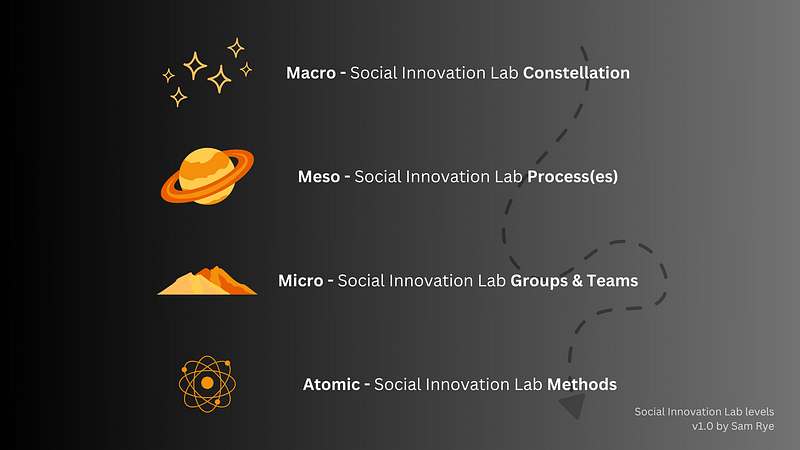
I was struck by how much Sam’s thinking about “the collection of methods and tools which are used in the social innovation lab to support people to take action together, develop responses and advance change” summarised above echoed the story I had been shaping to bring coherence to 10 years of CoLab Dudley work.
Sam’s post is one in a series he has written in relation to The Future of Labs Gathering. I spent time in advance of our team retreat digging into The Future of Labs Primer and the 2024 Future of Labs Gathering Final Report which Sam had called attention to through his warmly received Fieldnotes. This prompted discussions as a team about:
- What seemed promising / inviting about idea of social labs to me in 2014, namely that they are practical, experimental (signalling creativity, and an unbounded nature) and are rooted in learning.
- Reasons for initiating CoLab Dudley. In 2014 they were around creating a dedicated space for people who wanted to share, collaborate and use their imagination and creativity to help organisations and communities adapt to new challenges.
- Challenges with the unfamiliarity of social labs. Funders don’t understand what they are. People working in local voluntary sector and public sector organisations don’t understand what they are. People we bring together aren’t interested in lab practices or social infrastructure; they just appreciate the convening. I think that only about 40% of the 21 people I’ve invited to date to be CoLab Dudley team members have been energised by infrastructuring work.
- The history of labs, the thinking which has informed and shaped them (much of it anchored in Western, colonial values) and tensions between social labs and social movements, inviting a question about where we seem to be or might choose to be situated.
Having this discussion and holding open the possibility of evolving into something else generated a sense of potential and new possibilities as the two days unfolded.
A new reflection. As I’ve been writing together this Lab Note I’ve started a course with The Wild Academy. Each month we’re invited to reflect on an archetype of the Wild Self. The first we’ve met is the Shapeshifter. I didn’t feel any resonance with this archetype, until it suddenly dawned on me that my work is shapeshifting. CoLab Dudley is necessarily a Shapeshifter. A convening of edge walkers. Drawing on The Wild Academy prompts, CoLab Dudley resonates with the symbolism of the snake; shedding skin (ways of organising and behaving in modernity), renewal (experimenting with new ways), and ancient wisdom (paying attention to overlooked and erased local stories, and teachings from cultures who remain in relationship with land.) The new possibilities we were holding ourselves open to as a team during our retreat relate to the symbolism of the moth; metamorphosis and surrender to change. And perhaps I’ve always seen CoLab Dudley as a little like mist; flowing between forms.
In the book Labcraft: How Social Labs Cultivate Change Through Innovation and Collaboration the editors write:
In the alleys and on the sidewalks, in homes and schools and parks and the multitude of spaces between and outside of institutions — and even the elevators and hallways of skyscrapers themselves — seeds of transformation are germinating.
The diverse collections of people who are sprouting these seeds find themselves with comparatively few resources with which to develop alternatives. They may work from outside existing institutions or within them, but either way they’re often in need of spaces in which to experiment with alternative approaches. Many of these radicals either choose to or are unable to work within the confines of conventional structures. They may be marginalised or ignored.
Our labs are one solution to the challenges such pioneers face. They work to bridge the gap between these disconnected worlds by translating ideas and resources from one world to the other.
I’m also reminded, thanks in part to a recent conversation about this excellent work, that while it’s all too easy (and deliciously tempting) to situate one’s work at a radical edge, there is good reason to flip this narrative and see emerging practice as being right in the centre of systems, not an outlier. In the essay Reclaiming Hope for Alternative Futures, Jess Prendergast and Sally Lowndes introduce Onion Collective’s Petal Model of Regenerative Transition as a way ‘to reflect where the radical power for change really lies’. The Petal Model was referenced frequently during our team retreat, and has been developed because of the Emerging Futures Pathfinders network we’ve been part of, so is worth calling attention to.

Day 1 (afternoon): Lessons from our Principles Focused Evaluation
In preparation for the retreat, our Collective Learning Lead, Jo Orchard-Webb had drawn out critical takeaways from our Principles Focused Evaluation evidence over the previous year, building on lessons learned prior to that through our use of this evaluation approach. She grouped these lessons in three kinds of lessons, around:
- The process of using Principles Focused Evaluation as a team.
- How the principles are serving our intentions and further work we need to do in relation to this.
- What the evidence around adherence to our GUIDEing Principles is flagging up around collaborations.
Process
In relation to how our GUIDEing Principles are serving our purpose/ intentions Jo had drawn out how our past year of learning and testing had helped bring some new clarity in articulating the lab role. She described this as follows.
CoLab Dudley is designed to help create conditions for regenerative resilience through the rehearsal of practices in place. These practices include creative and imagination practices, relational practice, long-term thinking, social arts practices and collective learning practices that are all orientated towards transition to flourishing futures for all.
These sites of practice are spaces and moments of connection, curiosity and learning through doing that help grow awareness, agency, capacity and capabilities needed for individual and collective responses to the Earth Crisis that aid mutual flourishing. These practices are creating multi-sites and moments for more relational kincentric behaviours through ways of working (or organising?) such as: network weaving, commoning, reciprocity, multiplicity, pluriversality, tending, healing, gifting, collective imagining, sensing (including deep listening, observation, embodiment), collective sense-making, creative documentation, reflection and cultural action/activism.
In time, we believe rehearsing these practices, spreading their aligned ways of working/ being, and the behaviors and actions they catalyse, will animate new cultural narratives grounded in regenerative ways for humans and more-than-humans to be in right relation as a community.
The lab nurtures these regenerative practices in place by convening an ecosystem of Time Rebels experimenting with and testing out these practices. We have a role in network weaving people, projects, and clusters of collaboration. We do this through convening creative spaces and moments of practice rehearsal, shared learning and encouraging cross pollinating and flows of resources across fertile edges.
Perhaps by co-creating learning infrastructures, hosting shared learning/doing enquiries, celebrating/ amplifying the story of that practice and collective learning, then weaving together clusters for collaboration, we are nourishing the beginning of Time Rebel communities of practice that support the emergence of new systems and a just transition?
Intentions
Jo also brought challenges to the ways we have been activating our GUIDEing Principles, with an observation that there is a first order and second order to our principles. The first layer is easier, the second layer is harder, trickier, but about a shift to systems change. She suggested that we need to bring attention to the second layer of our principles to better orientate us towards transition and action for earth crisis. Jo expressed concern that CoLab Dudley’s work could remain peripheral in Dudley. So through the two day retreat we held questions around what might be needed to support emergent / alternative ways of working to be more embedded, to take root in local communities and be less ephemeral.
Collaborations
Jo’s key takeaways on our collaborations centred around:
- Challenges we face repeatedly in coming up against unhealthy practices, policy and behaviours in the dominant system. The high levels of labour required by lab team members to respond, hold these relationships and push back, reframing for alternative ways of being in collaboration.
- The labour and need for use of our GUIDEing principles in the ‘dark matter’ of governance work. This is both in terms of pro-active shaping of briefs and agreements with collaborators and in reactive renegotiation and reframing of contracts and resourcing we are offered.
- Observations that doing the work above doesn’t always create the generative collaborative behaviours we are seeking.
We spent the afternoon of day 1 exploring the lessons from our evaluation and how we wanted to evolve our Principles Focused Evaluation practices, rhythms and rituals.
Day 1 (early evening): Dreaming before dinner, and considering three horizons in our work
While dinner was cooking Holly shared writing she had been doing during our conversations through day. This was the start of an articulation of a clear framing for our work (thank you Holly!), which I feel is an expression of emergent strategy.
Holly suggested a framing around repairing our relationships with land, explaining that this is particularly relevant in Dudley and the wider Black Country with the history of extraction from land as the heart of the Industrial Revolution. Holly asked: “do we do this repair through cultural shifts?” And “what do we need to repair our relationships?” Some ideas included:
- Stewarding place based knowledges
- Capability ‘green-ness’
- Reclaiming land from business as usual uses
- Retrofit capabilities
- Climate action
- Gift and exchange between spaces
- Skills and capabilities

Jo bounced off Holly’s listening and ideas, suggesting that our work is about flipping the story of separation: reanimating / remembering our story of interconnection. She then started to suggest what this might look like across three horizons, using Bill Sharpe’s Three Horizons framework.
We had recently been inspired by the way our friends in the field at Makespace Oxford had used the Three Horizons in a compelling way to describe ways they are taking action as:
- right here, right now;
- now and longer term; and
- experimenting today, to hasten a more regenerative future for generations to come.
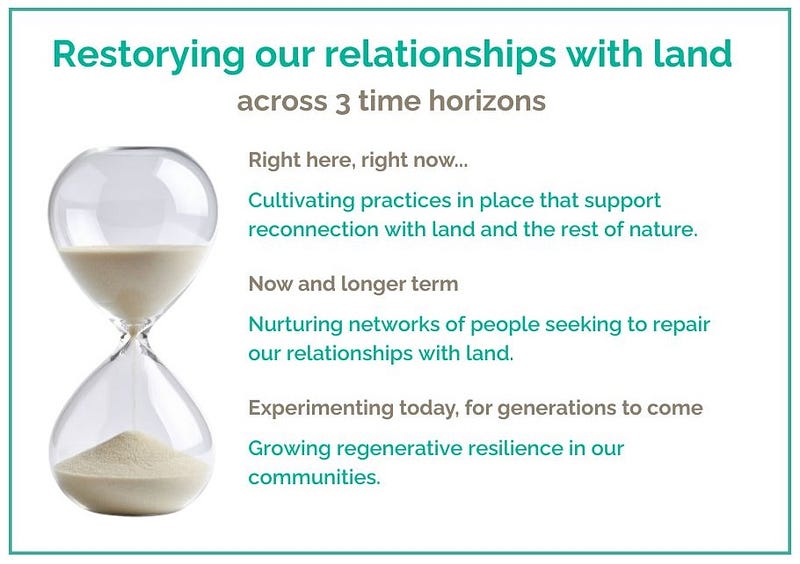
We started drafting ours, which have become:
- Right here, right now: Cultivating practices in place that support reconnection with land and the rest of nature.
- Now and longer term: Nurturing networks of people seeking to repair our relationships with land.
- Experimenting today, for generations to come: Growing regenerative resilience in our communities.
After dinner I went for a wander down by the river, pondering on this emerging articulation of our work and the three horizons we’re working across simultaneously. My brain was fizzing with words and connections. I found a blog post by Joanna Chin (an Environmental Studies Doctoral Student at York University) which was titled restorying our relationships with land. I thought ‘restorying’ was a nice spin on ‘restoring’ which spoke to all of the work we have been doing to question and shift deep cultural narratives.
I’ve since found this helpful explainer:
Definition: Restorying involves the process of revisiting and reinterpreting past experiences or narratives to construct new, more empowering stories…
Application: In research, restorying might be used in qualitative studies to explore how individuals or communities reinterpret their life stories or cultural narratives…
~ Source: Restorying & Reframing
So by the end of the first day of our team retreat, through exploring our history and lessons learned by us and others in the field, we had found an articulation of a strategic (re)framing of CoLab Dudley work, rooted in clear actions we could communicate around. This emerged in no small part thanks to the trust and openess between us, and deep respect for our different ways of being, skills and knowledges, and the very different perspectives offered by our varying lengths of time as lab team members (11 years, 9 years, 5 years and 8 months respectively).
… emergence shows us that adaptation and evolution depend more upion critical, deep, and authentic connections, a thread that can be tugged for support and resilience. The quality of connection between the nodes in the patterns.
~ adrienne maree brown, Emergent Strategy: Shaping Change, Changing Worlds, 2017

Day 2: Consolidation and consideration of commoning and collaborations
Following a check-in after breakfast, we spent the first part of our second day together excitedly consolidating and building on ideas generated during day 1, catching up on developments of the thinking which had energetically sparked in smaller conversations.
We spent some time considering relationships within the network / collective of creatives we’ve been convening and growing since 2020, and connect or possible disconnects with work we’re now being funded to do. This led to plans for a network session to share as soon as possible (a week later) what was emerging through our time together so that we could ascertain the appetite for the ideas and swiftly begin to socialise the thinking. Our convening had been in a disjointed state because resourcing around cultural strategy work with Time Rebels had come to an end, and while some members of our network had showed interest in a 6 month opportunity to run creative workshops, not everyone did, so we had temporarily lost the sense of being a whole network doing and learning together. A benefit of that 6 month contract however, had been the introduction of more local creatives to our work and network.
We wanted to propose to all members our network (from those we’d worked with for 5 years or more and those we’d known for a matter of months) that the focus we might grow the network around would become Restorying our Relationships to Land. We wanted to invite explorations of ways that each of them, their practices and their activities had already been part of this story, and could continue to be if desired. We would explain that this is how we’re bringing focus to our cultural work. And that we wanted to underpin this with key actions around reconnection, repair and growing regenerative resilience in our local communities.
We had previously communicated that in the future it was unlikely CoLab Dudley would hold resourcing which would facilitate financial investment in projects and experiments led by local people and creatives. (Although we have learned a lot from small scale experiments as local infrastructure which creates enabling conditions supporting clusters of collaboration as outlined in the concept of the Pando Fund. We would love to be one part of a wider constellation of actors creating enabling conditions in our bioregion.)
As a team we’re curious about how our network might act collectively in ways which can be resourced through everyone taking responsibility to offer what they can to a commons and organise, manage and share collective resources together over time as commoners. This isn’t a new idea. In 2017 we identified commoning skills and knowledge as important practices and behaviours modelled through CoLab Dudley (ref. Detectorism Insights #1). In early 2020 we started exploring ideas around commoning patterns in David Bollier and Silke Helfrich’s book Free, Fair and Alive:

At the beginning of this year, I returned to the ideas in Free, Fair and Alive by initiating a gentle open enquiry into commoning patterns. I introduced and explored the concept of commoning, and the commoning patterns with co-creators of Flourishing Edges in April and with peer learners during CIVIC SQUARE’s Re:Assemble Gathering in June. Throughout our Lab Team retreat we were weaving aspirations around commoning into our conversations. We’re also curious about ways that commoning and bioregioning approaches intersect. (More about bioregioning to follow in my next Lab Note.)
We therefore decided to take the following two questions to our network
- What does it mean to act collectively? (A gentle entry into commoning explorations.)
- How does repairing our relationship with land (rest of nature) show up/ might it show up in your practice?
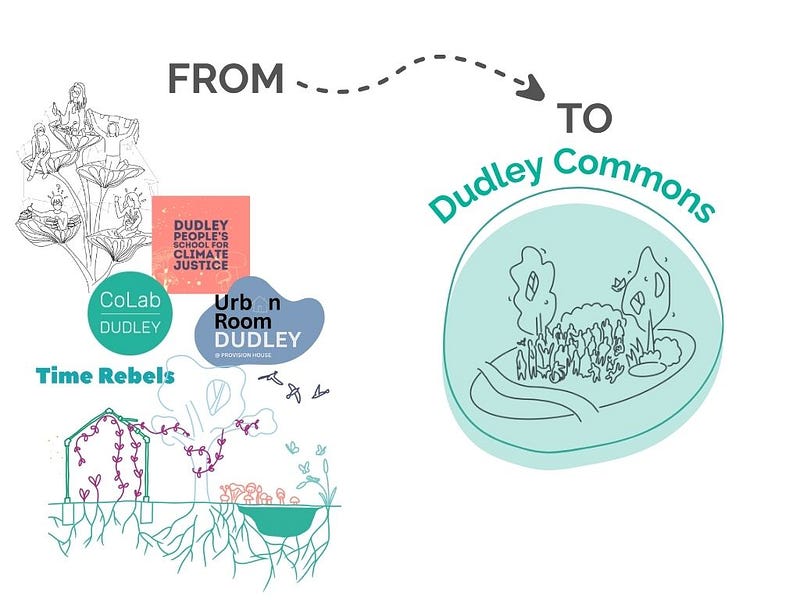
The visual below was used to suggest movement from our previous and current constellations of collective enquiries and ways of organising, towards a Commons.
After lunch we dug into the challenges Jo had called attention to around some of our collaborations, and we developed some clear criteria to help discern when a collaboration opportunity might have a good fit, and when to decline invitations.
We reflected on what we wanted to commit to as a team around network and open (public) convening, what our team rhythms around that would be, and ways we might start to common the lab space.
And so we gently closed our team retreat, with sharing of reflections in response to prompts which circled back to our intentions, hopes and fears generated through our check in at the beginning of day 1.
Emergent Strategy… [is like]… ways for humans to practice being in right relationship to our home and each other, to practice complexity, and grow a compelling future together through relatively simple interactions.
~ adrienne maree brown, Emergent Strategy: Shaping Change, Changing Worlds, 2017

Exploring emergent strategy with our network
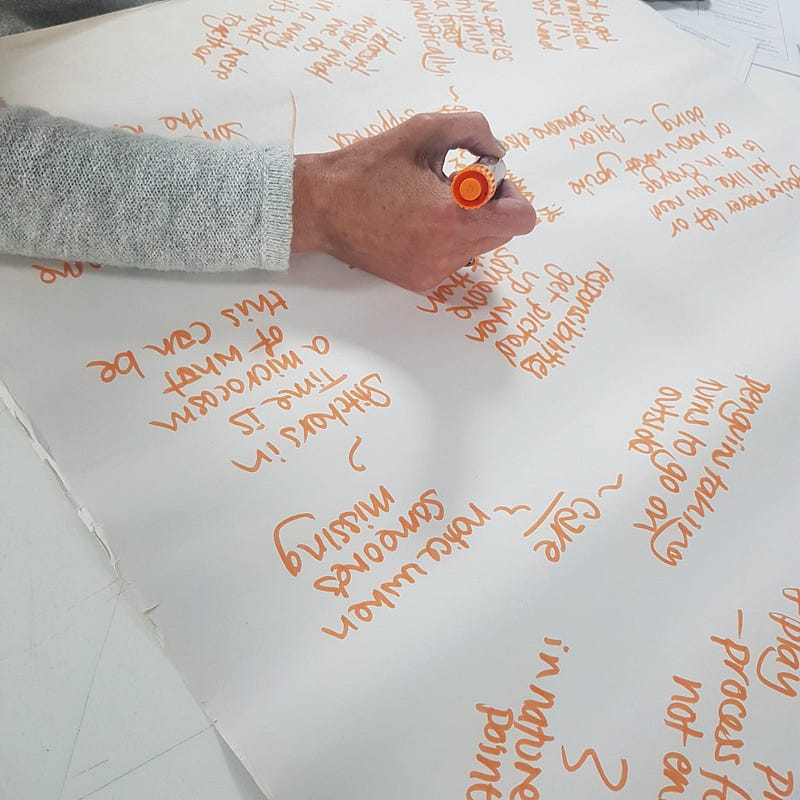
A week after our team retreat we met with some of our network members and shared what we’d developed. There were feelings of disconnect for a few, while others readily engaged. The following are a selection of responses to the our question: how does repairing our relationship with land (ie the rest of nature) show up (or might it show up) in your practice?
- Translation through poetry — I now notice things more.
- Raising consciousness and nurturing empowerment to act at the micro/ local level.
- Care through noticing.
- Drawing outside.
- Responding to a group member’s knowledge of nature in our drawing/ illustration/theme for Stitchers in Time.
- Noticing the mundane ways to connect.
- Ways of bringing nature into our work via photographs of nature.
- We look up, look down, slow down.
- Performing with nature and place.
- Through the books I read.
- Through collaboration with others.
- Small moments.
- Creating new mythologies that invite care for the more-than-human.
- Interacting with natural landscapes — inviting people to notice.
- Questions around access to nature.
For a few members of our network, who we continue to hold in relationship, the following was felt:
- I’m not a nature person.
- It is present in my personal life but not in my practice.
- I’m finding this question really hard.
- I don’t think about it — it is more about people for me.
During June, July and August, Deb and I met one-to-one with those in our network who hadn't been able to come along in May. There was a palpable energy and resonance around restorying our relationships with land, so in early September we convened again, this time with the convening call to become a member of a Bioregional Learning Network. And that is the story of my next Lab Note!
Social movements right now are fractal, practicing at a small scale what we most want to see at the universal level. No more growth or scaling up before actually learning through experience.
~ adrienne maree brown, Emergent Strategy: Shaping Change, Changing Worlds, 2017