Initiating a Bioregional Learning Network in Dudley
What if communities in Dudley borough lived in ways which were deeply attuned to ecological, cultural and historical realities of place?
What if communities in Dudley borough lived in ways which were deeply attuned to ecological, cultural and historical realities of place?
- Repairing damages wrought by extraction.
- Reconnecting with the rest of nature.
- Reimagining ways that we live, learn, grow, eat, move, play, make, create, organise, belong and heal.
This Lab Note shares photos and notes from the first meet-up of a Bioregional Learning Network convened by CoLab Dudley.
The purpose of the network is cultivate local practices of bioregioning.
Why a Bioregional Learning Network?
In my last Lab Note I shared the story of how the CoLab Dudley team came to express our emergent strategy as Restorying our relationships with land, and that it resonated with most of our network of Time Rebels, creatives and co-creators.

Following the team retreat described in the Lab Note above, Nick Paling (a Director at the Bioregional Learning Centre in Devon) invited the CoLab Dudley team to a series of Learning Days planned in Devon in July. Jo and I were able to attend the first part of this series of days, which gave us so much in terms of:
- Understanding of what bioregioning practices and work looks like, especially in the UK.
- Inspiration and practical resources to draw on.
- Wonderful connections with people quietly undertaking beautiful work.
- A feeling of being part of a diverse network of practitioners in this field.
- Confidence to start convening around bioregioning in Dudley.
We shared photos of our hand written notes in real time with our team, and Jo compiled a stack of resources for us to refer to and share. We’ve popped these on our new website-workspace, with the most immense gratitude for the generosity of those creating and sharing this work.
The Bioregional Learning Centre highlight that there is no one way to do bioregioning and it is more an art than a science (though it does make good use of lots of natural science). There is a real focus upon relationship building and nurturing in the context of Earth Crisis, or what founder Isabel Carlisle described as ‘Gaia on the Move’. They stress that these bioregioning relationships and capacities are critical for both human adaptation and mitigation as well as increasing landscape scale resilience while loosening political boundaries. Equally, they lift up the role of arts and creative practice as being critical to sensing the bioregion and dreaming within a framework of collective learning.
At the Learning Days in Devon it became really clear that bioregioning is a welcoming array of practices which can help us to restory our relationships with land. And given we are a social lab which focuses on learning through doing and experimentation, and convenes using a network approach… well a Bioregional Learning Network is clearly the way to go!
Our invitation to potential network members
In August we started crafting an invitation to local people who have been collaborating with or participating in work led by CoLab Dudley and/or by Ekho Collective CIC, through Dudley People’s School for Justice and work that we’ve convened around cultural strategy and collective imagination.
Our invitation:
You’re invited to join a new adventure being catalysed by CoLab Dudley; restorying our relationships with land. Together a group of us will combine our capabilities, discover secrets that Dudley has to share, and cultivate our local practice of bioregioning. We will generate a knowledge commons through this work, and rehearse ways of commoning in Dudley.
A commons arises whenever a given community decides it wishes to manage a resource in a collective manner, with special regard for equitable access, use and sustainability.
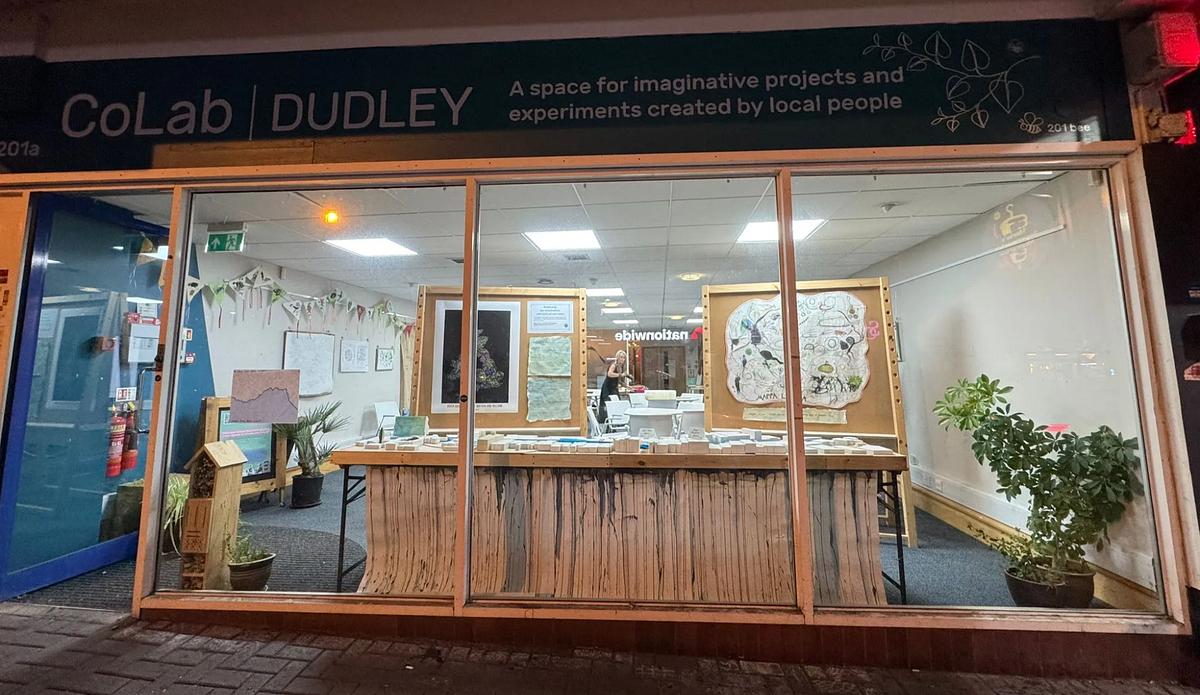
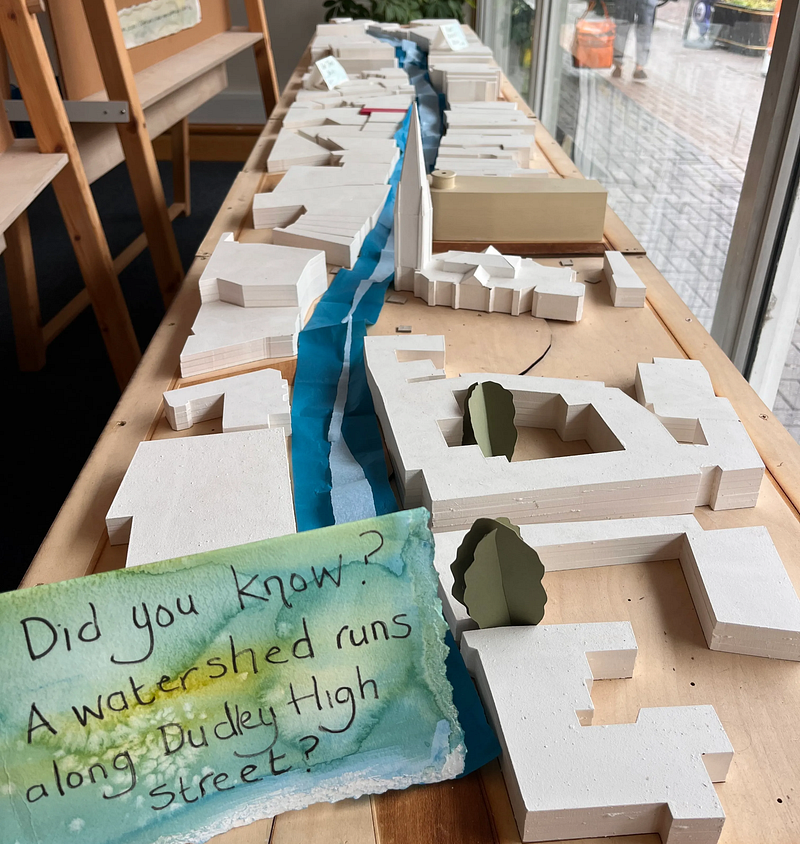
An installation in CoLab Dudley’s window on Dudley High Street, Sept-Nov 2025, featuring a scale model of Dudley High Street created by architecture students from Birmingham City University, and artwork by Helen Garbett and Deb McDonald.
Gathering on a watershed
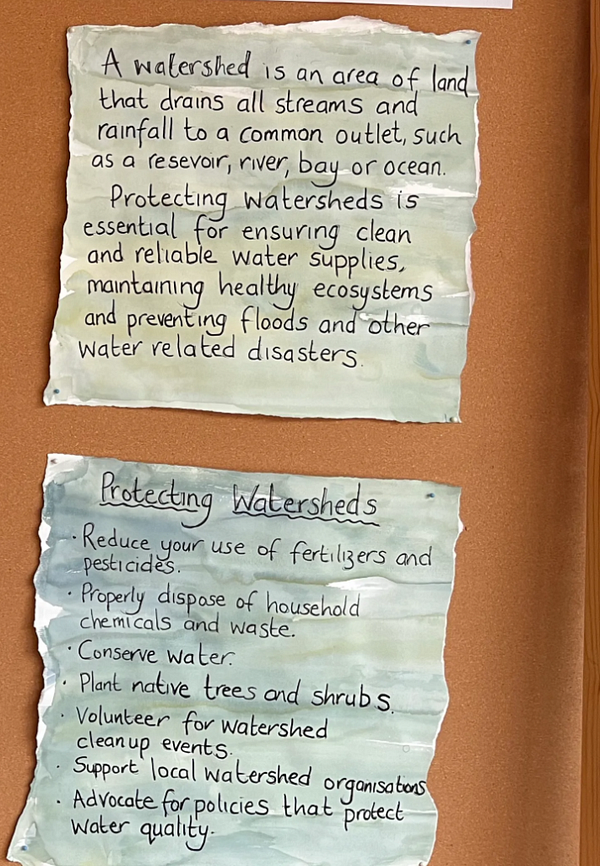
23 people gathered at CoLab Dudley on Dudley High Street on 3 September, in the middle of week in which autumn had announced it’s arrival with gusty winds, showers and sudden heavy downpours. Upon arrival at the CoLab Dudley space a new installation in our large window space introduced watersheds and river basins. A model of Dudley High Street made by Birmingham City University students has been repurposed by Helen Garbett and Deb McDonald to help illustrate that the High Street is a watershed — a ridge which divides two river systems. Rain falling on Dudley High Street has a chance of either flowing westward into the Severn River Basin towards the Bristol Channel, the Celtic Sea and Atlantic Ocean, or eastward into the Trent River Basin and on to the Humber Estuary and the North Sea.
Welcomes and weaving
After time to have a brew, a bit of food and a chat, everyone settled in. On their arrival, Deb had given each person a small card which described why the CoLab Dudley team thought that person, their practices or activities were a pocket of hope in relation to bioregioning and restorying our relationships with land. Everyone was invited to introduce themselves, and share how they were feeling , if they wished. Most read out what was written on their card, thus weaving threads of their gifts into the emergent network.
What is bioregioning?
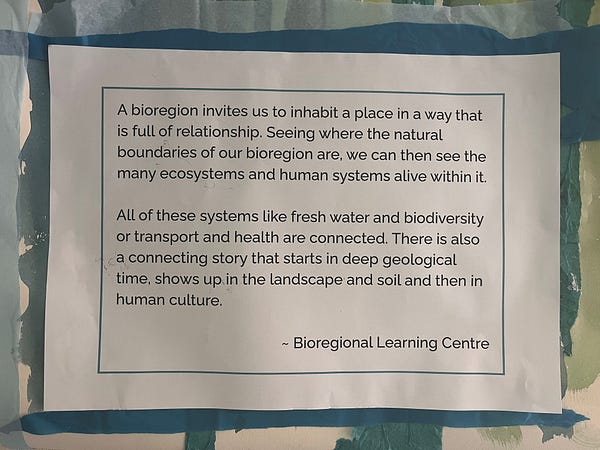
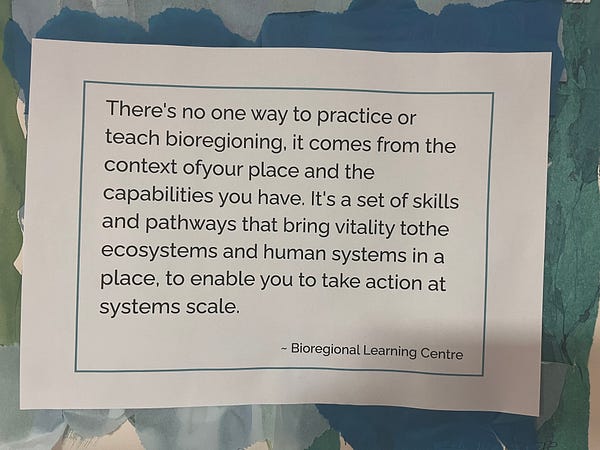
Deb from the CoLab Dudley team introduced a little bit about bioregioning, using explainers from the Bioregional Learning Centre in Devon which were shown on a large digital screen, and were part of a new installation in the space.

Bioregioning can be described as a story. Or a framework. It’s about going back to basics and seeing things afresh.
Bioregioning is a practice, a journey of connection, learning, and action. Seeing systems is a vital aspect of bioregioning-a many-sided skill that asks us to both ‘work at the edges’ and ‘see the whole’. There is no separation between human systems and ecosystems, bioregioning brings them together. Nor is there privilege; of one kind of ‘knowing’ over another. Science and art, community action and policy-making go hand in hand. The bioregioning actions below are designed to build the skills and relationships needed to foster thriving, resilient places.
~ Isabel Carlisle, Bioregional Learning Centre
Sensing our bioregion
We don’t yet know the ecological boundaries which could help us define fuzzy edges of our bioregion. Discovering these is part of the adventure we’re starting out on. Jo Orchard-Webb from the CoLab Dudley team explained that we need to start building up a collective understanding of our own bioregion. And that we might start that by mapping our own pockets and weaving those together. (See Hands on making, below.)
Re-imagining maps that tells stories of many layers
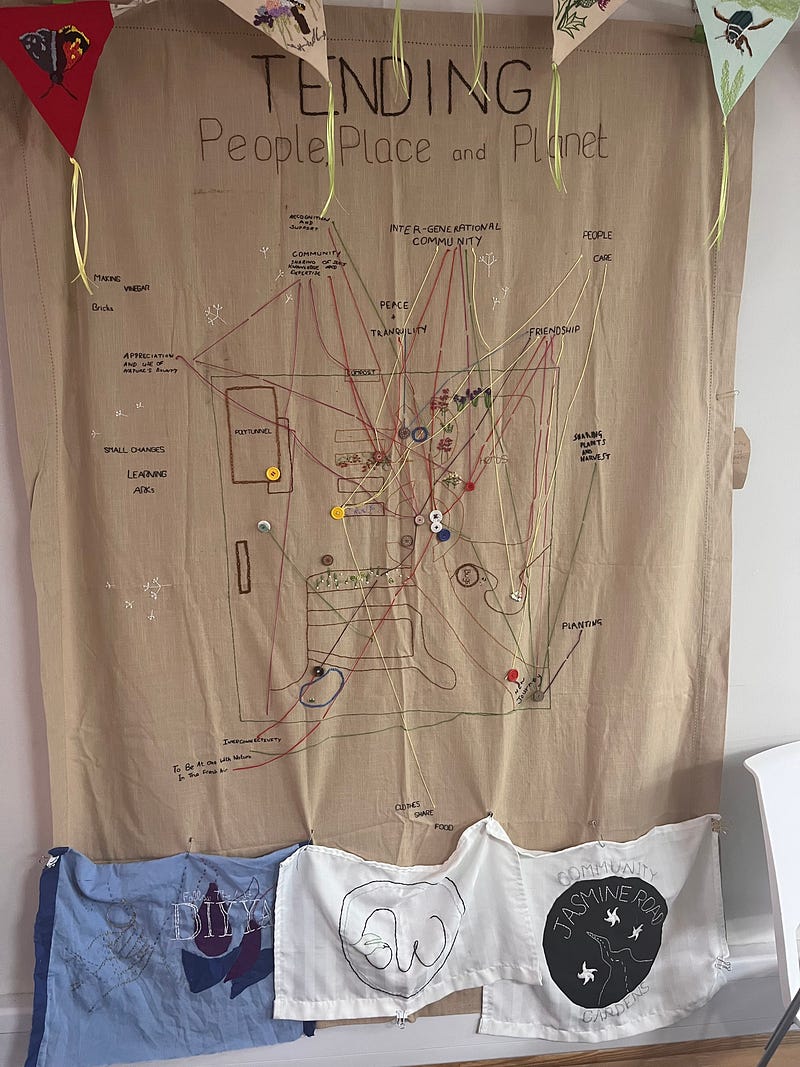
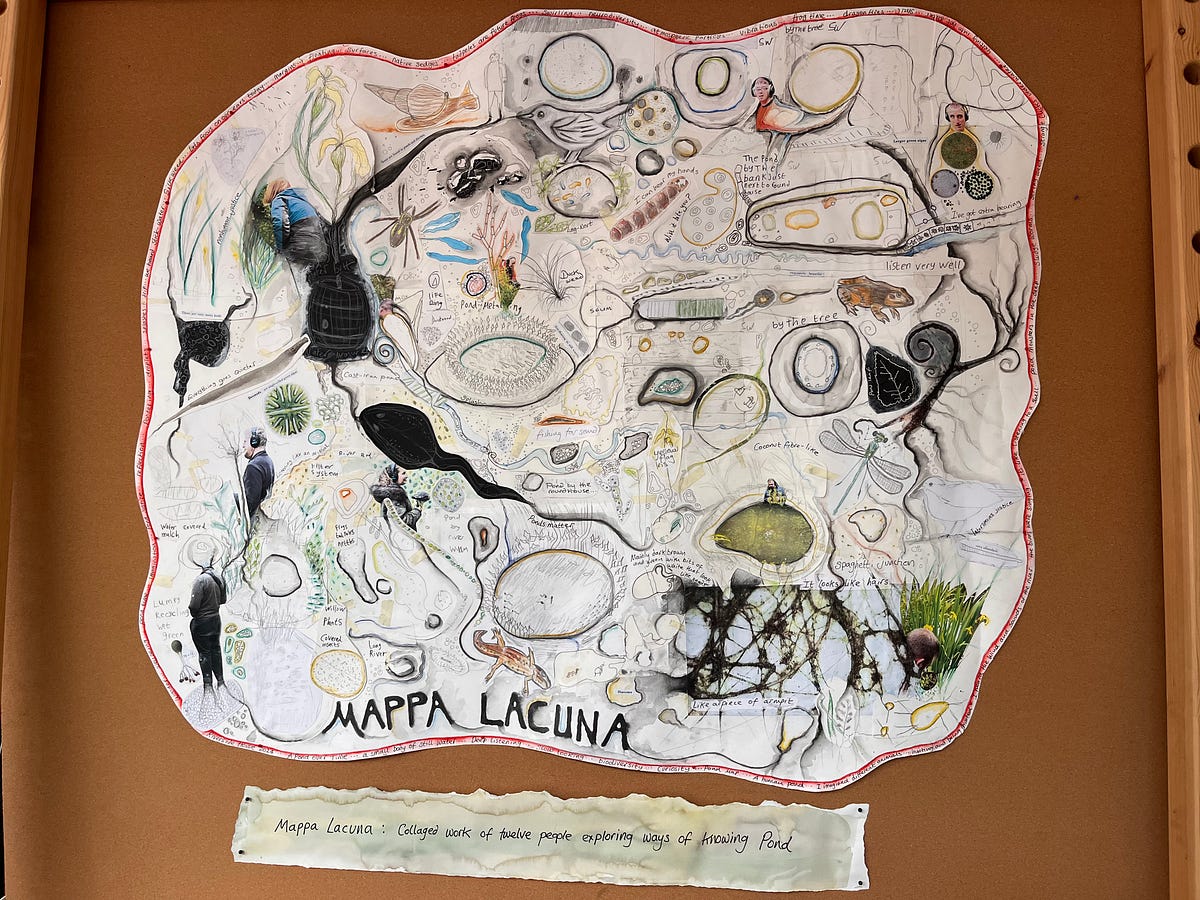
Jo suggested that as a network we might embark on an exploration of counter-mapping. This involves being critical, starting to unpick traditional maps. Deb had curated an installation of countermaps from work led by Ekho Collective CIC and Workshop 24 as part of work with CoLab Dudley around Dudley People’s School for Climate Justice. These were briefly introduced as inspiration for many kinds of mapping.


Mapping around nature based principles through the Tending People, Place and Planet project. Maps by Deb McDonald.
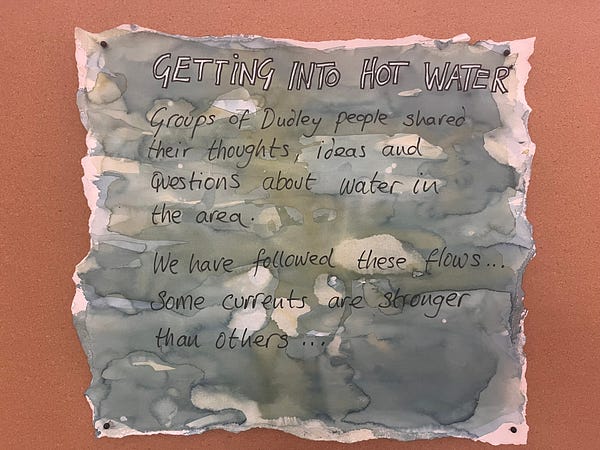

Mapping possible lines of enquiry for Getting Into Hot Water, during Water Walk sessions in 2023. By Helen Garbett, Workshop 24.
Hands-on making
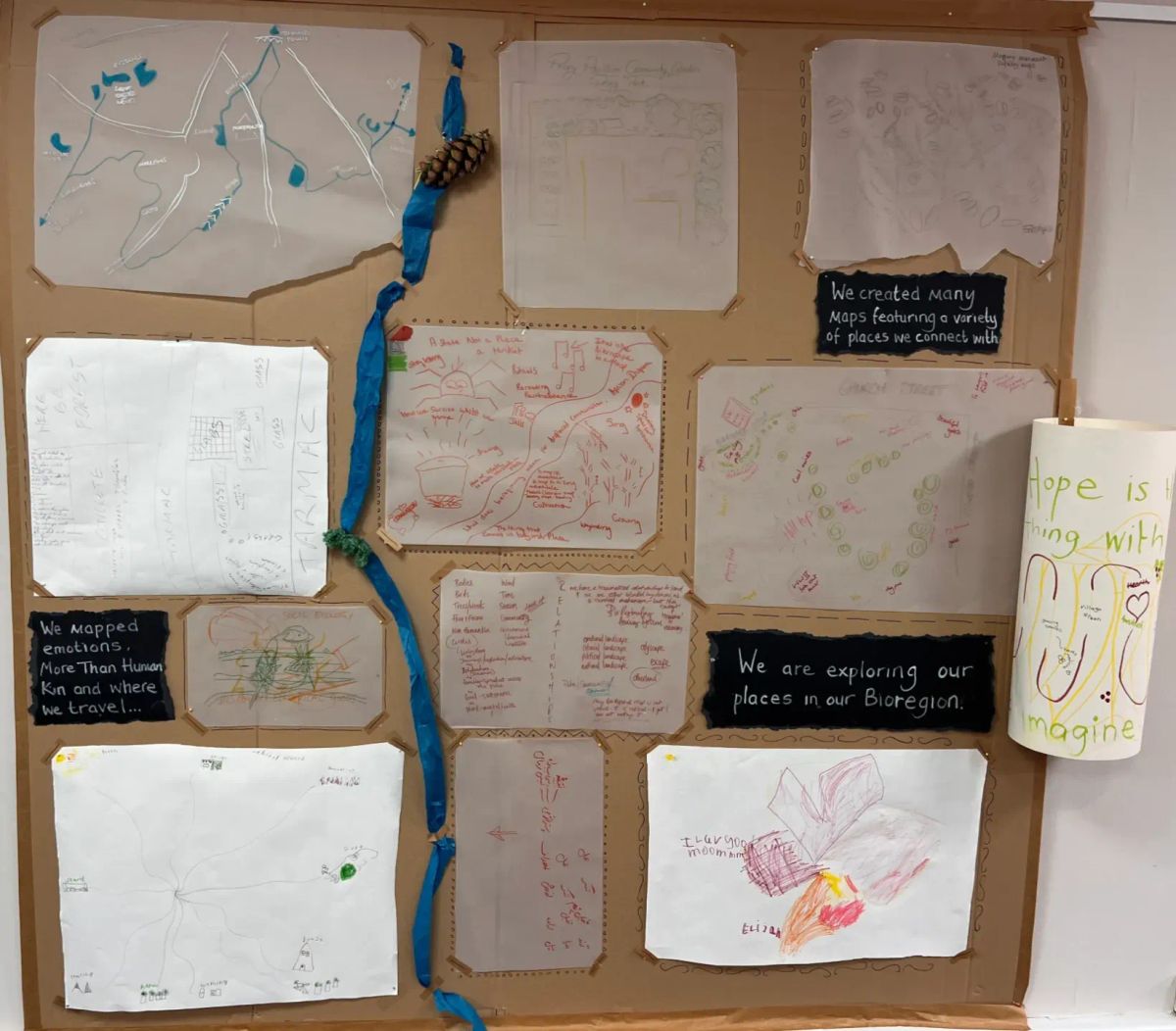
Everyone was eager to map their own pocket in our bioregion. Whether it was a place where they live, walk, work or spend time. Tracing paper, wallpaper, tissue paper and pens swiftly spread into all corners of the room and maps began to emerge. We spent an hour so so making maps and moving around to find out about each other and other people’s maps.
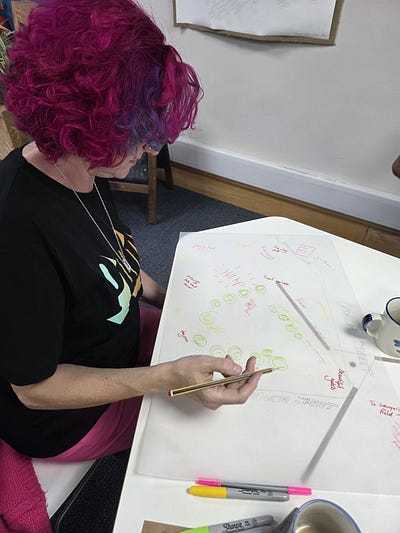
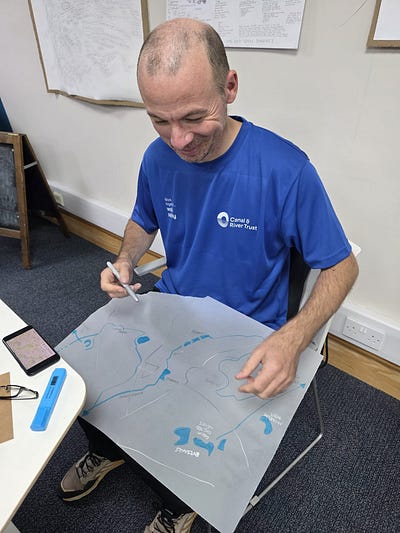


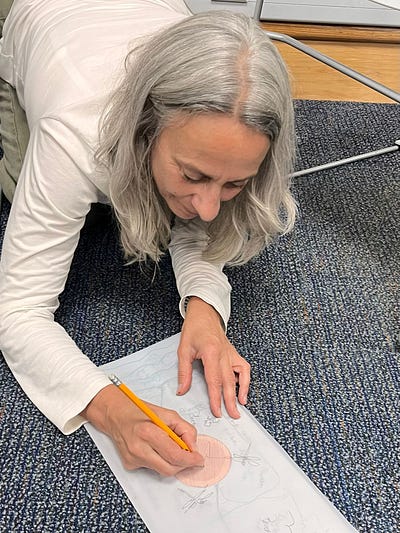
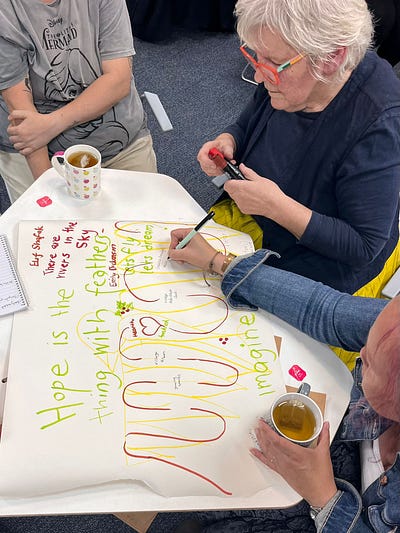

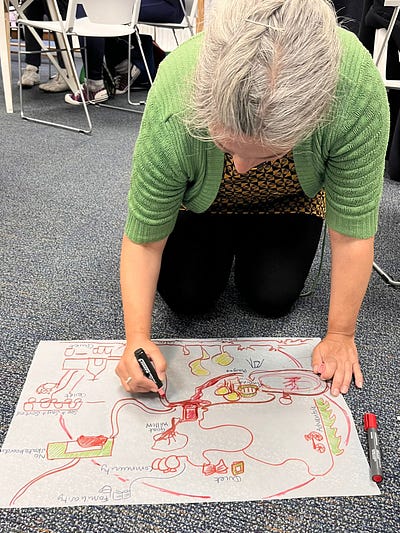
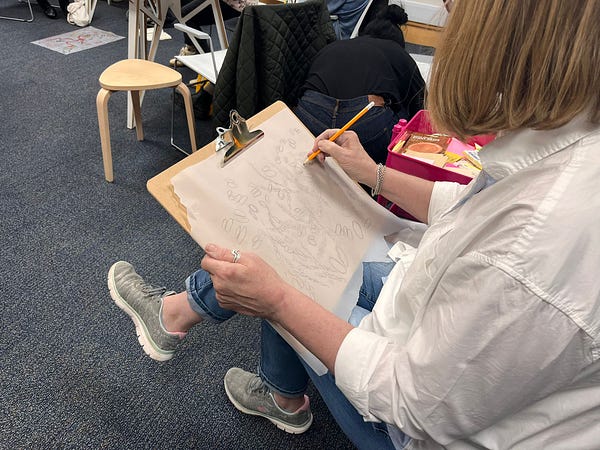
Map making at our Bioregional Learning Network session, 3 September 2025
After the evening, Megan wrote a blog post about being introduced to countermapping in this session and her mapping in the session of her Zone of Familiarity.
I am excited by the idea of mapping against the grain and already use ideas of drawing onto and into existing maps through collage, cutting, sketching and myriad interruptive practices.
What might Bioregional Learning Network activities look like?
Towards the end of the evening, I introduced an activity inviting consideration of what weaving a network focused on bioregioning might look like and ways that people might wish to be involved. She acknowledged that many of the people gathered are already engaged in deep activity and learning around their relationship with land and water and that a role CoLab Dudley offers is convening and weaving people around this doing and supporting reflection and collective learning. The CoLab Dudley team are committed to weaving a network of people who come together in solidarity around our relationships with land and water over the coming years.
This network is being formed in a spirit of allyship, in contrast to partnerships which revere positional power or institutional status. Something critical which CoLab Dudley brings to this work and our weaving is working to cultivate lived and embodied place based knowledges, ways of being, stories, eco-literacies, and skills that help us re-inhabit our bioregion with care for all future life. This has emerged through projects like Stories of Place, the Council of All Beings, and Reclaiming our Roots (all led by people in our network.)
The following activities were suggested, with invitations to suggest more, and to indicate interest or otherwise in these:
- One-to-one connecting — making time to get to know someone else and their work. Developing trust. Introducing people you know who haven’t met each other.
- Learning Huddles — a group of Network Members coming together for a one-off session or an ongoing collective enquiry around a bioregioning practice, topic or theme. Co-hosting is encouraged.
- Local visits — thoughtfully researched and designed visits to people, places and projects where repairing of land and/or deepening of our relationships with land are already underway, or showing the potential to begin.
- Seasonal meet-ups — for a network of people who want to learn about our bioregion and bioregioning approaches. Learning by doing.
- Weaving of learning and knowledges — sharing our learning openly for anyone to use, and actively weaving it into wider communities, groups, teams and networks we are part of.
Members of the nascent network added to a roll of paper to indicate interest in these potential network activities.
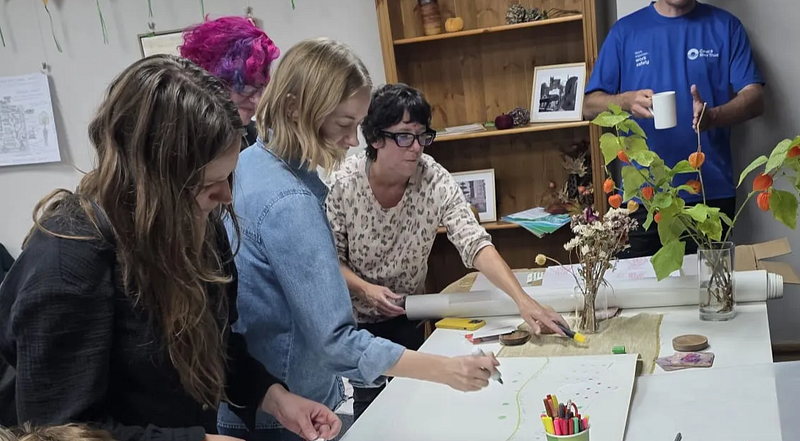
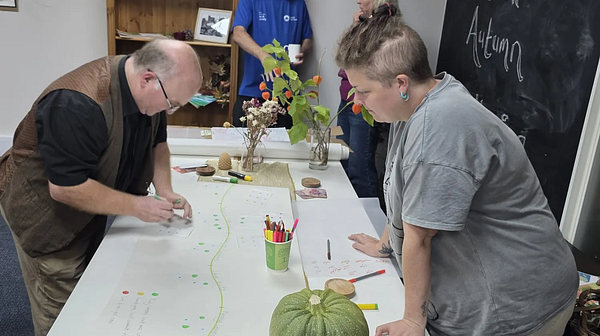
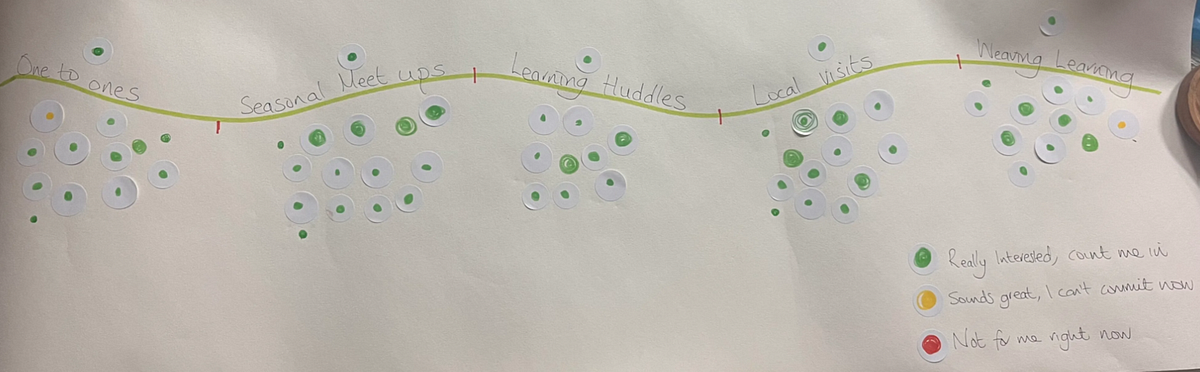
All the suggested activities were overwhelmingly popular!
What next?
A counter-mapping learning huddle
During the course of the evening Jo had connected with both Laura Onions and Megan Wakefield around their counter-mapping practices. They agreed to talk further about co-hosting a countermapping learning huddle to network members to develop this bioregioning practice.
Getting Into Hot Water ~ amulet making workshop invitations
Helen Garbett from Workshop 24 had generously given time to work with Deb to create the watershed installation in the window of CoLab Dudley, and had also curate a pop up installation with invitations to amulet making workshops (image below). Helen explained that this was part of the Getting Into Hot Water art-based inquiry into water and climate change locally, which in turn is part of collaborative work through Dudley People’s School for Climate Justice. Amulet making was inspired by a recent field trip to Pitt Rivers Museum which prompted reflection on the fact that people around the world have always created things with strange and beneficial properties. Workshop 24 are inviting Dudley people to make amulets together to raise awareness of and ward off the many toxins found in water and our wider environment.

Gallery of our pockets in our bioregion
Following the network session, an installation of the maps made was curated by CoLab Dudley team member Deb, and hung in the lab space.
Reactions to the first network session
As members joined a WhatsApp group chat for the emerging Bioregional Learning Network, they shared reactions to the session.
Wow. My feet are just touching the ground! A vital happening happened last night. One regret/request — I didn’t get chance to take in, spend time and absorb the beautiful project work around the room. Feel good vibes and connections are already gushing through that portal opening.
Yesterday was very important for me.
A poem shared by Spun From Air and Sunlight
All trees want to be a forest.
Connections, communities, relationships,
Are life.
To be a part of the glorious network,
The web,
The pattern and Magic of Gaia,
Requires engagement.
It isn’t optional.
However hard we try,
We can’t separate ourselves,
From the rest of our community,
From the lives,
Of those who are “more than human”.
From the green ones,
Who feed on our waste,
Taking what we have processed,
Returning food, the very air we breath.
We can’t ignore,
The feathered ones,
Who sing to us,
Reminding us of the seasons turn,
Murmuring peace and joy to our souls.
Or the furred ones,
Who balance flows with green,
Who make the tiny trails,
That lead us to wonders.
We can’t remove
The armoured ones
Who fly or crawl,
The seekers for fowers,
The dung rollers,
And carrion clearers.
We can’t forget,
The hidden ones.
The resource returners,
Cycling in soils ceaselessly
Supporting us in secret spaces.
So, just like trees,
We should all want to be,
Part of a forest,
Because community
Is life.