The Kith & Kin Living Lab: a field building approach to evaluation
Why and how we co-created a Kith & Kin Living Lab to explore Dudley People’s School for Climate Justice work.
TL;DR Why and how we co-created a Kith & Kin Living Lab with bridgetmck and Raechel Kelly of Planet Cheltenham to explore Dudley People’s School for Climate Justice work. An account of the relational process leading up to the Living Lab, photos and reflections from the two days, and a longer look back two seasons later, as we prepare to harvest learning from the second year of this work.
Quick links to Kith & Kin Living Lab documentation:
- Kith & Kin Living Lab report by Bridget McKenzie
- Kith & Kin Living Lab Portraits by Raechel Kelly
Quick links to parts of this Lab Note and reflection prompts for readers:
- Experimenting with a field building approach to evaluation
- Inspiration for a Kith & Kin Living Lab
How does this starting point differ from usual ways of starting out on evaluation work? - Seeking co-creators from our field
What would you look for in people to work with you on evaluation? - Creating conditions for this approach to evaluation with our local collaborators
- Co-creation begins! And an evaluation framework is developed
In what ways might evaluation processes be generative for your field of practice? - The Kith & Kin Living Lab 5–6 March 2025
How do you tell the stories of your work?
What artefacts help you to do this? - Practices in Place
Which practices resonate with you? - Gratitude and reflections
- Kith & Kin Living Lab documentation and exhibition
What if… instead of traditional external evaluation we invited in expertise around just transition and futures building work from others in our field, to help us to learn and to bring a critical lens from other places and practice-based experience?
We have been able to do exactly this in relation to our work supported by the Lottery’s Climate Action Fund, thanks to a resounding, wholehearted “YES!” from both Bridget McKenzie (Climate Museum UK, Culture Declares Emergency and Flow Associates) and Raechel Kelly (Planet Cheltenham) when we asked if they would be interested in co-creating a Kith & Kin Living Lab with us.
Below I share a some background to the Living Lab, and a brief account of the design and relational processes which took place over 9 months in preparation for it. This is one way in which we are attempting to illustrate what it can look like when learning and evaluation with people not directly involved in the work is developed in ways which are care-centred and put relationships first. I’ve added photos which illustrate a little what we did over the two days, and a few of my reflections on it. I’ve also included reflection prompts for readers, in the hope that you might take something from this if you are involved in activity which is evaluated. There are also links to Bridget’s and Raechel’s reports above and at the end. They feature new frameworks, film photography and critical questions which we’ve been holding since.
Experimenting with a field building approach to evaluation

As those familiar with our work will likely be aware, CoLab Dudley uses a Principles-Focused Evaluation approach, which evolved as a type of Developmental Evaluation.
Developmental Evaluation supports innovation development to guide adaptation to emergent and dynamic realities in complex environments. Innovations can take the form of new projects, programs, products, organizational changes, policy reforms, and system interventions. A complex system is characterized by a large number of interacting and interdependent elements in which there is no central control. Patterns of change emerge from rapid, real time interactions that generate learning, evolution, and development — if one is paying attention and knows how to observe and capture the important and emergent patterns. Complex environments for social interventions and innovations are those in which what to do to solve problems is uncertain and key stakeholders are in conflict about how to proceed.
~ Michael Quinn Patton (2010), Developmental Evaluation: Applying Complexity Concepts to Enhance Innovation and Use
We are among the first in the UK to use Principles-Focused Evaluation, which, like all Developmental Evaluation approaches, is much more effective when an evaluation role is held by the team doing the work. However when we applied for funding for Dudley People’s School for Climate Justice, the National Lottery Community Fund still required us to undertake a traditional evaluation approach. We made an open call for external evaluators (and approached trusted evaluators). However we found that a traditional tendering process wasn’t relational enough for us to find a generative enough space in which we could gracefully hold the tensions between the different values / perspectives / approaches / stances / paradigms which shape our approach to evaluation as participatory co-creation, and other approaches which see it as the job of an evaluator to determine what is of value in the work. (See Why so many evaluation approaches: the short story version from Michael Quinn Patton for more on this.)
We chatted to our funder about this function of a formal evaluation model coming into tension with our ways of learning and reflection. We asked if we could explore more creative ways to bring external criticality and accountability into our work, while still nourishing our generative learning culture. Which led to Jo Orchard-Webb’s What If… question:
What if… instead of traditional external evaluation we invited in expertise around just transition and futures building work from others in our field, to help us to learn and to bring a critical lens from other places and practice-based experience?
Jo has recently shared more about our efforts to nurture a collective learning practice and why we see this as integral to alternative futures building, in a mini-series of lab notes about collective learning as a liberatory practice:
Inspiration for a Kith & Kin Living Lab
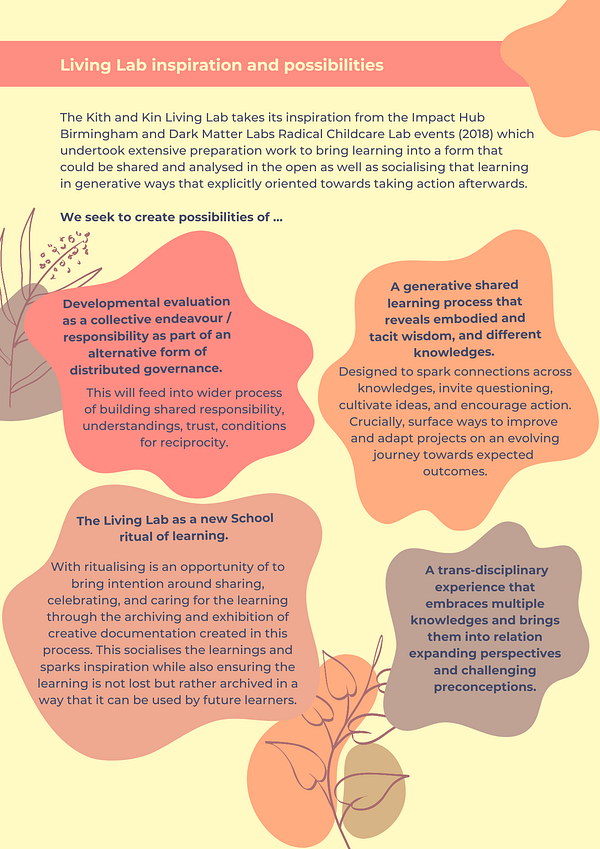
In June 2024 Jo proposed a Kith & Kin Living Lab for our work, inspired by Impact Hub Birmingham / Dark Matter Labs Radical Childcare Lab events in 2018 which she had been part of. She explained that through the events in Birmingham there was extensive preparation work in bringing the learning into a form that can be shared and analysed in the open as well as socialising that learning in generative ways that explicitly oriented towards taking action after the gatherings. The format involved a range of mediums of sharing the data collated, static and interactive, as well as multiple scientific and arts based forms. She suggested that we could seek to do the same, creating the chance to develop an end of year exhibition in CoLab Dudley for people in our community to take part in / contribute to. (This became our 100 Ways to Be A Good Ancestor exhibition which opened in December 2024.)
Jo then began working on an incredibly thoughtful brief for co-creators of a Kith & Kin Living Lab, including some descriptions of what she meant by this:
- Kin: relation of kind
“Kinship speaks to the truth of an interrelatedness that is shared no matter how deeply we as individuals perceive this connection. although it might be more beautiful to dwell in awareness of our kinship with all of life and to act from that center, such awareness is not required for the fact of our kinship to remain as an ecological given.” (from writing by Lyanda Fern Lynn Haupt) - Kith: relationship based on knowledge of place
“… kithship is an intimate connection ‘with the landscape in which one dwells and is entangled, a knowing of its waymarks, its fragrance, the habits of its wildlings’. Unlike kinship, kithship is earned through being near, still, opening up and observing in our places, and crossing ‘dimensions of knowing’… Kithship enlivens and complexifies kinship, and it is essential if the fullness of kinship’s wisdom is to be lived.” (from the same article by Lyanda Fern Lynn Haupt) - Living Lab
A creative social space which people are invited into. In the Living Lab research and innovation processes come together so that people can design and experience their own futures.
Through the Kith and Kin Living Lab, we seek to hold ourselves responsible and create the conditions deepen our understanding of the impact of both our work and the open ended, rhizomatic learning which our work is catalysing and supporting. We see this as an opportunity to invite collective responsibility and to reframe evaluation in regenerative learning infrastructures. - Co-creators
We wish to co-create the Living Lab process with two fellow travellers who don’t know our work intimately, and so can bring a critical view, as well as support design and facilitation of the process.
We would like to design with the recently published CreaTures evaluation framework, which is specifically developed to “set out how creative practices can stimulate action towards socially and ecologically sustainable futures”. The CreaTures framework views evaluation as an active and potent intervention, not simply an administrative due diligence activity.
Seeking co-creators from our field
Jo and I agreed that we were looking for the following in fellow travellers that we would approach to co-create and facilitate the Living Lab.
- Knowledges in relation to climate justice and role of arts/creativity/cultural practice in this movement.
- Facilitation skills; supporting our cultivation of network leadership.
- Systems thinking; helping us take a whole living systems view of Dudley People’s School for Climate Justice, considering system intervention points.
- A design approach; bringing intention to the design of the invitation, spaces, session activity, and possibility of learning artefacts.
- A long view; ritualising learning, the role of unschools as social infrastructures for just transition.
- Knowledge of what it means to work deeply in place; with care, respect, contextual specificity, and being interconnected.
- Analytical skills; pattern seeking and synthesis.
- Network weaving; working to encourage flows of relations and resources between people involved in our activities and across our network edges into other initiatives, groups and organisations.
- Support in embracing different ways of knowing; helping us bring a range of perspectives and ways of knowing to this shared analysis and sense-making.
- Reflective and reflexive practice; supporting us to explore our blind spots and bringing criticality to this moment.
- A capabilities approach; starting from a place of capabilities
- A commitment to justice; recognising privilege, centering lived experience.
- Empathy and perspective taking; starting where people are at.
- Shifting narratives / story-tellers: playing with time, creativity and the arts (different ways of knowing), and building new narratives
- Your whole self; in this work we have actively lifted up all the different elements of our whole self we bring into the School that enriches it further. We want you to feel comfortable doing this and recognising this will be a valuable part of the norms expressed at the Kith and Kin lab.
We considered people across our network of amazing fellow travellers in relation to the above, and in September 2024 we approached:
- Bridget McKenzie, founder of Climate Museum UK and Culture Declares Emergency, who also undertakes evaluation work through Flow Associates. We’ve long followed Bridget’s work and have introduced some of her frameworks to people in Dudley in relation to our work on culture and climate justice. I had recently ‘met’ Bridget through participation in her excellent (online) Earth Talk course.
- Raechel Kelly, founder of Planet Cheltenham. Raechel and I met through CIVIC SQUARE’s Doughnut Economics Learning Journey in 2022, in which we were both hosts of peer learning groups. We were paired up as host buddies, and got really curious about each other’s work. I’ve enjoyed time in Cheltenham learning more about ways in which local people of all ages there are taking really practical action around the climate crisis, thanks to Planet Cheltenham’s convening. Raechel visited us on Dudley High Street in May 2024, and generously shared stories of climate action in Cheltenham during a lunchtime session with curious folk in Dudley.
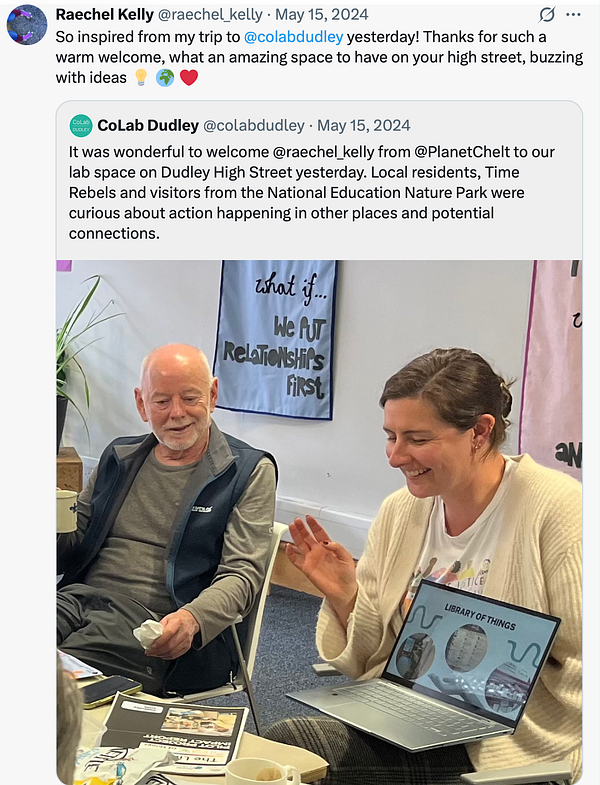
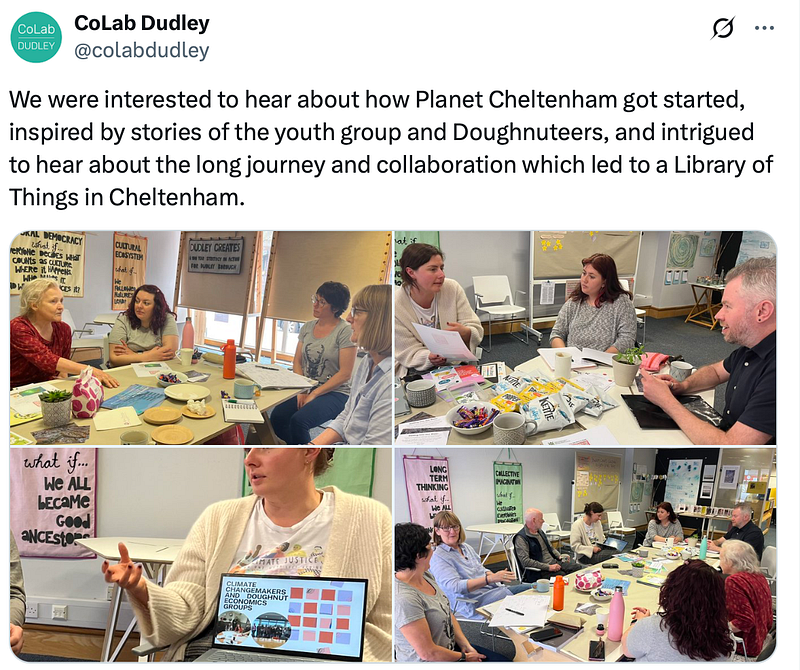
We were delighted when both Bridget and Raechel agreed to co-facilitate the Living Lab together, having never met before. We met each individually in October so that they could ask questions about our brief and expectations. We got agreements for the work in place by the end of 2024 and scheduled some times to meet in early 2025.
Creating conditions for this approach to evaluation with our local collaborators
Jo spent a lot of time in December and January in conversation with our seven collaborators in Dudley People’s School for Climate Justice work, so that there was clarity on and opportunities to ask questions about and respond to:
- The purpose and objectives of the Kith & Kin Living Lab.
- The logistics and time commitment (which was in addition to planned time on this work, but enthusiastically committed to, and paid for).
- The tone and energy that we hoped to generate over the two days of the Living Lab.
- How we hoped the Living Lab would build on learning collected and shared to date.
- A reminder of our developmental approach to evaluation, and some of the design and evaluation frameworks we have shared and have been drawing on in different ways in the first year of this work.
I deeply appreciated the care and time that Jo invested in creating conditions for this receptiveness to learning and evaluation and the tending of a relational approach going way beyond group emails. Jo spent time in conversation with our partners individually or in small groups to explain what we were developing and to ensure the Living Lab process would address things from their perspectives.
Co-creation begins! And an evaluation framework is developed
Jo brought Raechel, Bridget and I together over a few Zoom calls starting in January this year. She created space for Bridget and Raechel to get to know each other. They soon discovered that they could work really well together as each enjoyed and was confident around elements of design, facilitation and documentation that other wasn’t.
Bridget immediately started thinking about a framework for evaluation. We had explained that we tend to be framework magpies, using a pick ‘n’ mix approach. We draw on what feels useful for us, leaving the bits that aren’t, tailoring and taking inspiration as we find most helpful. We’ve mostly used the 5 Pathways to Nature Connection described in The Nature Connection Handbook (University of Derby research), though we reimagined their nature connection index. We’ve explored the 8 Pathways to Cultural Action, developed by Bridget McKenzie for Culture Declares Emergency, which has since evolved into the Culture Declares Emergency blueprint for change. We also introduced to partners, but haven’t yet used, the Doughnut Economics four lenses framework.
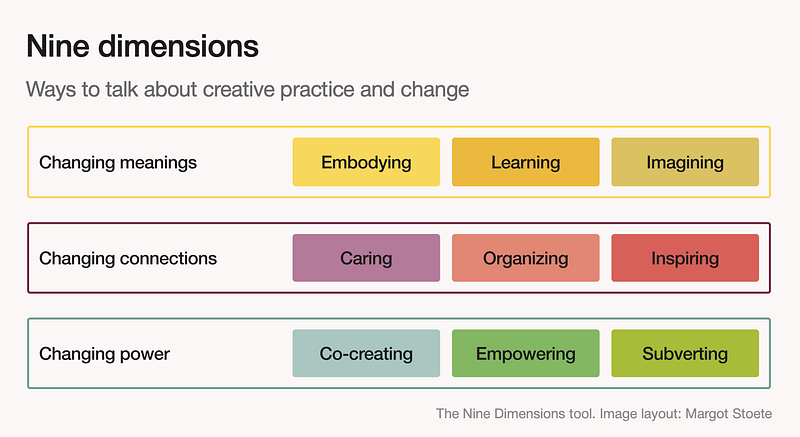
We had more recently been testing out and taking inspiration from the CreaTures project who have researched the pathways and practices of creatives who are intentional about social and environmental transformation. We thought their tool for evaluating creative practices and how they connect to transformative change was potentially helpful for our creative work with communities around climate justice.
As Jo explained:
Measuring and monitoring the change we seek in Dudley People’s School for Climate Justice is made more challenging by the often intangible but crucial cultural pathways to change enabled through creative practice that the School embraces. Yes, we can name and list skills developed and hours spent tending biodiversity gardens. However, the journey towards a just transition is not simply a technical or skills based challenge — though democratising these is also important.
Dudley People’s School for Climate Justice starts from a position of viewing climate justice and interlinked crises as a cultural challenge. We believe we need to take a more shared learning and relational approach to working with our creative partners to surface the change unlocked through centering creative practice within our work.
The depth of that potential change is explained in this quote from CreaTures researcher Laura Houston:
“Transformation takes time, and in their experience, it is more often gradual and incremental than urgent and radical. Our creative collaborators think about how they can shift relations, rather than how they can transform systems. Working outside of governance settings, they do not seek to deliver specific climate or biodiversity goals. Rather they explore sustainability problems as cultural problems, ones that often result from extractive and industrialised ways of life. As cultural producers, our colleagues see themselves as having a significant role to play in changing culture. Together, the creative fields have an incredible public reach — engaging people in large-scale public artworks as well as intimate community group meetings. They can raise consciousness of the challenges that we face, and provide protected spaces for experimenting with alternatives.”
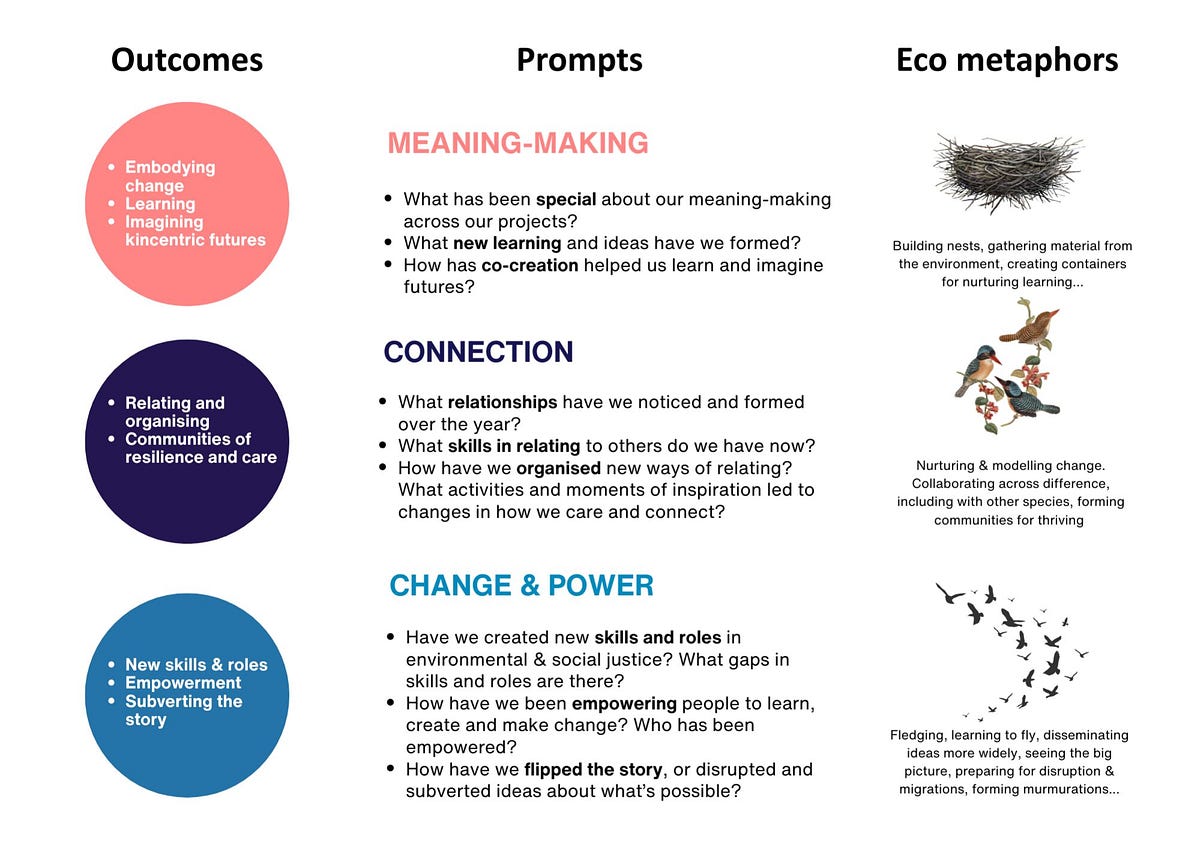
Bridget immediately saw that the 9 dimensions in the CreaTures tool mapped onto her Culture Declares Emergency three values of truth-telling, care-taking and change-making. They also mapped onto a framework which we were unaware of, developed through Bridget’s work as an evaluator with Flow Associates. Their Three Lenses framework considers change occuring in a nested way, considering character, capacities and context. Bridget then created an easy to hold framework which we could introduce and use during the Kith & Kin Living Lab.
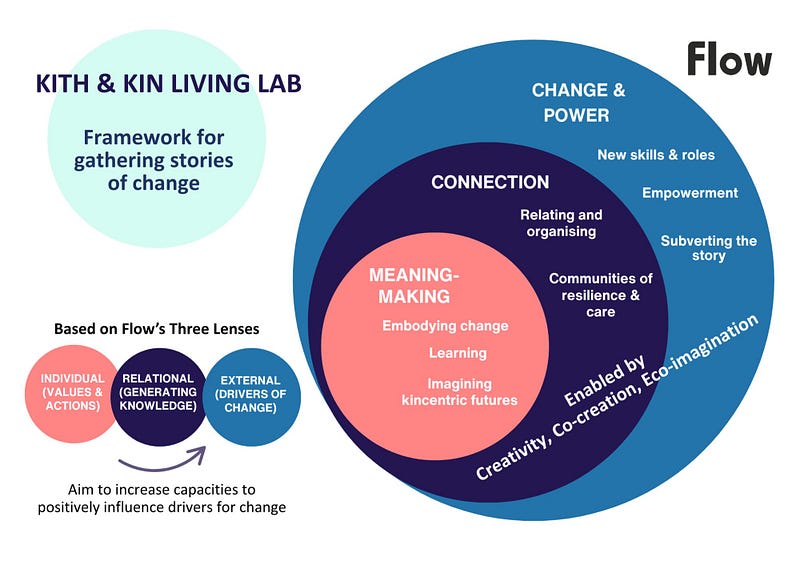
The framework developed by Bridget (more below), is something new which we are testing and iterating, and which we invite others to play with (please credit Bridget McKenzie). The more familiar we become with it, the more uses we are finding for it, beyond our climate action work, and as a bridge to it.

This framework became the foundation from which Raechel and Bridget developed a sequence of facilitated activities for the Living Lab which to invite collective exploration of and critical reflection on Dudley People’s School for Climate Justice work by partners.
The Kith & Kin Living Lab 5–6 March 2025
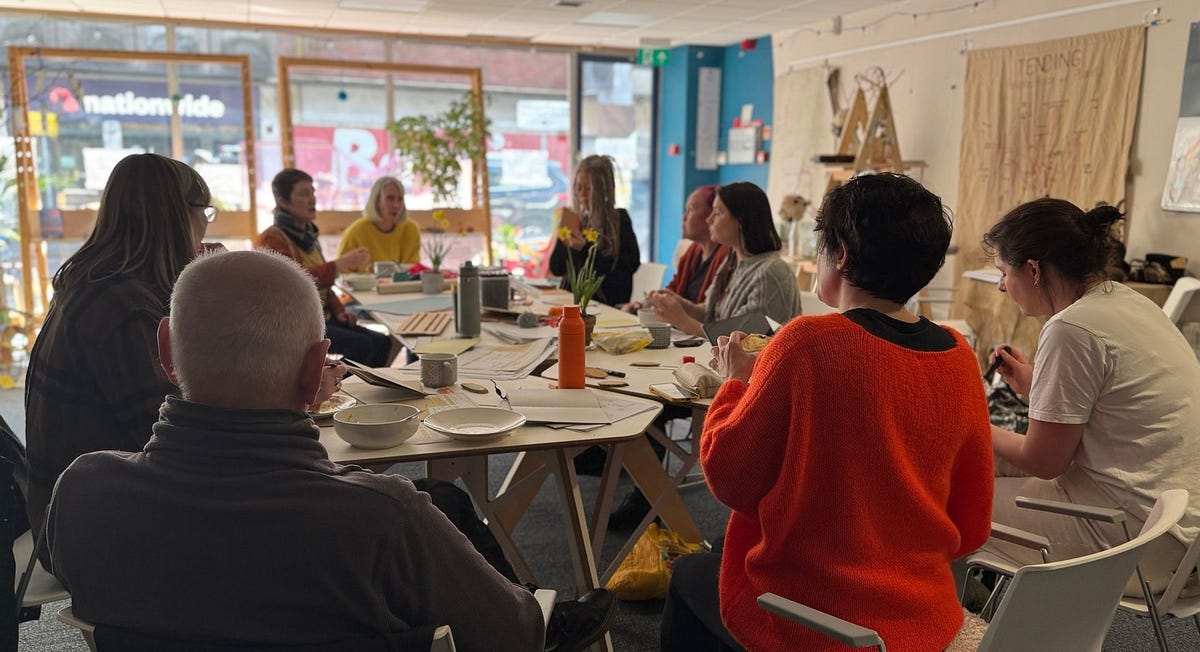
We gathered for lunch on Wednesday 5 March. We’d planned bring and share meals, resulting in a nourishing abundance of food including home made bread, soups, curries and stews which were enjoyed over the two days 😋 ↓

To ease us into the sharing, reflection and thinking ahead, Bridget showed us a few ways to create our own journals for the Living Lab using simple book binding techniques 🪡 ↓
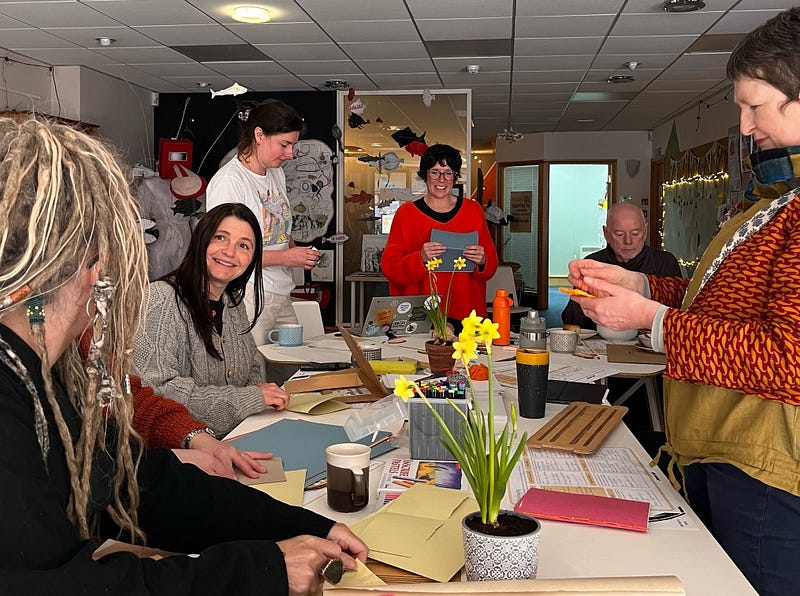
Jo Orchard-Webb opened the Kith and Kin Living Lab, and had given us each a reminder of why we were coming together in this way written as a note to each of us on seed paper 🌱 ↓

What if our sense-making was grounded in our interrelatedness with all kin, and the intimate knowledges of the places we dwell (our kith)?
What if we co-created a generative, joyful and creative space to reflect, sense, connect, care, question, design and spark imaginings based on our first year as Dudley People’s School for Climate Justice?
Through the Kith & Kin Living Lab we are holding ourselves accountable to the prefigurative process, or rehearsal of this regenerative learning infrastructure and all that makes possible for just transition and futures building.
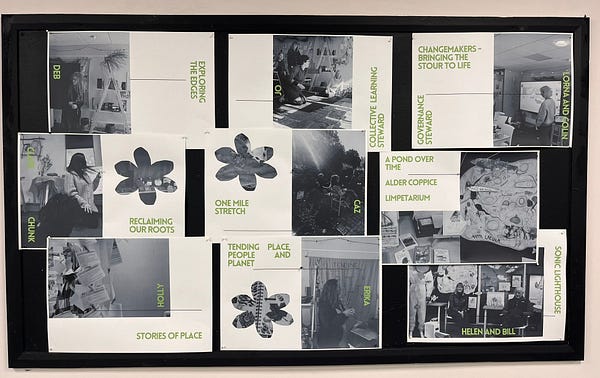
The lab space was full of work developed during the first year of Dudley People’s School for Climate Justice work, curated for our 100 Ways to Be A Good Ancestor exhibition in December. We went on a tour of the projects, sharing with Raechel and Bridget what had happened and was emerging through: Growing Land Connections (incorporating Exploring the Edges, Tending Place, People and Planet, and Reclaiming Our Roots); Getting Into Hot Water (including Pondering work, Correspondences with a Wet Wood Land, and Sonic Lighthouse); Stories of Place; and Bringing the Stour To Life 💬 ↓
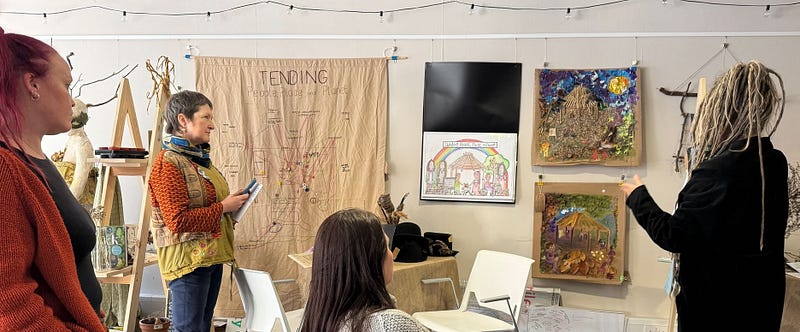

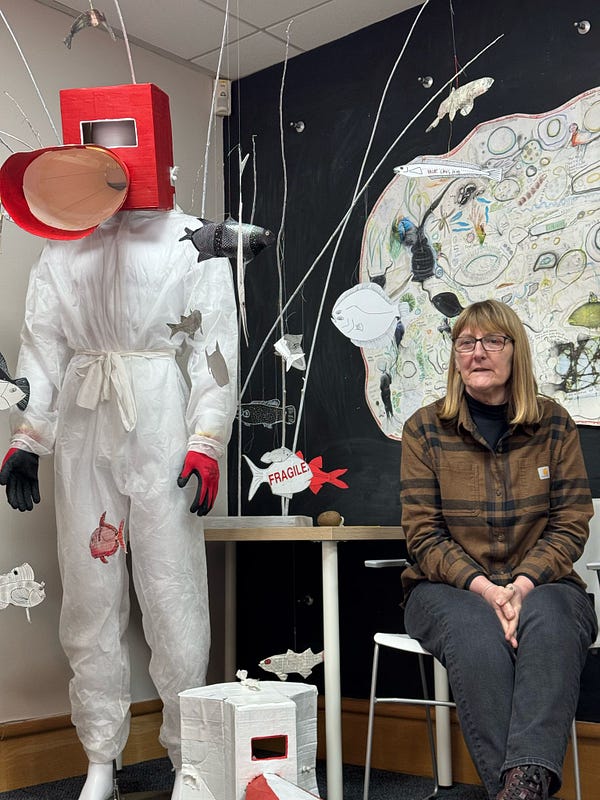
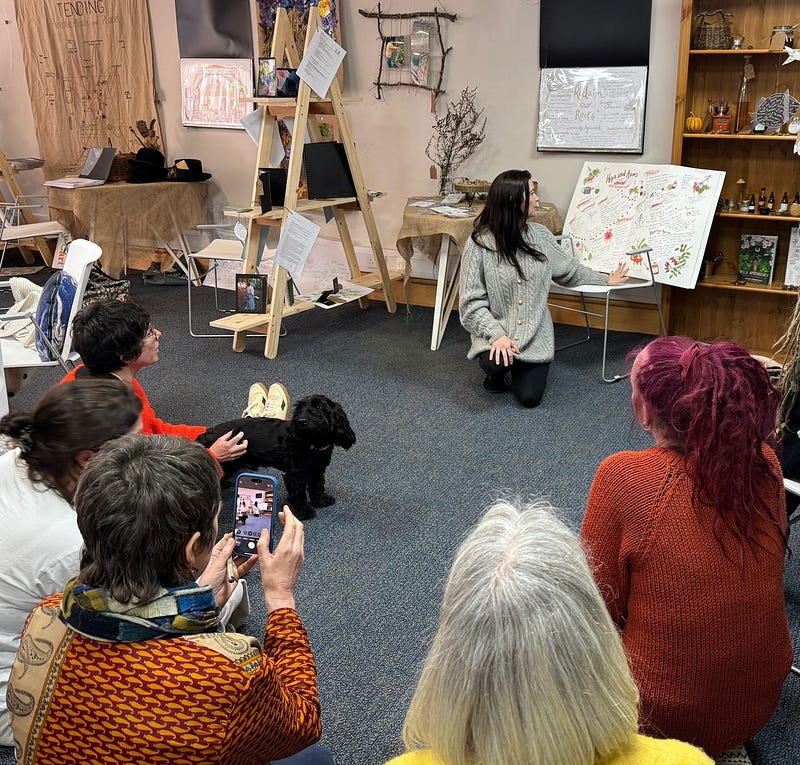
This form of storytelling was made possible through our commitment at the outset of our work together to: undertaking detectorism, creatively documenting activities, and a collective annual showcasing of activity.
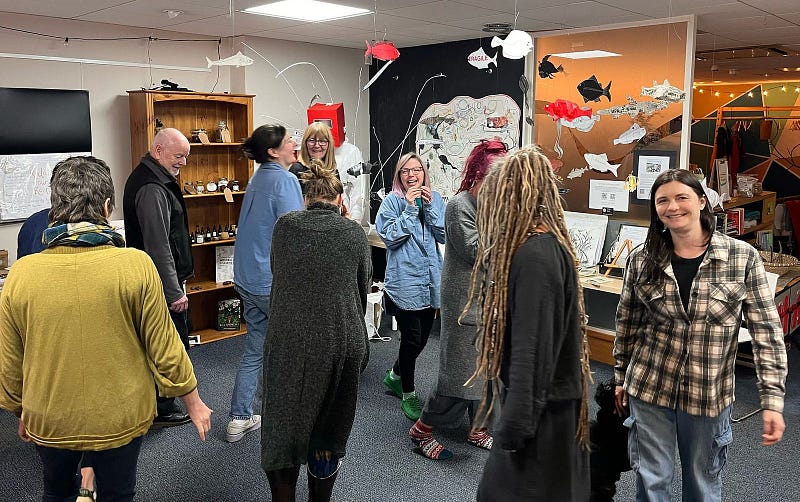
During the two days some of us were invited to the edge of our comfort zone with some embodied activities. These aren’t a norm when we gather as collaborators, but generated laughter, breaks from brain work, and a few insights. Once again this demonstrated the value of working with critical friends from our field of practice, as it introduced us to ways that they work with their communities and with different cohorts of people, such as Raechel’s work with young people.
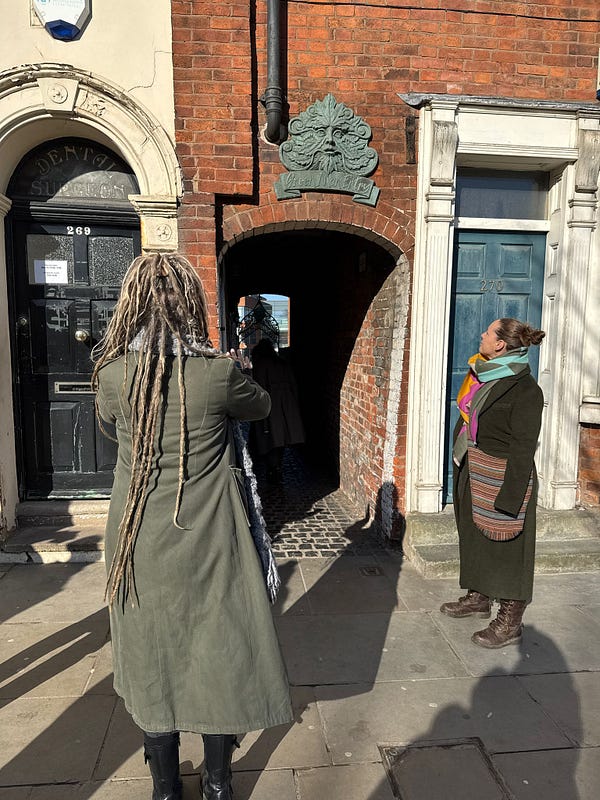
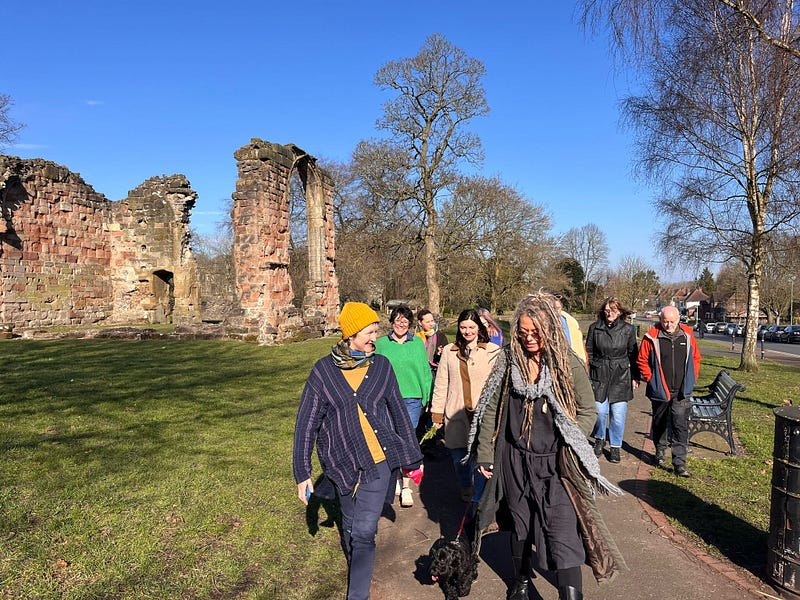
On the second day of the Living Lab, following a shared breakfast, we walked northwards through Dudley Town Centre, through Green Man Entry and past college buildings to Priory Park. Bridget led us through a grounding meditation inviting us each to attune to our body, mind, emotions and connection with all life by turning to face each of the four main compass directions. This activity draws on medicine wheels constructed by various indigenous cultures.
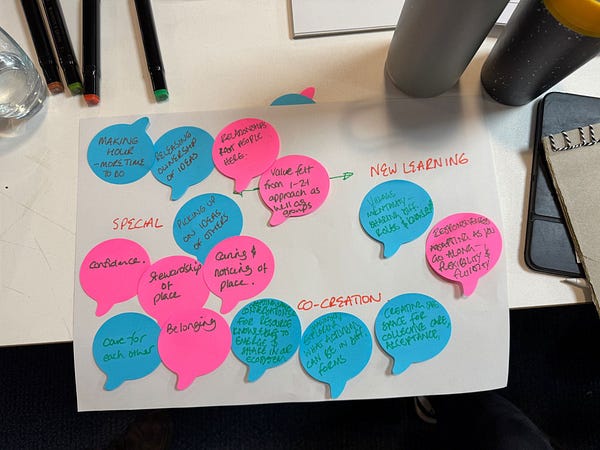
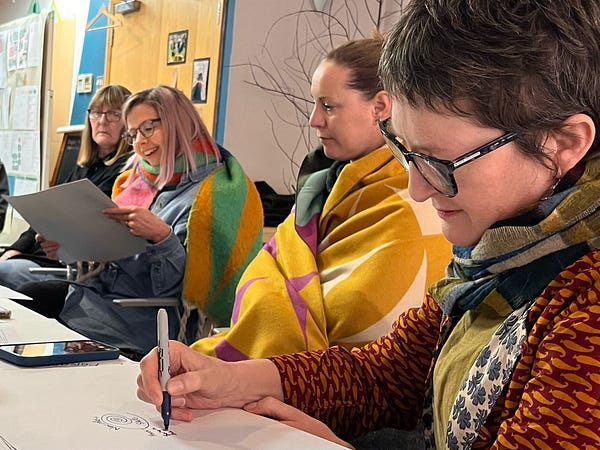
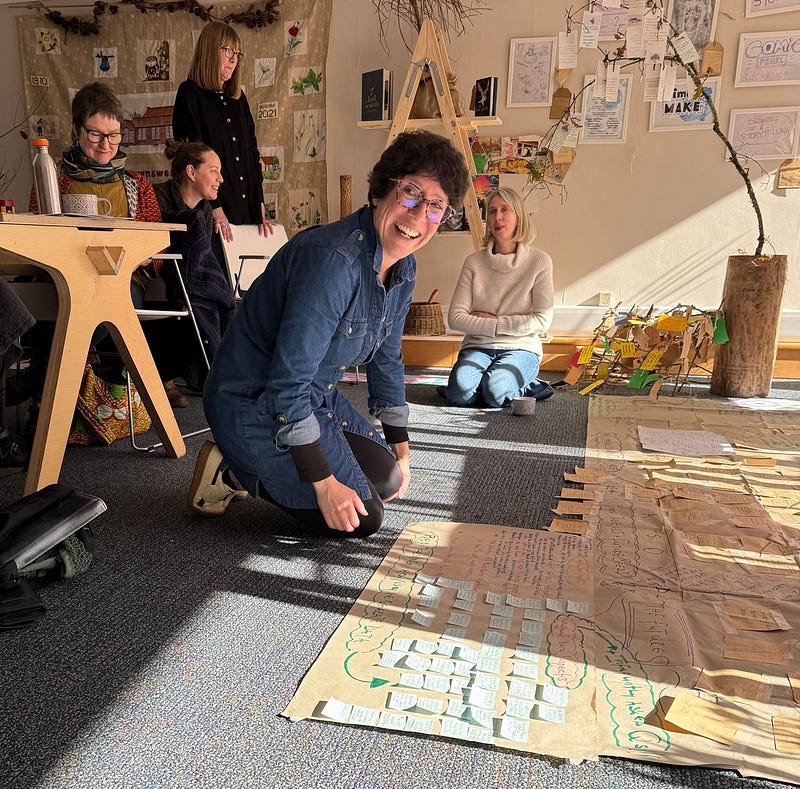
By day two we were really deep into the evaluation framework, thanks to clear discussion prompts, and an invitation to work in different combinations of people in groups of 3 as we considered each part of the framework. The discussion prompts generated a huge volume of insights, reflections and new ideas. We could have filled 5 days just exploring these. Care was taken to hear from each of our smaller group discussions so that the learning and ideas were socialised across our whole group.
Practices in Place
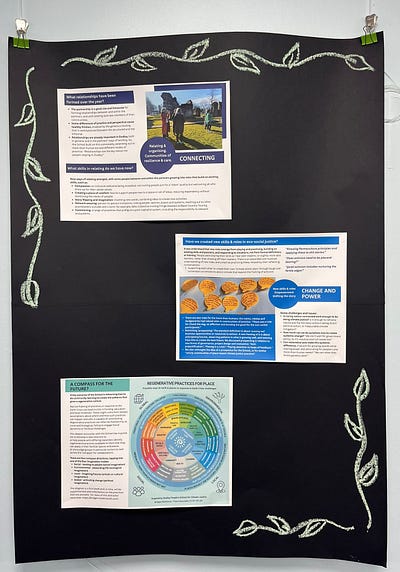
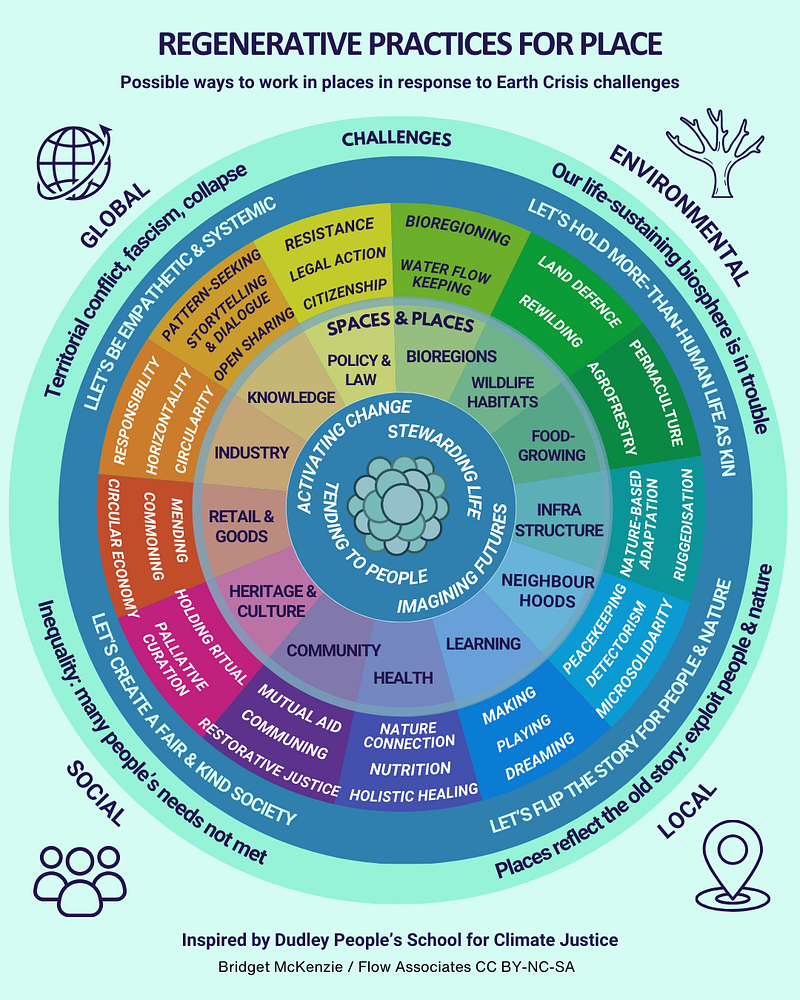
A significant emerging insight during the Living Lab was a way of considering our many and varied ways of doing and working with local people on climate action as a collection of Practices in Place. Bridget swiftly synthesised these into a shareable, Creative Commons licensed resource which takes the form of a compass called Regenerative Practices for Place. She has written about and shared it here:
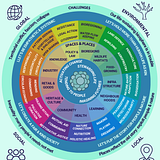
Here is the first iteration of the compass inspired by our work and shared by Bridget to:
- help people with differing capacities identify regenerative practices available to them in the spaces and places familiar to them
- encourage groups in particular sectors to look across the compass for collaborations.
Gratitude and reflections
The overriding feeling for me at the end of the two days was immense gratitude for the ways in which everyone showed up. Grace and generosity were manifest through every element of the Living Lab, from the offers of and bringing of food to share, collective care of the lab space including sharing clearing up after meals, the receptiveness to the invitations and discussion prompts from Raechel and Bridget, and the listening, dialogue and open sharing of ideas and new learnings.
Our focus on a field building approach to evaluation felt so much more relational, meaningful and generative than contracting with evaluators who wouldn’t be likely to share or use what they learned or developed.
Raechel reflected that this collaboration came at a good moment, as she emerged from a period of intensive delivery on climate work and wanted to ‘stick her head above the parapet’ to discover more about work others are doing. I trust that when she combines her work with her learning from others it will, in turn, shape my thinking and our work again. as I have often borrowed from Raechel’s work with Planet Cheltenham, thanks to our relationship cultivated through leading Doughnut Economics Learning Journeys in our respective places. I was grateful for the care and creativity that Raechel designed into the Living Lab process
Similarly, Jo and I have drawn a lot on Bridget’s work and thinking over a number of years, so this was an opportunity to develop relationships and generate a flow that we hope will develop into gentle ongoing reciprocal learning exchanges. Being together in place created a depth to previously online connection, and feels exactly the opposite of what could have been an extractive evaluation exercise. I was blown away by how rapidly Bridget synthesises information and at such a detailed level, her documenting never stopped!
It was also important for me to see Jo, as our collective learning steward in the lab and this work, to have others to collaborate with on generating learning. Although we usually work as a team, Jo’s role has demanded her to be front and centre of our collective learning activities, so it was great that she could participate in the Living Lab, thanks to Raechel and Bridget holding and guiding the process.
Kith & Kin Living Lab documentation and exhibition
We are absolutely chuffed that Raechel and Bridget generated two very different, but complimentary forms of documentation of the Kith & Kin Living Lab.
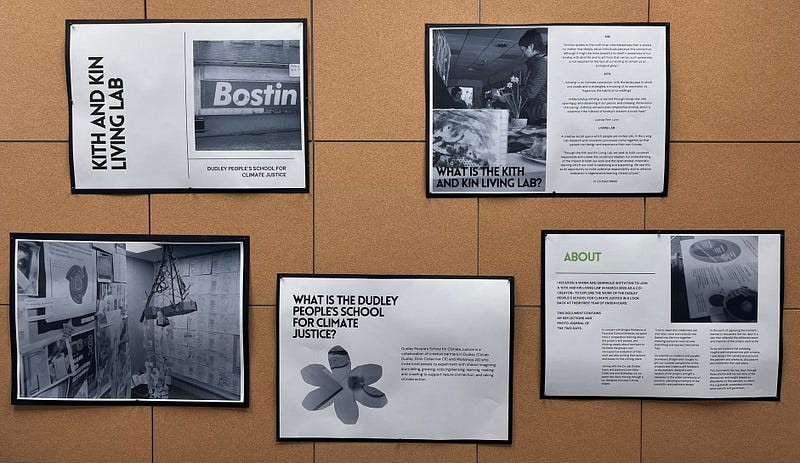
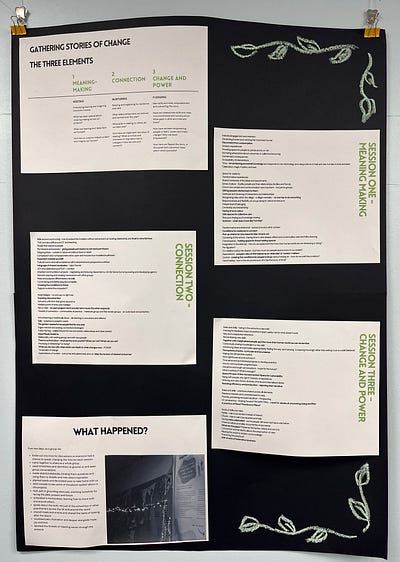
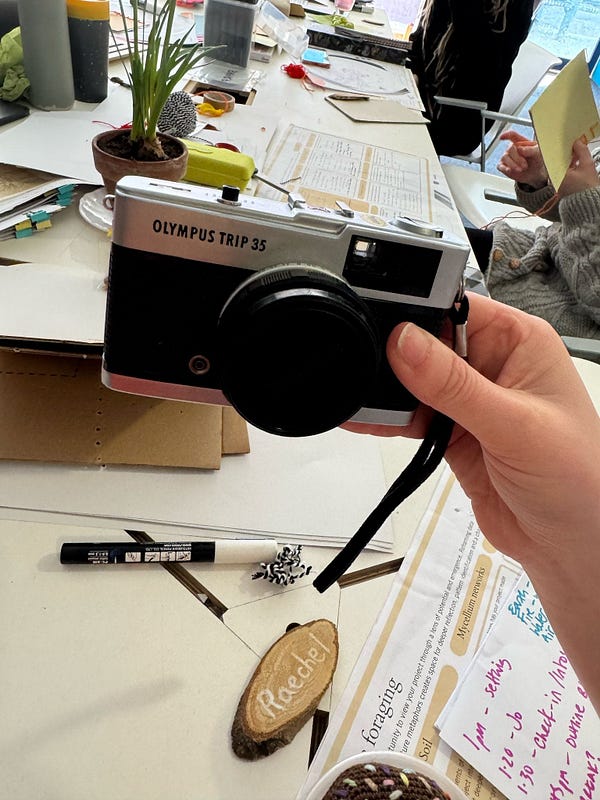
Raechel produced a series of Living Lab portraits created with black and white film photography, which she included in a report which offers an overview of what happened in the Living Lab, and key insights and ideas she recorded during discussions around each of the three parts of the evaluation framework (meaning making, connection, change and power). Click to see Raechel’s Kith & Kin Living Lab Portraits.
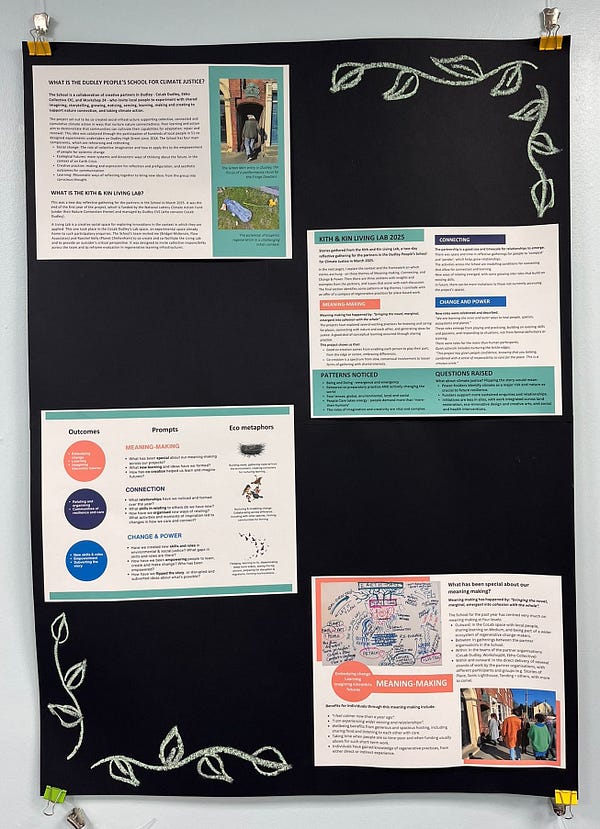
Bridget produced a visually engaging evaluation report including accounts of our work and issues and challenges for us to address. The report includes the evaluation framework and the practices in place compass which Bridget developed during her work with us. Here is Bridget’s Kith & Kin Living Lab report.

The visual nature of both Raechel’s and Bridget’s documentation led us to create a Kith & Kin Living Lab exhibition opening in December 2025. It will remain in the upstairs of our lab space through 2026, and will be added to as we harvest and showcase more of our learning. Associated provocations will invite interaction and reflections on the approach and our work.
Below are a few snaps of the exhibition in our lab space as it is being developed. If you are local to Dudley and would like to visit it, and other installations showcasing our work through Dudley People’s School for Climate Justice, you are warmly invited to our Winter Gathering on Wednesday 3 December 2025.