Counter-mapping — a radically relational practice in place
How might counter-mapping alter how we inhabit and navigate the world? Photos, resources and reflections from counter-mapping learning huddles and Unschool counter-mapping.
As we begin to explore the many layers and fuzzy edges of our bioregion we are exploring the power of counter-maps and counter-mapping practices. As we move into a new year we are gently holding this question: “How might counter-mapping alter how we inhabit and navigate the world?”
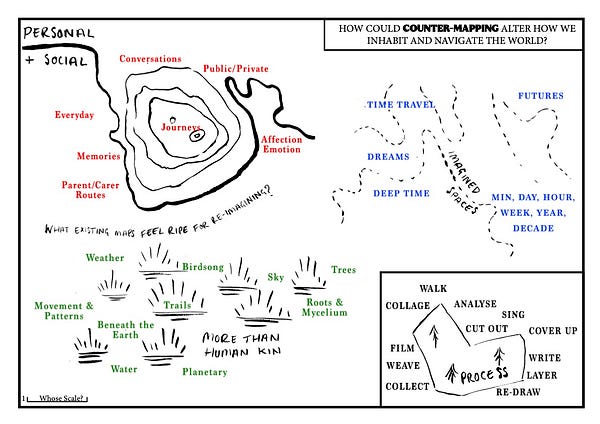
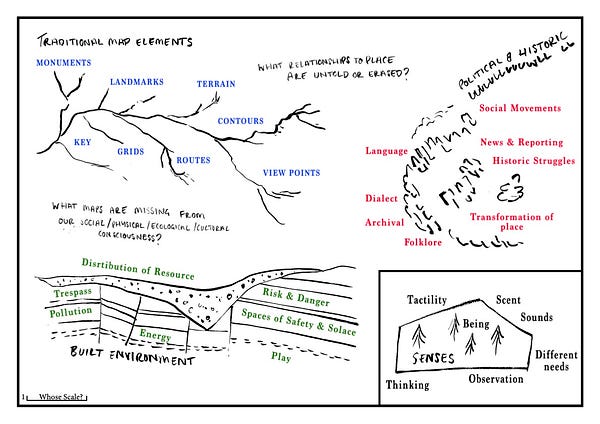
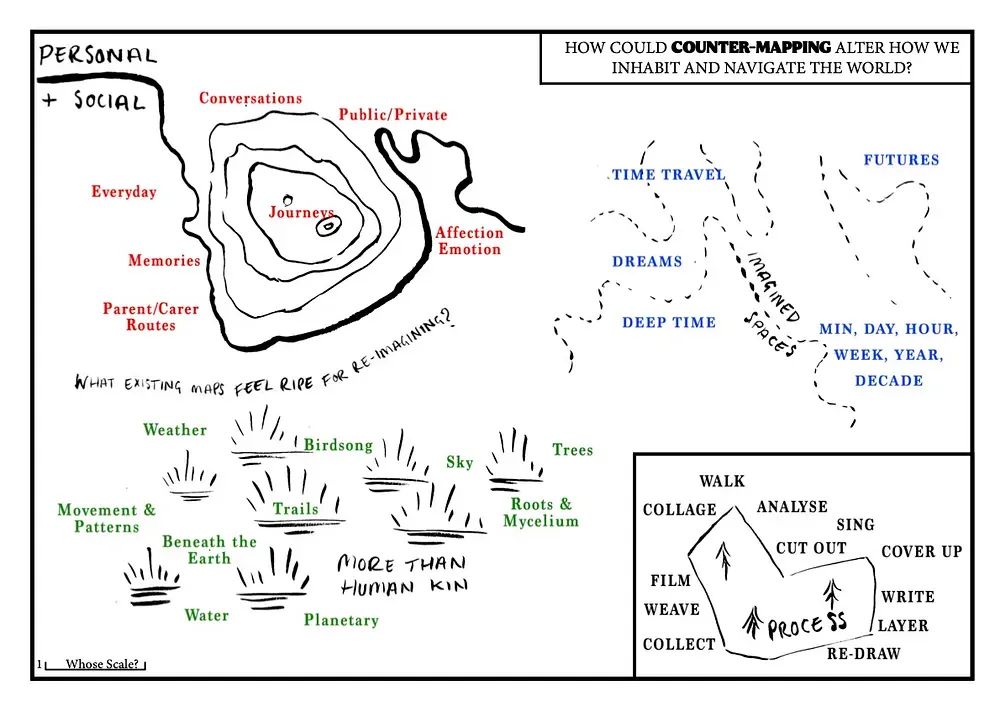
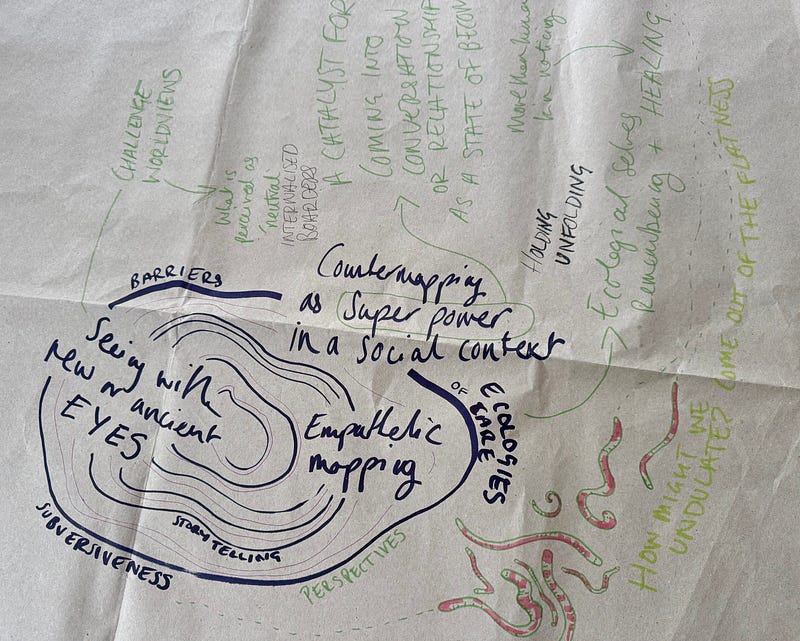
Counter-Mapping Prompt Canvas: Created through direct conversation between Meghan, Jo and Laura, design by Laura for sharing through Creative Commons. Developed September 2025 as part of our Bioregional Learning Network.
Counter-maps as a tool for bioregional re-storying and reinhabitance
As a newly gathered Bioregional Learning Network, we are bringing our attention to re-storying our relationship with land through cultivating local bioregioning practices centered on repairing, reconnecting and reimagining here in Dudley and the wider Black Country. Repairing concerns acknowledging and healing damages wrought by extraction; Reconnection concerns remembering our interconnection with the rest of nature, and Reimagining relates to using our imagination powers to experiment with alternative ways we might live, play, learn, create, make, grow, move, heal and organise that are more attuned with the health of all life in our bioregion.
Within this intention counter-maps and counter-mapping have prooved to be a beautifully generative and curiosity sparking starting point for this forever learning and journey of reinhabitance. Perhaps it is the elusive, unmapped quality, or its visceral and industrially charismatic nature (the Black Country was inspiration for J.R.R Tolkien’s Mordor) that invites this speculative and counter-cultural curiosity?!
There are many definitions of where the Black Country is but one thing is for sure, you won’t find it marked on any map. [BBC]
This resistance to formal mapping seems incredibly wise given “[m]aps are never neutral, they represent a particular way of seeing the world” (Harley, 1989). Indeed, maps have been part of shaping our relationship with place and the rest of nature for centuries (notanatlas). They are able to determine how we are connected with land by creating what are perceived as authoritative versions of our story of place according to whomever holds the power to map.
This led us to ask:
What if we disrupted that narrative power asymetry using democratising counter-mapping practices available to everybody? Just as it matters who does and who does not get to imagine the future, it must surely matter who gets to map it?
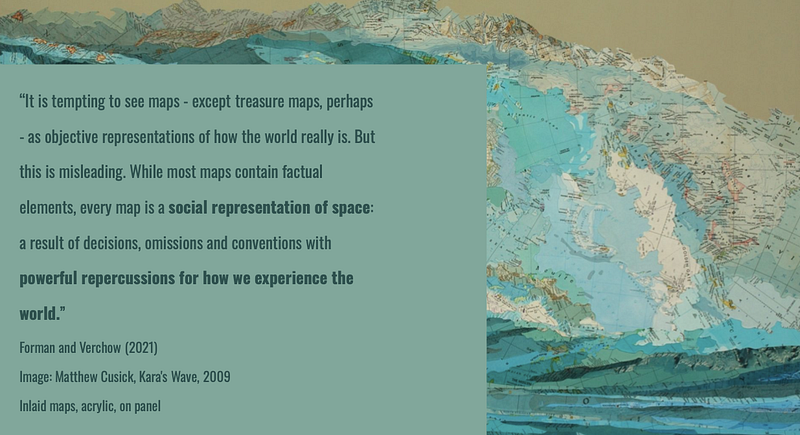
Many formal maps have been used to advance a narrative and perspective of dominion and elitism of certain humans. For centuries they have been used to reify hierarchies and separation of beings; for operationalising the enclosure of Commons; to secure the erasure of Indigenous territorial claims and knowledge systems; to enforce exclusion and displacement of communities via planning and nation-state mapping; as well as being a tool for enabling extraction across the globe and of course here in our home bioregion in the West Midlands. The latter point maybe goes to the heart of re-storying in this bioregion. We are part of the Black Country, so named after its critical manufacturing role in the British Industrial Revolution in the Nineteenth Century. During this time the sky was said to be black with smoke from thousands of iron working foundries; the buildings black with soot from the forges and mining of the shallow thirty foot coal seam that runs close to the surface of this land.
The region was described as ‘Black by day and red by night’ by Elihu Burritt, the American Consul to Birmingham in 1862. Other authors, from Charles Dickens to William Shenstone refer to the intensity of manufacturing in the Black Country and its effect on the landscape and its people. [BBC]
This is a story and relationship with land that we now know — in the context of cascading climate, ecological, health and social justice crises — to be deeply harmful for all life in our bioregion. So what might re-storying our relationship with this scarred land through counter-maps reveal?, or perhaps more crucially what might they invite in our stewardship of place?

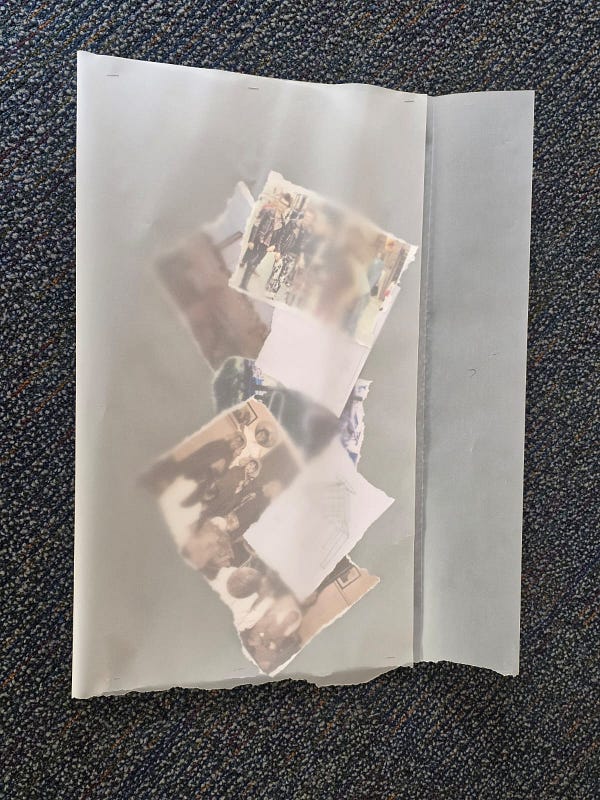
Counter-maps created by Bioregional Learning Network members during our first learning huddle exploring stories of place, and spatial relations at differnt scales of resonance and relevance.
Certainly counter-mapping invites you to start with a deep questioning of the mapped status quo, and how that has shaped our relationship with land, and narrated our dominant stories of place. This definition from Mapping Future Imaginaries lifts up the meaning-making and relational quality of counter-mapping as a practice that supports us to ask big critically engaged questions of the stories we tell ourselves, or we are told, concerning our relationship with this land and all the life that calls it home.
Counter-mapping is a method of critical inquiry in social art making, urban planning, and community development that disrupts, connects and makes visible the ways local stories, practices, relationships, physical memories, and rituals constitute meaning. Historically, maps have also served as tools of colonization, ownership and exclusion. Contemporary artists, cultural development workers and community activists use creative citizen-led cartographies as tools for engagement, understanding relationships, and to draw attention to counter-narratives and the politics of land, place and history. [https://mappingfutureimaginaries.com/home/]
Just as traditional map making has been used to exert destructive power over life in place, counter-maps hold a radical power that offers us the chance to ‘see the world through new eyes’ (Joanna Macy & Chris Johnstone), and in doing so relate to place in life centered ways.
Counter-maps offer us a way of telling untold stories with this land; expressing kinship rather than ownership, a way of reweaving connections, making bioregionning practices and ways of being and knowing visible and interlinked. Counter-maps can reimagine spatial futures in ways that disrupt modernity and extractive capitalism shaped spatial relations. They can also tell the story of local ecological loss on a more intimate and relatable level that cultivates compassion, empathy and inspires action for change through deeper connection to the rest of nature.
This capacity to subvert dominant narratives I suspect is key to our love of counter-maps. Even today, typical cartographers’ maps feed stories of place that are often tied to narratives of capital and technological dominion, human control, order or hierarchy via lines of land ownership, administrative or political boundaries, indices and categorisations of communities, and of course the road networks that shape how we travel through place in dangerous big metal polluting boxes!
Counter-maps by contrast invite critical, relational and creative engagement with place by mapping alternative stories of place that are often hidden, forgotten, erased, or simply not seen as important enough to map. These are the maps and stories we are interested in surfacing and co-creating in our Bioregional Learning Network. This is a practice that has the capacity to invite reconnection to the rest of nature, and perhaps in time, to reinhabitance? Perhaps by paying attention through the mapping process to different layers of kith knowledge, (local specific place based knowledges) we weave ourselves more deeply back into kinship with the human and more-than-human of our places?
As well as being a tool for asking great questions, counter-maps are a magic meeting place of diverse disciplines that invite a multiplicity of ways of knowing to come together in a form of radical story-telling in/of place. We know from years of creating conditions for learning-doing as a social lab that this cross-pollination of a multiplicity of knowledges and diversity of practices is critical to possibility in place.
Mapping in a regenerative sense is always a collective effort that is part of field building. The act of mapping is a co-creative sense-making process that builds capability and understanding of living systems. [Jenny Andersson — Really Regenerative CIC]
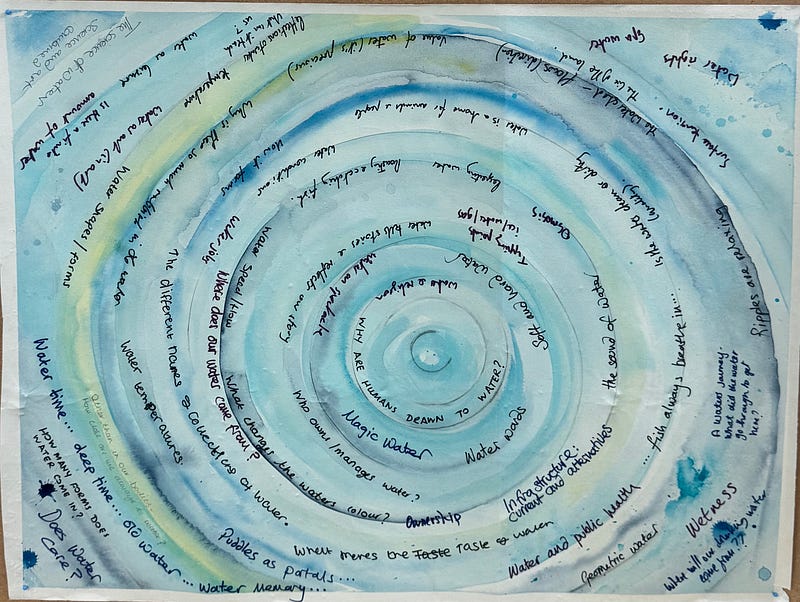
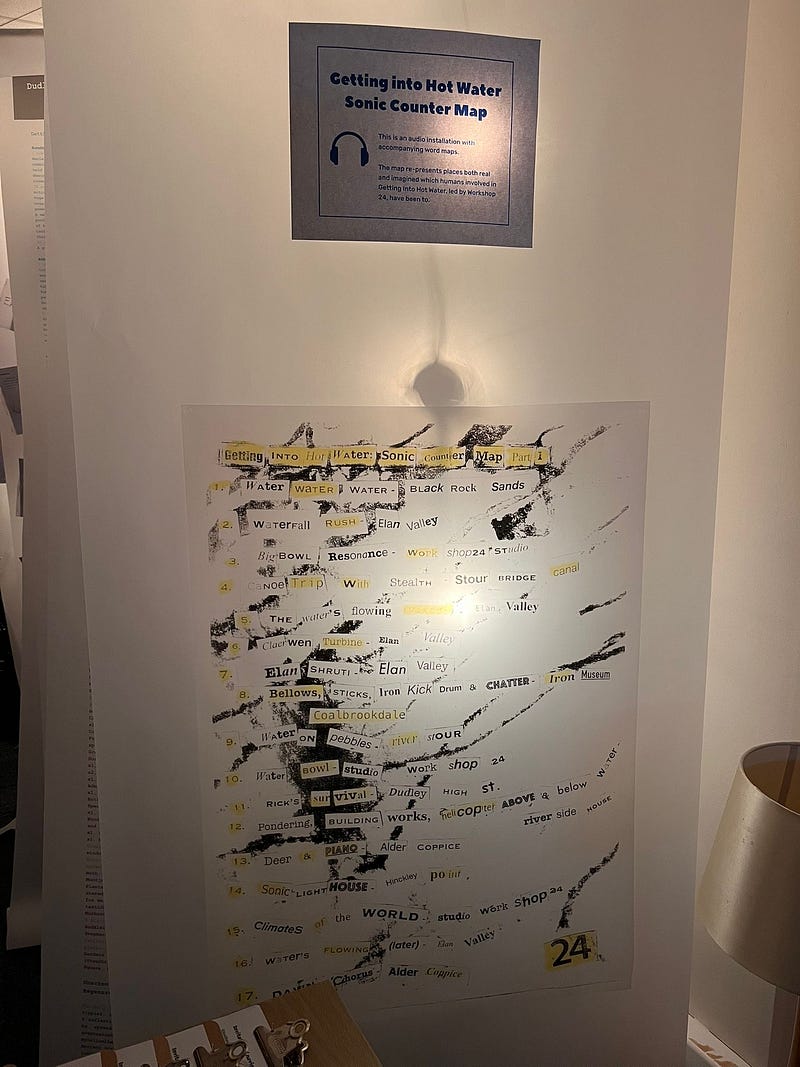
Counter-mapping has bubbled up across different areas of our work for years — they have manifest in the connection to place stitched into the beautiful community tapestry representation of the Tending Garden at Hawbush; or the illustrated map of favourite local foraging routes mapped by the Reclaim our Roots community; or in the Seeds of the Future jellyfish mobile which is an assemblage of experiment ideas gathered over years by the Stories of Place community; or the Mappa Lacuna ripples of different conversations about our relationship with water created in Getting into Hot Water.
Over the Autumn/ Winter period of 2025 we brought even more intention to this counter-cultural practice, as we increasingly recognised its power as a type of alternative futures story-telling, weaving, connecting and navigation tool. As part of a commitment to re-storying our relationships with land we understand those futures must acknowledge the histories of harm and dominion in our bioregion, and seek to gather, co-create and take action around stories of mutual flourishing instead.
So with that intention in mind — through our Bioregional Learning Network we have convened a counter-mapping learning huddle co-facilitated by network members. Together over twenty of us are exploring and trying out counter-mapping practices as part of our emerging bioregioning approach. These peer learning journeys include:
- developing our own personal counter-maps of place;
- a learning-doing inquiry into local bioregion mapping materials;
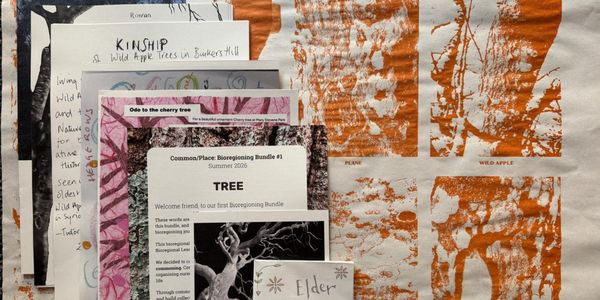
- the co-curation/creation of our very first bioregion Bundle (a collection of place specific bioregion knowledges and artefacts) called Common/Place;
- and then in January this year, experimenting with Relational Beings Mapping practices both in place and online with our Understory friends Parlour.
We engaged in collective documentation for our first peer learning session together as a way of supporting the commoning of knowledge in our counter-mapping learning journey, and you can read all about it here.
I wanted to lift up from that early session expressions of curiosity concerning the power of counter-maps to subvert business as usual narratives of how we relate to and inhabit place. Alongside this was a curiosity for using counter-maps as part of a practice of Active Hope ‘to see with new eyes’ and so reveal through maps and map making alternative world making perspectives. My favourite was a wonderful pondering about the capacity for these counter-maps to help us get lost!
“What if we wanted to map to get lost?”
[Bioregional Learning Network member]
The idea of getting lost in our familiar places, by moving through space without intention or direction, and so seeing them anew, disrupts powerful hegemonic spatial relations that otherwise encourage us to follow lines of consumption, speed, efficiency, or orderly civic flow, rather than moving with curiosity, uncertainty and relationality. This practice has an intellectual origin called Derive or Drift, and it keeps popping up in conversations with friends in the field as we explore what it means to use embodied and relational mapping practices as part of our collective learning and counter-mapping. I suspect we will be sharing more on this collective curiosity soon!

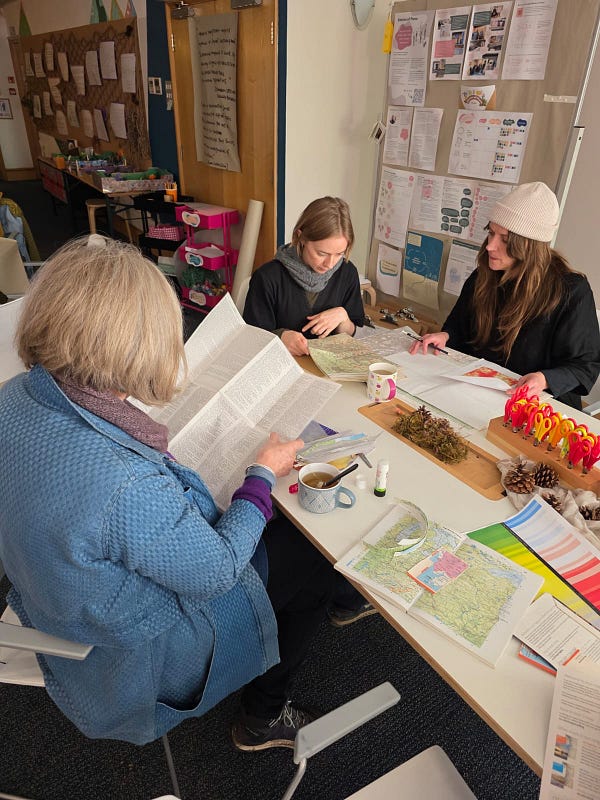
Bioregional Learning Network members gathering in CoLab Dudley space on the High Street to explore individual and collective counter mapping practices, and how this might support our emerging bioregional approach
It turns out that our bioregion counter-maps create a reason to gather, map, and share place based knowledges, as well as explore and express more kin-centric perspectives.
Our counter-maps are beginning to show us knowledges, relationships, representations of reality, imaginings and stories in/with place that are missing from existing maps. They embrace lots of different ways of knowing and so invite us to come into relationship through knowledges of head, hand, heart and even other Kin. In addition, they can help connect our inner and outer landscapes through mapping subjective and emotional spatial realities. Counter-maps can offer a space for creative, reflective and imagination processes that help us re-inhabit place through careful noticing of all natural beings, patterns and cycles. The maps, and the way they are emerging as part of a collective enquiry underpinned by relational learning practices are a catalyst for participation and connection.
What if they became a type of bioregioning navigation tool that offer us a way of telling untold stories of land, expressing kinship rather than ownership, a way of reweaving connections to land and kin, making bioregionning practices and ways of being and knowing visible and interlinked across our bioregion and across time?
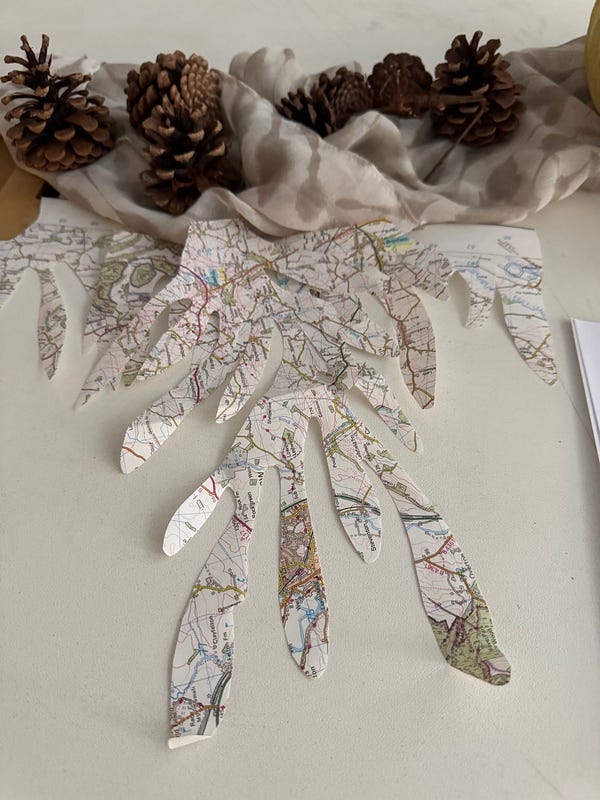
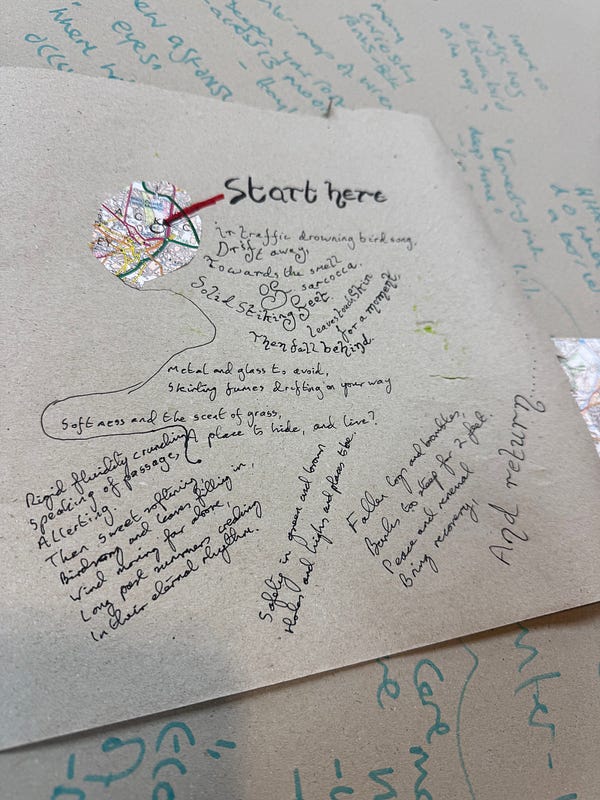
Counter-maps created by Bioregional Learning Network members during our learning huddles to explore stories of place, and spatial relations left untold by usual mapping.
Unschool counter-mapping
Alongside the counter-mapping fruiting through the Bioregional Learning Network we have been co-evolving a counter-map as learning partners in Dudley People’s School for Climate Justice. This counter-map is a way of diversifying the data we value, gather and bring into new relationships, to tell the multiple stories of our unschooling practices over the year.
Diversifying the data we gather to better reflect what we value, how we make sense of change, and how we relate to place, has always been a lab practice, and we believe it is critical to evolving typical evaluation processes that seem ill suited to the relational and emergent quality of alternative futures work. However, this is the first time we have co-created a whole counter-map of the multiplicity of Unschool layers of data. It has taken lots of time co-creating (there are lots of data we have gathered and wanted to share but ran out of time to curate), many hands (this has been a truly collaborative effort across nine partners and 100s of unschool learning companions), many materials, and a good deal of relational practice, dancing with living data across different areas of work. But it is so worth it!
There was the joy of the co-creation or ‘map becoming’ process where we socialised and imagined the layers of the counter map; and then there is the insight and sense interconnection that comes from bringing together different data from different partners, practices, places in the bioregion. To weave between the six foot suspended multi-media layers of this evolving counter-map of ‘unusual data’ is to be both joyfully immersed in the wider community of stories in the work and reassured that this is regenerative practice akin to agroforestry and not mono-culturing!
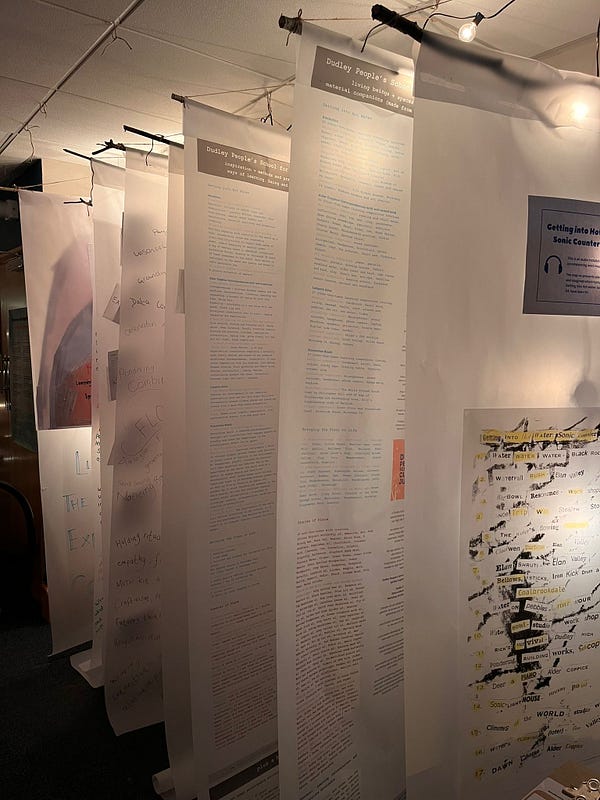
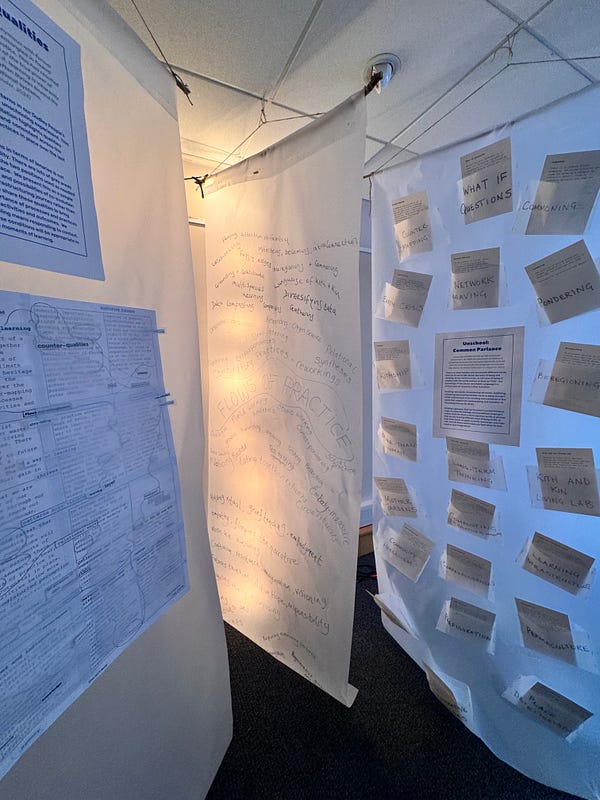
Dudley People’s School for Climate Justice Unschool counter map suspended layers sharing unusual data gathered during 2025. The countermap is exhibited in CoLab Dudley space on the High Street.
This counter map will evolve over 2026 as we celebrate three years of learning together in this constellation of collaborators of human and more-than -human learning learning companions. At the moment it includes seven layers, each with an invitation for you, as the counter-map ‘reader’, to participate in that layer of living data. These invitations are key to the power of counter-maps as performative, as evolving, and as a generative part of conversational learning within our unschooling. I have named these layers below as I think they illustrate different types of data we can use in counter-mapping to tell untold stories of place, multi-species learning and regenerative practices.
In addition, the invitation/ navigation prompts illustrate their power as living data that moves beyond the static fixed report to invite new learning companions into relationship with our unschooling practices that are just as relevant to everyday ways of being. The pictures below help give you a sense of how these counter-map layers act in concert within the installation in the lab space where Lorna and Deb curated them as part of our Winter Gathering focus upon the late Joanna Macy’s practice of Active Hope.
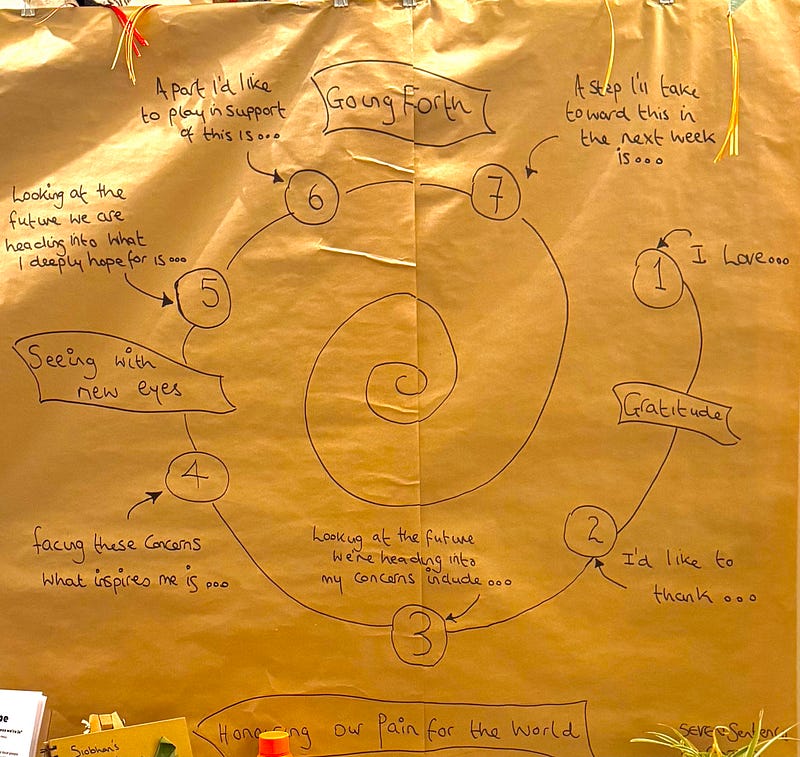
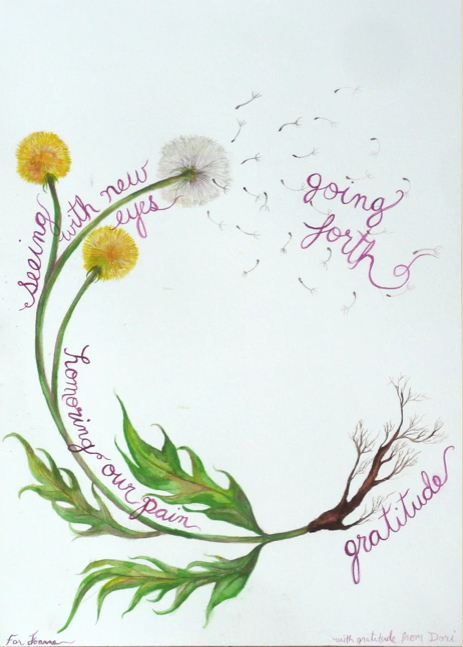
Left: A copy of Joanna Macy and Chris Johnstone’s Active Hope Spiral alongside their prompts for conversations. This is exhibited in the CoLab Dudley space on the High Street to act as a provocation at the end of our Winter 25/26 Active Hope exhibition. Right: The original Dandelion Active Hope Spiral gifted to Joanna Macy by artist Dori Midnight.
In the spiral of Active Hope she asks us to see with new eyes the mutual flourishing and inter-connection of all life. To me, this wall sized multi-layer counter map invites us to do just that by both witnessing the care in the small details of kith and kin often noticed, but rarely named in data gathering, but also as a window into the dynamic interconnection of this community of data as a life centered assemblage of stories of place in our bioregion in 2025. The counter map layers are best experienced in place in the lab, but for those curious about our unschooling and relational way with data you can dive in here …
1. Unusual data gathered during 2025 by Dudley People’s School for Climate Justice partners and learning companions.
This counter-map layer offers a floor to ceiling abundance of coded unusual data with a tiny sprinkling of usual data.
Unusual data suspects is a made up or co-created phrase by CoLab Dudley that is a subversion of “usual suspects” a phrase often used in community development work as a criticism of only engaging with typical “vocal” voices or community members, and failing to represent the wider community and a complete story. ‘Unusual data suspects’ is an intentional framing and paying attention to the community of data (and so voices/ stories) that don’t typically get requested by funders, or paid attention to by evaluators. It is a way of revealing, celebrating and shining a light on things/ practices we care about as distinct from, or in addition to, those things we are advised to pay attention to as part of societal norms of monitoring and accountability.
Invitation/ Navigation prompt: As you read this data layer of unusual data, consider what ripples from slowing down and paying attention differently in order to intentionally diversify the data we gather. What ripples when you pay attention to smaller fractals of data, to living data, to relational data, to what we value, to what we care for, to the practices in place, stories, voices, creations and beings we often ignore in our reporting as we strive to evidence impact?
Before you dive into this layer of unusual data we invite you to consider a line borrowed from a beautiful poem by Rebecca Del Rio called Prescription for the Disillusioned generously knowledge gifted by local poet and collaborator Hayley Francis … “Arrive curious, without the armor of certainty, the plans and planned results of the life you’ve imagined.”
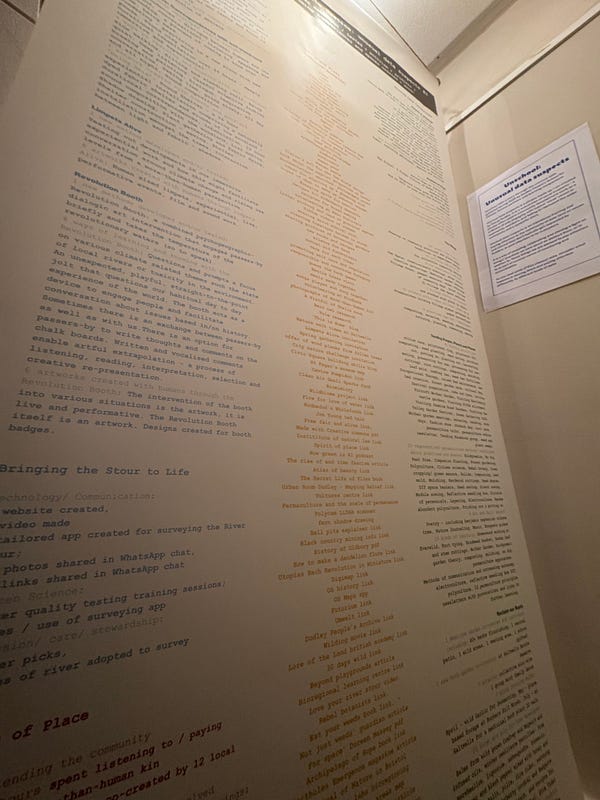

Unusual data counter map layers with unusual data on the left and usual data placed in contrast on the right hand side of each layer. Not to malign usual data but rather to illustrate how much more we can understand about our work and change if is pay attention differently.
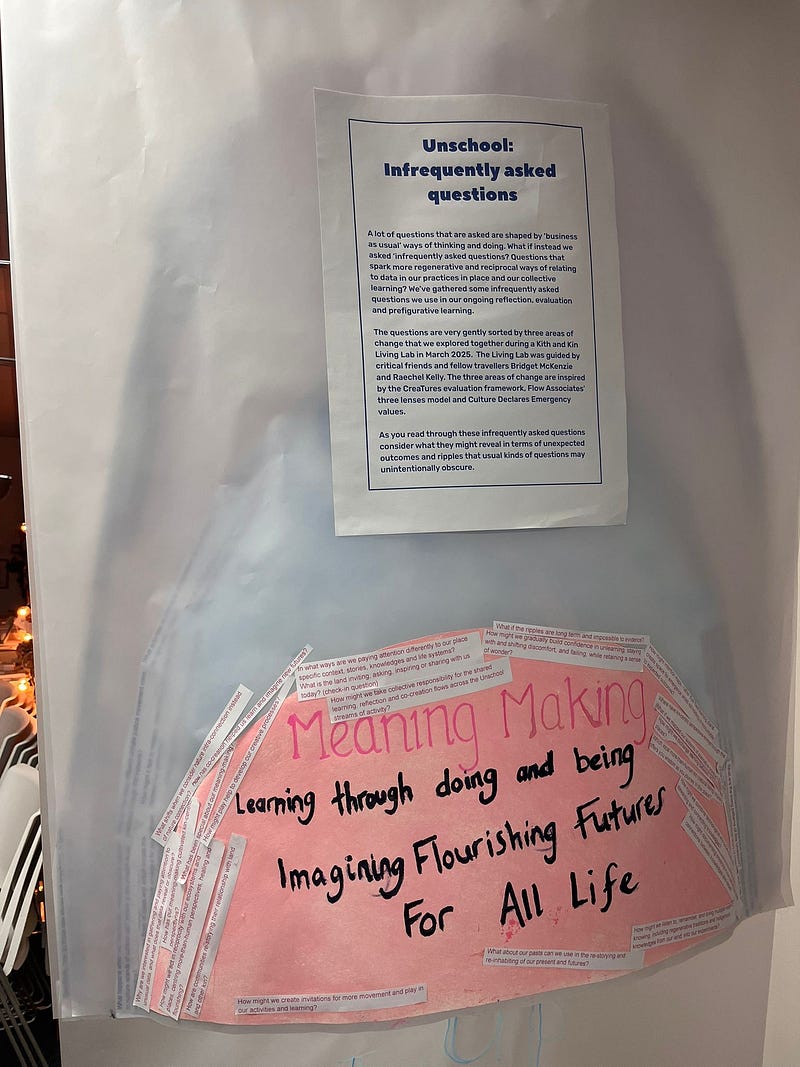
2. Infrequently asked questions
This layer of the counter-map traces infrequently asked questions our different practices and areas of work have sparked. It visually clusters them around a framing for gathering kin-centric stories of change that subvert life harming narratives. The questions are gently located on this map layer around zones of shifts in meaning-making that make change possible and necessary; ways of connecting and organising for that change; then rippling into actions for change and shifts in power.
This layer invites you to ask: What if … instead of asking questions shaped by business as usual impact metrics and capital shaped risk management, we asked ‘infrequently asked questions’* that spark more regenerative and reciprocal ways of relating to data in our practices in place and collective learning? We have shared some of the ‘infrequently asked questions’ we use to dig deeper into our ongoing reflection, evaluation and prefigurative learning practices in the Unschool. These are very gently sorted by three areas of change that we explored together during the Kith and Kin Living Lab in March 2025, where we were guided by critical friends and fellow travellers Bridget McKenzie and Raechel Kelly. These areas of change are inspired by the CreaTures evaluation framework, FLOW three lenses and Culture Declares Emergency values.
Invitation/ Navigation prompt: as you read through these infrequently asked questions perhaps consider what they might reveal in terms of unexpected outcomes and ripples that usual data may unintentionally obscure.
3. Unschool qualities
This counter-mapping layer takes a traditional table of information of unschool / school binary qualities we have observed over the last two years, and offers a more punk zine feel that draws connections between different words and unschool elements encouraging the map reader to move in non-linear ways around the table of data. During co-creation I had joked with Helen that she had taken my ‘totally tedious table’ and responded to it by bringing a more subversive, mycelial navigation and curiosity sparking aesthetic. There is also a pocket on this map layer which holds the unredacted ‘totally tedious table’ for those wanting to read this data in more typical form.
We are sharing these unschool qualities as part of a practice of working out loud as we journey together testing out how to cultivate more regenerative learning infrastructures. We have noticed lots of patterns in our Dudley People’s School for Climate Justice unschooling experiment, but the qualities below feel most common and consistent across the different projects and practices in place over the last two years. We share this in our counter-mapping to bring attention to the importance of processes and practices in this story, not just activities and outcomes. We are sharing with a BIG old caveat that we understand unschooling means responding to context and therefore not all these conditions will be appropriate in different places and moments of learning. We also acknowledge that defining these conditions in terms of binaries is not really a reflection of reality with there being lots of grey areas of practice in between the two positions used as needed to reveal potential in place. So we present the conditions / qualities below more as a simple way to show pathways and possibilities of co-evolution in our unschooling infrastructuring journey rather than fixed destinations.
“Learning has become synonymous with formal education, which is often entangled in flawed systems that perpetuate injustice. This has resulted in a distorted perception of the true power of learning. As we understand it, learning is inherently a liberating practice that often thrives beyond the confines of educational systems.” (Mohini Govender, 2024)
Invitation/ Navigation prompt: As you read this data layer of unschool qualities, imagine how creating the conditions for these qualities might ripple into your day to day learning and sense-making — in your own life and family, in your organisation and ways of working, or in your community? What might they make more possible? When you read the school practices on the right-hand side do you recognise these? Where do these show up in your thinking or ways of working? What might letting go of these typical practices look like ?

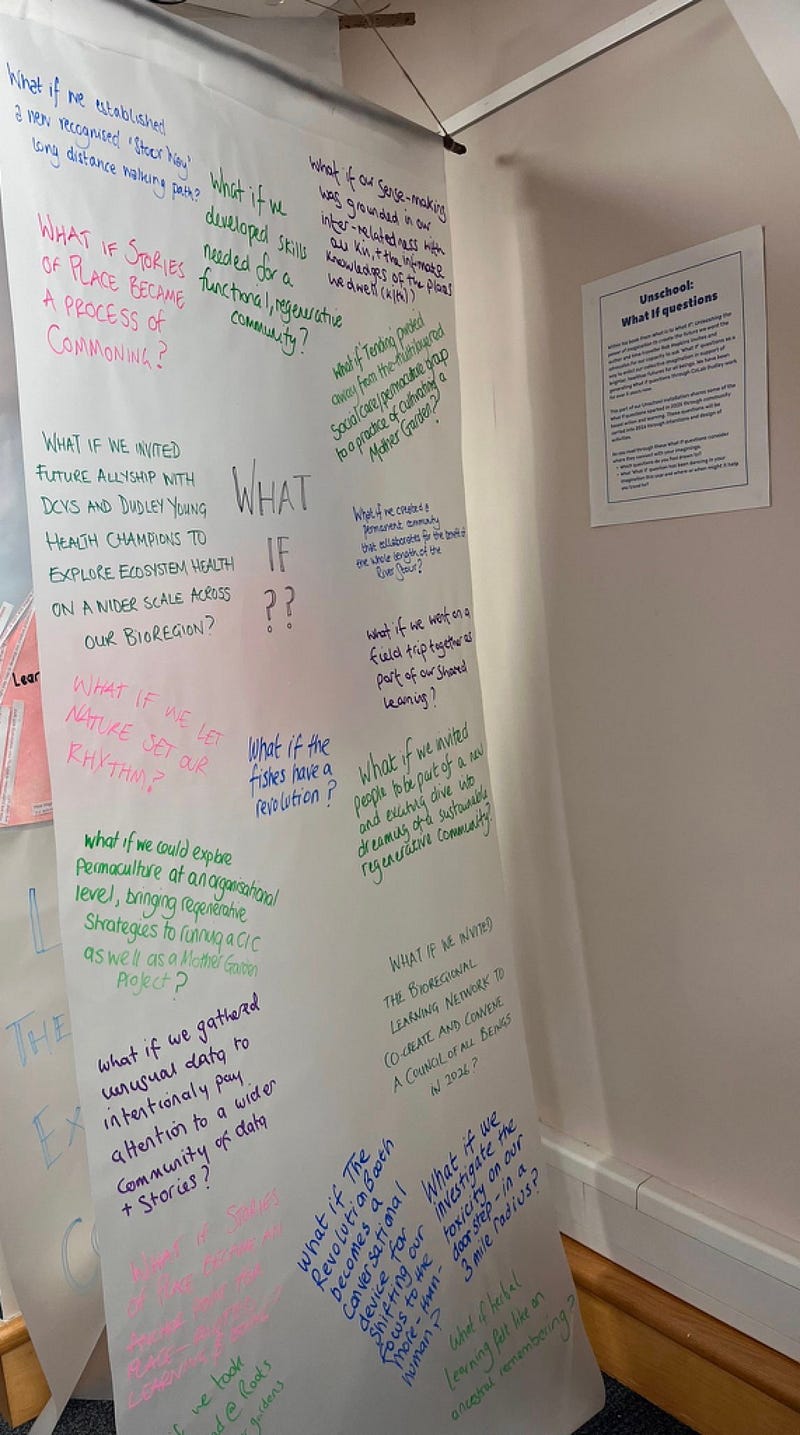
4. What If Questions
Questions that Dudley People’s School for Climate Justice partners are holding, sparked by 2025 learning-doing, as they move into Winter reflection and composting to inform Unschool intention maps for 2026.
What is a What If Question?
Within his book ‘From What is to What If’: Unleashing the power of imagination to create the future we want’ the author and time traveller Rob Hopkins invites and advocates for our capacity to ask ‘What If’ questions as a way to enlist our collective imagination in support of brighter, healthier futures for all beings
Invitation/ Navigation prompt: as you read through these What If questions consider where do they connect with your imaginings? Which questions do you feel drawn to? What ‘What If’ question has been dancing in your imagination this year and where or when might it help you travel to in 2026?
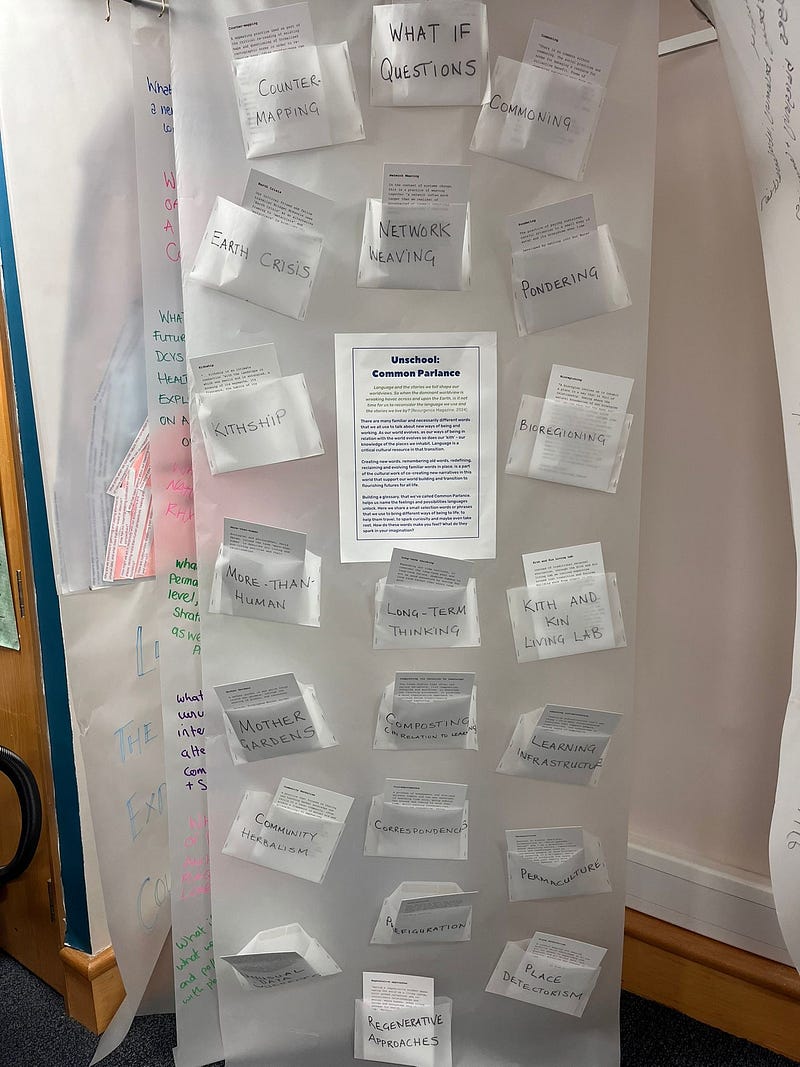
5. CommonParlance
A layer of our unschool counter mapping that tells the story of a small selection words or phrases we use to bring different ways of being to life, to help them travel, to spark curiosity and maybe even take root.
“Language and the stories we tell shape our worldviews. So when the dominant worldview is wreaking havoc across and upon the Earth, is it not time for us to reconsider the language we use and the stories we live by?” (Resurgence Magazine, 2024)
There are many familiar and necessarily different words that we all use to talk about new ways of being and working. As our world evolves, as our ways of being in relation with the world evolves so does our ‘kith’ — our knowledge of the places we inhabit. Language is a critical cultural resource in that transition. Creating new words, remembering old words, redefining, reclaiming and evolving familiar words in place, is a part of the cultural work of co-creating new narratives in this world that support our world building and transition to flourishing futures for all life. Building our glossary helps us name the feelings and possibilities languages unlock.
Invitation/ Navigation prompt: as you read through these words, they may be familiar or unfamiliar to you, how do they make you feel? What do they spark in your imagination? What words do you want to weave in? Where might these words and ideas take root in your life?
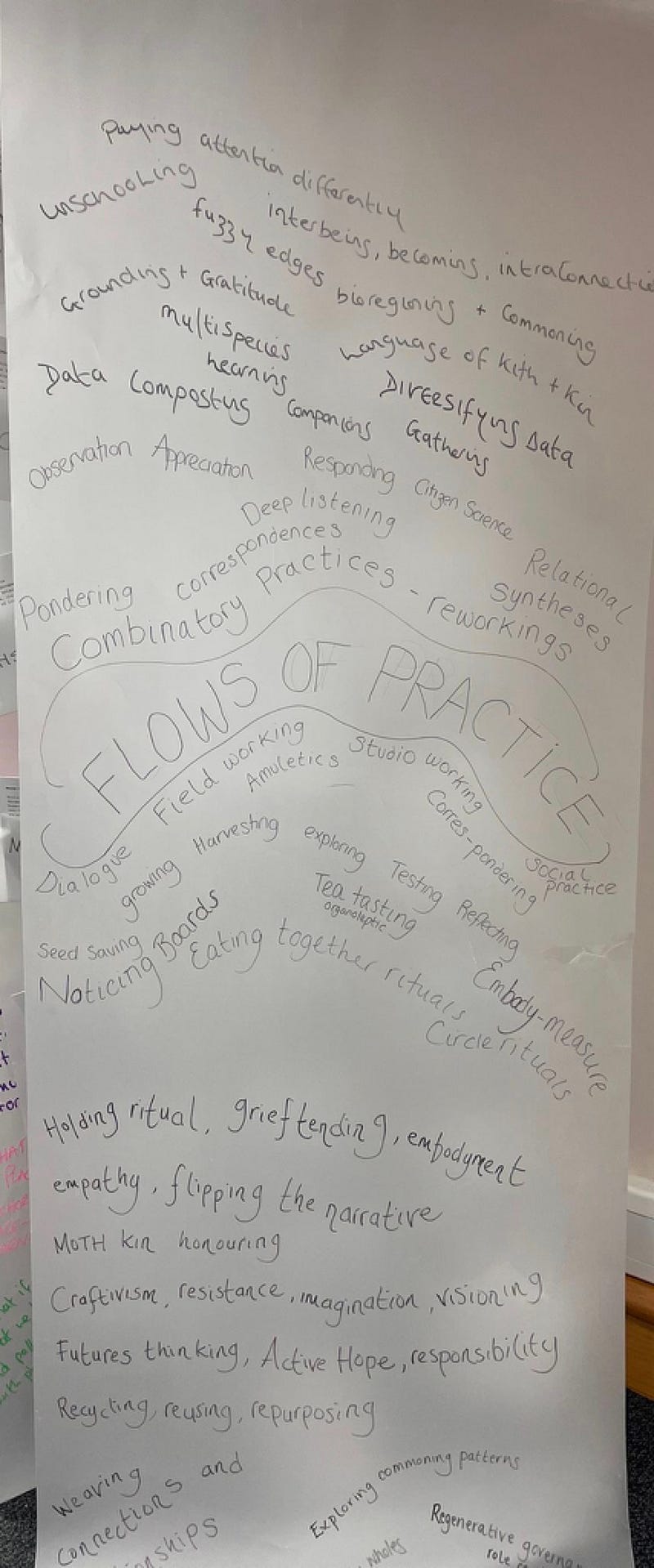
6. Flows of Practices
When knowledge or practice is siloed or enclosed for whatever reason it often becomes stagnant. Practices are at their most regenerative and reflective of context and moment, when they flow both with intentionality and through unexpected co-evolution. Paying attention to the liveness of practices in place is important to unschool work. Unschool partners reflected upon their year as collaborators with each other, our community of learning companions (human and more-than-human), and with place.
In this counter-mapping layer they shared these flows in relation to the prompts:
- What new practices have emerged for you?
- Where has your practice flowed (across the UnSchool, and beyond the UnSchool)?
- What practices have been gifted to you/your work by others?
7. Getting into Hot Water soundscape countermap
An invitation to listen to the field recordings and co-creations of water and other beings and objects. This immersive counter-cultural playlist is an invitation to explore local watery worlds while moving through the other layers of the counter-map.
So what have we discovered so far?
A counter-map can be many things.
It has unlimited thematic focus, its process of creation can vary enormously depending upon who/ what beings are involved including what medium or materials used. This diversity of applications, and postdisciplinary quality, invites a multitude of questions for spatial norms and how we might re-story our relationship with land, with place, with this bioregion. We sense their role in our gentle activism — to dare to tell an alternative story of place that surfaces the unspoken or intentionally obscured.
We have witnessed counter-maps as weavers of human and more-than-human kin through stories of interconnection of life and multi-species relations that are of course missing from say the Ordnance Survey map, Google Map, or A-Z street maps of this bioregion. We have celebrated counter-maps as an expression of care and love for particular places at a more micro level — offering insight into hyper local and often subjective kith knowledges and connections.
Perhaps their most radical capacity is as an act of democratising the processes of imagining alternative futures. These aren’t maps by city planners, politicians, architects or developers — these are everyday maps telling stories of place — past, present and future — that surface the lines of attachment or relationality that determine belonging or disconnection. When brought together they tell an altogether more holistic and multi-layered story of the many kinfolk woven into place.
“Whereas mainstream mapping depends on expert cartographers, Bioregional mapping is done by ordinary citizens who rediscover local places through their map-making explorations” [Brandon Letsinger, Cascadia Bioregon]
These are the maps we want to bring attention to in our work as a network re-storying our relationship with land. These maps and our peer learning about counter-mapping practices are a critical and vibrant beginning to our approach to bioregioning as we begin to name and feel our way into the territorial consciousness of our bioregion — with all its fuzzy porous edges!
It has been so joyful to see how powerful a convening call counter-mapping is. Counter-maps have shown themselves to be a chance to create and tell stories with place:
- through the micro locus of the maps such as a bus stop, a tree, a local park, a pond, or an internal emotional landscape;
- through the locally sourced bioregion materials used to co-create the maps such as clay, natural dyes, local plant inks;
- through communing with local kin — Watershed, River, Yarrow, Robin, Rose, Deer, Ivy, Clay seams, fossilised sea creatures, learning network peers — that spark the imagining or multi-species learning of alternative maps and ways of relating with place and kin;
- through the emergent and performative act of the counter-map ‘becoming’ and so evolving over time as new layers are added;
- now in installation in the lab as an invitation to be in conversation with a community of living data that spark, reveal, challenge, protest, animate and activate in their large scale impossible to ignore performative and interactive quality;
- also how this process of nurturing our counter-mapping practice in our very new Bioregion approach has been a story that friends in the field want to hear about and learn from for their own experimentation — counter-mapping it would seem is highly contagious!
As part of her counter-mapping learning huddle facilitation Laura created a prompt sheet that she has commoned for everyone, called How could counter-mapping alter how we inhabit and navigate the world? This feels like the perfect question for us to gently hold as we continue our counter-mapping journey in 2026 as we co-create counter-maps for our first ever Bioregion Bundle ‘Common/Place’, and test out digital counter-mapping of our newly rehearsed relational beings practice.
With much more to come with story-telling, print-making, folk-lore and Time Portals I am excited to see how this radically relational practice informs our bioregioning in 2026. We’ll share more soon …
Sources of counter-mapping inspiration
We are really grateful for the generous sharing of practice and wisdom by counter-mappers all over the globe. Here are links to just a few we are learning from in this journey.
https://decolonialatlas.wordpress.com/
https://notanatlas.org/
https://shop.grand-union.org.uk/product/lucy-reynolds-a-feminist-chorus-a-tender-map/
https://adventureuncovered.com/stories/meet-the-counter-cartographers-using-maps-as-a-tool-for-social-change/
https://ecampusontario.pressbooks.pub/spatialhumanities/chapter/counter-mapping/
https://mappingfutureimaginaries.com/home/