Diversifying data gathering to cultivate inhabitancy
An exploration of four practical strategies we use in our collective learning practice to diversify data gathering to cultivate inhabitancy. Inhabitancy and kithship; Diversifying data gathering and multi-species learning; Accountability to future generations; and Language and collective learning.

This lab note is part of a series offering a deeper dive into our co-evolving collective learning or how we learn together.
- The first note offers a summary of critical shifts in power, connection and accountability this way of collective learning cultivates.
- The second note offers a little bit more detail about “detectorism” as the foundation to our collective learning and why we learn like this.
- The following notes take a look at ‘What does disruption of business as usual project learning look like in practice?’ These mini lab notes cover nine different practical strategies we use to diversify evidence and value in our collective learning. They are grouped into four bundles for ease of exploration:
↗ Values led developmental evaluation
↗ Commoning knowledge, knowledge weaving and relational ethics
Diversifying data gathering to cultivate inhabitancy (this note)
↗ Decolonising our learning practices and the role of semi-permeable boundary holding
(Semi-permeable boundary holding in regenerative learning infrastructuring. Decolonising our learning practices.)
As we continue to explore themes of scaling deep, funding, and evaluation, one pattern keeps rising to the surface: the growing shift from traditional measurement toward collective learning — not just as a buzzword, but as a real, grounded practice that redistributes power and reorients how change happens. [Tatiana Fraser — The Sanctuary]
In this note we explore four practical strategies we use in our collective learning practice to diversify data gathering to cultivate inhabitancy. These are broken down into: Inhabitancy and kithship; Diversifying data gathering and multi-species learning; Accountability to future generations and Languages
Inhabitancy and kithship
A thread that runs through all of our collective learning is an intention to help nurture what David Orr calls ‘good inhabitance’. Contrasting inhabitance with what he describes as the temporary and often limited understanding of place by ‘residents’ Orr explains:
“The inhabitant … ‘dwells’ as Illich puts it in an intimate, organic and mutually nurturing relationship with a place.” [David Orr]
Regenerative design academic and practitioner Pamela Mang explains why this is a valuable line of collective inquiry for us in cultivating the potential of place and all their beings. She talks about the required shift from a ‘place-blind culture’ to regenerative cultures that enable ‘good inhabitance’.
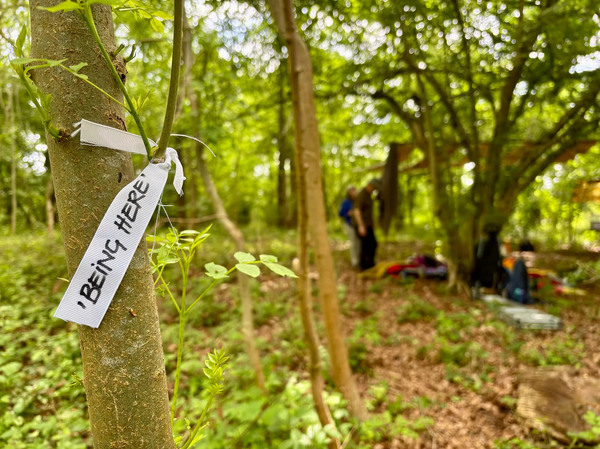
We see our collective learning — through careful sensing, observing, deep listening, and paying attention to place — as a type of pathway to coming into right relationship with place, of remembering and practicing inhabitancy:
“Humans, like all other species, are place-based creatures — shaping and shaped by the places we inhabit. Our diverse cultures are the products of our interactions with particular places. Cultures that sustain their vitality and viability have developed practices appropriate to their place, and rituals, moral systems, songs and stories that sustain those practices. Since the advent of the Industrial Age and its universal, place-blind culture, we are increasingly losing the ability to develop and maintain appropriate relations with place. We have, “fallen out of place” and are losing or have lost the once inherent capacity to understand and then establish right relationships, to put ourselves “back in place.” We are becoming what David Orr describes as residents rather than inhabitants. Where residency requires only cash and a map, an inhabitant “dwells . . . in an intimate, organic, and mutually nurturing relationship with a place. Good inhabitance is an art requiring detailed knowledge of a place, the capacity for observation, and a sense of care and rootedness.” Learning how to restore the value and the capability for inhabitancy is the creative challenge and opportunity. “ [Pamela Mang, 2005]
We have found the concepts of kithship and kinship useful in giving a vocabulary to this type of relationship to place that can otherwise feel alien in a world shaped by modernity’s tendency to move at disorientating speed, to fragment, to individualise, to disconnect and to other. Modernity generates in humans what Tyson Yunkaporta describes as a feeling of being ‘out of place and out of time’ and what David Orr calls “deplaced”. In contrast:
“… kithship is an intimate connection ‘with the landscape in which one dwells and is entangled, a knowing of its waymarks, its fragrance, the habits of its wildlings’. Unlike kinship, kithship is earned through being near, still, opening up and observing in our places, and crossing ‘dimensions of knowing’… Kithship enlivens and complexifies kinship, and it is essential if the fullness of kinship’s wisdom is to be lived.” [Lyanda Fern Lynn Haupt]
Good inhabitance and kithship are more than being place-based in our learning or contextualising our learning; it is an internal understanding and way of being that is felt more than any book learnt theoretical knowledge. Within our collective learning it is about an internal process that cultivates an intimate and felt knowledge of place and its beings. These practices encourage a foundation of care and reciprocity that shows up in the habit of vocal gratitude to plant friends during foraging (in Reclaiming our Roots), in the sense of wonder at more-than-human learning companion senses (in Stories of Place), or the deep noticing and listening to pond beings (in Pond Over Time), or the dialogue with a very specific wet woodland ecosystem (in Alder Coppice: Correspondences with wet woodland), or deep attention and observation of microclimates and soil (in Tending People, Place and Planet), or the reimagining and reanimating of land based myths (in Exploring the Edges), or remembering what it means ‘to river’ in a myriad of ways (in Bringing the Stour to Life). These kin-centric practices are often slow, embodied, lived learning or sensing processes that pay attention differently, cultivating kithship and in doing so forging deeper bonds of connection with kin and place. These bonds change us, deepen our sense of belonging, and expand the possibility of good inhabitance.
We see this deeply embodied and lived capability of inhabitance and kithship — developed in and with place by learning through doing — as a valuable foundation for community regenerative resilience*. Unlike previous interpretations of resilience that seemed wedded to an unjust status quo (i.e. bouncing back post disaster to business as usual), regenerative resilience is instead aligned to transformative change and nurturing the capabilities needed for transitioning from the precarity and injustice of Earth Crisis to a future framed by mutual flourishing.
We believe the shifts in perspectives, along with the eco-literacy and kin centric behaviours invited by good inhabitance and kithship, can help in that regenerative resilience journey.
We are grateful for the inspiration and wisdom from these knowledge elders:
- David Orr on Place and Pedagogy
- Lyanda Fern Lynn Haupt on kinship and kithship
- *CommonVision — Towards Regenerative Resilience
Diversifying data gathering and multi-species learning
“What this pattern highlights is a need to diversify, challenge, change the sorts of data we are collecting, the indicators we are using and the evidence we are building in the process of moving towards transformation.” [Good Shifts]
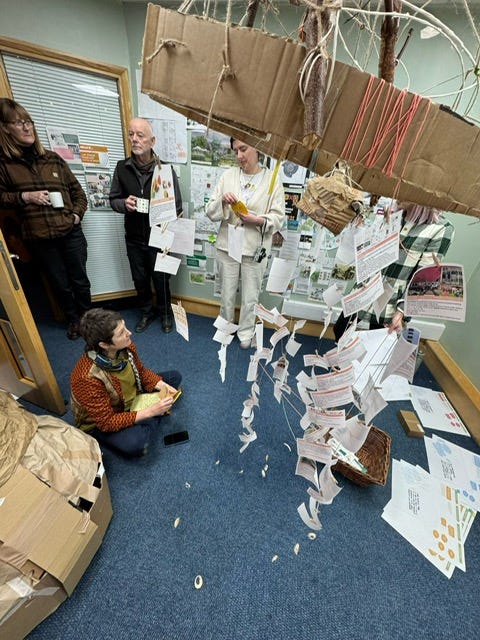
In January 2025 Dudley People’s School for Climate Justice partners started playing with and noticing ‘unusual data suspects’.
This is a tiny data pattern disruption that invites a shift in focus of attention, and makes more explicit what we value through a playful and more expansive data gathering and story-telling.
Unusual data suspects is a co-created phrase by CoLab Dudley that is a subversion of the phrase “usual suspects”. Usual suspects is a phrase often used in community development work as a criticism for only engaging with typical “vocal” community members, and failing to represent the wider community and a complete story.
‘Unusual data suspects’ is an intentional framing and paying attention to the community of data (and so voices/ stories) that don’t typically get requested by funders, or paid attention to by evaluators. It is a way of revealing, celebrating and shining a light on things/beings/ practices we care about as distinct from, or in addition to, those things we are advised to pay attention to as part of societal norms of monitoring and accountability.
The School partners embraced this invitation and so we began sharing …
numbers of poems inspired by foraged plant friends, songs sung witnessed by the gardens, fruits trees tended, hours pondering with pond beings, correspondences with the other-than-human, knowledge gifts exchanged, number of seeds of ideas for transition created, number of climate justice roles rehearsed, number of more-than-human kin learning companions, number of works inspired by rest of nature, numbers of herbal remedies made, number of litres of rainwater harvested, number of people composting for the first time, number of kilometres walked with canal and river, number of clothes exchanged and repurposed, number of new noticing methodologies being tested, number of stories told, number of knowledge lineages interwoven, number of counter-maps created, number of limpet structures formed …
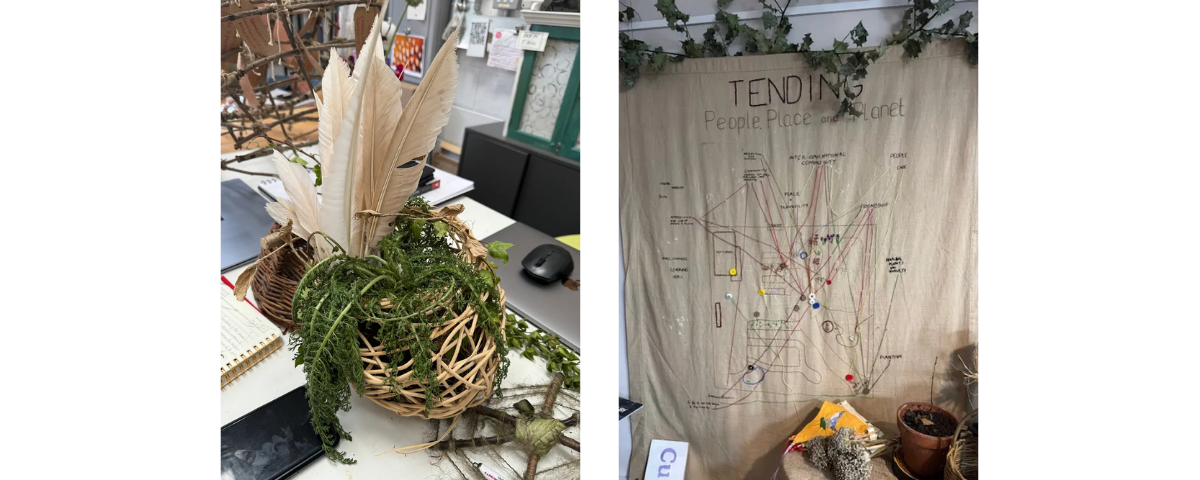
The list goes on and on in all its abundance, offering a much more expansive story of the work and the connections to place/ beings it weaves. As the year has progressed this practice has evolved, for example, Erika is leading the Tending People, Place and Planet community in collective data gathering of unusual data with a real focus upon the role of our more-than-human learning companions in permaculture practice.
It isn’t that we don’t collect more usual data — number of human participants and co-creators, different communities taking part/ co-creating, different organisations we collaborate with, number of activities, length of activities, budget lines, human participant quotes and case studies etc — it is just that we are determined to try to shift how we care for more unusual data and what that inspires, illuminates, provokes and helps us value and connect to differently.
For example, Helen (Workshop 24) responded to this unusual data gathering call by marrying it with ‘infrequently asked questions’. Both are part of a critical practice and intention of making the invisible visible in our data gathering and collective enquiries. It also feels like this is also part of how we engage in knowledge reciprocity and relational responsibility in our data gathering.
As part of our intention of ‘diversifying evidence and value’ we also have a deepening practice of weaving the wisdom of our more-than-human learning companions into our shared learning. This is a practical way of disrupting human exceptionalism, and naming our interdependence with all life. It is also a way of expressing gratitude and honouring the gifts they share as a reflective prompt which in turn reinforces our relations and cultivates kin-centric behaviours. Anab Jain reminds us of Anne Galloway’s perfectly timed What If question:
“What if we deny that human beings are exceptional? What if we stop speaking and listening only to ourselves? [Anne Galloway]
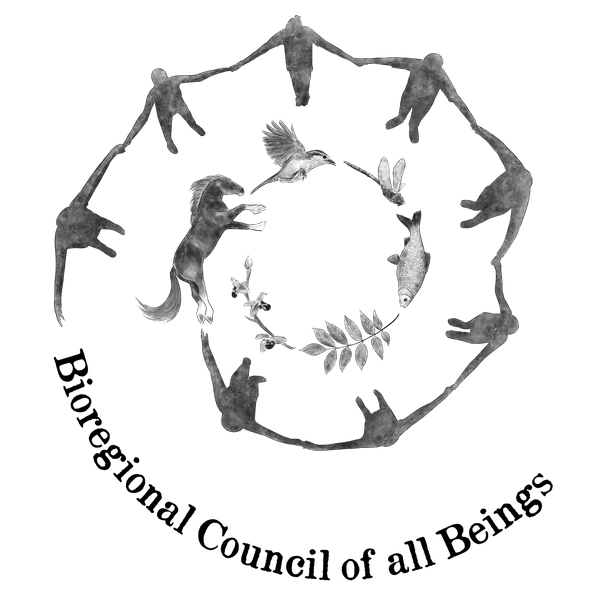
This multi-species focus is embraced in Place Detectorism within Stories of Place led by Holly (CoLab Dudley) which includes an embodied practice of sensing and sense-making in place with a more-than-human kin companion. This is a way of forging deeper connection to our more-than-human kin and opening up of new senses/ sensory interactions with place in our noticing. Similarly, this year in Exploring the Edges, Deb (Ekho Collective CIC) is convening a group of human and more-than-human learning companions to take part in the late Joanna Macy’s powerful practice “The Council of All Beings”. Here our sensing and noticing is once again centered around multi-species learning, interbeing empathy and more-than-human wisdom shared to support life-centred futures:
“And so we awaken today to a new kind of knowledge, a growing comprehension of our connectivity- and even identity- with everything in the universe.” [Joanna Macy]
Both these collective learning practices point us towards what Anab Jain refers to as a multi-species politics:
“By seeing the self not as an individual hero, but as one among many — human and non-human — a new kind of tentacular, multi-kind, multi-species politics of care might emerge. … A politics that gives us a new kind of relational agency to help us imagine alternatives for living with and through global warming. A politics which allows us to invent new practices of more-than-human care, humility, imagination, interdependence, resistance, revolt, repair, and mourning.” [Anab Jain]
Our varied practices of unusual data gathering invite multispecies learning and so a way to expand the relational circle (and cycles) of learning. Gathering and paying attention to unusual data — particularly using more-than-human sensing or representation exercises or ways of being — invites an understanding of interbeing with the rest of nature, and subverts the narrative of human exceptionalism. In their writing on these methods of sensing and sensitizing, Ann Light points to their critical role in our prefiguration of alternative more-than-human futures:
“Harnessing the power of feeling differently means offering experiences of connection through methods that step out of dominant accountability cultures and approach interdependent response-ability. For instance, being-with and becoming-with are qualities of a changed relationality that can perhaps be fostered through experiential means. In the range of more-than-human exercises, these may bring us closer to the worlds that we want to create, where feelings of care and interconnection lead. However, deployment has to remain context- sensitive. Capacities to suspend disbelief, experiment and play vary by culture: impacted by location, organization and role, as well as mood and experience. But, while not all techniques give access to a capacity to feel differently, perhaps all processes that speak to changed human-world relations with respect and humility — whether sensitizing or representing, imagining or informing –are part of a greater move to more-than-human futures that we can prefigure now.” [Ann Light]
Unusual data gathering offers an expansive re-storying of the projects, lifting up the complexity and interconnection of layers of experiences (intellectual, spiritual, emotional, physical, material, social, ecological, cultural), and inviting a more multispecies justice perspective.
This is a rejection of more reductive telling of the project around value for money, hours of delivery, direct anthropocentric benefit. Instead there is care for the design, the process, the rehearsal of ways of knowing, and being in community, and in right relationship with all kin. This is also about honouring the whole learning community by naming both human and more-than-human and so inviting whole living systems thinking, a holistic ethical practice, and subversion of extractive models of reporting authorship or contribution.
In concert with the democratising detectorism in the wild evolution, our multispecies learning and unusual data signals an intentional orientation in our collective learning towards a more radical pedagogy (bell hooks).
Specifically, within our collective learning: everyone is a learner and everyone is a teacher; learning is a relational process of co-creation, of reciprocity, of becoming, of critical consciousness, and of action for mutual flourishing for all life; ultimately the learning is a craft for “thickening relationality for and with the Earth” (Donna Harraway).
This approach to learning invites us to nurture a more relational ontology — learning from and honouring Indigenous knowledge systems and ways of learning in community and in place with all life (Laura Tynan, Lyla June Johnston, Tyson Yunkaporta).
We are grateful for the inspiration and wisdom from these knowledge elders
- Anab Jain’s field guide for More-than-Human politics
- Joanna Macy — The Work that Reconnects and Council of all Beings
- Lyla June Johnston on kinship and indigenous pedagogy
- Laura Tynan on relational ontology
- Ann Light’s paper: More-than-Human Participatory Approaches for Design: Method and Function in Making Relations
- Tyson Yunkaporta — Fire in the Belly
Accountability to future generations
While detectorism is a way of paying attention and noticing differently in order to build new relationships with place, how do you encourage its use in service of alternative futures?
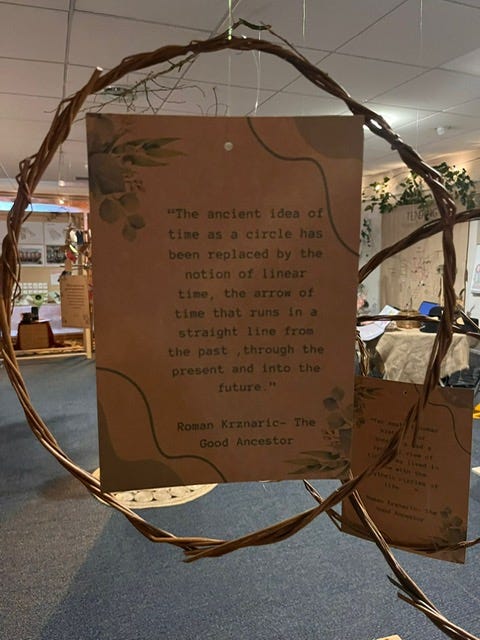
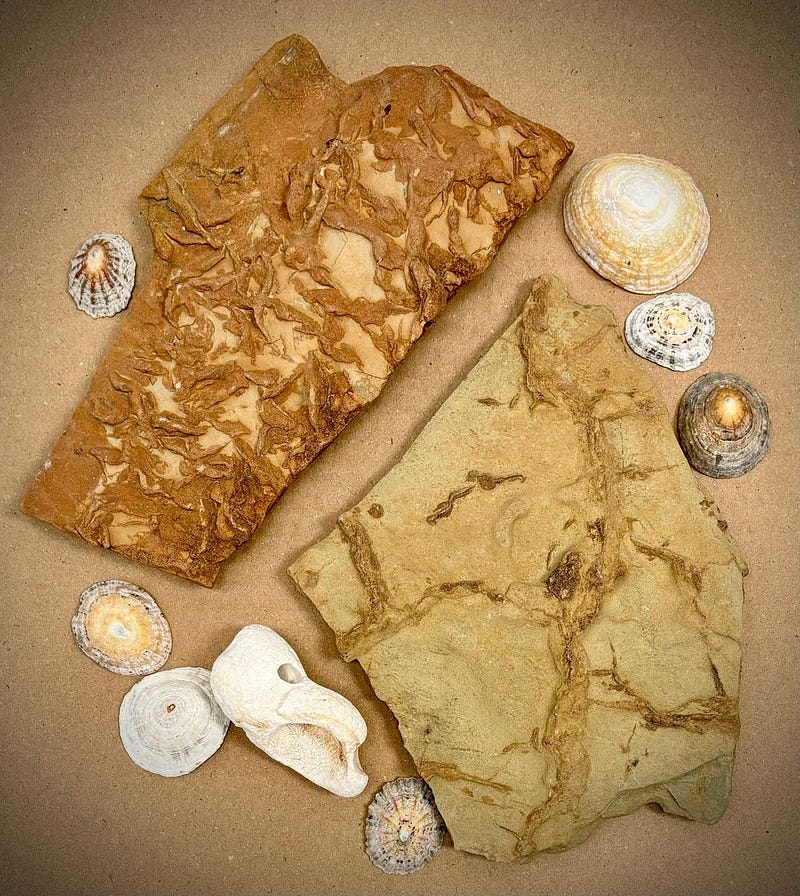
Left: A quote from Roman Kraznaric reminding us of the ancient idea of time as circle. Right: Helen (Workshop 24) lifted up the time based learning of more-than-human kin: “Fossilised waves from Orkney with limpet and hagstone companions — A suspended moment in time which will go on to erode/ reconstitute in different form. Passage of time. Water & flow.”
Since 2020, we have been inviting local people to join us on Time Rebel missions. We borrowed the term Time Rebel from Roman Krznaric whose inspirational book The Good Ancestor invites us to nurture six different ways of shifting from short term thinking to long term thinking in service of the wellbeing of future generations of humans and more-than-humans. He makes a call to action to join a growing group of Time Rebels — people all across the world — in all areas of life — using long term thinking to act in service of intergenerational justice. He reminds us that this is a practice integral to many Indigenous and traditional knowledge and governance systems. Long term thinking expands our circle of accountability to future generations of human and more-than-human whilst also drawing upon the wisdom of our ancestors.
Being a Time Rebel requires us to practice long-term thinking and challenge the degenerative dominance of short-termism in contemporary society.
Responding to this call to action, Dudley Time Rebels have been co-designing small creative experiments, with detectorism open learning woven in. These experiments cultivate long-term thinking by using a range of What If Questions - inspired by the imagination activism work of Rob Hopkins - that invite local communities to imagine better futures for future generations of humans and more-than-human kin in Dudley.
While we know long term thinking is needed to be a good ancestor, we also know it is really hard to practice in a world designed for short termism. Through our time rebellion we have realised that we need to explore new relationships with and ways of experiencing time if we are to begin to develop long-term thinking capabilities. So we have started a practice of breaking it down to just paying attention to the presence of time — a form of Time Detectorism if you like. To begin with we’ve been trying out just noticing how time shows up in our place. A bit like establishing baseline data. By noticing how it shows up currently and what behaviour that encourages we can imagine alternative manifestations of time that nudge long term thinking and action. You can read about this practice in our collective learning with fellow traveller Makespace Oxford.
As we repeat and extend this practice we begin to raise consciousness of our 21st Century degenerative relationship with time and its entanglement with modernity, extractive capitalism and over consumption. That consciousness invites us to consider how we might begin rehearsing different relationships with time invited by long-term thinking (Roman Kraznaric), time travel, (Rob Hopkins), and earth citizen timefulness (Marcia Bjornerud).
When we understand that modernity’s relationship with time — as an agent of power, control, efficiency, and production — is not fixed, then we can slow down and begin to imagine alternative ways of relating to time in order to develop the long-term thinking capacities needed to be good ancestors.
Similarly, time has become prominent in the second year of Dudley People’s School for Climate Justice with partners Bill, Helen, Holly and Deb exploring time through the concept of chronodiversity — the varying timing preferences or understandings of human and more-than-human beings. In addition, Deb and Holly are exploring the role of counter-mapping in this invitation to experience or consider time differently as a follow on invitation from the Council of all Beings. Further, with the co–design of the Dudley Time Portal led by community technologists Common Knowledge — a 100 year digital public archive is emerging.
The Time Portal is a form of long-term learning infrastructure intended to care for, and help steward place based knowledge (kith) so that it can be readily accessed and woven into understandings, organising and action for change by future generations.
We are grateful for the inspiration from these knowledge elders
- Roman Krznaric’s inspirational book The Good Ancestor
- Rob Hopkins’s book “From What Is to What If: Unleashing the Power of Imagination to Create the Future We Want” . We love that our convening of Dudley’s Time Rebellion is featured in his new book: How to Fall in Love with the Future : A Time Traveller’s Guide to Changing the World
- Marcia Bjornerud — Wrinkled Time — The Persistence of Past Worlds on Earth
Language and collective learning
We have loved how collective learning invites new words and languages to emerge and come into relationship as part of a wider practice of sensing and sense-making that is both liberating, but also enabling deeper collaboration.
“Language and the stories we tell shape our worldviews. So when the dominant worldview is wreaking havoc across and upon the Earth, is it not time for us to reconsider the language we use and the stories we live by?” [Resurgence Magazine, 2024]
As our world evolves, as our ways of being in relation with the world evolves so does our ‘kith’ — our knowledge of the places we inhabit. Language is a critical cultural resource in that transition.
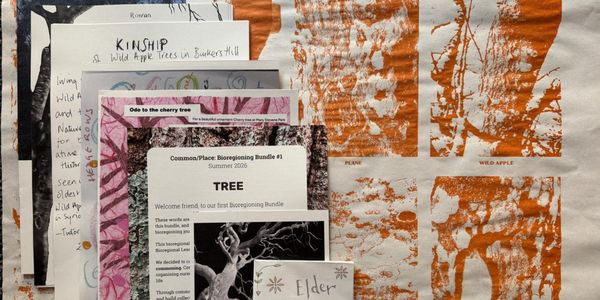
Creating new words, remembering old words, redefining, reclaiming and evolving familiar words in place, is a part of the cultural work of co-creating new narratives in this world that support our world building and transition to flourishing futures for all life. Building our glossary helps us name the possibilities languages unlock. The glossary will in time form part of an emerging project of commoned learning/knowledge bundles — shaped as a newsletter — called CommonPlace.
That said, we also know that modern English, its grammar, and the written word, often fail to convey the complexity or subtlety of connection or relationship with other kin (see the work of language stripes). For this reason, and through the playfulness of our detectorism framed collective learning we have always explored the storytelling power of new (made up!) words and other modalities of communicating. Our feeling is that ‘wordplay’ helps invite a stronger notion of interconnectedness with our planetary home.
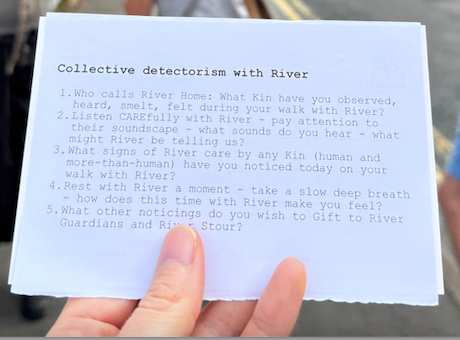
Robin Wall Kimmerer, in her seminal text Braiding Sweetgrass, invites us to consider the grammar of animacy common in many Indigenous languages as part of a way of being in right relationship with our more-than-human kin. This is often a way of ‘verbing’ our relationship to kin, rather than limiting them and our relationship to them, through a grammar that makes them a ‘thing’. Robert Macfarlane, in his beautiful book “Is the River Alive?” explains how verbing brings an aliveness to that being, for example, “to river” not “the river”. Inspired by Macfarlane’s words of aliveness, at our Summer Gathering on the River Stour, we invited river guardians to engage in ‘detectorism with river’, testing out a grammar of animacy in our prompts. This raised smiles, questions, provocations, confusion and resulted in lots of conversations about the grammar and how it felt alien for many. We are excited to keep testing this grammar in our collective learning to see what it might open up in our relationships with place.
In other areas of our work we have been embracing multimedia creative documentation, using different ways to document our experiences and learning that intentionally does not privilege the written word. As we try out these new ways of knowledge sharing — emerging through the sounds, materials, tastes, markings, words, symbols, notes, and movements — new ways of knowing and being come into relationship. Alongside these many languages we have prioritised the use of nature based metaphor (written and material) helping nudge us incrementally into closer interbeing with our more-than human kin. We will keep exploring language in its broadest sense, and stay alert to chances to reanimate, reimagine and reframe the words and other language modalities we relate through.
We are grateful for the inspiration and wisdom from these knowledge elders
- Robin Wall Kimmerer’s seminal text Braiding Sweetgrass
- Robert Macfarlane’s beautiful book “Is the River Alive?”