unschool qualities — noticings sparked by counter-mapping our journey in regenerative learning…
Paying attention to processes and practices of unschooling. Partner noticings from two years of rehearsal as Dudley People’s School for Climate Justice.

Unschool qualities: noticings sparked by counter-mapping our journey in regenerative learning infrastructure. Paying attention to processes and practices of unschooling — partner noticings from two years of rehearsal as Dudley People’s School for Climate Justice.
Learning has become synonymous with formal education, which is often entangled in flawed systems that perpetuate injustice. This has resulted in a distorted perception of the true power of learning. As we understand it, learning is inherently a liberating practice that often thrives beyond the confines of educational systems (Mohini Govender, 2024)
Unschooling supports a way of learning that is less institutional, less formulaic, less hierarchical, less head learning dominated, and less structured than traditional modes of learning. Dudley People’s School for Climate Justice was always intended as a form of experimental learning infrastructure that made it possible for anybody in Dudley Borough to learn together through reconnecting to nature and taking action for climate justice.
The intention was to rehearse and co-evolve the regenerative learning infrastructure patterns our Unschool partners had been nurturing — together and separately for years. We wrote about our foundational learning infrastructure patterns here. Two years into our infrastructuring together we have named what we see as Unschool qualities that are common across our work. These are the different elements of the work, or ways of working, that support more experimental, curiosity and context led learning that nurtures more life-centered perspectives. Perspectives that support mutual flourishing of all life.
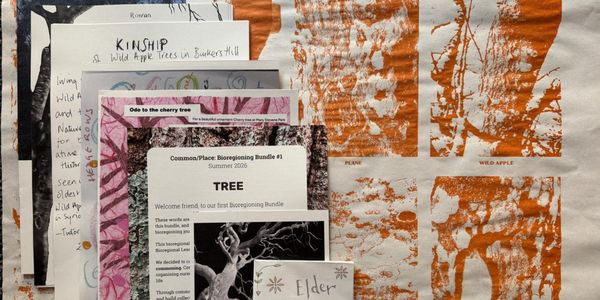
These noticings around what is it we do differently as an unschool to typical learning environments and practices was sparked by and formed one of the layers of Dudley People’s School for Climate Justice counter-map. In a floor to ceiling wall wide exhibition we gathered layers of our learnings, lessons and reflections on process, practice, change and of course our unusual data as an unschool in 2025. The counter-map formed part of a two month Active Hope exhibition at CoLab Dudley on the High Street — inspired by the work of the late Joanna Macy. You can read more about our peer learning journey with counter-mapping practices here.
This particular counter-mapping layer takes a traditional table of information of unschool / school binary qualities we have observed over the last two years, and offers a more punk zine feel that draws connections between different words and unschool elements encouraging the map reader to move in non-linear ways around the table of data. During co-creation I had joked with Helen that she had taken my ‘totally tedious table’ and responded to it by bringing a more subversive, mycelial navigation and curiosity sparking aesthetic. There is also a pocket on this map layer which holds the unredacted ‘totally tedious table’ for those wanting to read this data in more typical form.
The copy from that table is shared below. No doubt there will be more patterns to add to this list by the end of the year and dollops of humility and active iteration as some patterns unravel — that is the joy of experimenting and working out loud!
We are sharing these unschool qualities below as part of a practice of working out loud as we journey together testing out how to cultivate more regenerative learning infrastructures.
We have noticed lots of patterns in our Dudley People’s School for Climate Justice unschooling experiment, but the qualities below feel most common and consistent across the different projects and practices in place over the last two years. We shared this in our counter-mapping to bring attention to the importance of processes and practices in this story, not just activities and outcomes.
We are sharing with a BIG old caveat that we understand unschooling means responding to context and therefore not all these conditions will be appropriate in different places and moments of learning.
We also acknowledge that defining these conditions in terms of binaries is not really a reflection of reality. In truth there are lots of grey areas of practice in between the two positions that are used as needed to reveal potential in place. So we present the conditions / qualities below more as a simple way to show pathways and possibilities of co-evolution in our unschooling infrastructuring journey rather than fixed destinations.
Invitation: As you read this data layer of unschool qualities, imagine how creating the conditions for these qualities might ripple into your day to day learning and sense-making — in your own life and family, in your organisation and ways of working, or in your community.
- What might they make more possible?
- When you read the more typical practices under the letting go heading do you recognise these?
- Where do these show up in your thinking or ways of working?
- What might letting go of these typical practices look like/ feel like?
Embracing/ creating conditions for unschooling
Multiplicity of learning — The network learning moments are multifaceted and pluralistic in nature and form. They embrace a multitude of methods, mediums, co-learner perspectives, and convening spaces or moments. Importantly, learning multiplicity brings different ways of knowing and knowledge types into relationship. This invites us to be curious, use all our senses and make use of multiple ways of paying attention. Paying attention differently includes multi-sensory, often embodied creative and layered noticings across different zones of possibility (inner and outer change).
Letting go of typical schooling practices
Static and singular — Traditional learning infrastructure typically relies upon one or two ways of learning and single knowledge type (often lecture, head centered, book/ written word led). This way of learning can be passive, uni-directional and is often bounded or static in form and content. It signals to us that there is a single authoritative source and form of knowledge. It leaves us unquestioning and strips us of the chance to practice different ways of paying attention to our world.
Embracing/ creating conditions for unschooling
Peer learning and commoning knowledge — “where everyone is a teacher and everyone a learner”. There is no hierarchy of unschool members, only learning companions, knowledge exchange, cross pollination and co-evolution of understanding. This is an intentional act of democratising learning infrastructure and commoning shared wisdom. Peerness is a way of being in the world, not just a way of learning together. It is rooted in equity, and solidarity. Our collective and peer shaped learning is intended to disrupt hierarchies of types of knowledge and sites of knowledge production. It draws on a long heritage of peer learning as a process of liberation, cultural change and social transformation (e.g. bell hooks, Paulo Freire). The unschool peer learning informs and is informed by everyday activism and action for climate justice. Action and change takes place through internal shifts in perspectives and imagining for kincentric futures; through nurturing new ways of connecting and organising for resilience and care; and through cultivating new skills, roles, and agency in taking action. We honour labour in our knowledge commoning by citing learning companions and knowledge lineages as part of efforts to rewire a legacy narrative of single hero solutioneering that limits our capacity for peerness.
Letting go of typical schooling practices
Hierarchical and individual — Specifically a teacher/learner hierarchy where learners gather to receive information from teachers. There is limited exchange of knowledge and the knowledge is static, not organically evolving. A hierarchical learning system is competitive by nature and reinforces unhealthy power dynamics that we then take into the world. These dynamics are amplified and rewarded by a dominant hero narrative that ignores shared learning from peers and elders past, present and future.
Embracing/ creating conditions for unschooling
Kith and Kin learning — This way of learning is relational, slow, centered upon care and reciprocity and so emerges through coming into right relationship with other human and more-than-human kin over time. It centers upon sharing place based knowledges or ‘kith’ and knowledge bonds across generations that in turn nurture deeper kinship with the rest of nature. Kith and kin centered learning pays attention to pathways to re-inhabitance through repair and regeneration of living systems. Critically, how we share this knowledge is framed as collective and interconnected multi-species story-telling.
Letting go of typical schooling practices
Human exceptionalism — anthropocentric ways of seeing the world that prioritise human Western scientific knowledge, with limited consideration of ancestral, indigenous and more-than-human wisdom. This form of School learning reinforces a hierarchy of knowledge, and risks undermining or even erasing other forms of knowledge and ways of knowing. This form of learning is driven by student employability within a consumer capitalism shaped economic model.
Embracing/ creating conditions for unschooling
Flows and entanglement — our unschool has tested out ways of intentionally encouraging flows across project lines, places, practices, concepts and communities. This form of ecologically inspired emergent ‘curriculum’ has de-siloed learning content, and creative learning through doing. Through noticing connections and possibilities of co-creation and co-evolution, alongside a practice of active knowledge weaving in our local networks, we have explored a more post-disciplinary and fluid learning approach. These flows and entanglements create space to make living systems, rhythms, and patterns more visible. We are aware this way of working requires conditions for more open and relational ways of learning together.
Letting go of typical schooling practices
Fixed and inflexible — traditional curriculum subject silos can be artificially fracturing and disconnecting in their way of presenting the world and how it works. This has ripples for our capacity to understand systems thinking and the interconnected quality of life systems and our relationship with the rest of nature. The rigidity of both subject silos and the ways learning interacts limits cross-pollination and co-evolution of knowledges. The default is a reductive static lens not a holistic emergent lens.
Embracing/ creating conditions for unschooling
Natural rhythms and rituals of learning — we have tested an alternative seasonal rhythm of learning — for the most part reflection and composting our learning over Winter, co-developing new learning activity in Spring and then bringing full energy to that learning activity throughout Summer and Autumn. This isn’t fixed or universal across the unschool, but the instinct to pay attention to rhythms and rituals of learning manifests throughout as a way of making visible, socialising and sharing learning more widely. It brings the learning closer to a way of sensing context and responding to place.
Letting go of typical schooling practices
Artificial rhythms and rituals of learning — traditional Schools also have rhythms and rituals of learning like any system, however, these are often less seasonally or place aligned, and instead framed by a universal bureaucratic focus of student progression, institutional monitoring, school league tables and examination.
Embracing/ creating conditions for unschooling
Collective and futures consciousness — Our learning together is orientated to long term thinking, life affirming imaginaries, and spaces to practice alternative ways of being. This is where learning offers a way to ask good questions, and create new stories about different futures that subvert dominant Business as Usual narratives and reimagine the degenerative systems they support. This futures focussed way of learning together brings attention to ‘time’ in many forms: to deep time, to the wisdom passed down by our ancestors, and the understanding of our collective responsibility to imagine and co-create alternative futures into being for future generations of ALL life.
Letting go of typical schooling practices
Stuck in the me and now — traditional learning infrastructure, designed for Victorian England, was intended to create unquestioning and productive workers to drive an extractive industrial economy. Its’ focus was learning that supported unlimited growth in the present at any cost to the majority of human and non-human life. It pays little attention to how this system of education and understanding the world actively colonises the future by doubling down upon human dominion over the rest of nature, commitment to mass consumption and material extraction; whilst ignoring forever waste/ pollutants and living systems collapse. There is very little accountability to future generations at a multi-species and whole planet scale. The focus is on individual gain in the present. This way of learning embeds the false story of separation.
Postscript
Perhaps it is useful to finish this lab note by siting of unschooling and other regenerative learning infrastructuring within a way of being that invites us to ask and live questions together in order to collectively explore and rehearse alternative futures. This is wonderfully expressed here by regenerative practitioner and teacher Daniel Christian Wahl:
The first step is to be aware of what we are activating in the world by the power of our attention and the story we propagate through our thoughts, words and actions. When we reach out to our communities (families, neighbourhoods, colleagues and friends) and invite them to live the questions together, we are inviting multiple perspectives and diverse ways of knowing to inform our cooperation in the co-creation of regenerative cultures. This kind of open exchange and inquiry can facilitate the emergence of collective intelligence and future consciousness to inform wise actions in the face of increasing complexity and in humble recognition of the limits of our own knowing. You too can become a conscious activist, change agent and bridge builder by starting such an inquiry in your community. (Daniel Christian Wahl, 2017)