Co-creating Dudley People’s School for Climate Justice
A Lab Note on the progress of an idea to a funded demonstrator over 14 months.

A Lab Note on the progress of an idea in September 2022 to a funded demonstrator being led by a multidisciplinary team of 8 collaborators in December 2023.
In Dudley our most vulnerable communities are at high risk from climate change. We also have natural habitats listed as high risk from climate change.
Dudley People’s School for Climate Justice is a collaboration between CoLab Dudley, Workshop 24 and Ekho Collective CIC. It will generate opportunities for over 500 local people of all ages to increase thier connection with nature, get curious, and take climate action together.
18 months ago members of the CoLab Dudley team started thinking about ways to build on nature-based activities and curiosity about alternative futures that we had seen emerging through experiments developed among our collective of Time Rebels. Such as the More-Than-Human High Street experiment developed by Workshop 24. Ideas for regenerative futures generated by Birmingham City University architecture and design students we’ve worked with. Ways that nature does and doesn’t appear through Stories of Place explorations on Dudley High Street. And an interest among Creart Collective CIC community members to explore permaculture design and land connection among migrant communities.
Generating ideas (September 2022)
In September 2022 lab team member Holly Doron convened nine Time Rebels, those who had been leading the above work. It’s fascinating diving back into our Miro board from the time of these conversations. Below is how we were feeling the first time we came together around this, captured during our check-in (check-ins are a CoLab Dudley ritual).
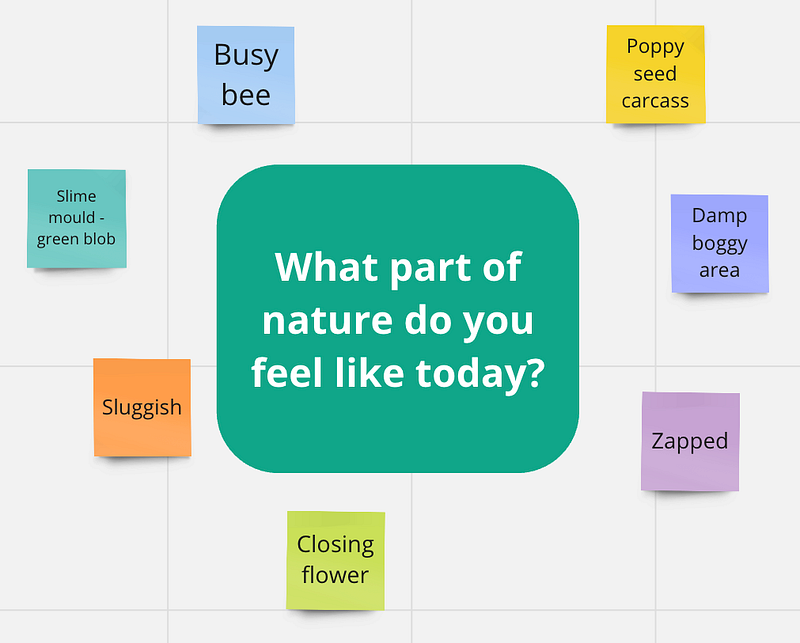
Despite our tired or distracted feelings, we soon shifted into some creative ideas generation, seeded by research Holly had done around initiatives previously funded by National Lottery Community Fund, which she shared in a helpful way on a Miro board. Together we looked at the kinds of projects supported through the Lottery’s Climate Action Fund nature and climate programme. We used key themes from these, such as using nature to address growing climate problems, and using creative approaches to engage communities with climate and nature as a springboard to generate some ideas for Dudley.

Helen Garbett from Workshop 24 noted:
We think that any project should be rooted in place and specific to our area and how it is and might be affected by climate change. We have found that of all the climate risks to the West Midlands, water and its management is highest on the list. This includes both a shortage and excess of water.
We read in West Midlands Combined Authority research that in Dudley our most vulnerable communities are at high risk from climate change. We also have natural habitats listed as being at high risk and very high risk from climate change.
Lab team member Jo Orchard-Webb wondered in relation to climate action by communities might we lean into the common patterns around the liberatory power of new narratives we keep observing in learning and doing on Dudley High Street and beyond, led by Time Rebels. She noted:
Given how narrative has been prominent in our learning and doing I am wondering is there something in the shift in control that is possible if you shift the meta narrative that in turn enables the shift in the scale of ambition of reimagining the civic purpose of the High Street? If we continue to work for and within the narratives, logic, norms, language, technologies that created this crisis we are still feeding it/within its control/our work is evaluated by it (or co-opted by it as we have already seen). There is something in the ways this can be disrupted using alternative tools to embrace a different narrative and alternative destination for the High St.
Patterns in relation to this I want to lift up that I have observed:
- Disorder (Sennett & Sendra) — happenchance, serendipitea, alchemy
- Inefficiency (Hill) — slow, pause/dwell space, sense, connect
- Incompleteness (Sennett & Sendra) in terms of who: distributed agency to shape (from individual purpose to collective purpose — Izora); and what: acknowledgement of human & more-than-human entanglement (Tim Ingold) — shift from narrative of separation to narrative of interbeing Daniel Christian Wahl; and in terms of time: ongoing non-static, long-term timefulness — Marcia Bjornerud, Roman Krznaric)
- Non-linearity — open to change, opportunities, resilience, adaptive, iterative.
- Journey and destination (Quinn Patton) — focus upon process; the how not just the what.
These are qualities observed at edges/borders/ liminal spaces; speculative spaces/places of possibilities” (science fiction — Octavia Butler)
Converging on an idea for a proposal (September 2022)
Through our conversations, we saw an opportunity for hundreds of people across Dudley borough to share their ideas, skills and knowledge to respond to the climate crisis and reimagine the structures and systems which created the climate crisis and the inequalities which people face every day. We kept circling around the idea of linking learning and action.
Helen encouraged us to consider the diversity of our disciplines and approaches and what it could mean to connect and combine them. Holly asked whether we might be able to group a number of smaller projects in one larger proposal.
We soon converged on an idea to initiate a community-led School for Climate Justice (thanks to Jo Orchard-Webb for seeding this framing) in which everyone is a teacher, and everyone is a learner. Using nature’s guidebook, place-based peer learning could lead to action for people, planet and the future.
To be clear, we are all interested in climate justice; which means we see the climate crisis as a social and political problem, as well as an environmental one. We are concerned that different communities locally and globally feel the effects of the climate crisis differently. Thus any people we support to take climate action would be encouraged to bring this critical lens. We would do this in a multitude of ways, drawing on a diversity of knowledges.
Initial application development (October — December 2022)
We submitted a 3000 word initial application to the Lottery’s Climate Action Fund on 20 December 2022, responding to the questions:
- What’s your proposed project idea?
- How will your partnership work?
- How does your project help communities to take climate action?
Full application development (February 2023)
On 31 January we were invited to develop a full proposal, which we turned around in a month so that it could go to a decision making panel in June. It outlined our vision and long-term goals, where and how activities would take place, how we would put communities first and how we would reach more people. It also responded to questions about how we would work in partnership, how we would measure and evaluate the project, and how we would learn and share what we learned.
We determined that changes we hoped to see over three years among 500 or more people we would involve include:
- People increasing their nature connectedness, which is associated to wellbeing.
- People developing their abilities to learn with and from each other.
- Locally relevant and practical climate and ecological knowledge spreading across the borough.
- More people building relationships, getting involved and feeling able to take climate action with others.
- More people organising projects, leading community activities, making imaginative new uses of resources around us, and designing actions is ways which support flourishing of all life.
During spring and summer 2023 we shared a printed summary of our proposal with Time Rebels, collaborators, colleagues and people we met who were interested in the idea. We were finding it to be an engaging proposition, and we enjoyed sharing our thinking even when we didn’t know if we’d secure this particular funding.

Deferred funding decision (June 2023)
We heard in June that the Climate Action Fund Panel had deferred a decision on our application. They had a number of questions for us, we think because our ways of working and approach to use of the funding is quite different to other projects they have supported. Their questions were primarily around reach, inclusion, evaluation and impact/outcomes/legacy.
We shared historical data and projections on our reach, our approach to inclusion and examples of who has participated in our work.
As those familiar with our work will likely be aware, CoLab Dudley uses a Principles-Focused Evaluation approach, which evolved as a type of Developmental Evaluation.
Developmental Evaluation supports innovation development to guide adaptation to emergent and dynamic realities in complex environments. Innovations can take the form of new projects, programs, products, organizational changes, policy reforms, and system interventions. A complex system is characterized by a large number of interacting and interdependent elements in which there is no central control. Patterns of change emerge from rapid, real time interactions that generate learning, evolution, and development — if one is paying attention and knows how to observe and capture the important and emergent patterns. Complex environments for social interventions and innovations are those in which what to do to solve problems is uncertain and key stakeholders are in conflict about how to proceed.
~ Michael Quinn Patton (2010), Developmental Evaluation: Applying Complexity Concepts to Enhance Innovation and Use
We are among the first in the UK to use Principles-Focused Evaluation, which, like all Developmental Evaluation approaches, is much more effective when an evaluation role is held by the team doing the work.
The Climate Action Fund Panel had asked: “will internal evaluation be sufficient to ensure the project is truly impactful?” We appreciated that as a funder the National Lottery Community Fund was seeking a traditional evaluation approach. We believe it could be possible to design a more traditional evaluation to complement and enhance our Developmental Evaluation approach. We agreed to seek external evaluators who could be critical friends, and signpost and connect us to wider networks and knowledge.
In order to communicate more tangibly some of the outcomes we expected, we turned to one of the inspiration points for our idea; Dudley’s peer to peer Doughnut Economics Learning Journey. This was part of an amazing expansion of neighbourhood level work with Doughnut Economics led by our fellow travellers CIVIC SQUARE. Holly and I invited Sue and Sal from Dudley’s learning cohort to meet and share what impact our peer learning had resulted in one year on from our experiments to ‘take the ideas off the page’. We looked at these from just a single group of 8 learners, and asked: what if 100 local people of 300 we expected to engage through Dudley People’s School for Climate Justice took similar actions? The following is what Holly Doron drew together to illustrate some tangible outcomes in relation to water, biodiversity, food, transport and energy, waste and wider systems.


Funding decision (August 2023)
On 23 August 2023 we heard the great news that we were being awarded £578,000 for this work. We are matching this to a total of £750,000 with funding we will bring in over the next three years and current investment in CoLab Dudley’s work on Emerging Futures from Joseph Rowntree Foundation, along with CoLab Dudley activity supported by funding from Arts Council England and Reaching Communities.
Changes in our partnership (October 2023)
Next came some detailed work on our partnership, which led to some difficult decisions and changes to our plans.
Partly due to changes in leadership in Creart Collective CIC, there was no longer a person bringing the passion and curiosity around permaculture design to this collaborative work. Following some challenging head and heart work among all of us, Creart Collective CIC decided to hand the part of the project they had developed (Growing Land Connections) on to Ekho Collective CIC. Ekho had also been developing work on connection to land with people historically removed from land by colonisation. This exploratory work, Reclaiming our Roots was supported by CoLab Dudley, as a Time Rebel project in 2023 among a number which formed our Dudley Creates strategy in action, funded by Arts Council England.
We remain deeply grateful for the ideas, time, and care that Marlene Fortes and Ailine Pereira brought to the development of this work. All partners involved in Dudley People’s School for Climate Justice will continue to work with interested Creart community members through this work.
Getting to know each other as a new partnership (November — December 2023)
We found ourselves in a group of eight collaborators about to embark on a three year journey together without all knowing each other, but bound in relationships of trust and respect through each other. So we took some time in November and December 2023 to connect around our work, our practices, qualities and skills, and some hands on making. We met in Workshop 24’s studio at the Ruskin Glass Centre in Amblecote, home to Helen’s Limpetarium.


Our first two sessions together were thoughtfully designed and very gently held by Helen from Workshop 24, who invited us to consider Dudley People’s School for Climate Justice as an assemblage. A coming together of us, what we’ve done previously, the places we work, the people who join us, the land, the water, the weather, the funding, the funders…

We now describe Dudley People’s School for Climate Justice as an assemblage of community-led projects. (This circles back to Holly’s early pondering on whether we might combine many projects in one funding proposal).
The task of turning imaginative ideas into lived realities invariably involves assemblies that combine multiple things into a useful form rather than just extrapolation from a single idea… what changes the world in the end is the generative ideas, not the detailed blueprints.
~ Geoff Mulgan (2022), Another World is Possible, How to Reignite Social and Political Imagination
The projects make it easier for people to learn from each other and connect with nature. Everyone is a teacher, and everyone is a learner. Using nature’s guidebook, place-based peer learning will lead to action for people, planet and the future. It will see neighbours, artists, learners, designers, tea makers, tinkerers, researchers, crafters, gardeners, quiet activists and more to learning together, connecting with nature and taking climate action.
The team of us behind Dudley People’s School for Climate Justice have backgrounds in social art, therapy, community work, architecture, research, education, and health and wellbeing. We will be learning with and from each other, and are combining our practices and knowledges to create a diversity of activities across the School, to appeal to a wide range of people.


Our ‘Mother Tree’ projects (January 2024 — December 2026)
Just as forests have Mother Trees which connect and communicate with the other trees and plants in the forest, sharing nutrients and information, so we see elements of the Dudley People’s School for Climate Justice assemblage as Mother Trees. We anticipate that Getting Into Hot Water, Growing Land Connections, and Stories of Place activities and will generate all kinds of offerings and resources which people across Dudley borough connecting with nature and taking climate action might choose to make use of. Below each of our Mother Tree projects is outlined; each will evolve over the life of this work.
Getting Into Hot Water, led by Workshop 24
Helen Garbett and Bill Laybourne, artists from Workshop 24, based in Amblecote, are inviting people to explore water and climate in Dudley. Getting Into Hot Water is a social art project that aims to question the habitual ways by which we know water, stimulate dialogue regarding our relationship with water, engender a sense of curiosity and wonder, and create a change in ourselves and water locally. People will go on water walks and field trips, and spend time observing a pond in Stourbridge. A series of workshops will invite different kinds of creative explorations around water.

Growing Land Connections, led by Ekho Collective CIC
Ekho Collective CIC, based at Hawbush Community Gardens in Brierley Hill are leading activity around land connection. Monthly Reclaiming Our Roots sessions will involve a group of local residents engaging with seasonal cycles and getting to know our plant companions, weaving connections between art, community and nature. Exploring the Edges will see groups of people marginalised by mainstream structures exploring urban places, edges and boundaries as provocations for curiosity, co-coreation and climate conversations. Alongside this, Tending Place, People and Planet will bring a further group together weekly for a year long exploration of permaculture principles, cultivating eco-conscious living and community resilience.

Stories of Place, led by CoLab Dudley team member and architect Holly Doron
Stories of Place is a space to imagine, be inspired, and take collective action with collective support. It is a safe space for people to test and evolve ideas together that bring us closer to Dudley, nature, climate action, and flourishing futures. Monthly sessions invite nature inspired observation, sensing and connection activities in Dudley town centre, and connection with stories and artefacts from Dudley’s past, present and future and co-create flourishing futures. We will work with community technologists to grow and share an open, living archive of ideas and stories to help inform community led climate action.

Other ways to experience the School
I will be supporting people from neighbourhoods, groups, schools and colleges to become Climate Changemakers, hosting groups embarking on nature connection and climate action activities. Through this we aim to support over 40 more learning journeys around many and varied topics over three years.
A programme of free exhibitions, performances, film screenings and seasonal celebrations, and a School Library tailored to local learning enquiries will enhance learning opportunities and inspire even more local people to take climate action.
We’re borrowing ideas from and building on the knowledge of our friends at Planet Cheltenham, CIVIC SQUARE, Huddlecraft, Doughnut Economics Action Lab, and many more amazing future builders out there.
Many more lab notes will follow. Please get in touch if you’d like to contribute to Dudley People’s School for Climate Justice in any way.
My email address is: Lorna@dudleycvs.org.uk