Why GeoPoetry? Why now?
When the data failed, the geologists turned to poetry. Poetry is all encompassing, and we need new compasses to navigate ways out of the human-centric World conspiring around us.

What a poem does
First and foremost, poetry is all encompassing, and we need new compasses to navigate ways out of the human-centric World conspiring around us. The poem darts from one aspect to the next, through themes, time, relationship, places, spirit and the cosmos. A poem weaves it all into one small read. It doesn't matter if the poem is about one specific perspective or moment, it uses what the literal moment isn't, it de-objectifies whatever the subject is, revealing patterns between themes and seemingly random imagery; what ripples in a literary Pond isn't specifically a Stone in the Water, that pattern is in a ricocheting sound, or fumes rising off cars in a traffic jam in a heatwave, or an old argument without solution coming back again between two lovers with no resolve, or the lines in Rock formations and how they compare to the widening circles in a sawn Ash limb. Poems are maps of their own, small islands of symbiotic moments, which time-travel, witness, honour and lay claim to our lives as humans; interpreting, translating and relating with the more-than-human-world through animism, metaphor and simile.
the reason I write poetry is, I think, because I'm trying to juggle or navigate several ideas all at once, and there's something about the form of a poem that allows me to do that without completely collapsing.
GeoPoetry is then a concentration of this, with Land, Gaia, Earth, Mountain, and (for me anyway) all that comes from the Rock of the Land. We could step into ecopoetry, but I like to lean into Oliver Dawson's argument that all poetics must ultimately be considered as GeoPoetics.
Why GeoPoetry? Why now?
Fire arrives on our doorstep — Stourbridge, Portway Hill, Wren's Nest, the Dudley wildfires. At this moment in time, the current prime minister of the UK has increased funding to firefighters, and put a ban on disposable BBQs. It's reactive, ignorant to the causes, and gaslights us into self blame. Our call to arms is to ban BBQs while pushing for further drilling in the North Sea. In the Observer on Sunday 16th August, page two is an advertisement for spatchcock chicken from Waitrose with the title 'Beach Days, BBQ Haze' — and a few pages on, a piece on firefighters who didn't have the resources to fight the Fires of tinderblock Britain.
While reactive news articles, and history books record wars, politics and societal shifts, poetry preserves what humans felt throughout. In his MasterClass on reading and writing poetry, the former U.S. Poet Laureate Billy Collins opens by stating that;
"poetry is the only history we have of the human heart."
Poetry is romantic and sensorial. It chronicles our love and heartache with eachother. The 'iambic' pentameter is a ten foot or ten beat line. It can be six beats, or twelve, but the number isn't important here. The length of a line of poetry represents the ordinary length of a sentence in speech, and the ordinary length of breath. The beats within the poem synch with the feet when walking. The poetry line is natural rhythm, walking and breathing on the Earth.
But I take this even further. If poetry is the only historian of the human heart, then GeoPoetry is writing towards the first occurrence of rhythm; a beating planet, from the core of the Earth, the beating planet itself pulses through our own hearts and onto the page. This makes sense to me because I find poetry leaves you with a feeling that makes sense to you in its failure to word what doesn't have language. It's the pattern of words that create the validating feeling, and I read a lot of poetry, and have made a lifestyle from it, to admit to you here poetry fails in expressing what cannot be expressed — what I'm really trying to say is the pattern of poetry replicates the patterns of wild Nature and our travels with them, and in doing so holds and shapes feeling for our connection to each other and the wilder world.
If you trace poetry back to its oldest roots, the underlying core emotions remain identical to what we experience today: the fear of death, loneliness, adventure, unrequited love, gratitude. Because these emotional frequencies do not change, reading poetry creates an instant bridge of companionship across generations.
In my own work
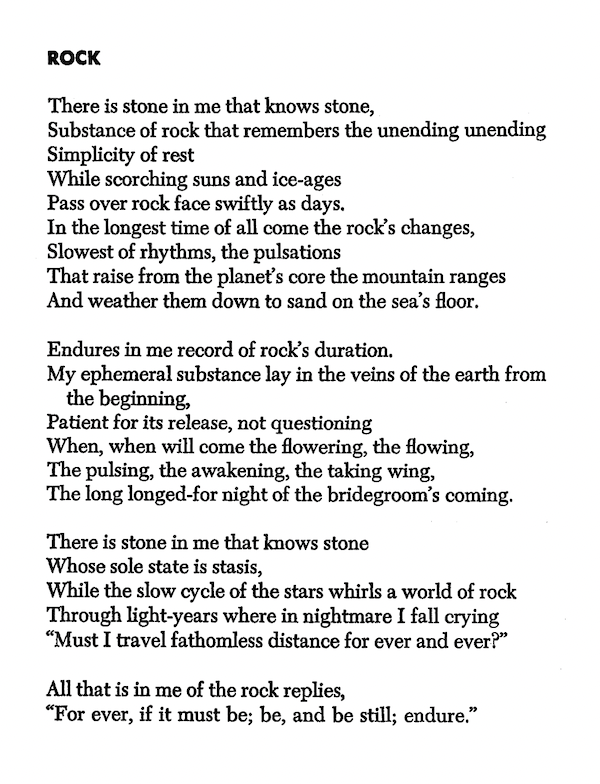
Kathleen Raine's "Rock" has been a companion of my poetry practice, travelling with me like a pebble in my pocket. In the poetry therapy circles I run, this poem invites thinking of oneself as another being through example. We ask ourselves which Weather, Season, Plant, Animal, and Element can best represent our emotional, internal landscape without getting into individual trauma stories; we fast gain a sense of a person's wellbeing seeing them identify as Nature. This tool has long served me. Dropping into rehab programmes, and community projects on a short-term basis means I don't have the privilege of long term relationship development, where mutual trust evolves and emotions are safe to feel. Poetry gets to what can't be said very quickly, and facilitates connections both together as a group and individually. We see our feelings and internal worlds through outer landscapes. Nature gives us a language for ourselves. Raine's poem offers a way into remembering our connection through a palm-sized story of origin; GeoPoetry, and as we borrow identification from Rock, or another life-form other-than-human, we witness how we feel, which is door then to feeling what we feel, rather than running from and numbing them.
This Summer (2026), I've worked at Midlands Metropolitan University Hospital as poet in residence, witnessing and listening to patients' stories. What I hear about, again and again, is loss of industry, loneliness, loss of family connection and community purpose because of changes in how we work with the land. Poetry has offered respite here. And the process of writing has provided a geological history of the place through listening and writing poems on the people, and how and where they were raised.
I've recently drafted a manuscript for my next collection of poetry, which is a dance in ancestry, Land, and what we're losing. Roma is about my adoptive grandmother. Care, working-class womanhood, relationship, language and place are the themes I enjoy the most when reading poetry, and in this collection I am challenging lineage by exploring how identity is shaped through care rather than bloodline. The poems centre on Roma's caregiving and the family dynamics of holidays spent at a caravan site in a former Quarry in Exeter. The Quarry holds it all — memory, refuge, relationship — and its post-industrial history sits behind everything.
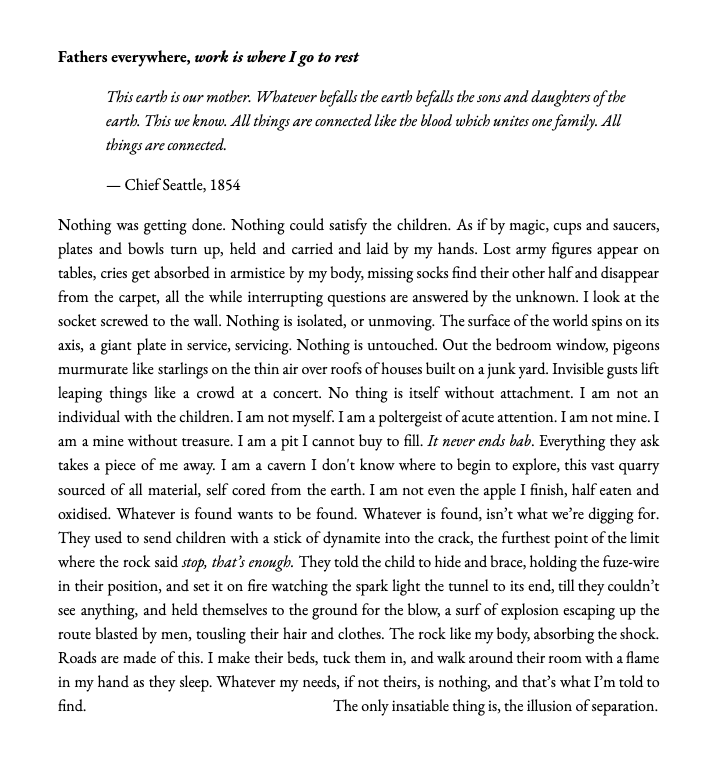
Here is one poem from the collection, showing how my time living in Dudley, the deep time travel on a day trip on the Canal and River Trust into the Mountains beneath Wren's Nest, holidaying in a Quarry as a child with my grandparents, and the culture of motherhood along with the homonym mine create an understanding of myself and my relationship with my children. My environment shapes and gives meaning to my experience: GeoPoetry.
This GeoPoetry residency has emerged from the Understory. What I had started to do was witness and make sense of the conversations taking place between organisations in post industrial towns, working in communities and civic systems to explore counter mapping as a creative way to deconstruct complex thinking, generate active hope, and wake up to climate change. I found the conversations and relationships difficult to get to grips with, and have found poetry to be the communion and sense maker of this work; I use wild Nature as the metaphor connecting the dots and patterns of humans attempting to integrate an ancient way of being as an emerging practice to strengthen communities and deepen their relationship to the places they live. (I will share these as my residency continues over the coming months to give you a deeper sense of my practice with Understory.)
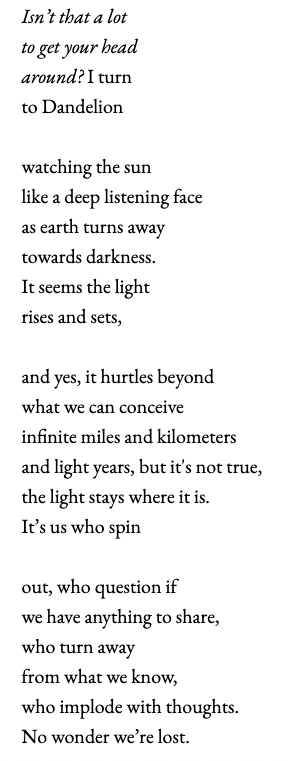
Another segment from the poem Dandelion, uses local dialect and the history of horses set to work and abandoned post industry (eventually going mad from the mined minerals and dust in the grass they ate) as a way to understand human impact, land use, and relational loss with Nature.
We're as mad as those tethered oss's
of the lost Black Country
rounding them up in preference
for manicured patches of grass.
Becoming indigenous to place
Most humans we know, as well as ourselves, live from a template of life handed to them by the system, culture or people they find themselves in. The environment is their mould, and when detached from the Land, what role does the Land have in shaping us? This is where GeoPoetry could assist in our reconnection. We are given a 'starter pack' for life to choose from, an identity formed for human-centric need and good. We do not know how to tend the Land we walk on. Becoming indigenous to place is the act, the active hope GeoPoetry can assist us in ascertaining.
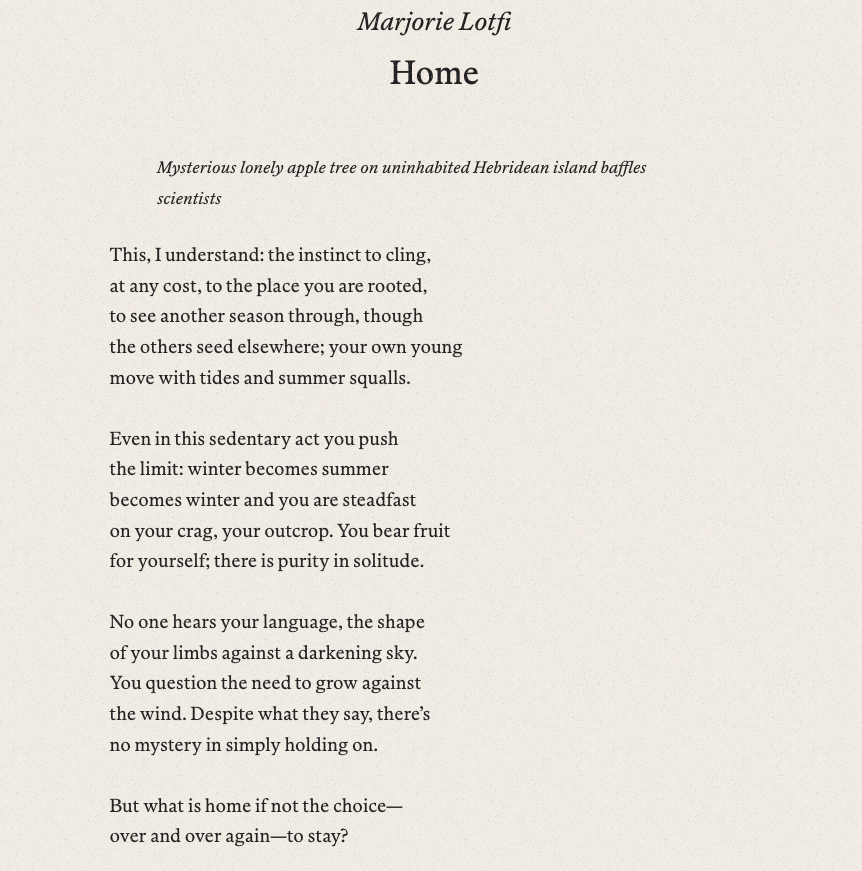
Marjorie Lotfi's "Home," written after a lone Apple Tree was found on an uninhabited Hebridean island, presents us with a way of being lived by the Apple Tree, personifying this being and anthropomorphising a sense of understanding of staying rooted to the Earth in order to have a sense of belonging. It closes on the question of what home is if not the choice, made over and over again, to stay.
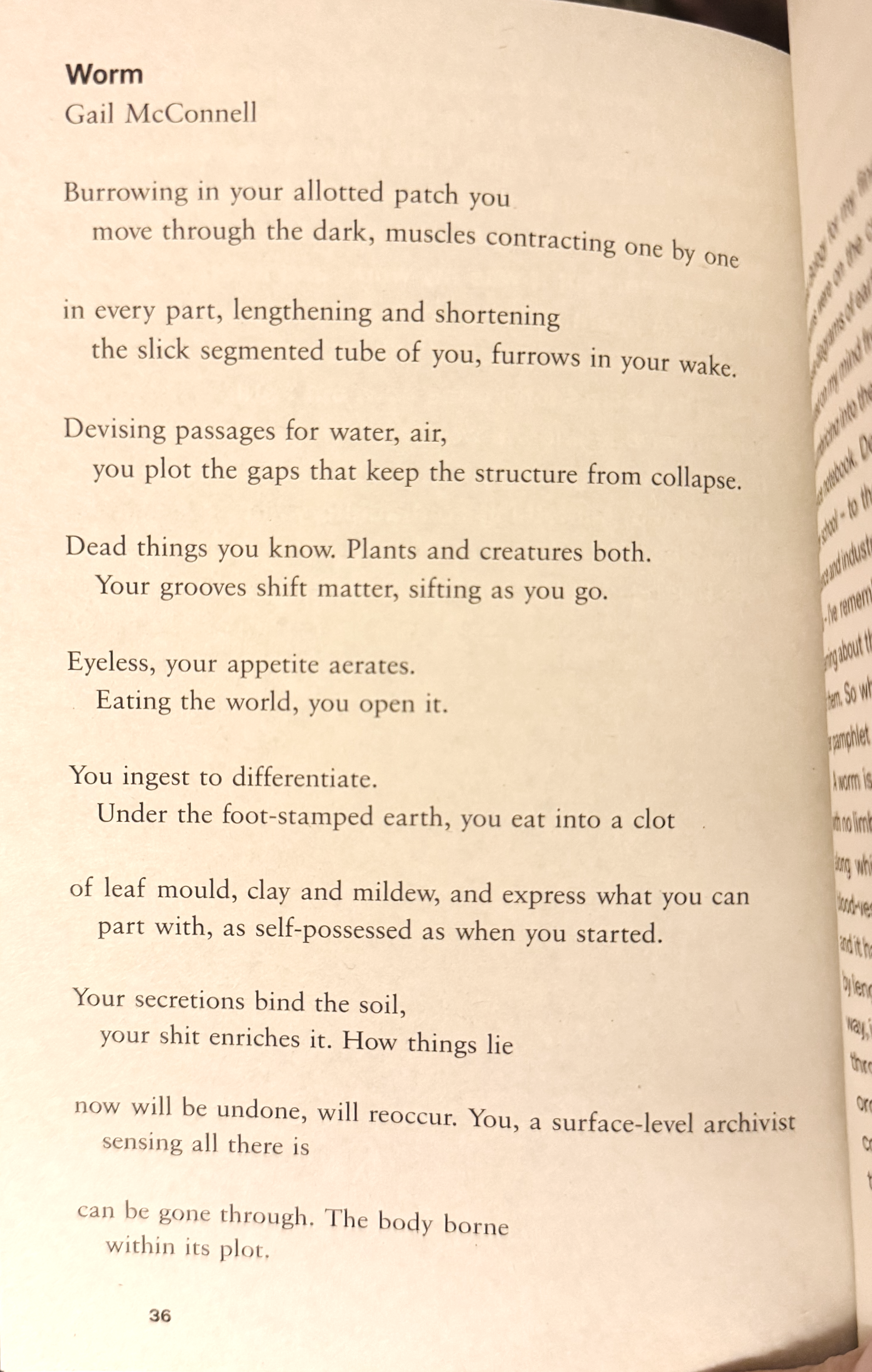
Recently I unearthed the Worm's own starter pack, in the form of the poem Worm by Gail McConnell, to assist in the design of a Compost Party for Understory with Jo. Composting supports us all in practising Understory as a relational and reciprocal way of engaging in collective research, rather than approaching the research with a new project framing. We know we aren't starting from scratch; Understory is an extension and co-evolution of our respective relational, weaving and imagination practices. The poem (well, the Worm witnessed through the poem) became a GeoPoetry guide for the curation of a compost party.
Another reason for GeoPoetry then, is to prescribe poems on the more than human, geology and geography included, to support this vital and urgent work.
What if we gathered learning from our everyday actions and gifted them to the Soil where anyone can access them, layered those gifts with learning from other places and ways of being and knowing, spent time with them together, letting them sit and decay, and shared the process along with the nutrition-rich castings and tunnels that nurture and connect learning and action with other places?
Jo Orchard-Web
Geo, and Poiesis
So that's the practice. Here's where the words come from. When I went looking for the origin of GeoPoetry as a phrase and practice, I found more than one answer.
Poesy is an archaic word for the craft of poetry, used from the 14th century. It derives from the ancient Greek word for poetry, poiesis, meaning "the act of creation or making," and was commonly used to describe verse even up to the early 20th century.
If geography means Earth-writing, GeoPoetics can be interpreted as world-making. It is fundamentally about creativity. As Mairi McFadyen puts it, GeoPoetics begins with a 'radical critical analysis' of the 'cultural mindscape' we find ourselves in today, and argues for the plural need to amend the excessive damage the environment, human consciousness, and being are experiencing as a consequence of this 'loss of world.'
First use of the word GeoPoetry is given to the American geologist Harry Hammond Hess. In the absence of hard data, he made an imaginative leap, envisioning molten Magma oozing up from the Earth's mantle along mid-ocean ridges, creating new Seafloor that spreads laterally and eventually sinks back into deep ocean trenches. Within a few years, researchers verified Hess's "GeoPoetry" through the discovery of symmetrical magnetic stripes on the ocean floor, and it laid the foundational framework for modern plate tectonics. At the time there wasn't enough data-driven evidence to prove the theory, and "the term GeoPoetry allowed for expression of imagination in the lack of hard data." He was not writing poetry, but poetry accessed an imaginative spirit in sense making geo-Rock-Land behaviour. I think he was remembering from his own deep ancestry to mineral Rock through witnessing, and the imaginative leap was a moment of revelation.
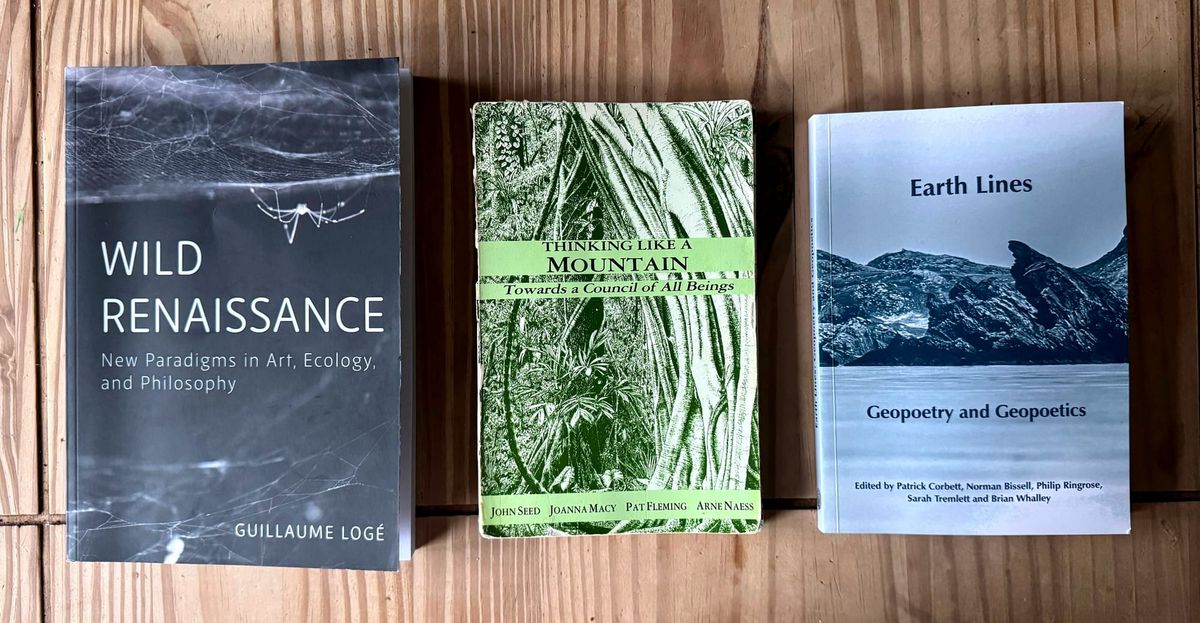
Guillaume Logé, writing on the Renaissance in Wild Renaissance, describes a moment when the sciences alone could not do everything, when there existed another form of revelation that originated in another source of language.
Poetry became a vehicle for philosophy and for descriptions of Nature.
The use of verse, a form more obscure than prose, verse in its formation, sought to penetrate mystery. Both the form and the contents of poetic language served to bring thought closer to the sensation of the Oneness of things. That penetration of mystery is the same imaginative leap Hess made, five centuries apart, and for the same reason: the data on its own could not hold it.
Norman Bissell gave a very clear definition at the GeoPoetry 2020 meeting, held online in the year of the pandemic as a follow-up to a Geological Society gathering in 2011:
Geopoetry regards geology as crucial to our understanding of the Earth and expresses place and geoscience in poetry. Geopoetics involves a response to the Earth in poetry and also its expression in the visual arts, music, oral and written work of various kinds.
Geopoetics places the Earth at the centre of human experience and involves a heightened awareness of it and its creative expression in a variety of arts, sciences, thinking and combinations of these. It is a trans-disciplinary method and outlook which seeks to develop a sense of world and build an international movement to bring about radical cultural renewal.
One is more Rock-centred and the other more people-centred, and I find I am working across both of them at once; the Rock of the Land, and the people whose lives were shaped by what was underneath it.
Kenneth White, influenced by the geology he encountered walking the Devonian Old Red Sandstone shorelines, founded the International Institute of GeoPoetics in 1989. He conceived the geo of GeoPoetics as bringing together not geology with poetics, but geography with poetics. When asked about the links between physical and human geography, he said GeoPoetics goes beyond those separate categories, "entering areas beyond humanism and has something to say to all disciplines."
Here I am drawn to share R.M. Francis's naming, in his essay "Ancestral Genius Loci: GeoPoetics and Place-Identity." Writing on GeoPoetics and place-identity, he opens with Kenneth White's line from a 2019 keynote:
they know their address, they don't know where they are.
Francis writes that the blinkers of business-as-usual everydayness turn our sight away from our local and wider geographies; I would add that it drives our Waters into a Canal; that we are somnambulists (people who do things while asleep); and that GeoPoetry cries for "re-awakening and re-finding of place, space and the Earth." The GeoPoet "goes in search of the lost ancestral genius loci" — the primal foothold and foundation Stone, the Rocks and minerals that give rise to the cultures that precede them. To seek spirit, in other words, and the loss of it.
Oliver Dawson, whose PhD work approaches poetry as an encounter with impersonal forces, argues that GeoPoetics should be less attached to commenting on and responding to preconceived problems, and should instead be a way of thinking with the Earth. Once poetry is a commentary, he says, it is a representation and confirmation of existing thoughts and ideas, the realities of what we already know. And when data isn't enough, poetry cannot just be data, it has to traverse over the Mountains, through the valleys, caves and ridges and untangle what we know with a clear image of our wild terrains.
And I would extend this. I believe that poetry is a meditation with the subject. It provides deep witnessing of wild Nature, our actions, and our travels through them, creating an internal dialogue that discovers patterns of past and present, allowing us to initiate active hopeful change. This is where my work as a GeoPoet was identified. When I called on a natural phenomenon to hold the complex thinking of organisations, it simplified the actions and relationships taking place.
Which reminds me of these passages and comments on language and poetry, which I use in my writing circles to prove the importance of poetry to alchemise our struggles into beauty and meaning. George Eliot:
"The poets have told us of a dolorous enchanted forest in the under world. The thorn-bushes there, and the thick-barked stems, have human histories hidden in them; the power of unuttered cries dwells in the passionless-seeming branches, and the red warm blood is darkly feeding the quivering nerves of a sleepless memory that watches through all dreams. These things are a parable."
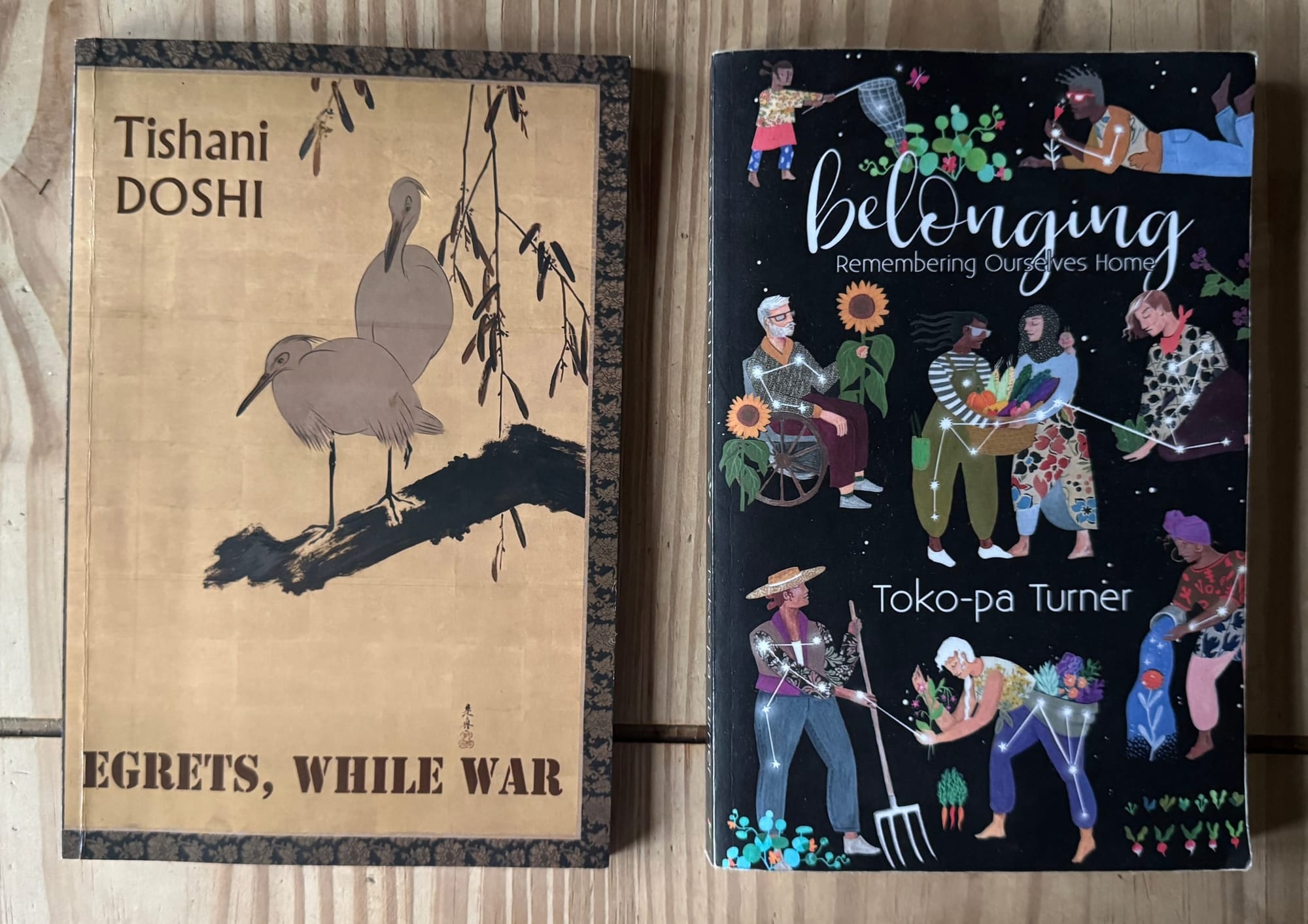
Toko-Pa Turner, in Belonging, writes of this poetry and language:
it doesn't strive for objectivity, which is removal from feeling, but rather sinks us deeply into the muck of it. It takes things personally. And it gives things personally in return. There is no such thing as impartiality when you live in a body; it speaks from the flesh and bone rhythms of that first belonging. It knows the secret loophole: you can't argue with poetry.
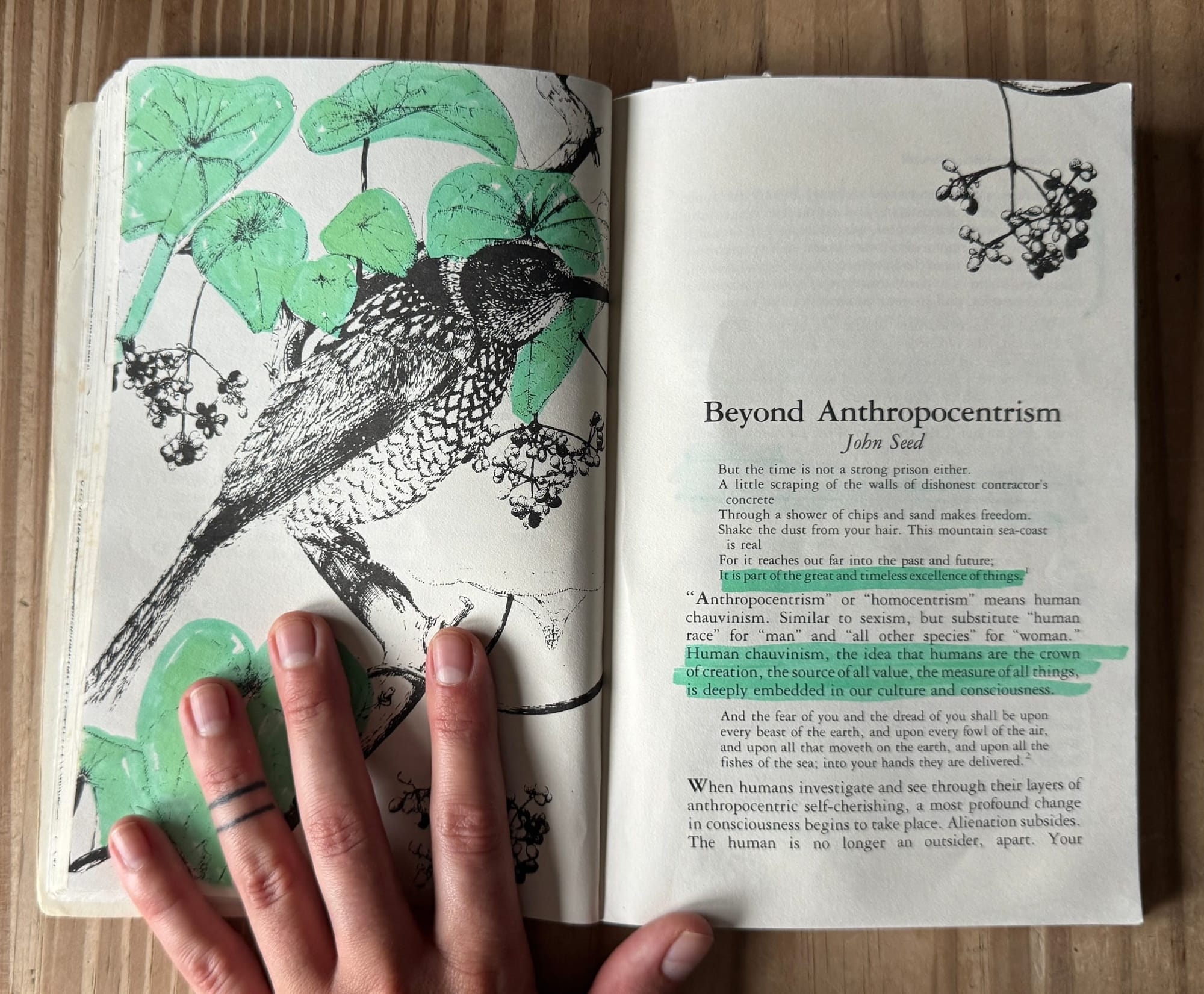
Thinking Like a Mountain holds that there must be identification in order for there to be compassion and solidarity. And John Seed, in "Beyond Anthropocentrism":
"Remember our childhood as minerals, as lava, as rocks? Rocks contain the potentiality to weave themselves into such stuff as this. We are the rocks dancing."
Sense-making
The data isn't enough. We've had decades of data premonitions through analysis of the past and present, the consequences of human productivity and the extraction that feeds it, and still no mass collective wave of action. This is too much. The world is burning, in parts. It is drowning in others. Tree loss, global warming and acid Rain was drilled into me as a pupil in geography. I was learning about the core, mantle and crust of the Earth just as Blair invaded Iraq on false accusations of chemical warfare, at 11 years old, and then my teacher declared none of the world's deterioration distracted by war fuels — sorry for the pun — global warming, as it was known then, known now as climate catastrophe or climate crisis. What have we done across two decades but continue the damage?
Each generation accepts the world they grew up in as the natural baseline, and fails to notice how much has changed against what came before. Shifting-baseline-syndrome, happens because we rarely look back more than one generation, because humans adjust to new comforts quickly, and because we compare ourselves to peers, not ancestors.
Poetry allows us to remember — to dissolve our sense of separation, and trace our lineage through evolution.
Emerging, or remembering?
Why GeoPoetry, why now. Because the data isn't enough, and hasn't been for decades. Because we know our address and not where we are. Because becoming indigenous to place is the act, the active hope GeoPoetry can assist us in ascertaining, and because the poem is the small read that holds all of it at once — deep time and this morning, the Rock and the body, the loss of industry and the loss of the senses that would have let us grieve it properly.
When the data failed, the geologists turned to poetry.
(*In this article on systems change Sophia Parker reminds us that imagination practice is critical to this moment and describes imagination in this way "The cultivation of imagination as a critical and legitimate form of anticipatory evidence" from this piece. The role of imagination and poetry and geopoetics is very seriously needed in this moment if we are to reinhabit place and come into right relationship with all life.)
Poetry is digestible, small, consumable. Poetry gets to the heart. Poetry is non-committal; you don't get overwhelmed by the length of reading a poem like you do an essay or book. Poetry can hit you or confuse you. Poetry is animism. Poetry replicates forms we make from Earth for our lives: brick, urn, vase, plate; haiku, sonnet, free-verse, pantoum. Poetry is discerning and uncertain, and so poetry validates our discernment in uncertain times. Poetry reveals and it hides, like a landscape. Poetry feels the thing we want saying, with words that dance around it. Poetry holds what can't be said. Poetry translates the songs of the Land, and Lands beings. Poetry is disordered and contained, like we are in our houses. Poetry is contradictory and divisive. Poetry is alive and lived in. Poetry is universal. Poetry reveals patterns: the spirals of life, the same pattern again and again, rippling in all things. Poetry contains everything in one thing. Poetry witnesses. Poetry imagines.
Over the coming months of this residency I'll be sharing poems and reflective writing on the process of writing poems as an active exploration as I emerge in GeoPoetry, or remembering I am one and have been for all time.
Bibliography
Books
Corbett, P., Bissell, N., Ringrose, P., Tremlett, S. and Whalley, B. (eds.) Earth Lines: Geopoetry and Geopoetics.
Doshi, T. Egrets, While War. Bloodaxe Books.
Eliot, G. Adam Bede.
Francis, R.M. 'Ancestral Genius Loci: Geopoetics and Place-Identity', in Corbett, P. et al. (eds.) Earth Lines: Geopoetry and Geopoetics.
Logé, G. Wild Renaissance: New Paradigms in Art, Ecology, and Philosophy.
Seed, J., Macy, J., Fleming, P. and Næss, A. Thinking Like a Mountain: Towards a Council of All Beings. New Society Publishers / New Catalyst Books.
Turner, T. Belonging: Remembering Ourselves Home.
Poems
Frances, H. 'Dandelion'. (Extract.)
Frances, H. 'Fathers everywhere, work is where I go to rest'. From Roma.
Frances, H. 'What you will live through'. Written in residence at MMUH.
Lotfi, M. 'Home'.
McConnell, G. 'Worm'.
Raine, K. 'Rock'.
Essays, articles and web sources
Bissell, N. Definitions of geopoetry and geopoetics, Geopoetry 2020. In Corbett, P. et al. (eds.) Earth Lines.
Dawson, O. 'Why all poetics must ultimately be considered as geopoetics', Landscape Surgery. https://landscapesurgery.wordpress.com/2022/02/10/why-all-poetics-must-ultimately-be-considered-as-geopoetics/
Hess, H.H. (1962) 'History of Ocean Basins', in Petrologic Studies: A Volume to Honor A.F. Buddington. Princeton University.
McFadyen, M. Geopoetics lecture, Scottish Centre for Geopoetics. https://www.geopoetics.org.uk/mcmanus-geopoetics-lecture-mairimcfadyen/
Poetry Foundation. 'Poesy', glossary of poetic terms. https://www.poetryfoundation.org/education/glossary/poesy
Seed, J. 'Beyond Anthropocentrism'.
USGS. 'Harry Hammond Hess: Spreading the Seafloor'. https://pubs.usgs.gov/gip/dynamic/HHH.html
White, K. International Institute of Geopoetics. https://www.institut-geopoetique.org/
Other
Collins, B. MasterClass on Reading and Writing Poetry.
Chief Seattle, 1854. Epigraph to 'Fathers everywhere, work is where I go to rest'.
Doron, H. On collective knowledge composting / co-creators as earthworms. CoLab Dudley.
Doshi, T. Interview with Hayley Frances, Verve Poetry Festival. https://vervepoetry.substack.com/p/youve-got-poetry-youve-got-music