Co.LAB #3.1 — ‘My’ Street 2030
Student Time Rebels Kiera, Kirstina, Rebecca and Sita return from a Dudley High Street of the future with memories of food, fulfilment and wellbeing, and generate a design illustrating stepping stones to a reimagined High Street.

The student Time Rebels returned with memories from the future of Dudley High Street; to share stories of what they found and stepping stones of how to get there. Below is a (rough) transcript of what one of the four groups shared with their fellow Time Rebels.
Time Rebel Team 1 — ‘My’ Street 2030
Kiera Bindra, Kirstina Edgar, Rebecca Lisney, Sita Patel
From the very beginning we wanted to create a sense of public ownership of public space. We wanted to challenge perceptions of what a High Street is and could be. When we began reimagining Dudley, we thought of core principles that we would like to wrap our design ideas around: food, fulfilment and wellbeing.

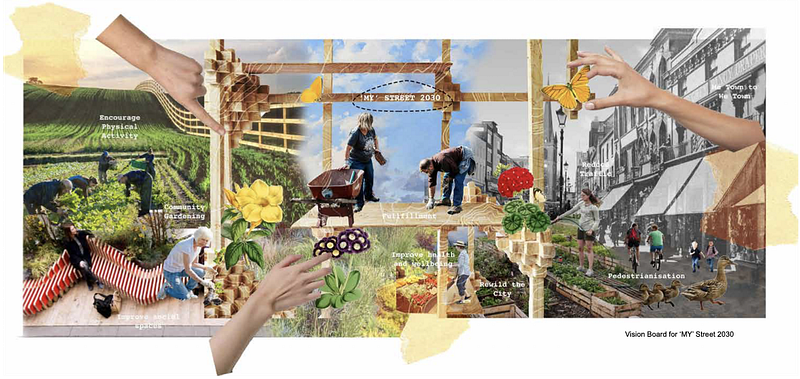
With the vision board below, we tried to capture and represent all the different interests and aspects that we were focusing on: improving social spaces, creating a sense of fulfilment, and re-wilding the High Street.

We explored the idea of narrative as a design tool. The first thing we did was remember our High Streets when we were growing up, so we wanted to bring that back in and give a child’s perspective of what Dudley High Street is going to be like in 2030. We got into the West Midlands mindset and used a lot of colloquial terms. We had a lot of fun creating something that was bespoke to Dudley and could help us as a design drive.
Below are the stepping stones that we wanted to achieve, with a scale of intervention, starting with small changes that could still have a big impact e.g. street furniture. At the other end of the scale is topography, where larger adaptations can be made for what we want to achieve.


The first stepping stone is to fully pedestrianise the High Street so people can gather and socialise. The next stepping stone would introduce street furniture to help the High Street become somewhere you would want to spend the day. We noticed there are a lot of empty buildings that we could utilise to make it more inviting to the local community. The final stepping stone is a green canopy to adapt to climate issues and make the High Street a place to go even when it’s not sunny.

Stepping Stone 1 is about making the High Street a productive landscape. We broke down our steeping stones as ‘mini’ stepping stones in order to achieve them.

The first step is sectioning out for pedestrianisation. It was important that we did this so we can move down the intervention scale to the next stepping stone; laying the foundation for social and ecological benefits. The hierarchy of space is very much dedicated to cars right now. If you design for cars, you’re going to get more cars. If you design for people, you’re going to get more people. According to Just Economics, the footfall can increase by about 40% following pedestrianisation, and retail follows suit with about 30% increase in sales.

If you can create a micro ecosystem within an urbanised space, you can reap a lot of the benefits and make it into a productive landscape that can help towards the de-commodification of food, and make it a more enjoyable experience for communities to gather around.
Below are suggestions of things that can be altered on the High Street during Stepping Stone 1.

Pond — At the northern reaches of the High Street lies a raised bed with nothing but a sterile patch of grass. We suggest as a miniature stepping stone, we replace the grass with a pond. The sounds of water can soften the noise of the traffic and it will invite pedestrians onto the high street by having this point of interest. It also works with the plans for re-wilding and growing food along the High Street as it aids pollination.

New use for cars — As part of pedestrianisation we would like to suggest a memorial of sorts to cars. The feature would sit in the middle of the High Street and would consist of an old out-of-use car, being used as a planter and being filled with plants. This gesture symbolises the movement of the High Street’s priorities shifting from the automobile to plants, people and food.

The space to the Inhedge has been impacted by low quality design and hasn’t received very good public care. By injecting life into the space, it will push space ownership for the public.
The image below shows what this space could look like as a productive landscape. Where all the space is used. Vertical growing space can be utilised for pollinators for heights out of human range and for fruit and herbs in the lower regions that lie within our grasp. Trees can provide shelter, pollen and fruit, as can shrubs.


Stepping Stone 2 is about making the High Street bespoke to Dudley through street furniture. We wanted to make the High Street more sociable and colourful. By providing outdoor seating areas, people would be invited to speak to each other and bring back a sense of community.


For Stepping Stone 3, we focused on taking back ownership of the High Street by utilising the empty spaces and units. The main concept was to re-establish public spaces as public spaces. Having spaces allocated on the High Street for community gardening, exhibition and education spaces will help to create an area of engagement that a wide audience can get involved with.
We pinpointed all the empty spaces on the High Street and realised that a passageway and courtyard on the side of the High Street had huge potential to create a nice central space for Dudley. It can also help to expand the High Street outwards and connect it to other spaces.

We started thinking about the journey into this space. A green wall facade across the passageway could create a bold landmark to attract people to the courtyard space.

By utilising the passageway to display exhibition work from local institutions it would not only encourage them to create their crafts, it will celebrate their work and the range of crafts that Dudley has.

By using the courtyard space as allotments, it will create a social hub for the local people and connect it to local businesses and stores.

This is aimed for a wide audience. By placing a community garden in this space space you can learn how to plant food and it will lead to more edible spaces on the High Street that will then lead to the re-wilding of Dudley.


Stepping Stone 4 adds layers to the High Street. Like the other visions, we wanted to use CoLab Dudley’s principles ‘use nature as a guidebook’ and ‘create conditions for curiosity and experimentation’. The main way we proposed to do this was adding a green canopy to provide shelter, create a hybrid indoor outdoor space welcoming to families and a more communal open space, and support ecosystems.

With the current High Street, there is very little to entice people to spend their time there, so we are looking to create this intervention with different types of canopies that will attract people to the High Street.

We looked at how we could intertwine green streets with green skies into the green canopies to create a space not just for humans but also for other livings things. This would provide habitats for animals and insects, as well as making the High Street more enjoyable and fun. Green roofing would increase the output of oxygen, provide shade, help fight against climate change, and bring more green to the urban grid. We looked at precedents from different cities for inspiration on how we could bring this to Dudley High Street.

The visual below represents Dudley High Street re-imagined; a new vision of a re-wilded, food-centric town centre. The green canopy will begin as a frame that will encourage the growth of plants. Smaller scale units will be integrated at the start and build towards the final vision.

Below is a sketch showing workshops utilising the empty spaces, street furniture, canopies on the side, and street art to brighten and liven the current High Street.

To sum up, we think we tried to tackle a lot of complex challenges, such as climate change, habitat loss, and the national death of the High Street. We used food as a way to mitigate some of the impacts of urban sprawl. We wanted to deliver a proposal that was meaningful and bespoke to Dudley High Street that reflected its history but focused on where it could be going.

“We’re all really proud of what we managed to do and would have loved to do more. We don’t think there’s an end to projects like this.”