Co.LAB #3.2— Industry 4.0
Student Time Rebels Weitong, Emma. Olivia and Luciana rolled the dice on their Dudleypoly board and returned from a Dudley High Street of the future with memories of circular economy pavilions on the High Street.

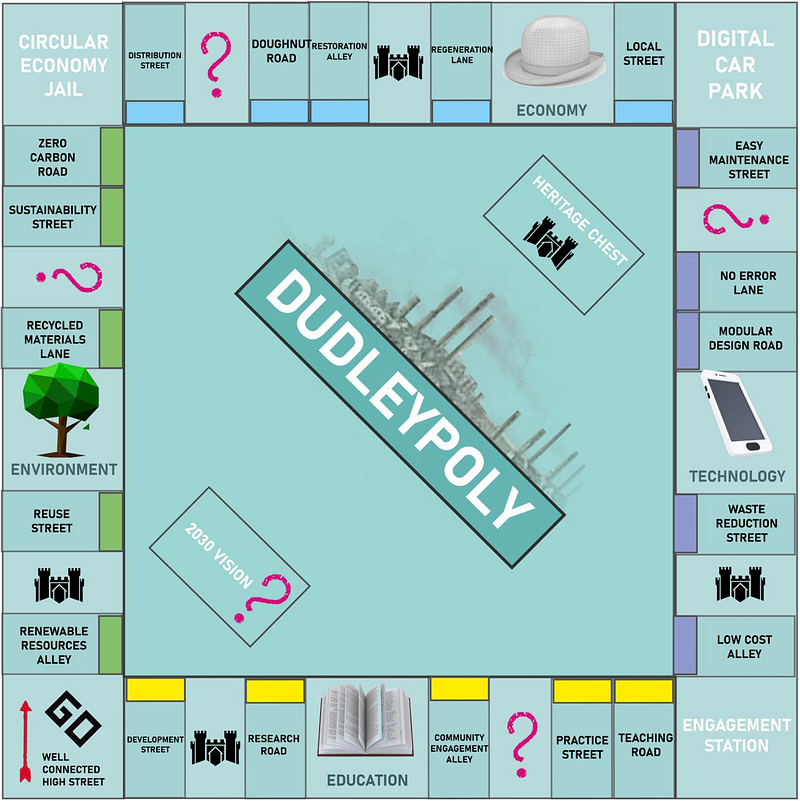
The student Time Rebels returned with memories from the future of Dudley High Street; to share stories of what they found and stepping stones of how to get there. Below is a (rough) transcript of what one of the four groups shared with their fellow Time Rebels.
Time Rebel Team 2 — Industry 4.0
Weitong Jiang, Emma Langley, Oliwia Malanowicz, Luciana Micarelli
Our stepping stones towards our vision for the future High Street were:
- Taking responsibility for our impact on the environment and reducing it
- Introducing pavilions as a mechanism for economical improvement and sustainability
- Showing Dudley heritage by implementing technological developments
- Connecting the community with the High Street by engaging the educational sector

We created a visual representation of the main factors and sectors we came across in our research and explored individually: environment, economy, technology and education. It also summarises our goal of creating a connected High Street, and the steps we took to achieve this goal.
This diagram shows where we came from and where we are going in terms of the Industrial Revolution and how this has developed over time. We started using machines that used water and steam power, moving onto electronic power that led to electronics and IT. We are now moving towards cyber physical systems and an industry dominated by digital methods.

We started by looking into Dudley’s heritage which informed our direction for the rest of the project. Dudley was pretty much at the centre of the Industrial Revolution. It had many advantages like making things faster, leading to technological advancements, a wider distribution of wealth and the social changes that came with this. However, it also had its own set of problems that are still relevant today which we need to acknowledge and address to successfully move forward, mainly: overpopulation, housing, water, air pollution and depletion of natural resources. We focused on these last two.

So how do we combat these problems? By linking together our four different topics of research (environment, economics, socio-culture and disintermediation), we came to the idea of an open factory. The diagram below shows how the factors could link together and promote distributed manufacturing which emphasises the recycling and re-use of waste products and collaborative and innovative design.

Distributed manufacturing is made possible due to advances in technology allowing wealth and knowledge to be shared more freely, as explained through Doughnut Economics. We wanted to implement the same thinking into our project to help create a thriving economy.

We looked more into the idea of circular economy and it became obvious to us that the main focus was sustainability. Design becomes a way to restore and regenerate, and this requires designers to source materials responsibly, design for the future, and consider the whole life of their product.

Industry 4.0 is from the cyber physical systems that are able to communicate with each other. They use modern control systems, have embedded software systems and are connected through the internet of things through which they are addressed. They basically work like changing channels on a TV, except these systems communicate with each other without much input from people, making things easier. It has benefits such as enhanced productivity and more flexibility in terms of what you can do with it in realtime, so things can be personalised and customised. The quality is much better, using less resources and producing less waste, and it makes things a lot faster. The machines and processes are connected through this network.

Digital manufacturing systems follows on from Industry 4.0 to increase efficiency through joined up manufacturing processes which eliminates errors. It’s basically using digital technology to manufacture things.

WikiHouse is an example of how people can be enabled to design and make their own houses using digital manufacturing system technology. A digital design is produced, locally fabricated and assembled rapidly. This makes it easier and faster for local people to do it themselves without a large environmental impact.

We researched into the education aspect, and how universities could work with local communities, and bring their knowledge to the High Street. We looked into precedents of projects that already exist, including a micro-campus, which were buildings that had been put into a city centre where people could interact with the locals.

Our collective vision for Dudley is to support a creative community that is connected through our internet of things; creating spaces that allow for the collection and redistribution of materials that locals can use to construct products with. Community engagement is central to this design network with local businesses encouraged to get involved in manufacturing.

We decided to bring alive this vision through a series of pavilions positioned through the High Street, following a process through recycling, storing constructing and manufacturing. To take this idea further, we allocated several empty units along the High Street to become spaces involved in the open factory, from workshops, educational centres and co-working hubs. Since we wanted to show the journey people would be able to take, we decided to create a storyboard for our final visual.

The visuals below show how the pavilions could sit in the High Street, starting at the market place, past CoLab Dudley’s base, and ending up at Top Church. We wanted to show how people would be able to interact with these different spaces and navigate between them.