Dudley Time Portal | Dreaming of a 100 year archive
What if there was a digital archive that cared for and shared place-based knowledges to inspire cultural climate action? This lab note shares early steps in living this question, as community technologists and people who care about Dudley begin co-creating the Dudley Time Portal.
Dudley Time Portal | Dreaming of a 100 year digital archive
What if people could develop deep connections with the places they live or work in: connections that invite care, relationships with life in that place, and learning through creative doing that deepens the climate resilience of that place? What if there was an archive that cared for and shared the stories and knowledges behind these connections, so anyone making that place their home or passing through could weave in and build on these connections? What if this archive was built to last 100 years, passing these knowledges down through generations?
This lab note shares our journey with these questions, finding community technologists to share their knowledge with people who care about Dudley, and the beginning of our co-creation process of the archive: the Dudley Time Portal.
Often when you talk to someone on Dudley High Street, they’ll say how it’s not as good as it used to be; it’s a street people rush down to get to where they need to go. Back in 2020, we started inviting people to pause on the High Street, awaken their senses, and jot down their experience on a map. This is called Place Detectorism (previously Street Detectorism) and it often leads to transformed relationships with the High Street: wonder at the languages, smells, music and colour, surprise at easily overlooked Nature, curiosity of what could be, and drive to do something about it.
We had a growing pile of Place Detectorist maps full of rich observations and new perspectives. We didn’t want these place-based insights to be hidden so we created a digital archive to care for and lift this knowledge along with a monthly ritual of coming together around the archive to inspire doing in Dudley. This evolved into Stories of Place: local curious co-creators gathering around stories from the past, present and future of Dudley to develop an understanding of place, imagine flourishing futures and start prototyping and rehearsing these futures in the present.
The Stories of Place gatherings continued but tending to the digital archive didn’t. It’s difficult to access and not easy to use. We recognised we just didn’t have a readily available tool or the skills to create something bespoke that would invite long-term care and interaction with the archive. We instead shifted to a physical archive, transforming a small room tucked into the corner of the lab space, which we lovingly began to call the Dudley Time Portal.

But we couldn’t let go of the potential of an online archive of Dudley knowledge, imaginings and possibilities that people can access anywhere, add to while they’re walking down Dudley High Street and see not just things but relationships. What if we could see how archived observations and creations have led to other ideas and experiments?
Dreaming with Dudley People’s School for Climate Justice
We brought the digital archive back to life as part of the Dudley People’s School for Climate Justice: a community-led assemblage of activities and projects that make it easier for people to learn from each other, connect with nature and take action towards futures where all life can flourish. Everyone is a teacher, and everyone is a learner.
In Dudley, our most vulnerable communities are at high risk from climate change. We also have natural habitats listed as high risk from climate change. The Dudley People’s School is an opportunity for people across Dudley Borough to share their ideas, skills and knowledge to respond to the climate crisis and reimagine the structures and systems that created the climate crisis and the inequalities that people face every day. Neighbours, artists, learners, designers, tea makers, tinkerers, researchers, crafters, gardeners, quiet activists and more are learning together, connecting with nature and taking climate action.
As part of this, we dreamed of co-designing a digital living archive that lifts and celebrates stories from across the Dudley People’s School as a learning and sharing tool to inspire and inform future experiments. We wanted the archive’s role to evolve to centre climate and ecological knowledge. The archive would enable the gathering and sharing of learning, ideas, and artefacts from the across the School as an act of cultural care. The Stories of Place monthly gatherings would use the archive to connect knowledge, shift towards action, and create gifts for the other projects.

Finding community technologists
We knew there must be people who could help us co-create the archive but we had no idea what to search for. Luckily, we met Multitudes through the Joseph Rowntree Foundation Emerging Futures ecosystem who describe themselves as ‘a design and technology co-operative that researches, designs and builds digital and material infrastructure for present movements and liberatory futures’ with ‘community technologists’. This is exactly what we dreamed of but didn’t know the name for.
We shared an open call for community technologists. Having spent 5 years establishing a creative participatory platform on Dudley High Street we have lots of learning about what meaningful and generative collaboration involves. We have always prioritised and invested our energy in building relationships that are rooted in trust, care, respect, abundance and reciprocity. Shallow and transactional relationships, which are commonplace on High Streets up and down the country, won’t support the emergence of a culture that makes a kinder, more connected and creative High Street in Dudley possible. Because of this, our collaborations usually build slowly through relationships rather than a blanket call. We felt nervous about the quality of relationship this would invite.
As a new collaboration, we invited community technologists to share responsibility in the following:
- Creating a ‘Do It Together’ culture. We will celebrate each others gifts and talents and make each other feel safe, welcomed and valued. We will co- create, share learning, embrace unexpected opportunities, and be open to testing out new ways of exploring.
- Creating conditions for a genuine exchange of ideas, deep listening and co-design.
- Working out loud by sharing ideas, resources, making connections, showing gratitude and sharing ‘mistakes’ or discarded ideas as part of the creative process.
- Documenting and sharing out loud the collaboration experience along the way helps us to link learning and doing, and build on and recycle previous experiments, knowledge and perspectives.
- Embracing transparency and being clear about resources, capacities, boundaries, and what helps are available from the state.
- Sharing collaborative digital spaces and tools. We have a Slack workspace, Miro boards and a Notion workspace which we use as appropriate to communicate and see collaborative work grow.
We created a similar invitation for an evaluation partner and were disheartened that no one could work with us in this way. We shared the community technologist invitation and hoped for the best. Common Knowledge came across our invitation on the Community Tech network and sent us their proposal. Excitement immediately began dinging between the Dudley People’s School team emails:
‘It’s amazing’
‘What a FABULOUS response! So beautifully written and their values make my heart sing!’
We were hoping for inspiring tech people to bring new skills and ways of working to our network but we didn’t imagine we’d meet people so wonderfully aligned with our values, ways of working and who just understand what we’re trying to do straight away. We met with Gemma Copeland and Alex Worrad-Andrews from the Common Knowledge team and left inspired by their thoughtfulness, honesty, the experiences they draw from, that they wanted to come into relationship and how they recognised the potential for ripples to spread beyond the project from our collaboration. We couldn’t wait to get started.
Groundwork
At the beginning of September, Gemma and Alex joined us in Dudley to hang out for a couple of days. They invited the Dudley People’s School for Climate Justice team (CoLab Dudley, Ekho Collective and Workshop 24) to share our ideas around what an archive could be, our goals, what we had tried already, who the archive is for and who would be adding to it, and what tech we like and don’t like. We ended the session curious about our data footprints and what good practices we could learn and share, how the archive could lead to new ripples and interactions with nature, the potential of connection across our ecosystem, and whether computer science been wrong to follow linear coding all this time! Alex and Gemma settled in to do the groundwork, digging into everything archive and CoLab Dudley ways of working we had gathered for them.


A couple of weeks later, Gemma and Alex shared what they’d learned along with inspiration, ideas and questions around a 100 year archive — you’re welcome to float around their Figma board along with Jo and I’s very excited comments, and even leave your own thoughts.

Common Knowledge beautifully summarised our dream for:
A living archive of creative artefacts and experiments from the past, present and future of Dudley.
A digital commons to be shared and stewarded by the Dudley community.
Digital infrastructure to facilitate community-led social innovation, collective imagination and cultural action.
Our conversations had revealed that the archive could be for people who want to:
- Learn about the project
- Find relevant entry-points and pathways
- Explore, share and care for experiments and multiple knowledges
- Start new experiments (make, do and learn)
- Iterate on existing experiments
- Share what they’ve learned
- Connect with people
- Start collaborations
Gemma and Alex imagined the archive as a non-linear assemblage or digital garden, resisting categorisations and hierarchical ways of thinking. They talked through how we might allow for complexity in a way that offers accessible entry points for new people getting involved.


Considering how we might initiate something that Dudley folk can own and control, Alex and Gemma were drawn to Walter Segal’s building method:
- The attitude is one of rigorous simplification of the whole building process from design to completion.
- Elements are reduced to their essentials to obtain a maximum economy of material and effort.
- The method is very open because it uses materials and techniques that are readily available.
- The whole building process is simplified so that it can be carried out by one person with basic skills.
- The simplicity of the construction and documentation makes the whole process transparent and easily understood by someone without experience who can thus become involved in controlling the process.
This has overlaps with permacomputing:
- Accessible well documented and adaptable to an individual’s needs.
- Compatible works on a variety of architectures.
- Efficient uses as little resources (power, memory, etc) as possible (minimization).
- Flexible modular, portable, adapts to various use-cases.
- Resilient repairable, offline-first, low-maintenance, designed for disassembly, planned for longevity, maximized lifespan, descent-friendly or designed for descent
We talked about introducing rituals around the archive in our existing activities, sharing skills of how to maintain an open source archive, which led us to a BIG question:
How might we create a digital archive that lasts for 100 years?
It’s difficult enough to imagine anything in 100 years, but when Alex invited us to consider that the internet is only 35 years old and the average lifespan of a website is 2 years and 7 months, our minds were well and truly blown. What technology will we have available in 100 years? What hardware will exist? Will people be using advanced technology beyond our imagination? What if we’re not mining for chips in the future? Will we be recycling computers from the 90’s?

If we want the archive to last 100 years, it will have to be simple. After all, paper, we were told, is still the most resilient archive material. The archive shouldn’t be seen as a technical solution: it is cultural.
Alex then guided us into the depths of tech in a wonderfully clear way. He invited us to imagine the archive as a seed bomb: we have the matter and the nutrients (the software) and the defence soil or clay (the hardware). I will attempt to relive Alex’s explanations from my notes without using the technical terminology, no doubt losing some of the nuance, but you’re welcome to float through the detail on Figma.
For the software language, we learnt that the easier it is to understand, the more energy it consumes, whereas the least energy consuming languages are more complex to explain. There’s a lot of balancing to consider. The archive would be more resilient if we could have one large simple file that we could have multiple copies of, but this would be a slow process; we wouldn’t see immediate change. Lorna wondered if this was actually an invitation for us to slow down. We don’t expect immediacy with seeds, so what if we rewired our relationship with and expectations of technology?
Gemma brought us back up to the surface from the tech depths into inspiring design ideas. What if the archive was in constant flux, changing with the seasons, time of day, micro-seasons, weather (I particularly love revisiting this example from Fig, which to my delight just now on this foggy day, the homepage is blurry!)


Gemma asked us: what if the archive could actually be out of season? She shared the example of Low-tech Magazine, who proclaim: “This is a solar-powered website, which means it sometimes goes offline”.


Gemma wondered how we might leave space for unexpected connections and surprises. People could leave messages, see the traces between experiments and ideas, peel away layers of the archive to reveal content behind, or even see surprise content pop up on the screen.


We were also invited to think about how we might create a situated digital archive that reflects what is happening in Dudley and the CoLab Dudley space. Gemma shared examples of situated archives and websites that bring together the human and more-than-human and digital and physical space. Might we have access to the digital archive in the space or on the High Street?


We then all got excited about how we could make the archive accessible to the broadest range of people. How might people customise the appearance of the archive? Might there be different modes or a sliding scale of complexity in what people see?


Needless to say, we were all tingling with the inspiration and the depth of thinking, and eager to get co-designing in Dudley.
Co-designing Dudley Time Portal
Co-creators: Alex Worrad-Andrews, Deb McDonald, Dionne Williams, Gemma Copeland, Holly Doron, Jo Orchard-Webb, Laura Onions, Lorna Prescott, Luke Hudson, Nat WB, Rebekah, Soheila Javaheri

On a cold, icy evening on 20th November, thirteen people gathered together in the lab space and online around the curiosity co-creating a digital archive. We checked-in by sharing why we where drawn to this curiosity, and what our relationship with or wishes around digital technology are. We had a range of people who had happy, geeky and familiar relationships with technology to those who described themselves as “technophobic” and “bringing the perspective of a primitive being not good at tech”. We were curious about how people can access technology differently, what we decide to archive and when, how we create an archive that isn’t stagnant but living, the possibilities of democratising technology and reducing the risk of the erasure of knowledge, how every server farms use resources and affect communities around the world, how we can combine digital archiving with place-based work, how tech can be about making life better than worse for people, how digitial technology relates to time, how the archive might enable connectivity between activity, how learning with place-based activities might foster community between people with different lived experiences, how technology can affect our wellbeing and impact the development of children’s languages and skills, how technology can support us in connecting, how it can be developed in more holistic ways and with respect so it doesn’t take away from human and non-human experiences.

Gemma introduced the purpose of the workshop: to gather feedback on Common Knowledge’s work so far and to steer the direction of future research and prototyping. They shared the Figma board and invited us all to play Crazy 8s. We each folded an A4 sheet of paper into 8 rectangles and within each rectangle, we had a minute to sketch or write out an idea sparked by their presentation.

In eight minutes, Rebekah dreamt of an archive where we behave like ants, who are small and make things that are big and connected. Erica thought about an archive that is simple and clear. Luke imagined the archive as a ball of string or river, where everything is interlinked and to possible futures. Nat was curious about hearing spoken and music archives as an experience in place and how it might feel more human. Deb thought about our more-than-human kin (plants, animals and creatures) and what the archive might look like from a birdseye or earthworm view. Jo imagined the archive as a spinning top, disturbing air movement and interacting with space, animating stories and bringing different perspectives and knowledges into relationship. Laura drew a cut patch of Dudley earth to see the layers below the surface, imagining the archive as a playful invitation for people select a blank patch and introducing creatures tethered to an aspect of the archive. I was drawn to the idea of a solar-powered archive, and how it could also create a habitat for bees and other creatures. Soheila was curious about a non-hierarchical archive as a culture of resistance: the archive is for people and they are invited to transform it. She dreamed of a Festival of the Archive, and wondered if the people and relationships might disappear with a 100 year perspective. Lorna imagined an archive that is open to anyone who is curious. Alex imagined the archive buried in the ground, which we could have to dig up in order to add to it. Dionne dreamt of an archive as a digital maze with different pathways in, and as a survival pack with solar panels, wind turbines, morse code and rationing packs. Dionne was inspired by earth seed from Octavia Butler’s Parable of the Sower, and wondered how we might see the archive through rituals and embodied treasures.

We were then invited to spend a longer time working through an idea, whether it was our own, someone else’s or a hybrid:
- Starting simple | Erica was curious about playing with the idea of basics and simplicity, thinking about who the archive is for and what people will do with it.
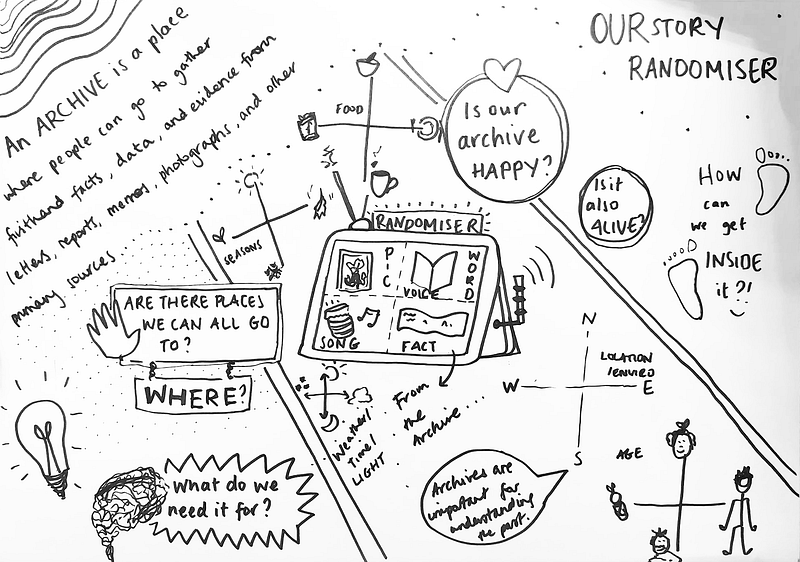
- OURstory randomiser | Rebekah imagined the archive as a place, locating it somewhere accessible, and whether it could be a way for us to learn who we are. She imagined moving away from bleak archives locked away in cupboards to a jukebox and randomiser, leading people deeper in and mixing media, and representing a broader spread of history, people and other living beings.
- Grounding in place | Nat wondered about the experience that comes with the archive, with people telling stories in person. How can you ground in place online?
- Our archive garden | Dionne dreamed of an archive garden where people can discover the archive through different views, clicking into rituals, sounds and beliefs. She imagined walking through Dudley with physical things to interact with on trails as seeds inviting people to add to the archive and become part of caring for and protecting the archive.

- Andean time spiral and slices | Lorna was inspired by the Andean time spiral and Laura’s layers and the histories we can learn from other places, wondering who is here in the archive and who is experimenting, located in climate facts and ‘What if…?’ questions.

- Simple, storytelling, inter and intra connections | Soheila dreamed of an archive with simplicity at its heart, with storytelling to revitalise archive materials as prestigious treasures, inviting intraconnection and playfulness.
- Stories of Place ritual | I was drawn to the rituals bridging the digital and physical archives, and how Stories of Place gatherings might adapt so people could choose to ground themselves in physical place or the archive, and in Making Hour, choose to collaborate on experiments or take time stewarding the archive and connecting experiments with each other.
- Portal | Laura was inspired by the place detectorism maps in the physical Dudley Time Portal space, and imagined a digital archive that was static or moveable depending on energy and time of day.


- Right story, wrong story | Jo weaved together Nat’s storyteller, Dionne’s survival pack, Alex’s spade to dig up the archive, bunting from Soheila’s festival, Dionne’s morse code and universal language, Rebekah’s ‘we are the archive’, eating on a vegetable plot cared for by the storyteller guide with the solar panel, Lorna’s protest banners inspired by Rebekah’s randomiser, talking about being good ancestors, telling new stories. Jo wanted this archive to be a good ancestor and provoke a new way of behaving.

What’s next…
Common Knowledge are hibernating over winter with our ideas, creating prototypes that we can test and evolve in the new year. Just reach out if you care about Dudley and would like to be part of the Dudley Time Portal co-design group, or keep an eye out on our events page. To close, here is an essay that Lorna shared with the group, which left her contemplating:
What if we designed the Dudley Time Portal digital archive using lessons from the longest existing archive that exists: the Earth’s crust?
This work is led by CoLab Dudley as part of the Dudley People’s School for Climate Justice, funded by The National Lottery Community Fund’s Climate Action Fund.