Flourishing Edges Unconference
Creative documentation and stories from a co-created gathering rehearsing learning processes that bring us closer to flourishing futures, which took place in Dudley Borough over 3 days in April 2025.
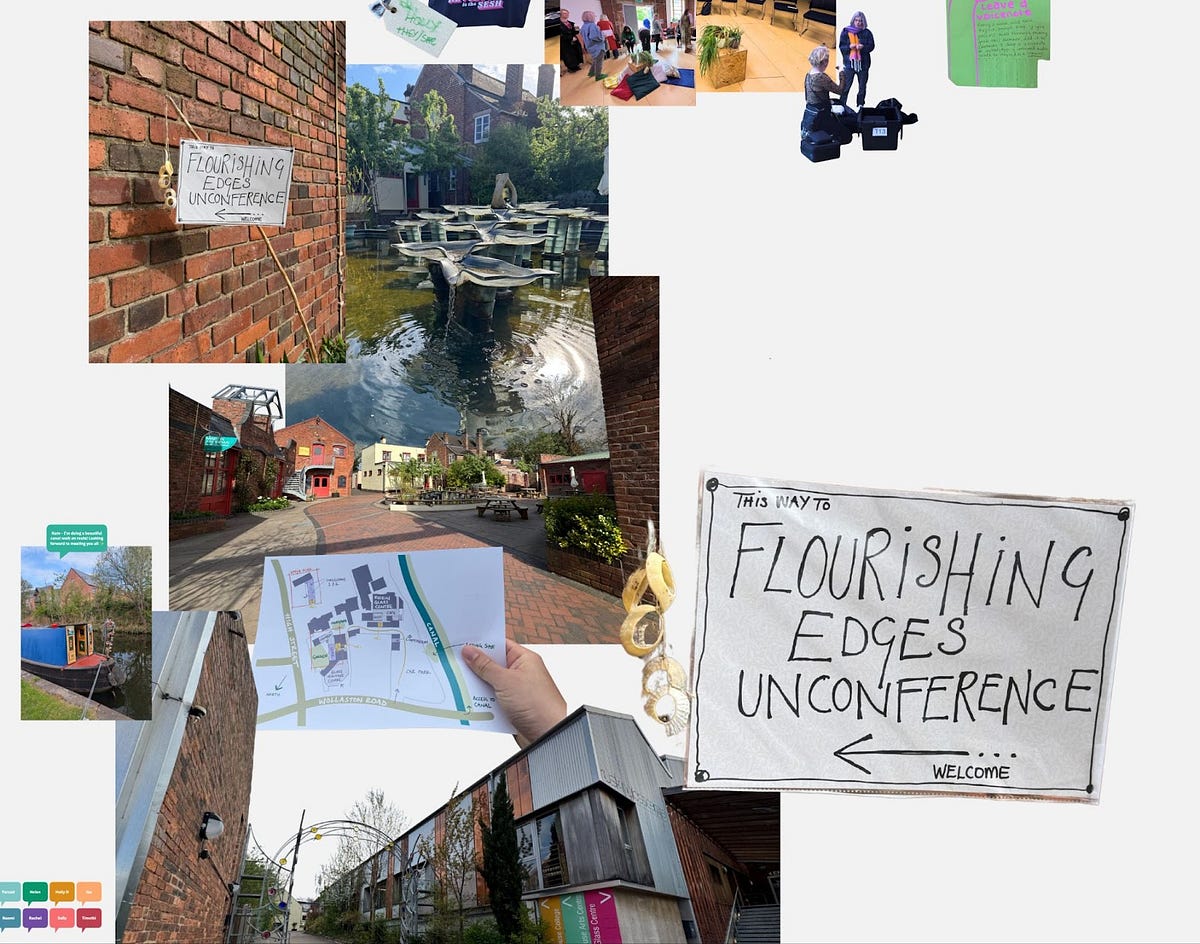
This is a weaving of visual and written stories from Flourishing Edges Unconference co-creators, sharing our experiences of gathering together at Ruskin Glass Centre 15–17 April 2025.
Flourishing Edges Unconference was a space for people from different backgrounds interested in learning processes that bring us closer to regenerative futures, in which all life flourishes e.g. through transdisciplinary, creative, decolonising, more-than-human methodologies. It was not a traditional conference with a fixed structure for sharing results; instead it was a co-created, safe, experimental and flexible gathering. We collectively imagined and enacted ways of sitting with complexity and uncertainty, in being in relation with Nature, and embracing multiple ways of knowing, in order to be good ancestors.
Our stories here share:
- Gathering — what we did during the unconference
- Soil — how we created conditions for the unconference to emerge
- Fruits and blossom — what emerged from our time together
- Compost — insights and shared learning for others who might want to co-create another Flourishing Edges Unconference or similar
- Seeds — what ideas and actions have spread and sprouted since
Gathering — what we did
Snippets from Timothi Lim’s blog:
Born of CoLab Dudley’s gentle provocation to cross‑pollinate our many knowings, the three‑day Flourishing Edges Unconference (April 15–17, 2025) brought together 28 brave co‑creators, and together we became a living mycelium. From the outset I felt adventurous, sometimes dismantled, always compassionately rewoven, nourished and cared for.
We snorkelled in soil, listened to limpets, wove willow with birch; Derrida, Deleuze, Latour and Haraway whispered through every thread, while Bridle’s Ways of Being, Sharpe’s Three Horizons (and Onion Collective’s Flower Model blooming reply), Butler’s starships and Le Guin’s carrier bags expanded the earth and the night sky overhead. Systems of Care met Regenerative Ways of Being; children’s classrooms folded into speculative futures; unconditional positive regard sat beside the Hole‑in‑the‑Wall. Each dialogue, each silent contemplation, was a seed, and soon I felt the old “bleeding edge” mindset snap in two. I renounce the blood‑stained chase of emerging technology and innovation, and choose instead to scatter germinating seeds, technological, ecological, relational, across a shared landscape of care and connection. No more razor; I choose the flourishing edge, scattering sprouts instead of scars, tending a commons that is free, fair and alive. When Naomi’s journaling exercise asked “Who do you lean on, and who leans on you?” the answer rang clear: everyone, everything; human, magpie, limpet, unknown cosmos, because in this porous weave of practice and hope, survival and becoming are joyfully co‑dependent, messy and creative, ever emerging, evolving and ebbing.
Holly Doron’s memories:
Greeting smiling faces; hands rolling soil; sounds from the depths of the canal pressed between heads; surprise and delight at a salad of pineapple, cranberry and pistachio; pausing and looking to the sky; an unusual and welcome absence of anxiety; mischief and unrestricted laughter; unexpected comfort to lie down and rest, listening to stories; generosity and kind-hearted gifts; sprawling across the floor with scribbles and brain tingles, untied with the need to plan speech in advance and freedom for thoughts to flow and intertwine; peaceful moments for reflecting alone; watching play with paper magpie; realising the fear of missing out is soon nourished with living through other co-creators’ experiences; sitting back and watching co-creation and self organisation unfurl and relationships blossom.
DAY ONE
Arrival
Grounding

Snippets from Holly Doron’s welcome words:
Usually I feel anxious about social events — especially if I have to say anything — but I’ve just felt this tingling calm and joyful anticipation of the completely unexpected happening just from us all being in this space together. We wanted to share our gratitude for you all — that you not only responded to our curious invitation but for your awe inspiring curiosities and wisdom in how we might convene this together, your enthusiasm, kind words, patience with us making this up as we go along, and showing up in all your varied and welcomed ways. I’m very grateful to be in this space with you all and thankful that this is happening because of you.
Snippets from Isa Collazos Gottret’s welcome words:
As the Flourishing Edges Unconference begins to unravel and entangle, we thought it would be good to remind ourselves of what are the conditions, values and ways of being we aim to embody. Jo has taken the initiative of creating the collective care board with our suggestions to consult at any time. These may come in handy if we feel a bit lost at some point or we’re having trouble making a decision. They may also help us connect with the people surrounding us through the values that resonate with ourselves: the importance of time to build trust, think and decompress. Setting agreements on how we want to work, so being very intentional and looking out for each other.

As we attempt to hold space for discomfort, clumsiness and complexity, without rushing toward a resolution and ignoring the contradictions, let’s see if we can do it with grace, respect and lots of self-compassion. Because these are aspirations which we may still struggle embodying and may play out differently in the following days. As you may already know, the body understands things differently to the intellect. So, let’s not feel too bad if the messiness is irritating us, or the contradictions between hoping for a relaxed programme and the impulse to experience everything makes us feel grumpy. Let’s give ourselves permission to just be.
We also invite you to pay attention to the consent board, pop your name where you feel most comfortable and, if necessary, take a look and see how co-creators around you may feel in order to respect their consent wishes as well.
Social commoning and self organising

Mapping (language) of care | Juliet Sakyi-Ansah (throughout the unconference)

Ancestral wisdom conversations | Danni/ Zaz Ebanks-Ingram (throughout the unconference)

Collective creative documentation | Jo-Orchard Webb (throughout the unconference)


Emergent strategy reflection journalling | Naomi Bennett-Steele

Embodied gratitude practice | Kate McLaven

Kate: Taking a moment to centre in our length, width and depth before tuning into a gratitude practice for our more than human kin. (Inspired by Staci Haines).
Sonic acts of noticing x Snorkelling in Soil | Julia Udall and Rachel Schwartz-Narbonne

Unexpected Stories in the Bagging Area | Artemis Bear, Katy Kent and Sally Lowndes
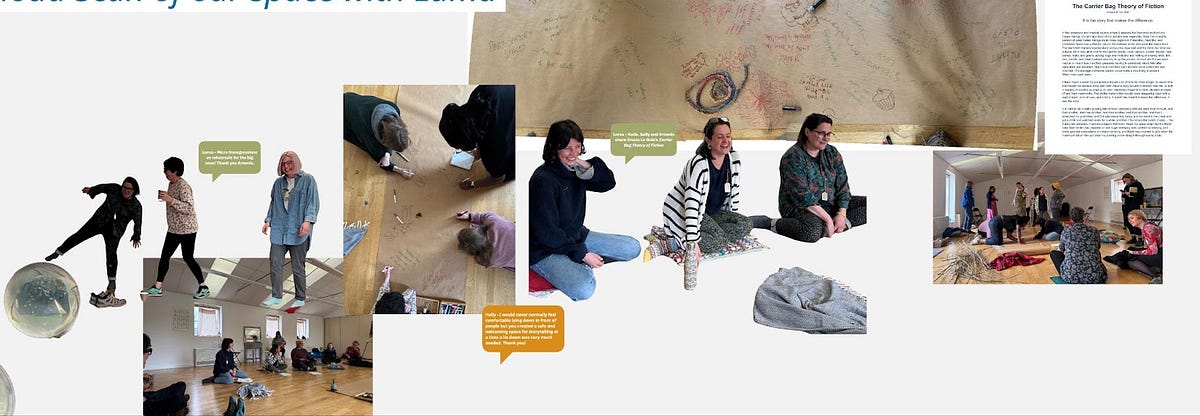
Lidar Point Cloud Scan of our space with Luma | Timothi Lim

DAY TWO

Magpieing magpie medicine | Rebekah Warmington

Regenerative Ways of Being: Breaking the Diagram | Holly Doron

Holly: I invited co-creators to find common ground for cross pollination by breaking my diagram of regenerative ways of being through drawing, collaging, embodying our different and overlapping realities and ecosystems. We ended up sprawled on the floor with cushions, diagrams, tracing paper and felt tips, reflecting on how regenerative ways of being show up / don’t show up in our different places, and how the diagram could evolve.
Sensing, Rehearsing and Rooting Commoning Practices | Lorna Prescott

Weaving Stories and Containers | Artemis Bear and Katy Kent

Navigating Discomfort — Embodiment and Zine Making | Kate McLaven

Kate: I opened a discussion about navigating discomfort in movement work, talking about conflict, stewarding endings, collective mess and recognising when navigating discomfort is a practice we can sharpen to move through rupture in movement, or when it’s a sign to start the process of stewarding an ending well. This intimate session gave us an opportunity to trial a practice in embodied allyship (my first experience of this was with Healing Justice London) paired with chanting practices where each member of the group was able to engage in a direct practice of asking for and giving allyship in the ways we want and need it. I noticed many folks moving through barriers of discomfort, and even as a facilitator I found myself doing the same in my facilitating this practice for the first time.
We ended by pouring our insights and reflections into zines.


Limpetarium | Helen Garbett

Hands-on Unplugged / No-Tech Activity about Tech | Timothi Lim

Decompression in the Limpeterium

DAY THREE
Explore the Soil! | Rachel Schwartz-Narbonne

Limpet Ting | Helen Garbett

Helen: On day two of the unconference I invited everyone to experience The Limpetarium, the contemporary, limpet-focused Wunderkammer or wonder-chamber created through my socially engaged artistic research venture over the last four or so years. Afterwards, on day three we gathered for a Limpet Ting, an assembly through which Limpetarium visitors were invited to exchange their limpety thoughts, reflections, ideas and questions. Everyone was offered a single sheet of paper upon which to note, jot or doodle during the Limpet Ting. When brought together these jottings would, I hoped, provide a collaborative record of our conversation.
On the sheet, as an introduction I wrote:
Based on ancient Norse parliaments, a ‘ting’, also known as a ‘thing’ is an assembly where matters of collective interest and concern are discussed, negotiated and agreed. At the Limpet Ting we will discuss The Limpetarium, our experience with it and how this might inform a change in our relationship with limpets specifically and the more-than-human world overall.
My hope is that The Limpetarium offers a different, perhaps perplexing or unsettling way of exploring and coming-to-know dimensions of the world that go unnoticed. Perhaps we need to be unsettled and perplexed a little in order to open possibilities of wonder and enchantment, those moments where we are struck by the extraordinary goings on around us.
‘Without… the enchantment effect… we might not have the energy and inspiration to enact ecological projects, or to contest ugly and unjust modes of commercialisation, or to respond generously to humans and nonhumans that challenge our settled identities’.
Jane Bennett, The Enchantment of Modern Life, 2001
Following your visit to The Limpetarium and during our Limpet Ting discussion please note your responses, thoughts or ideas below.
We had a beautiful conversation, full of carefully considered responses and thoughtful questions. I now have an assemblage of illustrated notes, each one unique to its maker. Some provide a few lines of text, others a scribbly drawing and yet more with intricately produced diagrams. Together they form a co-created document upon which I am now pondering and reflecting — there is much to learn from the Limpet Ting and everyone’s contribution.

Reflection on Preparing for the Worst whilst Designing for Most Hopeful Future | Catriona Rawsthorne

Grounding | Danni/ Zaz Ebanks-Ingram

Natural Materials Art Workshop | Jo Callaghan

Soil — the conditions we created for emergence
Holly Doron
Interesting things happen at the edges of ecosystems. Where water meets land, a rich diversity of species thrive at these edges. Back in spring 2023, an idea was sprouting. Helen was telling Jo and I a story of growth edges, where the edges of our different research areas, disciplines and ways of being come into relation with each whenever we meet at CoLab Dudley on Dudley High Street. Whenever we share how we are learning, interesting things happen. We wanted to create an intentional space for this cross-pollination, which led us to gathering every couple of months for Growth Edges.

At the same time, Isa and I realised interesting things could happen if our research areas of decolonising museums in Bolivia and nurturing regenerative cultures in Dudley could come into relation with each other. Isa was inspired by an event she had missed in Amsterdam: ‘Towards a Post-Extractive Culture — a gathering of souls dreaming and building a world of many worlds.’ We wondered how we might create a similar event in the Midlands, UK: a learning space that feels welcoming, relational and truly generative. A space of reciprocity, nourishment, creativity and care.

Somewhere along the way these two curiosities became entwined. A team of researchers and practitioners of geography, art, dance, museum studies, architecture, regenerative economics, and creative writing gradually came together and dreamed of the Flourishing Edges Unconference: a space of co-creation where the experimental meets curiosity, and complexity joins uncertainty, bringing together people from kaleidoscopic backgrounds to rehearse learning together for flourishing futures.
Rather than asking potential conference attendees to submit abstracts (a short summary of a research paper or presentation), we invited people to become co-creators and share their curiosities. We wanted to invite co-creators from a range of spaces, backgrounds and organisations (academic and non-academic). With funding from AHRC through Midlands4Cities, we were able to support free attendance and offer each co-creator support with travel and accommodation. Those who didn’t need support donated their share to a solidarity fund to support other co-creators. As a small unconference, we were intentional in not issuing a blanket call. To begin with, we reached out intentionally to people across our networks and ecosystems who wouldn’t normally go to conferences or feel comfortable there. We wanted to celebrate the many different ways co-creators might want to communicate so we welcomed curiosities in the form of text, voice notes, objects, images, collages — anything. We provided a suggested structure for guidance along with an invitation to break this structure:
- I’m curious about… learning with the more-than-human / inviting care in business-as-usual spaces / creating space for uncertainty (you can include several curiosities if you like)
- I’d like to engage with others around this through… sharing my work / walking and talking / making together
- I can offer… hosting a collaging activity / co-convening conversations / creatively documenting discussions and activities / bringing my lived experience of…
- I think this might bring us closer to flourishing futures because…
The unconference invitation brought together practitioners, artists, a funder, PhD students, a council employee, researchers, scientists, architects, educators and social entrepreneurs learning and doing through multisensory digital design, experimental and deschooling education, regenerative praxis, alternative economics, decolonising practices, community nurturing, environmental education, network weaving, nature therapy, sonic urbanism, museum studies, neuroscience, urban geography, architecture, land working, neurodiversity, natural science, grass roots organising, somatic healing, transition work, printmaking, queer liberation, environmental chemistry, and immersive technologies.
Central to the co-design and co-creation of the unconference was creating a welcoming and safe space that enabled abundant and emergent conditions for this collective exploration. We invited co-creators to join an online convening prior to the unconference to:
- Get to know one another.
- Establish it is ok to be present in different ways.
- Nurture a safe space for uncertainty.
- Share what to expect at the venue, introducing the different spaces available to us and the skeleton structure of times for arrival, eating together, decompressing and deconstructing the unconference.
- Explore everyone’s curiosities and discover potential for combining curiosities, nurturing conditions for collaborations to emerge.
- Begin to populate different times and spaces with emerging activities.
- Share asks and offers around the activities we would like to do, to help us feel more comfortable during the unconference, and understand what resources we already have in our ecosystem that we might share.
- Co-write our community agreement around collective care and ways to collectively create and steward a safe and inspiring space for co-creation and co-convening throughout the three days of the unconference.
- Reveal potential roles that we might want to create embody — space stewards for construction and deconstruction, creative documentors and archivists, grounding stewards, unusual data spotters, more-than-human guardians, ancestral knowledge keepers and guardians, future generations guardians, witnesses, supporters and holders of uncomfortable conversations with grace and care, welcomers, consent guardian, green space wanderers, and playful-ness-ers.
- Reveal infrequently asked questions — How can this unconference build capacity — not sap it? What questions could we ask at this unconference that are ‘unthinkable’ and ‘inappropriate’ for your typical conference? How can we centre joy, life affirming activity and play? How do we embody our learning? How do we cultivate ongoing care beyond the unconference? What practices might we draw on to help us become acquainted to begin to build a relationships with the site of the unconference? What does it mean to be hosting this in the Black Country?
We created spaces on Hylo and Whatsapp for co-creators to continue collaborating before and after the unconference.

Fruits and Blossom — what emerged
Jo Orchard-Webb

The unconference funders, Midlands4Cities, had a ‘post activity form’ for us to fill in, sharing outputs and numbers of people involved, as funders tend to do. We shared:
- Flourishing Edges Unconference collective gift in Miro as an ongoing and evolving documentation of our shared learning and unconference process.
- New and deepened friendships across disciplinary, institutional, identity and geographical boundaries.
- A safe space to share vulnerabilities in relation to pressures and anxieties of ways of working and precarity forced by late capitalism-led societal, economic and institutional norms, and the way the polycrisis manifests in our lives and the lives of beings we care for. Freedom to name the emotional and physical burdens of climate and social crisis. But also …
- A space of joy and poly-opportunity of practicing in common new/ old ways of being that are aligned with mutual flourishing. For many this unconference was a form of respite care, for others a glimmer of hope, possibilities and even prefiguration of alternative futures and ways of organising.
- Ways of being scroll with collective co-creator suggestions grouped around the core unconference intentions. This was framed by an introduction to these ways of being by Isabel. Both the scroll and introduction are documented as part of the Miro gift. These are useful starting points for others who wish to engage in unconference processes, as well as thoughtful naming of ways of being to be practiced in an ongoing way in the Growth Edges network.
- Network nurturing: 6x new Growth Edges members following the unconference — expanding and nurturing a network of regenerative practitioners / researchers/ learners and doers who gather every two months.
- 1x exhibition of creative artifacts from the unconference at the CoLab Dudley Spring Gathering of local creatives and learners. This gathering was focused upon fertile edges and bringing ideas, humans and more-than-humans into new relationships/ connections. This brought the unconference ideas to a new audience.
- 1x poster submission to the M4C Birmingham City University Interdisciplinary Dialogue Day.
- Deepening of collaborations amongst participants with site visits to gain better understanding of practices in place between Dudley, Birmingham and Sheffield planned as a result of the unconference.
- A previous unsuccessful application to explore alternative research networks and infrastructures that better reflect local sites of knowledge production and ways of learning has been reanimated by unconference sharing and is being explored further through Growth Edges network.
- Unconference “how to” work in progress template to share with co-creators who want to test this format out in their own learning spaces but also for future M4C PhD candidates.
- A jellyfish wall of collective reflections and wisdom shared in relation to “lore”, “intention” and “ritual” shared/ experienced/ emergent over the course of the unconference (the wall has been replicated on the Miro gift).
- An evolving installation of unconference artefacts using multi-modal expressions to lift up core elements of each curiosity. This creative documentation installation was a gentle way of connecting curiosities and gifting a signifier of a flourishing edges practice/ conversation/ method/ experience/ emotion as part of the co-creative collective process. Co-creators gifted their artefact, took time to read the tags of other gifts and over the 3 days saw the installation emerge, reorganise and evolve. (the installation artefacts/ gifts and their tags are documented in the miro).
- Sonic acts of noticing and Soil snorkelling spore/ cultures nurtured. Willow baskets and hangings cocreated. Commoning practices explored. Grounding ritual to give thanks to the earth. Emergent Strategy Journaling. Listening. Limpet Ting convening and collective note-taking. Regenerative ways of being Diagram breaking and remaking. Lidar scanning. Movement. Communing with more-than-human. Story-telling. Drawing. Immersive sound-walking. Jelly-fish corner reflections. Magpie-ing. Laughing. Conversing. Crying. Breathing. Jumping. Cart-wheeling. Mark-making. Soundings. Embodied gratitude practice. Zine-making. Anarchist kinesthetics.
- 28 curiosities shared — unlike static and linear abstracts these offer instead wonderful composting questions, provocations and lines of enquiry we can all dip into and connect with as part of the evolution of our interdisciplinary/ post-disciplinary practices.
Compost — insights and shared learning
Jo Orchard-Webb and Holly Doron
The following are insights we would like to share if anyone was to do something like this again.
It helped having funders who were excited about our idea and were enthusiastically supportive. The team at M4C understood the importance of this not just being a space for the PhD students (who they usually fund) but a space for anyone curious about everyday learning and doing that bring us closer to flourishing futures.
Having a team of planners and conveners helps with labour distribution and collective care. Some of the team were involved all the way through, others helped at the beginning but couldn’t join the Unconference, and we all dipped in and out when we had energy and space. Having a digital base in Notion with our collective tasks, timelines and communication, alongside a Whatsapp group made it easier for us to drop out when we needed, and come back into relation when we were able to. We could have benefitted from inviting co-convener roles that swapped over the course of the three days, but co-creators naturally fell into these roles when they saw the need, from bringing co-creators together to resetting the spaces.
We used a range of communication platforms to help support different ways of working: Miro, Email, Whatsapp, Zoom, Hylo. Hylo was less useful as many were not familiar with it. As ever, Whatsapp was the easiest and was very active during the unconference with sharing of gratitude, joy, signposting to knowledge gifts (links), images and ideas. Communication with those who answered our invitation and co-creators wasn’t perfect. There were a LOT of Google Forms, the complexities of which led to one person being missed off an email list. We also set expectations within these forms — offering individual conversations with people who wanted to know more about the online collaborative platform before joining it, rather than just offering a group introduction at the online codesign session. It was an unreasonable expectation to put on ourselves as a voluntary group juggling lots of commitments. With dedicated convenors focussing upon accessibility we were able to support a range of ways to participate and connect. It is important to note that this requires a real investment of time and care; and even then we missed some requests and questions. Managing expectations with timing and number of options iteration would be both practical and caring in future iterations.
We were also ambitious in creating a digital platform for co-creators to use, which would become a collaborative space after the Unconference for the wider network who were interested but not able to join. We still intend to explore this, but it’s slow going with our commitments.
Co-design offers an abundance of ideas, energies and perspectives but also benefits from some structure and care in facilitation. In the future, we might have a clearer structure in advance. Having time to co-design as co-creators in advance online was really valuable and generative (e.g. in terms of collectively naming ways of being and becoming aware of each other’s curiosity and roles). We could have also benefited from additional sessions to allow time for orientation, connection and planning. Not everyone enjoys or are able to engage with online convening so in person gatherings could have nourished connection and co-design.
Space, place and venue are central not just from a logistical perspective but for creative inspiration (e.g. historical narrative of the place), ethical alignment (Ruskin Glass Centre’s social justice vision and local, low carbon food sourcing) and practices of care in hospitality (e.g. nourishment, comfort, quiet space, outside space).
Rituals of grounding, welcome, check-in, and check-out are critical to the emotional, spiritual and reciprocal quality of the unconference. Unplanned check-ins with how we are feeling can be a welcome act of care between activities that focus on our minds, bodies and hands. As this is a very embodied and emotionally-engaged process, taking time out for rest and movement was critical.
The consent process was an iteration of Holly’s PhD relational ethics process in place. It involved a creative and tangible (almost craft like) process giving it a more meaningful, trust-led and embodied quality than a swift scan of a sheet of words and signature. Its image also acted as a simple reminder to co-creators in follow up communication to act with care in our sharing. That said, we might have lifted this up in the closing check out as a reminder.
The smaller total numbers helped with the pace of emergence and emotional vulnerability of sitting with uncertainty. We suspect larger numbers might feel chaotic. Co-creators joining and leaving at different times worked and we recognised we needed and fell into a dedicated co-convenor role to pay attention to this. We brought attention to it in the morning planning sessions and this helped.
The nature of the unconference invitations and ways of being actively and explicitly practiced meant there was an immense generosity of practical resources and time gifted throughout this process.
Seeds — what has sprouted since
Two months after the unconference, co-creators shared what has stayed with them or emerged since:
Rachel Schwartz-Narbonne | I think when we were diagramming with Holly, and I said something about how regenerative and commoning spaces were the minority, bounced in on all sides by extractive ways of being, and Lorna said “No, flourishing is everywhere if you open your eyes to it. It’s about seeing it and making the connections.” But it made me rethink a lot of spaces I’m in and how I approach the work. I don’t need to constantly create regenerative spaces, I need to look for them, they’re already there.
Lorna Prescott | I think what has stayed with me is an overwhelming feeling of deep joy for how curious and caring everyone was (and is), and how giving (erased / new) words to things (nouns, verbs, more) can really help us to understand the world around us and then to shape it.
Kate McLaven | My posture in spaces of delivery, planning, programming are far more comfortable in the non-binary, in the uncertain, I feel the unconference has enabled me to let go of the need for control I have learnt from dominant systems. Also remembering that play in close proximity to healing, embodiment work minutes apart from thinking space, hands in the soil, a session away from drawing, then deep thinking are harmonious balances that feel like a rehearsal of a flourishing future, of enabling the work at the edges to take centre stage for a moment.
Helen Garbett | Encouragement, support, care, attention, willingness, slowed-down-ness, uncertainty and love… flourishing futures are here, with us, now…
Timothi Lim | Since the unconference, I’ve tuned in more keenly to how emerging technology touches (and sometimes torches) the planet, other species, and the communal threads between us. I’ve come to believe that Extended Reality experiences only comes alive when we co-author / co-create its meaning together, so I’m now choosing a flourishing edge over the old industrial rhetoric of the bleeding edge and the silicon valley chase for perpetual, extractive and disruptive growth. Working with GenAI for my PhD keeps showing me that the internet holds only a sliver of human knowing — there are whole libraries of Global-South wisdom that still live off-screen, carried in objects, communal gatherings, and the bright stories we pass hand-to-hand.
Julia Udall | I felt that the space was one of refusal and possibility. Allowing a “no” to those damaging ways, and through collective care, attention, labour and hopefulness building the ways of being we need with our heads, hands and hearts. Some questions I had- how do we tie these approaches back to specific historical struggles and movements? How can we bring these situated and longer struggles that have created spaces for this? What does it mean to bring ancestral wisdom not as a thing residing in a person, but as many interdependent, intertwined directional desires for other worlds?
Jo Orchard-Webb | Flourishing Edges for me was: dancing with uncertainty; play and rebellion as practice; spaciousness for emergence; care and relational ontology writ large and felt in my whole being. Flourishing Edges was a space of co-authoring or perhaps remembering of a regenerative ‘ethnosphere’ — that is, the swirling mixture of cultural norms, ideas, languages, knowledges, social technologies, ritual, stories, and myths we urgently need for transition to flourishing futures. But most of all I just felt deep gratitude to share time and place with you all.
Farzad Jahanfard | For me, it was the word ‘commoning’ when we were in Lorna’s session. I’d never heard about it, and after learning about it, it made me think a lot and, due to the nature of my PhD in co-creation, socially-engaged art, and human centered design, it gave me a new perspective on how to design with people. It helped me to think how I can make a balance in power as a designer through inclusivity and accessibility and not treat users or stakeholders as just as a source of information. I can common with them during the whole design process which has made my project way more interesting and powerful. The funny thing was that it came from a session that I randomly went to, and I felt I didn’t belong. I didn’t understand other people’s language, and I felt so out of place and dumb. But after a chat with Lorna, who kindly explained it to me, it was a eureka moment. And that was the beauty of the whole 3 days, the most unexpected things happened. Truly unexpected. It was magical.
What next
There isn’t another Flourishing Edges Unconference planned (yet). Part of our reasoning for sharing our learning here is to open up the invitation for others to continue this. If you would be interested in evolving something similar, you are absolutely welcome to get in touch.
If you’d like to be part of the Flourishing Edges mycelium, you are welcome to join our bi-monthly Growth Edges gatherings. Again, just get in touch : )
Co-creators
Anna My Bertmark (she/her) is a PhD student in design and digital media, researching the transformative impact of multisensory and interactive artefacts for ecocentric perspectives. Anna is studying regenerative development and bioregional mapping, working for Regenerate Cascadia.
Artemis Bear (they/them) has spent the last decade developing an experimental education project in Bristol and is interested in rapid pragmatic culture change through deep deschooling and decolonising practice.
Catriona Rawsthorne (any pronouns) is a Doughnut Economics Researcher at CIVIC SQUARE, bridging between research, theory and regenerative practice in service of more safe and just futures. (team)
Charlie Clark (she/her) is first year PhD student, currently working on a project about the performance experiences of ADHD musicians. Interested in critical neurodiversity and critical ADHD studies.
Danni / Zaz Ebanks-Ingram (they/them) is a Birmingham-based artist with an introspective practice rooted in identity, decolonial thought, alternative systems, worldbuilding, learning from communities on the fringes (QTIPOC, disabled, racially marginalised) and intergenerational connection. They have a background in visioning, building and investing in civic infrastructure through a participatory lens. With this, they have continued interest in thriving communities, public space, alternative systems that centre collective care, people and the planet.
Dionne Williams (she/her) loves deep thinking and doing through creativity and experimentation.
Elisabeth Del Prete (she/her) is a curator, researcher and educator
Elizabeth Gray (team)
Farzad Jahanfard (he/him) is a designer and researcher exploring how socially engaged practice using XR Art and Design technologies can provoke meaningful, inclusive encounters between communities and spaces of exchange.
Frederick Hubble (he/him) is an artist and researcher exploring seasonality in arts practice and focusing on cultural ways of relating to the climate crisis.
Helen Garbett (she/her) is an artist-researcher based in Stourbridge. (team)
Holly Doron (they/she) is the Regenerative Research Steward at CoLab Dudley — regenerative learning through doing in Dudley through Stories of Place: a monthly gathering of curious local people collectively understanding place, imagining flourishing futures and rehearsing these futures through prototyping. (team)
Isabel (Isa) Collazos Gottret (she/her) is a Bolivian PhD student in Museum Studies at University of Leicester. With an ethnographic methodology, she is researching how State-led and/or theoretical ‘decolonising’ rhetoric has entered the museum, and how it has been interpreted, adapted or ignored by practitioners. She has degrees in History, Development Studies and Museum Studies, and has worked in UNESCO as a member of the Delegation of Bolivia. She was director of the Simón I. Patiño Cultural Centre (Bolivia) where she developed, with a multidisciplinary team, cultural project with a social change perspective. (team)
Joanna Callaghan (she/her) is a land worker and artist researcher exploring knowledge of the land. She works at Moreton Wood, a beautiful woodland in Herefordshire, managing it to restore diverse habitats for wildlife. Jo is particularly curious about how knowledge arises through work practice and how — or if — to make this knowledge visible.She is also an artist and really interested in the role art practice can play in revealing hidden knowledges. Jo loves learning with others collaboratively.
Johanne Orchard-Webb (she/her) is the Collective Learning Steward at CoLab Dudley — a critical urban geographer by training, with a history of engaging creative ethnographic and participatory research methods to support the co-design of collective learning alongside communities. Jo’s passion is co-creating and testing out regenerative learning practices, processes and infrastructures for change. She is here for learning through doing in service of flourishing futures for all kin. (team)
Julia Udall (she/her) is an architectural researcher and educator, and director of studio polpo, a social enterprise architectural practice. Julia is currently working on two strands of work- one at neighbourhood level-the AHRC/ Future Observatory project- Co-Designing a Positive Energy District with Sheffield and District African and Caribbean Community Association and one at landscape level LICHEN (Life Centring Cultural Heritage Network) which is a pan european network exploring natureculture learning. I work in a transdiscplinary way including with sound artists (www.Sonicactsofnoticng.org) performance makers (ark-sheffield.org) and natural scientists (snorkelling in soil)
Juliet Sakyi-Ansah (she/her) is a deeply curious architect with an interdisciplinary approach, working across the realms of industry, academia, and communities. Her work is rooted in exploring transformative change through a human-centered lens, focusing on the delicate balance between people and the planet. Juliet finds joy in stepping beyond the constraints of the 2D world — activating physical spaces, experimenting with ideas in real-world contexts, and connecting theory with practice. Her past projects include being a Time Rebel with CoLab Dudley in 2021 and collaborating with Workshop24 on their Radio Public Library initiative in 2023. She is currently completing a PhD at Oxford Brookes University, exploring “BIM-based Community Capacity Building for Participation in Settlement Upgrading.” Juliet teaches on the People, Leadership and Organisations MSc Project Management module at Brookes and Architectural Design at the University of Liverpool.
Kate McLaven (she/her) is straddling the non binary of institutional systems change with grassroots organising. Special interests are governance, somatic healing, what are the conditions for transition, place based transitions, alternative economies, arts and culture as tools for resistance, decolonial process and output. End of empire.
Katy Kent (she/her) is a Network Weaver / Community Nurturer / Nature Therapy Guide, Warm Data Host (Onion Collective, Somerset), building strong and rooted relationships between people and place; hosting collective learning experiences that help us recognise and share different ways of being and tend the links between personal and planetary health.
Laura Onions (she/her) is an artist with a printmaking practice often adopting sculptural, painterly and social forms to hold and share spaces for learning. Laura has been collaborating with CoLab Dudley on Urban Rooms project and also with the Wildlife Trust.
Lorna Prescott (she/her) is a CoLab Dudley team member grappling with the ups and downs of collaborating with humans in place, wishing we were in healthy relationship with all life.
Melanie Woodhead (team)
Naomi Bennett-Steele (they/she) is a researcher and facilitator, queer liberation & justice seeker and gardener.
Rachel Schwartz-Narbonne (she/her) is an environmental chemist embarking on a transdisciplinary journey.
Rebekah (Bek) Warmington (she/her/they) is a Teacher and Environmental Educator interested in Nature and community.
Sally Lowndes (she/her) is a social researcher and entrepreneur (Onion Collective, Somerset), exploring human and nonhuman networks and how collective memory could unlock the imaginative potential of communities to dream new worlds into being.
Timothi Lim Weihao (he/him) is a Creative Technologist and PhD researcher at De Montfort University exploring how Mixed Reality, Generative AI, and real-time data shape the social dynamics that emerge in the spaces between physical and virtual worlds. Through his practice-based research and eight years in the interactive tech industry, he’s fascinated by how we might design immersive technologies that enhance our collective experience and connection to each other, especially as the boundaries between digital and physical realities become increasingly blurred.
Zohreh Baghban (team)
Funded by AHRC through the Midlands4Cities Cohort Development Fund with support from CoLab Dudley (funded by Joseph Rowntree Foundation and the National Lottery’s Climate Action Fund).