Prototyping Street Detectorism
In summer 2021 a group of Time Rebels came together on Dudley High Street to prototype street detectorism. Holly shares learning from this live testing and what the next iterations will be.


Following on from our Lab Note Introducing Street Detectorism, we revisit our intentions for street detectorism (highlighted throughout this lab note with 💭), and share how it has since evolved. This process of thinking and working out loud has been an active design tool for the continual prototyping and development of street detectorism.
Street detectorism encourages us to use all our senses to experience and discover how we move, act, interact, socialise and respond to Dudley High Street. Through collective observations and experiences, we hope to grow our awareness and understanding of our surroundings, and use this to inspire us and help us to co-create High Street experiments in an informed and contextual way. We can then use our senses to fully take in any changes that our experiments cause, learn from them for future experiments, and share what we’ve discovered to make it easier for other people to do their own experiments.
Street detectorism is rooted in the space, place and people. It requires observation, listening and slowing done; and ultimately reimagining the purpose of the High Street.
Time Rebel Co-design
💭 We will be prototyping tools with Time Rebels prior to Do Fest, and co-evolving street detectorism as a creative experience that people from the High Street could dip into during Do Fest.
On 15th July, Time Rebels came together in the Lab to prototype street detectorism. We had planned to experiment with some of the Public Life Tools developed by Gehl, and find ways to adapt them for people on Dudley High Street to use during the upcoming Do Fest. Afro Histories Dudley’s Dionne helped us reach a breakthrough: we were overcomplicating it.

Rather than using tools designed for researchers, we wanted to create an activity that was easy and fun for people of all ages to dip into. We each quickly jotted down prompts that people could use to focus on different elements of the High Street. We grabbed a prompt that caught our eyes and at 4:10pm on a sunny Thursday, we ventured onto the High Street with felt-tips, pencils, and maps on clipboards.

Dionne explored the High Street, searching for ‘signs of happiness’. She walked past the 876 lounge, with reggae music blasting out and a man smiling, giving her a thumbs up while asking, “You alright?” Dionne walked past the Full Moon, which had an atmosphere of calmness, relaxation, serenity and togetherness. She discovered friends having a laugh outside after work, a dad feeding birds, children at play, and men laughing outside Davo Barber Shop with ginger beers and smiles.
Rick and Neil mapped ‘places to linger and rest’. Neil was surprised at how many benches there are, but only two were being used. Rick himself became a lingerer when a shopkeeper came out to chat.
Lorna focused on ‘speeds’. She began to tally car speeds, but her prompt drew her curiosity elsewhere: slow cars reversing, a couple walking slowly (a man was helping an older woman), buddleia and ferns waving in a gentle breeze, the small slow sway of a sign, the gentle flapping of a purple bin liner and crowd barrier covers, Rick slowing to a stop to talk to a shopkeeper, and very slow peeling of paint on the first and second storeys of buildings.
In our brief experiment, we discovered that our first street detectorism prototype:
- Helped us to slow down, focus, and reveal streetscape narratives and rhythms that would otherwise go unobserved or unappreciated;
- Encouraged us to reflect on how the High Street is and isn’t being used;
- Welcomed interactions and connections between strangers;
- Connected us to nature on the High Street.
With this, we were ready for Do Fest.
Do Fest Prototype
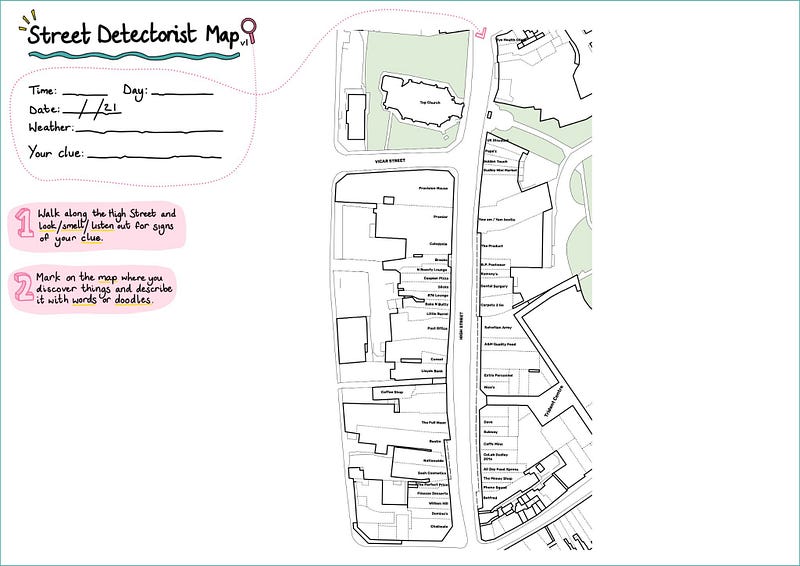
During Do Fest, there were a range of activities in the lab and market for people to take part in and connect with Dudley and reimagine its future. Alongside these activities, we set up a wall of 56 clues and a station of street detectorist maps ready to be taken into the wild by anyone who was curious about the High Street.

💭 We are developing street detectorist activities that will welcome different types of street detectorists, and tap into all sorts of gifts in our ecosystem… Street detectorist tools and activities will try to be multisensory and celebrate different gifts that street detectorists bring.
We invited street detectorists to look / smell / listen out for signs of their clues, and to mark on the map where they discover things and describe it with words or doodles. This, alongside open white space on the map, was an open invitation for people to share their gifts. We discovered photographers, rainproof sketchers, observers, and people with an excellent sense of smell. Street detectorists gifted their findings to the growing street detectorism wall in the Lab.
For our next iteration, we are building our wall of street detectorism to celebrate the drawings and observations that people have gifted to the lab. We will be hosting street detectorist sessions throughout October and November, so it will be calmer than the quick-paced drop-in buzz of Do Fest. This will give street detectorists more of a chance to prepare for and reflect on their walks up and down the High Street, so we will also share some inspiration of mapping techniques.


💭 Street detectorists will already have a relationship with Dudley High Street — they will be of the place, rather than detached researchers or drop-in professionals.
The activity attracted locals who were simply curious, and eager to do an activity on the High Street, as well as an urban designer and retired architect who were curious about different ways of people connecting with their built environment. Although they would be classed as professionals, they were not instructed to be here. They were drawn to street detectorism out of curiosity, and became of place through their 30–45 minute explorations of the High Street, through the gifting of their maps to the collective map, and through the sharing of their contact details to keep in touch with the project.
In the next stage, we will explore in more detail how street detectorism might invite new relationships with place (the High Street) and, in turn, how this might encourage High Street stewardship.
💭 Street detectorist tools and activities will try to enable active and passive experiences — some street detectorists will want to talk to people on the street, others will want to draw from their own interactions and experience of the High Street, others will want to watch from a stationary spot.
In public life studies, there are activities where you talk with people (walking interviews), and others where you are an objective observer. So far, street detectorists have moved away from the stationary observer to observing on foot and mapping passive experiences. However, the act of doing on the High Street has actually attracted active experiences. During the initial time rebel prototyping session, street detectorists were asked if they were ok, smiled at, and greeted, falling into conversation with others on the High Street. During Do Fest, one street detectorist was asked twice if they were ok, which led to a conversation around their street detectorism clue. Other interactions mapped included waves, smiles and conversations with other street detectorists encountered on their journey, or passersby picking up dropped street detectorist pens.
Although interactions are already happening, in the next prototype we will test adding an invitation to the maps for people to interact with other people on the High Street to see if it leads to different experiences, and to other people becoming curious about street detectorism.

💭 We want to integrate nature within the activities, so street detectorists don’t see the urban realm and the people within it as separate from nature, but all as a whole.
Several of the clues made direct references to nature, but street detectorists mapped signs of nature against other clues like:
- Beauty — ‘nature thriving in cracks’
- Tiny things — ‘tiny shrub on top a church’, ‘tiny patches of grass under bench’, ‘weeds growing on pavement’, ‘wet grass smell’
- Decay — ‘faded flowers, ‘decaying bodies, amongst ivy, holly, ragwort’, ‘buddleia and ferns growing in the guttering reaching for the sky’, ‘small tree growing next to wall, high up’, ‘ferns growing in the downpipe’, ‘mossy algae on wall below the windows’, ‘layers of rotten board and weeds’
- Connection — ‘green pockets overlooked by passersby’, ‘flowers in garden’
- Smell — ‘rain washed streets’, ‘fresh air’, ‘waft of damp grass’, ‘damp day in summer’ (these were all mapped as positive smells)
- Weird — ‘tree on roof’
Nature was associated with beauty and positive feelings, as well as signs of decay of the urban realm, and where nature was rebelling and reclaiming unloved parts of the High Street.
Referring back to Miles Richardson’s framework for nature connectedness, street detectorism has so far provided opportunities and prompts to notice and emotionally engage with nature through the senses, and to find beauty in the natural world.
The next prototype of street detectorism will explore how we can celebrate nature and how it brings meaning to life. This connects strongly with The more-than-human High Street time rebel project. It will also provide opportunities and prompts for compassion to care for nature and take action for nature by including reflection questions on the maps as well as inviting follow up discussions.

💭 Street detectorist tools and activities will try to be multiperspective, inviting people with different perspectives to carry out observations and to consider different perspectives, including sight lines and experiences of a child or someone using a wheelchair.
We intentionally kept the first prototype map as simple as possible to find out people’s own methods of mapping. Some of the clues alluded to different perspectives e.g. creatures, difference, views, access, safety (none of which have yet been taken onto the High Street). It was interesting to discover that none of the completed maps contained references to other perspectives.
This suggests a need for a prompt for people to consider other perspectives; an invitation to build empathy. This will be included in the next prototype map, as well as the street detectorism wall in the Lab space.

💭 Street detectorism will help us look for patterns and relationships, and what effects changes have on our neighbours, including plants and animals.
We were not expecting our first prototypes to yield insights into patterns as this will come over time. However, one detectorist explored the clue ‘connections’, which led to more analysis of observations than other clues.
Throughout October and November, we are inviting people to become street detectorists on Thursdays. You can also join us for Through the Seasons: Lorna is taking street detectorism to the Inhedge to spend time there, focus on patterns and relationships (getting to know weeds, availability of water, spotting creatures and their habitats and tracks), and learn how these might inform future ideas and designs for this patch of green land.
💭 Street detectorists will be invited to gift their findings to a co-created map in our Observatory to see how they are embedded within a collective effort to understand the High Street, and to humanise their data in ways that celebrate their gifts and talents.

Street detectorists have started to populate a wall in the Lab with their maps around what will become a collective map (or at least a layer of it). At the launch of the Extinction Rebellion Architecture (ERA) project, the same map was used to divvy up areas for Masters students to venture onto the High Street and sketch facades, uses, social aspects, invitations, accessibility, environmental issues, conversations they overheard etc. They then co-created one huge drawing of the High Street.


“We build our image of the world with data from our senses. By presenting these data in novel patterns, artistic interventions alter our sensibilities — change what we see and therefore how we conceive the world and again how we look at it.”
Lynch, K. (1981). A theory of good city form. Cambridge, Mass: MIT Press. p.163
Building on the data already gathered, and inspiration from the ERA mapping, we will begin to invite people to explore ways to co-create maps and analyse the layers of narrative that come out of this process. As discussed in our last lab note, Introducing Street Detectorism, this will draw from Giorgia Lupi’s Data Humanism manifesto, which calls for a move away from impersonal, extractive and infallible data to more human, imperfect and contextual data.
What next…
When we first set out to introduce street detectorism (then Public Life Studies), we had the following intentions:
- Encourage curiosity in the streetscape
- Collate maps and data needed to affect change on the High St
- Inform and inspire alternative High St imaginaries
- Encourage interaction with strangers about those imaginaries and the barriers to them being realised
- Opportunities for creative and playful spin offs and collaborations
The street detectorism prototypes have so far encouraged curiosity in the High Street, and interactions between strangers. Through this we have started to collect maps and data. Already we are starting to see street detectorism weaving with other time rebel experiments:
- Dionne is counter mapping Dudley’s Black infrastructure along the High Street to inform the development of a Black-led Creatives Network — so far we have been sharing maps and will be collaborating on how to visualise this data.
- Lorna is beginning to experiment with a permaculture-focused street detectorism, Through the Seasons, to connect with the Inhedge.
- Helen and Bill’s More-than-human High Street is inviting people to find signs of nature. The treasures created and found could be woven with street detectorism data.
- An Extinction Rebellion Architecture time rebel, Kyle, is exploring how to bring Doughnut Economics to Dudley High Street and integrate it within street detectorism.
- The next stage of street detectorism will build on Juliet, Natalie and Sarah’s Virtual Street Walks prompts inspired by Rob Hopkins: 1. What Is (observations): collate street detectorism data; 2. What If (visioning): sharing street detectorism data to inform and inspire alternative futures for the High Street; 3. What Next (linked visions): encourage interactions towards realising these imaginaries through future collaborations

The next stage will also explore how we can weave in our other design intentions:
💭 We want to create opportunities for people to build generous and trusting relationships, so we will invite new street detectorism enthusiasts to connect through using our tools and activities whenever they like, sharing their findings in the lab or online, and coming together to humanise each other’s data.
💭 Street detectorism will help us look for the historical context, and move away from ahistorical work by layering this with deep time e.g. geology, the industrial revolution, the British empire.
💭 We will bring these layers and range of data together in relationship with the rest of the ecosystem to help us reveal patterns and insights that inform our journey to a kinder, more creative and connected High Street.
💭 These insights will help to inform regenerative future experiments rooted in historical and future contexts, and help us to avoid short term or ahistorical quick solutions.
To help us move towards these intentions, we will build on what we’ve learnt so far about time rebel practice.
Creating conditions and processes that support time rebel practice
- Safe space and time to connect, learn and imagine as opposed to unsupportive meetings or being rushed with a focus on outputs;
- Convening with care and purpose to deepen relationships rather than thoughtless and formulaic convening;
- Unprescribed processes to enable flexibility and attention to context;
- Creating in the open rather than in isolation.
Prioritising place-based knowledge and wisdom
- Taking time for intentional place orientation, leaving with a greater sense of place or connection than before;
- Sensing in place, becoming part of the rhythms of that place, enabling access to the knowledge, empathy and connection we acquire through embodied practice;
- Creative and collective manifestations rooted in stories, materiality and experiences of place;
- Imaginaries and actions of hope rooted in the reality of place and wider systemic context that shift personal and place-based narratives.
Relational qualities
- Co-creation of ideas, prototypes and tools through supportive and collaborative practice and in collective spaces;
- Weaving links and insights between other experiments and ideas that lead to the unexpected;
- Gifting and sharing for collective long term abundance;
- Mixing practices into a new, ever changing practice through relationships in the ecosystem.
Leaning into alternative values
- Lifting our principles ‘be good ancestors’ and ‘use nature’s guidebook’ to avoid short-termist or extractive relationships;
- Using the imagination sundial to consider the wider mental, emotional, physical and networked conditions for imagination to thrive;
- Looking at time in a range of dimensions (deep time, impermanence, slowness, multiple futures, and past untold or erased histories) to avoid limiting our imaginations and our understanding of our interdependency and stewardship responsibility.
We have also been wondering whether we need to supplement data from street detectorism with data from Public Life Tools. Our original intention was to use these tools to help us capture measurable and consistently captured data before and after experiments on the High Street to inform future designs. To help us explore whether we still need to use Public Life Studies, we’ve referred back to Carol Sanford’s Four Modern Paradigms Framework. The framework is to help us navigate different mindsets and how our behaviour is influenced by these:
- Extract Value — ‘Know by accepting the authority of those with power over us’ e.g. seeking self-referential capitalism and value return
- Arrest Disorder — ‘Know by scientific method with sensorial inputs’ e.g solving problems through scientific methods, doing less harm, sustainability
- Do Good — ‘Know by moral teachings and metaphors’ e.g. philanthropic and charitable organisations defining what is good which can lead to social harm (colonisation)
- Regenerate Life — ‘Know by examining the dynamics of living systems’ e.g. looking for the potential and essence of people and places to evolve their own capacity to regenerate, regenerative design
This led us to wonder whether data gathered through Public Life Tools before an experiment would point to the potential of places, or whether it is actually inclined towards scarcity. Public Life Studies would lead to a critical evaluation of the High Street e.g. absence of sociability, poor sightlines, absence of seating etc. This perhaps partly lies within the Arrest Disorder paradigm. The data generated from this process could also easily be extracted from its context and interpreted to benefit the agenda of people with power, therefore shifting us into the Extract Value paradigm.
Would Public Life Studies inform designs other than pointing out negative aspects to ‘solve’?
Would it build connections and relationships that designs can evolve from?
If you work with Public Life Studies and answer “yes” to these questions, we’d love to have a chat with you!
There is a risk that pre-existing tools, albeit well-meaning (Do Good paradigm), could reinforce existing questions and mindsets that restrict us to doing less harm (Arrest Disorder paradigm). However, we don’t want to ‘reinvent the wheel’. Street detectorism would likely not have evolved if we had not started with our learning around Public Life Studies. There is still value in counting, but we’ve come to the conclusion that, in the context of creating conditions for a kinder, more creative and more connected Dudley High Street, the value of street detectorism lies in the process of stopping.
Street detectorism is framed in abundance rather than scarcity. It does not lead us to the default of seeking solutions to fix problems (Arrest Disorder or Do Good paradigm). This leaves us with the question:
By questioning the potential of the High Street, can we better understand its essence and create the conditions for it to become more regenerative?
Invitation to Street Detectorism
You are welcome to pop into the Lab between 11am and 2pm on Thursdays to become street detectorists: grab a map and a clue, and search for signs of your clue on the High Street.
You can also download the map here and make your way onto the High Street whenever you like, and send us a scan or photo of your map to: colabdudley@gmail.com