Stories of Place 2024–2025 Composting #3 | Co-creators as Earthworms
Learning patterns, design questions, intentions and wisdom emerging through collective sensing and reflections of Stories of Place co-creators at the end of 2024.

I burrow through the Earth, guided by moisture, vibrations and smell. I come across tunnels left by fellow Earthworms that lead me to a gathering around an abundance of food gifted to the soil. We share our feast over several weeks, gradually leaving our own gift to the soil: nutrient-infused Worm castings. Our castings nourish our plant neighbours, while our tunnels channel air and water to their roots. Our castings layer with other gifts from our ecosystem, becoming compost and mulch to nurture life.
What if we were more like Earthworms in how we learn and do?
What if we gathered learning from our everyday actions and gifted them to the soil where anyone can access them?
What if we layered these gifts with learning from other places and ways of being and knowing to catalyse a composting process?
What if we spent time with these gifts together, letting them sit, decay and revisit them as a practice of slow composting?
What if we shared this composting process along with our nutrition-rich castings and tunnels that nurture and connect learning and action with other places?
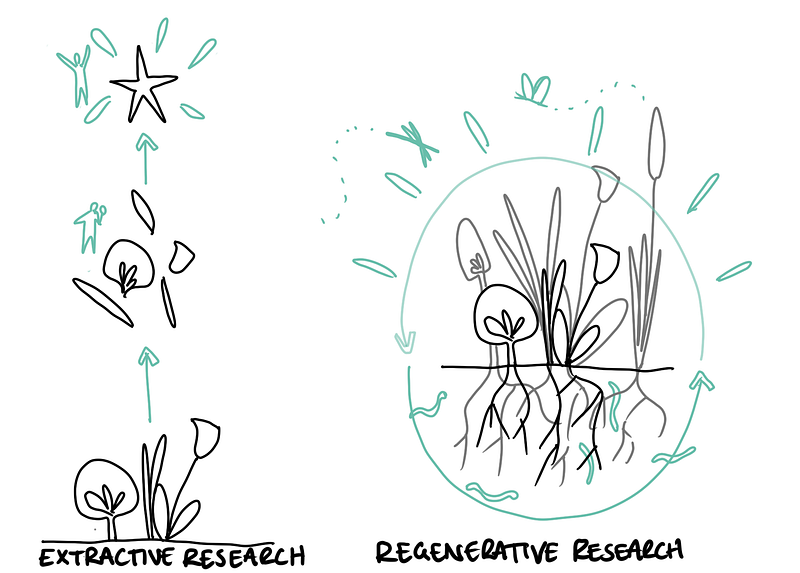
This post is part of a series reimagining what it means to research in place in ways that bring us closer to regenerative futures in which all life can flourish. Traditional research often involves a lone researcher visiting a place they are not part of to extract data. The researcher breaks this data down into separate parts through analysis to find a solution to a problem. Regenerative research invites co-creators rooted in place to gift data to a collective composting process: we layer multiple gifts and knowledges, allowing them to decay over time and slowly reveal potential pathways to flourishing futures. This composting is shared to be mulched into other places.
Here, I share the composting process from Stories of Place: a monthly gathering of curious co-creators who care about Dudley, collectively grounding ourselves in more-than-human understandings of our places, imagining more flourishing futures, and making small, cumulative, and connected actions to bring us closer to those futures. Together we are exploring:
How might we co-create conditions for regenerative cultures that bring us closer to life-centric futures?

Stories of Place co-creators
So far, the composting process has involved:
1 Gift gathering — We gathered materials for the compost, sharing what has happened in Stories of Place across the seasons in 2024.
2 Principles as a compost bed — I brought together knowledges around regenerative practices to evolve principles and questions that could catalyse the composting process:
- What helps, or could help, us to connect as part of Nature and place
- What helps, or could help, us to act towards just change?
- What helps, or could help, us to change our understanding of the world, and how we learn and do?
- What helps, or could help, us to care across time?
- What helps, or could help, us to do all of this together on a journey from ‘me’ to ‘we’?
Since then, Stories of Place co-creators became Earthworms, worming our way through the decaying gifts with our composting questions, combining our multiple perspectives, and connecting learning across the Dudley People’s School for Climate Justice. In this post, I share each composting question along with Earthworm castings that you might draw inspiration from. The castings contain nutrients that you might want to borrow, iterate, adapt and mulch into your own unique contexts and places (which we would love to hear about)¹:
- Learning patterns
- Design questions
- Intentions
- Wisdom we might draw from
- Composting stories for people who would like to burrow deeper into the learning
You can either read the summaries below, or dive straight into the deeper learning posts:
What helps, or could help, us to connect as part of Nature and place?
Part 1 - Burrowing deeper into Stories of Place composting
What helps, or could help, us to act towards just change (… or existence)? Part 2 - Burrowing deeper into Stories of Place composting
What helps, or could help, us to change our understanding of the world, and how we learn and do? Part 3 - Burrowing deeper into Stories of Place composting
What helps, or could help, us to care across time? Part 4 - Burrowing deeper into Stories of Place composting
What helps, or could help, us to do all of this together on a journey from ‘me’ to ‘we’? Part 5 - Burrowing deeper into Stories of Place composting
What helps, or could help, us to connect as part of Nature and place?


Learning patterns:
- Rituals of collective learning, reflection, imagining and making rooted in more-than-human perspectives can invite and deepen Nature connection and sharing of more-than-human and climate knowledges.
- Invitations, permission and recognition can help us shift from visitor and observer to being actively part of place.
These patterns differ from our everyday experiences and human-focused perspectives of seeing ourselves as separate from Nature and place, and extracting from Nature and place without reciprocity.


Design questions these patterns reveal for how Stories of Place might evolve this year:
- How might we think about our roles as part of our ecosys tems and places?
- How might we act in reciprocity with our ecosystems and places, centring more-than-human perspectives, healing and flourishing?
- How might we exchange learning between ecosystems and places?

Intentions for Stories of Place this year:
- Collectively name or reveal emerging roles in our ecosystems
- Find someone who can fix our 201bee hotel to our High Street sign!
- Continue to share and evolve place detectorism and Stories of Place with other places through these lab notes and the resulting emerging relationships, like our friends at MakeSpace who are prototyping place detectorism in Oxford.


Wisdom we might draw from:
- More-than-human justice — Helen and Bill of Workshop 24 introduced the term ‘more-than-human’ to Dudley High Street in 2021, inviting people to seek the more-than-human, framing and naming them as art pieces, and experimenting with more-than-human sounds to co-create an exhibition. Their art and research have created lasting and rippling effects, rooting the lab’s work in more-than-human. They are now exploring more-than-human justice through working with a pond as a more-than-human entity.
- More-than-human imagining / prototyping — Our collaborations with architecture and design students over the years have nourished our archive with their imaginaries of a regenerative Dudley. How might their explorations lead to smaller actions in the present that could bring these imagined futures closer to reality?
- More-than-human knowledges — Ekho Collective’s Reclaim our Roots project explored medical herbalism, and how people might build confidence around creating things with herbs through accessible learning that people can apply immediately. Could these knowledges and what is created invite us to ground ourselves in Dudley through taste? (It’s taken me so long to write this post, this has now happened!)


Cleavers water and Nettle tea tasting in Stories of Place, May 2025

Composting stories if you would like to burrow deeper into the learning: What helps, or could help, us to connect as part of Nature and place?
What helps, or could help, us to act towards just change?
Learning patterns:
- A process-focused culture might bring us closer to a culture of just existence.
- The social lab infrastructure that nurtures collective learning, creative processes and Time Rebel practices are a critical foundation for a horizontal exchange and deepening of knowledges, practices and relationships that shift imagining into action.
- Flexible structure is needed for non-linear imagining and making.
These help us to shift from being product or destination focused, away from the concept of making solely for productivity, and focusing on linear beginnings, middles and ends, which might limit possibilities or lead to action that perpetuates injustice.
Design questions these patterns reveal for how Stories of Place might evolve this year:
- How might we invite process-focused cultures through doing, rather than just imagining?
- What relationships can we build with our own creativity?
- How might it feel to imagine, create and make at different times between Stories of Place gatherings?
- How might play help to develop our creative processes?
Intentions for Stories of Place this year:
- Make with seeds of ideas to think, rather than just thinking in order to make (we are now doing this!)
- Explore how we might feel to be in creative processes, learn from each other and record and celeb rate our creativity journey over time through rituals of sharing our creative experiences.
- Creatively document the ripples of our Stories of Place interactions, in our individual and collective journeys.
- Invite material knowledges into the ecosystem without teacher / student dynamics
- Develop a library of group games that can supp ort our collective imagining, play and non-linear thinking.
Wisdom we might draw from:
- Making in order to imagine — Piers Taylor’s thesis explores how we might move away from only making when willing an idea into reality to revealing ideas through the process of making.
- Exchanging and connecting creative processes and tools — Mycorrhizal fungi create networks that transport nutrients and other resources across ecosystems. We could also be more like Salmon, connecting different ecosystems.
- Climate justice action through growing skills — Ekho Collective’s project, Tending People, Place and Planet, shared tools on climate activism, Nature journalling and Permaculture principles to build care and skills in wildlife friendly growing.
- Climate justice action through material skills — CIVIC SQUARE are exploring how neighbourhoods can retrofit their homes through learning and sharing skills in building in ways that “honour the reciprocal interrelation of land, materials, and people.”

Composting stories if you would like to burrow deeper into the learning: What helps, or could help, us to act towards just change (… or existence)?
What helps, or could help, us to change our understanding of the world, and how we learn and do?
Learning patterns:
- Regular gatherings with embodied activities in safe spaces that enable interactions between people on different journeys can invite unlearning, connecting of knowledges, reflexivity and difference, towards transition from business-as-usual mindsets.
- Invitations to pause in place can lead to noticing, sharing and learning from multiple places, cultures and worldviews.
- More-than-human kith invite multiple ways of experiencing, thinking, learning and imagining of multiple possibilities and intelligences.
These create opportunities for us to acknowledge and challenge dominant ways of thinking and power dynamics of teacher-student relationships that might close off conversations for people to voice difference. These experiences help us to recognise and wander from our siloed networks, usual ways of thinking and habits in place, which might otherwise limit possible futures.
Design questions these patterns reveal for how Stories of Place might evolve this year:
- How might we gradually build confidence in unlearning, staying with and shifting discomfort, and failing, while retaining a sense of wonder?
- How might we create invitations for more movement and play in our activities and learning?
- How might we listen to, remember, and bring multiple ways of knowing, including regenerative traditions and Indigenou s knowledges from our land, into our experiments?
- How might we bring more-than-human ways of bein g in other parts of our lives and systems?
Intentions for Stories of Place this year:
- Bring in more play!
- Connect with Ekho Collective’s learnin g from the land we are on.
- Creatively document our ways of being beyond Stories of Place.
Wisdom we might draw from:
- Building confidence to embody more-than-human kith — Helen’s social art practice often led them to exploring beaches as a Li mpet, which took time to build confidence to not “take this stuff seriously all the time.”²
- Bringing play into our lives — Sarah Round from the Bicycle Adventure Club invited people to ‘discover Dudley’s rich history and inspiring landscapes through the joy of play and the power of the bicycle’ through their Playtime in Dudley project as part of Urban Rooms Dudley — they created this inspiring video.
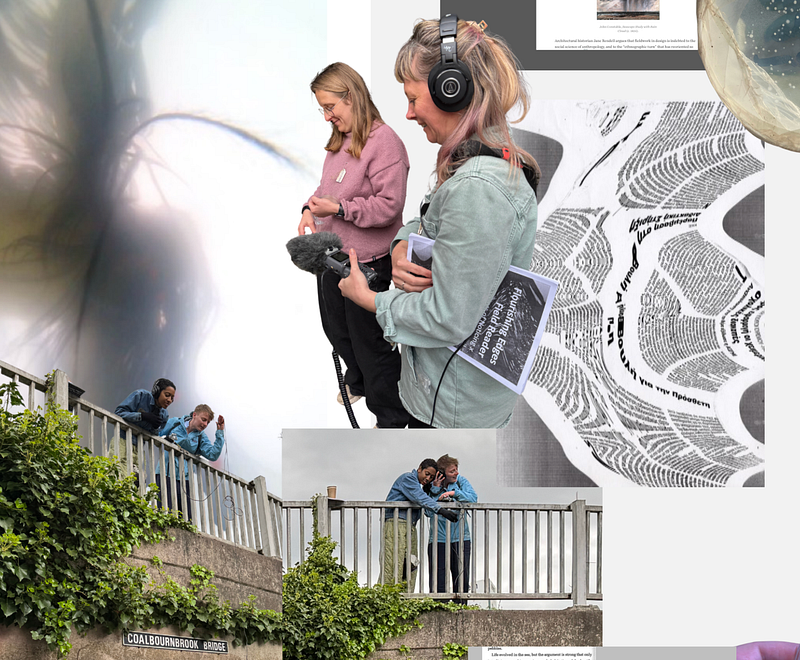
- Listening as critical spatial practice — Sonic Acts of Noticing are interested in “listening as critical spatial practice… might alter subjectivities and produce space in ways that emphasise care and shared learning as crucial for collaborative survival.”
Composting stories if you would like to burrow deeper into the learning: What helps, or could help, us to change our understanding of the world, and how we learn and do?
What helps, or could help, us to care across time?
Learning patterns:
- Rituals with more-than-human kith help us to expand our perceptions of time and long-term thinking.
- Stewarding knowledges and ideas can be a practice of relational long-term making and care.
- Ecological and wider systems lenses can invite reflections and imaginings around care.
These help us to shift us away from linear, short-term and individualistic thinking that might limit how we think about the world and what futures we can imagine. This also can help us to avoid action that is disconnected from place-based knowledges, perceives Nature and future generations as a resource to be extracted from, or prioritises productivity or efficiency through short-term solutions that might lead to harm.
Design questions these patterns reveal for how Stories of Place might evolve this year:
- How might we shift reflections of care towards practices of care?
- How do we distribute power in accessing, stewarding and evolving place-based knowledges?
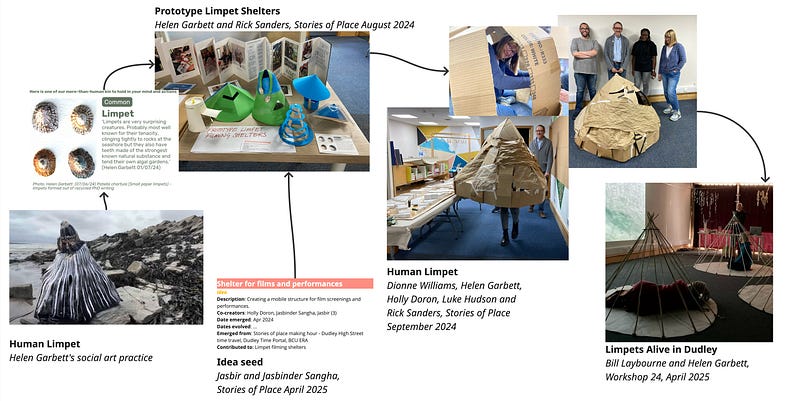
- How might we invite experimentation and long-term making as a regenerative cycle?
- How might we combine technological and social rituals with stewarding and connecting knowledges?
Intentions for Stories of Place this year:
- Integrate knowledges from Dudley People’s School for Climate Justice into the Dudley Time Portal and more-than-human kit h pool, gifting back interactions between them.
- Experiment with rituals of making with idea seeds (we’re now doing this!)
- Experiment with expressing and stewarding physical and social connections of knowledges.


Prototypes of the Dudley Time Portal Archive by Common Knowledge
Wisdom we might draw from:
- Place stewardship — Ekho Collective’s project One Mile Stretch invited people to regularly walk, litter pick and observe Nature along a mile of canal in Brierley Hill, as a form of evolving place stewardship.
- Sharing knowledge — Chimpanzees share knowledge by sharing tools. Slime molds “can learn and share what they learn with other slime molds by joining together for a time”.
- Digital archiving — Multitudes’ project Black Digital Archiving explored how community-based archives of Black history might “provide a springboard for further investigation, discussion and collaboration necessary to enact future change.”
- Experiencing time with Nature — Bill and Helen spent 24 hours inhabiting Alder Coppice, an ancient wet woodland in Sedgley, creating woodland sound music, experiencing the dawn chorus and Fern shadow drawing beneath a naturally dyed shelter.


Helen Garbett and Bill Laybourne, Workshop 24 in Alder Coppice
Composting stories if you would like to burrow deeper into the learning: What helps, or could help, us to care across time?
What helps, or could help, us to do all of this together on a journey from ‘me’ to ‘we’?
Learning patterns:
- A rhythm with hybrid gatherings supported by a virtual social space can invite cultures of collective curiosity, learning and reciprocity.
- The process of collective creativity through relational convening can invite multiple pathways of entry and ways of being.
- Space as a storyteller and a place of cross-pollination and unexpected connection plays a role in collective imagining and acting.
Collective responsibility and accountability are an alternative to expectations of service provision. Sharing our processes out loud demonstrates different ways of being as opposed to having closed processes as a siloed group. This helps us to value process as well as product, stretching beyond dominant ways o f being that can limit who can meaningfully be part of experiences. In our everyday experiences there is usually little dedicated space for imagination, creativity and paying attention to care and emotions, instead with efficiency and productivity being more valued and prioritised. These all might help us to shift from extractive behaviours to collective and regenerative behaviours.
Design questions these patterns reveal for how Stories of Place might evolve this year:
- How might Stories of Place nurture a collective culture that is resilient and decentralised?
- How might we evolve the physical archive in our spaces, embodying the digital archive in the lab, window and beyond across the Borough?
- How might documenting emotions in our gatherings invite connections between knowledges and ideas?
- How might we build collective knowledge and awareness of skills and resources available in ou r ecosystem?
Intentions for Stories of Place this year:
- Invite collective and self-organising hosting, convening and documentation.
- Let go of pressures of destinations and allow time to think, revisit questions and reveal connections.
- Create rituals with data humanism to document and value emotion.
- Create rituals around sharing our processes.
Wisdom we might draw from:
- Regenerative resilience — Common Vision’s Playbook for the Future ‘Toward Regenerative Resilience’ is a wonderful resource in understanding how grassroots community groups can “adapt to future societal transitions.”
- Peer learning journeys — Huddlecraft’s work on peer-led learning journeys, more recently with CIVIC SQUARE, are always an inspiration.
- Collective creative documentation — Jo has been co-evolving detectorism through CoLab Dudley over the years, which is our approach to learning: it “encourages knowledge sharing in multiple forms and mediums meaning it translates and transmits across multiple ways of knowing.” As part of detectorism, Jo has been exploring how a collective responsibility around creative documentation might contribute to how we learn together:
“Creative documentation can start small and simple, and might grow as a series, becoming cumulative in its building and archiving of knowledges and knowledge production processes. It might be a form of creative journaling, a photographic essay, collage or zine series, artefact assemblage, recorded audio or film, counter-map, crafted artefact, conceptual illustration, or any form of creative response to activities or interventions.” — Jo Orchard-Webb and Lorna Prescott, 2024

Composting stories if you would like to burrow deeper into the learning: What helps, or could help, us to do all of this together on a journey from ‘me’ to ‘we’?
- These nutrients were inspired by Jo Orchard-Webb’s structure for ‘Unlearning and Emergence Detectorism Notes’ for the first year of Dudley People’s School for Climate Justice in 2024.
- Helen Garbett, October 2024
Stories of Place Co-creators
Abby Staniland (Earthworm / Orkney Vole) grew up in Dudley, worked at the zoo and is now a budding landscape architect, bringing their connective imagination and visualisation talents. With other design students, Abby gifted dreams of local folk swapping waste plastic for Dudley pounds to mould into pop-up modular community tables for people to exchange goods, collaborate, create and learn together.
Alex Lui (Limpet)
Andy Edwards (Limpet)
Bill Laybourne (Sludge Worm) is full of fascinating facts and provocations, bringing laughter and inspiring disorder. Bill‘s sound-based social art practice led to co-creators noise making with more-than-human sounds of the High Street.
Caz Emery (Ginger) has a reputation for creating something out of nothing and getting stuff done, with curiosities around craft, nature and food. They are often found cooking plant-based meals on the campfire feeding and nurturing the Ekho Collective community.
Deb McDonald (Ant) is a network weaver, bringing knowledges and curiosities from Ekho Collective, and is particularly curious about how people can collectively engage with creativity, culture and heritage to co-create resilient communities.
Dena Khan (Bumblebee / Shark / Swift) brings an imagination that centres young people and how they can shape and renew places through creativity, connecting with multiple generations. They are curious about buildings being perceived as waste, and how we can bring life to them again through care and connection.
Dionne Williams (African Migrant Butterfly / Limpet / Mycelium / Northern Pool Frog / Red Squirrel) is a deep thinker and doer drawn to creativity and experimentation. Dionne has a gift for nurturing welcoming, safe and generous spaces, currently exploring how East African values might invite conversations and creativity that bring us closer to Nature-connected values in Dudley.
DKB (Dragonfly / Ginger) is curious about sharing sustainable farming and growing knowledges between different places across the world to help build hopeful resilience within the Earth crisis. This curiosity is rooted in their captivating childhood memories of running through their farm pausing to eat fresh mangos.
Erica Williams (Buddleia / Ginger) is a walking encyclopaedia of Black Country history, whose Storylines blog is rich with research connecting family history with wider systemic issues. Erica has a wonderful ability to connect ideas to inspiration from places across the world and knowledges gained from her background in teaching and training business communication, particularly in the marketing communications industry.
Helen Garbett (Little Whirlpool Ramshorn Snail / Limpet / Orkney Vole / Sludge Worm) always brings a contagious curiosity rooted in their social art practice exploring human entanglement with Limpets. Helen has a magical ability to shift us from imagining to making, inspiring us with their creations between our gatherings, and, of course, spark collective fascination in all things Limpet.
Holly Doron’s (Chiffchaff / Earthworm / Fountain Water / Great Diving Beetle / Limpet / Moth) favourite moments are watching people spark with others over a thought or idea so they try to create the conditions for this to happen while listening, note-taking and connecting learning and curiosities.
Jack Williams (Water Strider) brings their wildlife conservation knowledges from Dudley Zoo and is curious about what zoos might look in the future as spaces for community, nature connectedness and wellbeing.
Jan Norton (Hazel Dormouse / Peacock Butterfly / Robin / Zitting Cisticola) brings their creativity, stories with Nature, smiles and stunning skills and ideas with fabrics and stitching. Jan is a convenor of Stitchers in Time who research and create beautiful pieces connecting textiles, fabrics, stitching and other media with Nature, place, stories with heritage and futures.
Jasbinder Sangha (Puddle)
Jasbir (Water Strider)
Jhora Sangha (Pigeon)
Jo Orchard-Webb (Gorse / Hawthorn / Hedgehog / Mycelium) joins virtually from the Dorset seaside, bringing Nature perspectives and curiosities from Eric-the-dog walks along with their deep care for Dudley. Jo has a talent for absorbing and connecting everybody’s ideas with wider ecosystems and knowledge networks.
Laura Jane Round (Hammerhead Shark)
Laura Onions (Limpet) has an inspiring ability to get stuck in with making, gifting their creativity and curiosity to other co-creators. Laura’s art practice is rooted in printmaking and how this can take on new forms out and about with Nature across the Black Country.
Lorna Prescott (Barn Owl / Great Diving Beetle / Hedgehog / Nettle / Red Fox / Swift) brings years of lessons from doing in Dudley alongside deep thinking around systemic issues behind our everyday interactions. Lorna is full of curiosity and wonder around anything more-than-human and deep time.
Luke Hudson (Dragonfly / Great Mouse-Eared Bat / Limpet) brings their fascination and knowledges around green living, Nature and psychology, alongside their curiosity and laughter, diving into and co-evolving whatever unexpected activities co-creators are dreaming up.
Miriam Atikpo always brings deep reflections with critical thinking rooted in a stunning abundance of cultures and languages. If she’s not with us, it’s because she’s busy spreading care in the NHS.
Nat WB (Bumble Bee, Hedgehog, Little Egret)
Natalie Marsh (Snail)
Nichaela Reid (Bumble Bee)
Paul Burns (Hawthorn / Mycelium) brings invigorating perspectives and prose as a creative writer with a fascination in more-than-human folklore. Paul is generous in sharing photos and videos of their local wildlife in between gatherings and always has interesting Dudley memories to share.
Rachael Othala (Fountain Water / Great Diving Beetle) always arrives full of Dudley energy and curiosity, inspiring other co-creators with their creativity through making and poetry. They are curious about how the LBGTQIA+ community and allies can explore art together.
Rebekah Warmington (Badger / Bear / Buddleia / Ladybird) brings her gifts in creative making and thinking, with an extraordinary ability to weave deep reflections in the moment. Rebekah generously shares her experience in learning with and from Nature and Indigenous knowledges. She is also deeply inspired by play, and how experiential learning can enhance and guide the connections we make in our journeys of exploration and discovery.
Rick Sanders (Beaver / Limpet) brings their do-it-together spirit, gifting inspiration from their practice in poetry and breathing creativity into upcycling furniture and textiles.
This research is funded by the Arts and Humanities Research Council through Midlands4Cities. It is entangled with my work at CoLab Dudley funded by The National Lottery Community Fund’s Climate Action Fund and Joseph Rowntree Foundation as part of a network of Pathfinder organisations reimagining and redesigning the world we want to live in to achieve deep, transformative change.