Stories of Place 2024 Composting #1 | Gift gathering
A collection of gifts: an abundance of co-created Stories of Place resources, experiments and explorations through the seasons in 2024.
Stories of Place is a monthly convening of curious co-creators developing an understanding of Dudley, collectively imagining flourishing futures, and rehearsing these futures in the present through experiments and prototypes. Relational learning through doing underpins everything we do, which we share openly here.
data analysis → gift composting
In traditional academic research, data is captured, collected or extracted to be broken down into parts through analysis in order to find a solution. If we dig deeper, the word ‘data’ is actually rooted in words related with giving and gifting, rather than collecting and capturing. So, in Stories of Place, rather than extracting data to analyse, we gather gifts to compost. Composting invites multiple beings and knowledges to the learning process, leaving the learning to rest and mature, creating the conditions for new knowledges and potential journeys, not solutions, to emerge.
This lab note is the first of several stages of composting:
1 Gift gathering — We gather and celebrate materials for the compost, sharing what has happened in Stories of Place across the seasons in 2024.
2 Principles as the compost bed — I bring together knowledges around regenerative practices to evolve principles and questions that create the base of the compost, bringing structure with a mix of old soil/learning to help with drainage and air circulation (or the thinking process).
3 Co-creators as earthworms — The layers of composting/learning material are in place ready for Stories of Place co-creators to worm their way through, reflecting on the year, foraging and connecting learning.
4 Turning — The earthworms have left the compost as microbes break down the material and release heat. I regularly turn the compost over winter hibernation, revisiting the learning and letting it mature in the back of my mind, before bringing it back into Stories of Place 2025, when we re-emerge in spring.
These lab notes are a way of processing and sharing praxis (learning/research + doing/practice) as I go along, rather than hoarding it and editing detail out for a much more concise report/thesis another couple of years away. Writing is a thinking process for me, and I’ve found that unexpected connections and futures can emerge from sharing unpolished thoughts. So, you are welcome to delve into the depths of the compost below, or just look through the skimming guides at the beginning of each post. These lab notes are a process of sharing practices, rituals, tools and resources which you are welcome to borrow, iterate, adapt in your own unique contexts and places (this work is licensed under Creative Commons CC BY-NC-SA 4.0). We’d love to hear if this sparks anything for you.
Autumn is a time for foraging, gathering the gifts of the year as they fall to the ground within grasp. This lab note gathers this year’s abundance of gifts to celebrate them before we enter winter hibernation and composting, when we’ll dig into the deeper learning behind all the activity.
For quick skimming, this lab note shares:
Transition from 2023 to 2024 | I share key co-designed changes to Stories of Place. This might be helpful for people who convene co-creative gatherings or research.
Emerging experiments across the seasons:
- Spring — Sprouting | Try grounding in place with Place Detectorism or connect with ideas around East African culture, archiving, languages and dialects, more-than-human folklore, mollusc-mindedness, the CreaTures framework, or imagining 100+ years into the future.
- Summer — Flowering | Explore Place Naming or seeking patterns in nature, or connect with upcycling magazines into beads, flourishing processes on the High Street, stewarding seeds of ideas through diagrams, or prototype modelling.
- Autumn — Fruiting | Dip into Human Limpet making, learning foraging or the mobile Jellimpet.
- Winter — Hibernating | Step into the Dudley Time Portal before parting for hibernation.
Transition from 2023 to 2024
At the end of 2023, Stories of Place co-creators planned how we’d want our gatherings to evolve with the Dudley People’s School for Climate Justice, shifting towards nature connection and climate action. I was about to say Stories of Place felt especially different this year, but it does every year. It’s never static and constantly changes with who joins and the knowledges and lived experiences we each bring, and what emerges from each gathering. When we gathered again after a winter break in 2024, the key changes were:
Grounding and making hour — Last year, Stories of Place co-creators decided we could do with more time to do. So each session now begins with an activity to help ground ourselves in place, followed by collective reflection on our experiences, which inevitably sparks ideas and collaborations. Then we shift into making hour: co-creators choose to either branch off to focus on an experiment, or join an optional group activity to either prototype experiments or help us to reveal experiments we’d like to focus on in future making hours. We then close the session sharing our bubbling thoughts and actions.

Dudley Time Portal — This year, Stories of Place became part of Dudley People’s School for Climate Justice. We imagined Stories of Place as having a role in gathering, caring for, sharing and connecting stories, imagining and learning from projects across the school within a digital archive called Dudley Time Portal, which we’re currently co-designing with community technologists, Common Knowledge. In the meantime, we have a dedicated room at CoLab Dudley to physically manifest the archive.

Rehearsing 100 years — We had an overall theme to weave our acts of learning and doing, and to hopefully invite us to shift towards climate action.
More-than-human kith pool — Each gathering now begins with us choosing a natural companion (or more-than-human kith) from a pool of prompt cards to have in our minds throughout the evening to invite us towards connecting as nature. This was a shift from the previous invitation to take a ‘tool’ from nature to open up our senses, to gently building kithship. Lorna shared Lyanda Fern Lynn Haupt’s definition of kith: They explain that while kinship involves inherent connections, such as through blood, kithship is an intimate connection ‘with the landscape in which one dwells and is entangled, a knowing of its waymarks, its fragrance, the habits of its wildlings’. Unlike kinship, kithship is earned through being near, still, opening up and observing in our places, and crossing ‘dimensions of knowing’.

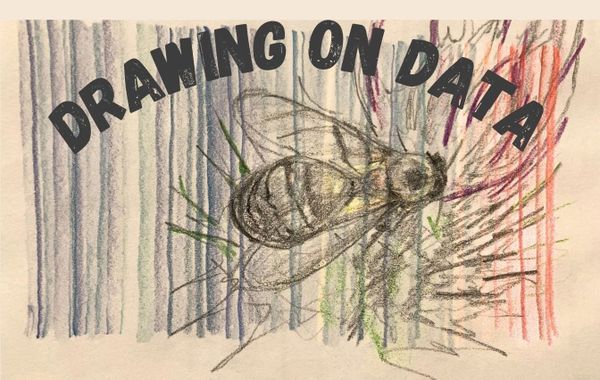
At the 2023 Dudley Creates Winter Gathering, the Stitchers in Time group invited people to sit below bunting they had created together — intricately stitched with wildlife native to the UK, with a coloured ribbon indicating whether they were extinct, endangered or of ‘least concern’. I sat with Lynne, Jan and Jen who invited Dionne, Nat WB and I to choose an animal and trace and colour them. We spent time chatting together with Hoverfly, Squirrel, and Swan. This was a transformative experience for me. Dudley Creates gatherings are beautiful, inviting, inspiring, collectively curated events, but when in groups I often feel overwhelmed with processing facial expressions, movement and sounds which leaves little brain space to process what people are saying nor thinking of what I can contribute to conversations. Focusing on my new Hoverfly friend unlocked the conversation part of my brain and I felt like a different person with a newfound appreciation and responsibility of care towards Hoverfly. I was also blown away by the Stitchers in Time folder of drawings and the research they’d gone into for each animal: pages of knowledge they had foraged and creatively translated into their bewitching bunting. They gave me the idea to grow a more-than-human kith pool from local experiments and curiosities. To begin, Jan generously gifted their notes and photos of each flag and the more-than-human kin pool sprouted with us in spring, growing over the year: here is the latest version which you are welcome to spend time with in your own places.


My time — the CoLab Dudley, CIVIC SQUARE and Birmingham School of Architecture teams managed to obtain funding for me to do a full-time collaborative PhD. Having previously stewarded Stories of Place in less than one day a week, this has given me time to more meaningfully nurture co-creative conditions for Stories of Place to evolve, rooted in deeper learning.
Collective care and consent — Along with a PhD comes official procedures around ethics and consent. I didn’t want Stories of Place to be co-opted by institutional processes which might lead to the relationship between my fellow co-creators and myself, as the researcher, becoming extractive. Instead, we are continuing our learning journey together with collective care principles we co-wrote, and with ongoing relational consent. Each gathering, we can shift what we consent to — photos of ourselves, our hands creating or what we create, recordings or quotes of what we say, and whether we want our contributions to be credited or anonymous.

Sharing learning — I already kept Miro boards of most sessions, recording our conversations, photos and links, and shared these on our group Slack channel. We now have a hub for all sessions on Miro and shifted to a more accessible WhatsApp group, where we could share inspiration, plan sessions and have a ritual of monthly miro board sharing.

Invitations — Having previously relied on word of mouth, Twitter and Instagram, I now share invitations on Eventbrite and a monthly changing poster in our High Street lab window. Each co-creator is gifted a welcome pack and a notebook containing swappable kin and question cards. These invitations include different roles people can join as: butterflies flitting in and out, or maybe even only once, but bringing curiosity and inspiration each time; bees frequently joining and focusing on doing; worms digging into the learning; and ants connecting and contributing stories during and between gatherings.


Spring — Sprouting
Co-creators and our more-than-human kin: Bill Laybourne / Sludge Worm; Dionne Williams / Red Squirrel / Mycelium; Erica Williams / Buddleia / Ginger; Helen Garbett / Little Whirlpool Ramshorn Snail; Holly Doron / Earthworm; Jan Norton / Hazel Dormouse; Jasbinder Sangha / Puddle; Jasbir / Water Strider; Jhora Sangha / Pigeon; Jo Orchard-Webb / Hedgehog / Hawthorn / Gorse; Lorna Prescott / Great Diving Beetle / Red Fox; Miriam Atikpo; Nat WB / Bumble Bee; Natalie Marsh / Snail; Nichala Reid / Bumble Bee; Paul Burns / Mycelium; Rick Sanders.

Stories of Place was ready to sprout up again, emerging from winter frosts. The hours were still dark for our first gathering so we settled in with cosy cuppas in the lab, and from our homes. We opened the gifts of ideas and intentions that we had stored in a time capsule over winter, honoured them and welcomed them into the new year. We eased ourselves in, reacquainting ourselves with previous ideas and connecting them with new co-creators and their multiple knowledges and ways of being.
As the evenings became lighter, we began gatherings by grounding ourselves on Dudley High Street through Place Detectorism. With a more-than-human companion from the kith pool, co-creators ventured out onto the High Street with a map, sensing and experiencing place in multiple ways, and returned with observations and stories, which inevitably sparked curious conversations, place-based knowledge exchanges, connections and ideas. You are welcome to try this in your own place with the Place Detectorism pack.

In making hour, co-creators began prototyping their experiments:
East African culture on Dudley High Street — Dionne picked up their seed of an idea from last year to celebrate East African culture on the High Street through Maasai beading, and exploring the values different colours represent.

Archive of doing in Dudley — Lorna was excited about using making hour to build an archive of CoLab Dudley’s platforms, experiments, infrastructure and governance from the past 10 years.

Languages and dialects in Dudley — Jhora and Natalie were inspired by their first Place Detectorism experience and explored counter-mapping and translating the Dudley dialect on the High Street into different languages, with colours and fonts to represent them, to invite connection and orientation within different cultures.

Dudley more-than-human folklore — Paul was also inspired by Place Detectorism to explore the mythology and folklore behind nature and ‘uninvited guests’ who have decided to live with us in Dudley.
Mollusc-mindedness on Dudley High Street — Helen’s Place Detectorism adventure on the High Street drew her (and me!) to considering what mollusc-mindedness might look like on the High Street.

CreaTures in Dudley — Lorna, Jo and Miriam were curious about the CreaTures Framework, a tool for ‘evaluating creative practices, and how they connect to transformative change’, and how this might reframe their understanding of risk assessments.
In making hour, I also hosted optional making hour activities for co-creators still seeking their experiment ideas. Inspired by the futures cone, we created a collective drawing: surfacing existing ideas, interests or issues we are drawn to with multiple knowledges, talents, skills and ways of thinking and doing; looking 100+ years into the future to explore what pathways our existing ideas might unlock, and what is missing; and connecting our imagined futures with existing knowledges to unearth experiments we can do now to rehearse the next 100 years. Another activity invited co-creators to forage stories from our physical archive, the Dudley Time Portal, and create a collage of a future High Street. These invited the emergence of experiment ideas around:
- Futures with AI — Bill was curious about exploring possible futures according to AI, depending on what we ask / teach it.
- Storytelling for transformation — Jo, Jan and Rick’s conversations took them to thinking about deep time and expansive storytelling as an ancient technology to bridge the past, present and future possible worlds, narratives and ways of being.
- Flourishing High Street — Nichala, Jasbinder, Erica and Jasbir had lots of ideas to bring us to more creative and flourishing futures, inspired by Place Detectorism and architecture student drawings they had foraged from the archive: street art, generation of electricity on exercise bikes, bee hotels, inviting people to create Dudley slogans and images to print on gifts / t-shirts, creating a mobile structure for films and performances, celebrating Dudley’s architecture, a waste exchange to repair, upcycle or compost through collective activities, and growing spaces and roof meadows to invite people to learn about and care for nature.

Between gatherings, co-creators began sharing where their Stories of Place curiosities had led them. Erica was inspired and motivated from Stories of Place gatherings to create a blog, Storylines, connecting their family history with wider events and systemic issues in the Black Country. Jo shared further reading they’d done around storytelling practices, inspired by their conversations with Jan and Rick. This inspired me to start a ritual of sharing curiosities and gifts between each gathering to connect co-creators whether they are able to make each it time or not. Other co-creators began sharing photos of nature around their neighbourhoods and even a ‘Snails of the High Street Unite’ badge.

Summer — Flowering
Co-creators and our more-than-human kin: Abby Staniland / Orkney Vole; Dena Khan / Swift; Dionne Williams / African Migrant Butterfly / Northern Pool Frog; DKB / Ginger / Dragonfly; Helen Garbett / Little Whirlpool Ramshorn Snail / Limpet; Holly Doron / Great Diving Beetle; Jan Norton / Zitting Cisticola / Peacock Butterfly; Laura Jane Round / Great Hammerhead; Lorna Prescott / Swift / Nettle; Luke Hudson; Miriam Atikpo; Nat WB / Little Egret; Paul Burns / Hawthorn; Rebekah; Rick Sanders.
As the (slightly) warmer months with lighter evenings set in, we tried other activities to ground us in place. Back in 2022, Helen invited co-creators to prototype an idea developed with Kirren and Alan: Place Naming: Transform Anywhere to Somewhere. We sought out micro places on the High Street and created a name for them. This time, we tried it with our more-than-human kith and, due to the rain (which there was a LOT of this summer), Dionne, Helen, Jan and I used our imaginations to track through our spatial memories of the High Street while Lorna explored the sheltered roof space above our space for new more-than-human place names to emerge:
- The Great Bore
- Great Mining Beetle
- Butterfly House
- Creeping Critter Corner
- Rainy Day Black Tar Pond
Lorna also invited us to ground ourselves on the High Street by seeking patterns in nature, inspired by Looby Macnamara’s People & Permaculture. We quietly observed the High Street around us, from the macrocosm of the clouds in the sky to the microcosm of how seeds are scatted, looking out for branches, spheres, scales, lobes, stacks, honeycombs, spirals, waves, starbursts, nets, flocking and bubbles. We then gathered to explore where else we have seen these patterns in our lives and communities, and examples of humans mimicking patterns in nature to solve design problems.

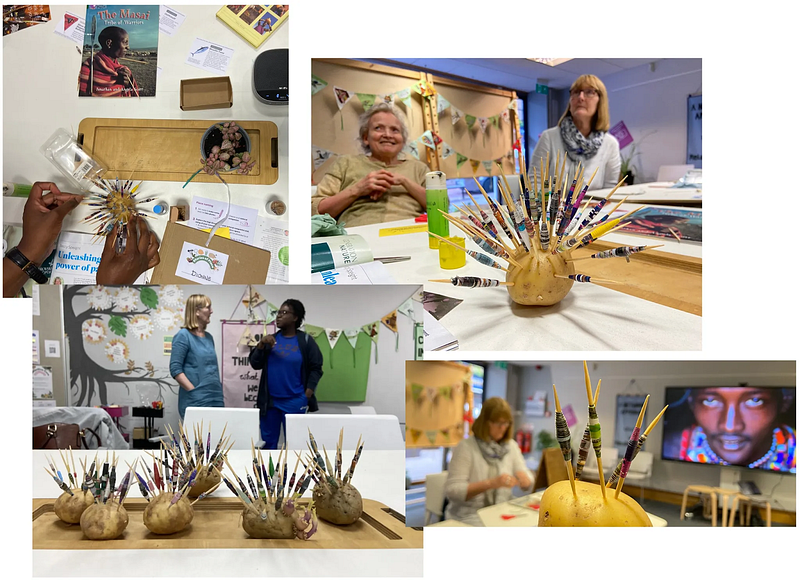
Making hour created space for Spring’s sprouting ideas to bloom. Dionne led the optional activity in two gatherings, inviting other co-creators to prototype their East African culture invitation. We sat together, upcycling magazines into paper beads while talking about East African values, and what values Dudley might have. This led to beautiful conversations, and sculptural potatoes, which I will delve into in the third stage of composting.

In July, with a flurry of new co-creators, we collectively explored what flourishing processes on the High Street might look like, drawing knowledges and inspiration from systems diagrams created by Birmingham School of Architecture students. Inspired by Miriam’s storytelling around the CreaTures Framework, I delved into the Framework’s questions that they ask creatives to unearth learning around their practices and transformative change, and created prompt question cards. This led to a fascinating layer of critical thinking around the ideas that emerged from making hour and, in turn, evolved with our conversations around them (I’ll also dig more into this in the third stage of composting). Emerging ideas included:
- Fabric truths and exchange — Jan was drawn to systems diagrams around textiles and wondered about inviting people to exchange the fabrics and processes they use, while questioning colonisation in relation to fabrics.
- Hidden spaces — Dena found a diagram that labelled derelict or empty buildings as waste, which was a new perception for them. Dena imagined opening up (waste) buildings for youth takeovers. Abby, DKB, Jan, Paul, and Laura Jane loved this idea and imagined them being used for play and artist residencies.
- Common ground — Abby started connecting systems diagrams of water, energy, air and culture leading to a curiosity around what disconnects and connects people, and what stories different cultures associate with ground.
- Audio histories — Nat WB, inspired by Abby’s link between cultures and stories, was curious about histories on the High Street and imagined audio guides to share stories.
- Growing learning exchange — DKB imagined creating spaces for growing food on the High Street and from gutters with a learning exchange of farming knowledges between communities across the world responding to climate change.

With an ever-growing abundance of seeds of ideas, I returned to the initial intention of the year to steward and care for knowledges. It can be all too easy for these ideas to be forgotten. In the background, I’d been trying various ways to visualise the connections between ideas to make tangible and honour how Stories of Place co-creators evolve each others’ ideas, whilst positioning them in the context of deep time to invite long-term thinking, rewriting our year date as if year 0 was 4.5 billion years ago when life emerged on earth (welcome to the year 4500002024). I prototyped rhizome-inspired diagrams, experimenting with how I could make it editable by every co-creator, but they were becoming increasingly complex and unintelligible. Inspired by Helen’s tactile concertina sketchbooks, and remembering mini zines Time Rebels were invited to create around our learning processes, I considered creating something similar that might invite co-creators to handle, interact and messily contribute, but our gatherings are already full of activity to create space for this.

I concluded what we needed for now were seeds of ideas that we could physically hold, and that showing the connections could come later as we co-create the Dudley Time Portal with Common Knowledge (who know how to code all this). The result was a collection of seeds of ideas that could be printed, cut out and sprinkled across the lab space. The effect of stewarding idea seeds was immediate. In August, Helen and Rick were drawn to Jasbinder and Jasbir’s April idea of mobile structures for films and performances and, accompanied by their Limpet kith, they created models of Limpet-inspired structures that we could instead explore and create more-than-human films from within. A seed of an idea had flowered prototypes, which were about to bear fruit.

Autumn — Fruiting
Co-creators and our more-than-human kin: Alex Lui / Limpet; Andy Edwards; Dionne Williams / Limpet / African Migrant Butterfly; Helen Garbett / Limpet / Orkney Vole; Holly Doron / Limpet / Fountain Water; Jo Orchard-Webb / Mycelium; Laura Onions / Limpet; Lorna Prescott / Hedgehog; Luke Hudson / Limpet / Great Mouse-Eared Bat; Rebekah / Badger / Bear; Rick Sanders / Limpet.
As the darker evenings crept back in, we felt vitalised by the summer activities and decided to break the grounding in place / making hour structure for our September gathering. We wanted a whole two hours of making to prototype Helen and Rick’s idea to create Human Limpet. It turned out to be a transformative experience for those making Human Limpet, and those climbing within (also explored more in the third stage of composting). We made it too big to fit through the front door, so rather than being a shelter for creating films along the High Street, this prototype became our resident safe space. Since then, the team, students, and NHS and Council employees have enjoyed the tranquility of the Human Limpet.

By the time the leaves were falling in October, we grounded ourselves in place by walking back in time over the year, reminding ourselves of and meeting other co-creator ideas and activities from each Stories of Place gathering, foraging anything that we wanted to celebrate. The resulting conversations, rich with reflections and learning, are also shared in the third stage of composting.

At the end of our foraging, an idea emerged for what we could co-create for this year’s Dudley Creates Winter Gathering: Jo was drawn to a mobile that shows the physical connections between Stories of Place experiments and Rebekah thought about creating a nest for hibernation that could have learning from the Nature woven in. The ideas layered and morphed into a dream of woven Limpet nest mobile, with seeds of ideas hanging, connected, being blown by sounds from the High Street, car horns distorted into wind. We dreamt of reconvening in spring, bringing gifts from nature that we had foraged over winter.

As our year cycle came to a close before winter hibernation, our final gathering focused on making. Rebekah had been chewing on their idea of weaving nests and adding connections with Nature, and evolved it into a wearable embroidered nest. Dionne, Luke and Helen began weaving the limpet, creating it from within the Dudley Time Portal room (we’d learnt our door-limiting lesson from the Human Limpet). Laura and Alex, for their first Stories of Place experience, delved straight into a process of limpetisation — experimenting with creating little limpets to weave into the mobile. Laura, Luke and I spent time with the seeds of ideas, sorting them ready to hang from the mobile. The result: Jellimpet (the tendrils reminded us of Jellyfish).

Winter — Hibernating
In our last Dudley People’s School for Climate Justice team learning gathering of the year, I used reflection time to finish hanging the idea seeds, and started to weave connection between them to show how they’d evolved and informed each other. In preparation for the Winter Gathering, I added all the new Place Detectorism maps to walls, rejigged the archive on display, and brought other experiments from across the ecosystem into the archive as a film screening (including the wonderful work of Ekho Collective and Boiler Babs). Human Limpet had also been magically squidged into the Dudley Time Portal, creating a cosy corner for anyone who wanted a social break during the Winter Gathering.

Of course, I didn’t finish in time for when our first guests arrived, but I don’t know why I was surprised by this. Stories of Place is never finished. I discovered sticking gifts from the archive onto the wall throughout the evening unleashed the conversation part of my brain for visitors to the Dudley Time Portal. Again, I don’t know why I was surprised by this after my Stitchers in Time experience from the last Winter Gathering. No, the connections weren’t fully visible on the mobile, but I realised I was embodying the archival connections:
Visitor 1: “I’m really interested in family history but also understanding the wider context of what was happening at the time.”
[Archive]: “Oh, in that case you’d love Erica’s blog, Storylines. There are so many rich layers of history connecting personal and wider systemic stories.”
Visitor 2: “You might have met my husband already.”
[Archive]: “Yes! Your husband joined the first ever Stories of Place: here are their Place Detectorism drawings from 2021, and here is a photo of fossils they sent to the archive!”
Before our guests departed, Jo asked everyone ‘What is your favourite way to be a good ancestor shared today?’ One person was inspired by Human Limpet: “There are so many things I have [been] introduced to today that I would never have imagined before. How this work is key to unlocking creative agency and climate action”. Another said: “Big conversation in the time portal — love how the time portal holds our memories and we imagined 2025 as the limpet year — how for Helen the limpet to others has gone from the “preposterous” to possible recognised practice people are curious about.”
With this final burst of social activity, I will now settle into hibernation. The leaves and fruits have fallen from the branches, and I can now see more clearly the branches, the underlying structure, the connections. With my nest of blankets and twinkling lights, I will settle into the darker months, composting the learning, gifting the partially decomposed compost back to my fellow Stories of Place co-creators, and seeing what emerges from our collective composting as we hibernate with the gifts from this year.
This research is funded by the Arts and Humanities Research Council through Midlands4Cities. It is entangled with my work at CoLab Dudley funded by The National Lottery Community Fund’s Climate Action Fund and Joseph Rowntree Foundation as part of a network of Pathfinder organisations reimagining and redesigning the world we want to live in to achieve deep, transformative change.