Stories of Place 2024 Composting #2 | Principles as a compost bed
Holly is researching how we might invite regenerative cultures. A year ago Holly shared regenerative principles emerging from their research. Here they share why and how these principles emerged and are still evolving.

Stories of Place is a monthly convening of curious co-creators developing an understanding of Dudley, collectively imagining flourishing futures, and rehearsing these futures in the present through experiments and prototypes. Relational learning through doing underpins everything we do, which we share openly here.
data analysis → gift composting
In traditional academic research, data is captured, collected or extracted to be broken down into parts through analysis in order to find a solution to a problem. If we dig deeper, the word ‘data’ is actually rooted in words related with giving and gifting, rather than collecting and capturing. So, in Stories of Place, rather than extracting data to analyse, we gather gifts to compost. The CoLab Dudley team often use nature metaphors like composting and mulching to describe our learning processes. Composting invites people with different knowledges to the learning process, leaving the learning to rest and mature, creating the conditions for new knowledges and potential journeys, not solutions, to emerge.
This lab note is the second of several stages of composting:
1 Gift gathering — We gather and celebrate materials for the compost, sharing what has happened in Stories of Place across the seasons in 2024.
2 Principles as a compost bed — I bring together knowledges around regenerative practices to evolve principles and questions that create the base of the compost, helping the thinking process.
3 Co-creators as earthworms — The layers of composting/learning material are in place ready for Stories of Place co-creators to worm their way through, reflecting on the year, foraging and connecting learning.
4 Turning — The earthworms have left the compost as microbes break down the material and release heat. I regularly turn the compost over time, revisiting the learning and letting it mature in the back of my mind, before bringing it back into Stories of Place 2025, when we re-emerge in Spring.
These lab notes are a way of processing and sharing praxis (learning/research + doing/practice) as I go along, rather than hoarding it and editing detail out for a much more concise report or thesis another couple of years away. Writing is a thinking process for me, and I’ve found that unexpected connections and futures can emerge from sharing unpolished thoughts. So, you are welcome to delve into the depths of the compost below, or just look through the skimming guides at the beginning of each post. These lab notes are a process of sharing practices, rituals, tools and resources which you are welcome to borrow, iterate, adapt in your own unique contexts and places. We use language that might be unfamiliar, so here is a glossary that the CoLab Dudley is gradually adding to and continually updating.
This work is licensed under CC BY-NC-SA 4.0 which requires reusers/evolvers to give credit to the co-creators. It allows reusers/evolvers to share, remix, adapt, and build upon the material in any medium or format, for noncommercial purposes only, under the same sharealike terms. We’d also love to hear about it too to gift learning to each other.
______
I am researching how we might invite regenerative cultures, recognising sustainability isn’t enough to undo the damage we are doing to Earth. How might we nurture conditions to heal towards futures where all life can flourish?
A year ago, I shared regenerative principles that were emerging from my research. Here, I want to share why and how these principles emerged and are still evolving. I have Jo in my head saying, “It’s not just what we do. It’s how we do.” So here I share how I’m doing, which will hopefully reveal what I’m missing. This might generally be of interest to people who are interested in:
- Principles-focused evaluation
- Practice-based learning
- Decolonising academia
- Regenerative praxis or ways of being
- Adapting some of these processes with your unique contexts
Skimming guide
- Why principles | CoLab Dudley’s principles helped me transition into starting a PhD while holding onto lab ways of working. They helped to counter isolation by centring networks, navigate with complexity, spark creativity, invite being a good ancestor, and invite research through doing. This led to developing my own principles to help me hold boundaries to extractive behaviour in my research.
- Evolving the principles from multiple knowledges | The principles aren’t new knowledge, they are built on multiple knowledges including various texts, resources, Indigenous knowledge lineages, and conversations with Knowledge Sharers: practitioners seeding change and people working in institutions. Visually mapping these knowledges revealed issues with some academic papers on regenerative approaches: they can miss overlapping approaches, non-academic publications, and knowledges from people in place; they aren’t developed in regenerative ways.
- How the principles have evolved since | This was a helpful process for me to delve deeper into the Knowledge Sharer conversations to reflect on and further iterate the principles.
- Principles as a compost bed | A short introduction to the latest iteration of principles and how these led to four questions to invite collective learning with Stories of Place co-creators.
Why principles
“PhDs are isolating”
“It’s so easy to get lost with what you’re focusing on”
These are statements that often come up in conversation with people who are doing or have done PhDs. I’m lucky that my PhD is embedded within the CoLab Dudley team, who have principles that centre relationships and networks. I feel I’m in a permanent state of being lost, but it’s more of an embraced state with principles anchoring and guiding me through uncertainty. Our principles actively counter isolation and a need for fixed goals and instead invite connection and action through curiosity. We find comfort in complexity and uncertainty.
When I started my PhD in 2022, I already had a practice of reflecting on my everyday actions through principles-focused evaluation, thanks to Jo Orchard-Webb and the rest of the CoLab Dudley team, so it felt natural to reflect on how I do my research through CoLab Dudley’s principles:
- Invite curiosity | We invite curiosity and creativity to nurture the conditions for collectively imagined futures — This principle inspired me to stretch my imagination and creativity muscles in how I explore and communicate my research, leading to developing visual composting.
- Be good ancestors | We champion and act with care for our planet and future generations. — This principle invited long-term thinking, linking my everyday actions with multiple possible future pathways beyond the 4-year PhD (I talk more about this in my visual composting post).
- Nurture connections | We nurture meaningful connections between people, with place, and with the rest of nature. — This principle helped to keep isolation at bay, inviting me to centre networks in my everyday actions, intentionally weaving my research with our wider ecosystem through reciprocal learning (see sketch below) with: peers at CoLab Dudley; Stories of Place and other experiments; other organisations or fellow learners through doing and Pathfinders; other researchers; and Growth Edges (a transdisciplinary group of researchers and practitioners meeting every two months to cross-pollinate learning).

- Learning by doing | We learn by doing together through hands-on creative experiments and action testing out future possibilities. — This principle, and many conversations with the team, guided me towards research through practice and experimentation rather than researching about other people’s work. This focus led to a spiralling process of applying my research into practice (through Stories of Place), which in turn informs how and what I research. The process of research (or learning) and practice (or doing) continually informing each other is called praxis.
- Seek living systems health | We cultivate ways to care as beings in complex living systems which we are dependent upon. — Similar to ‘nurture connections’, this principle invited me to consider how my research and learning can be meaningfully embedded and contribute to the health of the CoLab Dudley ecosystem: practitioners in different places, academics in different disciplines, policy makers and funders. It’s interesting revisiting this principle now, as I was previously focused on human, rather than more-than-human, parts of Living Systems. This changed through embedding the research in place, which I discuss later.
CoLab Dudley’s principles set the tone for my whole PhD journey. They helped to ground me in a very different way of working (having left architecture practice to delve into research), bring lab ways of working into an institutional context, and help reveal and hold boundaries to some academic traditions that are counter to these principles. My praxis was growing between very different learning partners: a university institution and a social lab. CoLab Dudley actively works to avoid mechanistic and extractive mindsets upon which academic traditions are founded. Lauren Tynan (2021) discusses how “extractivism sits at the core of colonialism; the extraction of knowledge, labour, specimens, resources, relationships and research”. Extractive mindsets “can seep into research practices, often in the quest to produce ‘original’ research” (Tynan, 2021, p. 598). How do I develop a PhD that is original whilst honouring co-creative authorship; is rigourous whilst being holistic and emergent rather than mechanistic; contributes to Living Systems without imposing impact based on pre-determined values; be repeatable without inviting acontextual copying and pasting in other places; and works with ethics that aren’t based on power dynamics with data extracted and controlled but are relational, with collectively gifted and stewarded data? I realised I needed something else to aid navigation through these tensions and settled on this question:
How can we research about regenerative cultures, unless the research is regenerative?
When developing my methodology, I found myself automatically entering a binary mode of identifying degenerative traditions of academia and what more regenerative research might look like:
- Shifting from pre-determined methods to emergent methods
- Shifting from being outside of place to part of place
- Shifting from being a lone researcher to co-researcher
- Shifting from being separate from Nature to part of Nature
- Shifting from ways of working that are competitive, closed and refined to collaborative, open and messy
- Shifting from complete research to transitional research
In March 2023, Lorna planted the seed of: “Do we need some research principles?” A key element of principles-focused evaluation is that the principles develop or emerge from their unique contexts. CoLab Dudley’s principles were evolved in, by and for Dudley. As I read through texts around regenerative approaches, I could see many overlaps with CoLab Dudley’s principles. They helped me transition into academic research without losing lab-ishness, but I felt a rebalancing of focus could be more helpful for the research. What began as a methodology structure soon evolved and merged into principles. I tentatively shared these verbally at a Glass-House round table which were included in their visualisation of the conversation.

Of course the principles needed to be visualised! I shared one of the first visual iterations in my post on regenerative research practice (so I won’t go into detail with them here).

Evolving the principles from multiple knowledges
These principles emerged from multiple knowledges. As Victor Udoewa and Savannah Gress emphasise in their work in Relational Design, this isn’t a ‘new argument, but simply a reality we have witnessed, experienced, a reality that is ancient’ in an attempt to ‘avoid the colonial understandings of time, history, and discovery by assuming that because we write it down first, we have discovered something’ (pp.105–108). These ways of being have existed for a long time, beyond the realms of academic publications. How we bring these ways of being into our unique contexts is where new knowledge emerges.
I mapped the texts, tools and resources that the CoLab Dudley team were already using in our day-to-day living and learning around the key theme I was exploring at the time (Co-creating regenerative futures: The role of architectural and social lab processes in communities shaping their civic and social infrastructures). From there, I snowballed, looking at what these texts referenced, and searching around key words: regenerative learning infrastructure/ culture/ architecture/ research/ principles/ design; social lab; flourishing; social imagination practice/ architecture/ art/ design. I mapped the literature that I had managed to read so far, wanting to reveal what knowledges, practices, cultures and time they are connected to:


First literature network map on Miro (2022) — Exploring key words relating to the research title and linking to literature already within our learning network helped to reveal text to start with and where I needed to search further.


Map of literature read and contributing to the principles on Kumu (2023) — This revealed clusters or lineages of regenerative texts that reference each other, which tended to contribute to most of the principles (complete rings), and texts that lie on the periphery from different disciplines which are still relevant to some of the principles but might be missed if I had undertaken a systematic literature review.

I’ve had to accept that this form of knowledge mapping is a mammoth task that would require its own PhD, but initial attempts revealed gaps in the roots of knowledges. What I soon discovered is that academic papers on regenerative approaches tend to restrict their searches to systematic reviews around key words relating to ‘regenerative’, understandably to create manageable boundaries. Whilst they do an incredible job of collating knowledges from a wide range of disciplines and areas, it means these papers often miss out on approaches that aren’t labelled as regenerative but have similar aspects (for example, Sacred Civics was frequently missed but very much overlaps with regenerative thinking). Papers on regenerative approaches also tend to prioritise academic publications due to what type of knowledge is valued in existing research systems, often (not always) bypassing practice-based writing shared outside of academia, texts published in languages other than English, or unwritten knowledges from people in their places, which increases the risk of creating echo chambers of Western mindsets. In addition to this, although there is a growing number of regenerative frameworks and principles emerging from academic publications, I haven’t been able to find whether the frameworks have been shaped by regenerative approaches. Carol Sanford (2023) calls out regenerative ‘experts’ without lived experience of regenerative processes, mixing and matching, organising and distributing models “around a Western Caucasian worldview” and “without testing with a cohesive set of principles that have been tested through time by cultures and teachers that have a Lived-Experience of regeneration”. Developing my research in the UK where there is very little lived experience of regeneration and as a white person brought up in a Eurocentric education system is problematic. Principles are one way to help guide me away from the cycle of extractive and mechanistic mindsets towards ways that meaningfully honour multiple knowledge lineages, whilst inviting multiple perspectives and lived experiences different from my own.
The principles emerging from my research are constantly evolving through a non-linear process of continual learning through doing in place with people with different lived experiences from me. I also wanted to invite multiple perspectives on what regenerative praxis might be, not just from published academics and consultants. I convened three learning exchanges with different groups of Knowledge Sharers to collectively dig into the emerging principles and how they might change in their own contexts:
- Emerging Futures Knowledge Sharers — CoLab Dudley is part of a network of social and cultural organisations of practitioners and researchers seeding deep, transformative change across England and Wales. The Joseph Rowntree Foundation invited us all to become part of the Emerging Futures ecosystem. The Knowledge Sharers were: Alastair Parvin, Open Systems Lab; Brodie Weir, CIVIC SQUARE; Clare Reddington, Watershed; Holly Doron, CoLab Dudley; James Lock, Opus; Jessica Prendergrast, Onion Collective; Jess Steele, Hastings Commons; Jo Orchard-Webb, CoLab Dudley; Juliet Can, Stour Trust; Juliette Mothe, Multitudes; Kate McLaven, Joseph Rowntree Foundation; Lorna Prescott, CoLab Dudley; Natasha Pencil, Black Farmer’s Market; Yoanna Okwesa, Joseph Rowntree Foundation.
- Dudley MBC and NHS Knowledge Sharers — Fellow Stories of Place co-creator, Dionne Williams, led a Learning Enquiry between people working at Dudley Metropolitan Borough Council (Dudley MBC) and Dudley Group NHS Foundation Trust (Dudley NHS) who were keen to learn more about regenerative approaches. The Knowledge Sharers were: Dionne Williams, Dudley MBC; Jenny Glynn, Dudley NHS; Jeremiah Idowu, Dudley NHS; Joanne Dodd, Dudley MBC; Lee Carpenter, Dudley MBC; Rachel Pearce, Dudley NHS; Sarah Owens, Dudley MBC; Tim Jarvis, Dudley MBC, Trish Williams, Dudley MBC.

The learning exchanges became a way to share learning across our ecosystems and critically engage with each other’s deeper thinking in relation to everyday doing, recognising the scarcity of individuals’ time and the abundance within our collective knowledges. The conversations led to deep reflections that shifted the principles, alongside time to test and reflect on them in Dudley.
How the principles have evolved since
Everything I read goes through the lens of the evolving regenerative research principles. Where are the overlaps? What is missing? What needs to change? Where does difference need to be held? Below, I share how each principle has evolved through reading, testing through practice, Knowledge Sharer conversations (either credited or anonymised with KS00), reflecting over time, and inviting others in the ecosystem to interact with them.
Embracing Complexity

Emerging Futures Knowledge Sharers gravitated to the principle ‘embracing complexity’. In their state at the time, the principles could be perceived as binaries and dualisms, representing old and new or right and wrong, rather than representing two different approaches amongst many, which risks oversimplification. Our discussions revealed questions to help evolve the principles:
- How might the principles represent multiple realities existing at the same time “in a constant process of becoming and ceasing?” (Alastair, James and Jo — quote from Jo)
- How might the principles integrate the storytelling of counter principles to hold complexity? (Jo)
- How might the principles communicate a spectrum of complexity in a simple, beautiful and accessible way? (Natasha and Clare)
The way I was communicating the principles wasn’t embracing the complexity that the principles invited. I wanted to visually communicate the principles without falling into dualisms, but in institutional contexts where people can be entrenched in the existing system, they have found the binaries helpful to lead to “aha” moments. I also felt the principles were in danger of being read as a tick box list of parts rather than being considered as a whole. I reflected that in whatever way the principles are represented, they would need to invite movement. Bridget McKenzie’s eco lens on heritage is more successful at representing a spectrum, showing a shift of mindsets from the dominant paradigm. However, I was still left with the question of how these paradigms exist simultaneously.

Sam Buckton and colleagues, who developed The Regenerative Lens, sought to invite regenerative ways of thinking without falling into either-or contrasts by instead showing how ideas can connect and show difference across systems:

The dominant worldview breaks complexity down into disconnected parts to develop understanding, rather than seeing the entangled whole, which is exactly what I had fallen into. What if the principles were shown as overlapping and entangled layers, and how much we see of them is determined by our mindset? What if the principles were an invitation to draw our different realities and break the diagram?
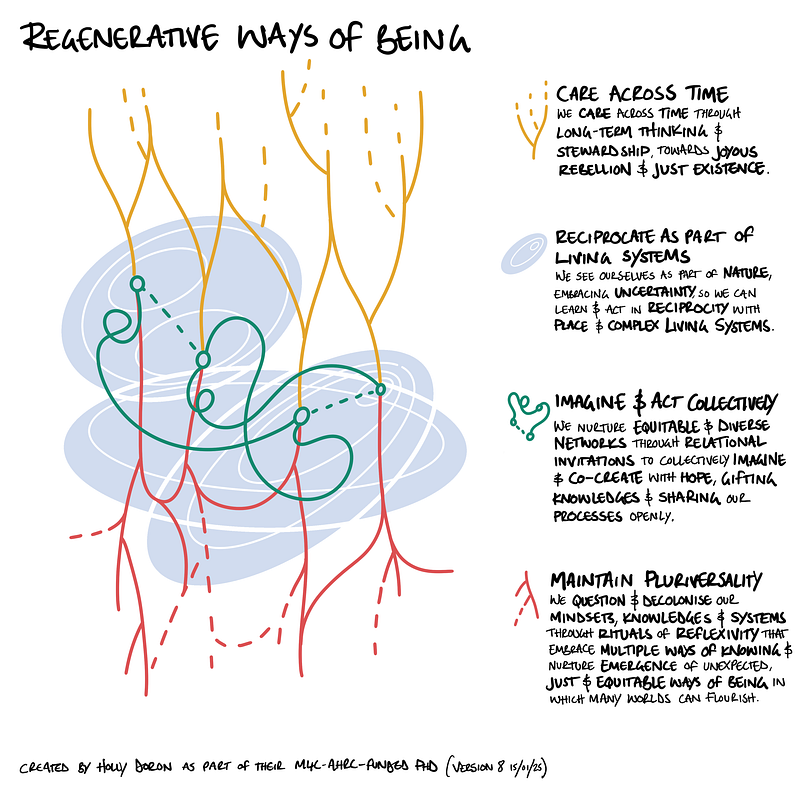
So… the principle of complexity is now absorbed in the storytelling of all the principles, which are shown as overlapping realities, representing the complexity we exist within. The spectrum of different ways of being can be shown to highlight the existing dominant worldview as counter principles. We can draw our own versions of the diagram to reveal our different realities and ways of being.

Being in relation with place

‘Being in relation with place’ invited Emerging Futures Knowledge Sharers to reflect on what it means to be in relationship with or belong to place, especially when we are fugitives or from diaspora whose hearts belong to another place that we cannot shape (KS07). We discussed community history as a “single snapshot moment of now, everyone who is in that place, it’s all of their histories” (KS05) and “rhythms of the moment” (Brodie). This highlights that being in relation with place is about collectively learning about place. In one Stories of Place gathering, one of the co-creators asked if it was ok for them to keep joining as they didn’t have a previous relationship with Dudley. They were absolutely welcome. They were choosing to come into relation with Dudley through a monthly ritual, gifting their knowledges and ways of being to place.
Discussions also highlighted how place is not just Nature but also built environment, the layers of history we have inherited and how we “darn the fabric of place” (KS05). The dominant worldview that humans are separate from Nature, have dominance over it and can exploit it as a resource has led us to the Earth Crisis (McKenzie, 2024). The English language reinforces this embedded bias: Nature is an object referred to as “it”, not a process (Mang and Haggard, 2016, p.161) nor a subject deserving pronouns as found in some Indigenous languages (Kimmerer, 2017). We care for Nature, not as Nature (Tynan, 2021). Language can reframe how we perceive reality, which, in turn, determines our reality (Lent, 2017). However, Carol Sanford argues that ‘we are not the same as or a part of nature, a concept used to try to solve the problem… it further fragments and makes an object of an idea, Nature, in order to do so’, concluding, ‘Nature is a term best dropped from our vocabulary in favor [sic] of Living Systems which evokes a nested system at work’. I still, however, find reframing how we see ourselves as Nature helpful to challenge the dominant mindset of separation. I feel it’s necessary until the complexity of Living Systems is embedded in our collective everyday thinking. Place and Nature are part of the same thing: complex Living Systems. How do I communicate this in the principles if people are not familiar with this term? The Dudley MBC and NHS Knowledge Sharers reflected that some of the language felt like a barrier, but after some time to reflect, the group returned wanting to spend more time with the principles. Dionne has reflected to me a few times that the language needed for this work requires us as individuals to go on a journey with the language. Language is an invitation to question. Why aren’t there easy to understand words in our everyday vocabulary to describe the work we’re doing? What needs to change so it becomes that?
So… place, Nature and complexity are now encompassed within ‘Reciprocate as part of Living Systems’, but are still explicitly referenced through the invitation, ‘We see ourselves as part of Nature, embracing uncertainty, so we can learn and act in reciprocity with place and complex Living Systems’. It is visualised as interacting, complex, nested ovals.

Maintaining pluriversality

The principle of “maintaining pluriversality” resonated with Emerging Futures Knowledge Sharers, valuing diverse, ancestral, and spoken knowledges while questioning dominant systems and knowledge hierarchies that marginalise alternative perspectives and often fail to honour knowledge embedded in marginalised communities (Clare, Jo, Juliet, KS03, KS04, Natasha). We discussed combining spoken knowledges with digital, open-source collaborations to nurture new modes of knowledge practice (Alastair, Jo) “caring for knowledge pathways with a risk of erasure” (Jo — you can read more in their lab note on regenerative learning infrastructures).
The depth of this discussion reinforced the need of this principle. A hurdle I continually come across, however, is what language to use. Originally, this principle was ‘maintain criticality’ , which invites questioning assumptions and seeking other perspectives, but suggests finding fault and judgement. It is also rooted in systematic, solution-focused analysis and evaluation as an objective researcher which perhaps limits the depth of questioning of our mindsets. I considered reflexivity, which invites deeper, personal questioning and challenging of our worldviews. Reflexivity, as a form of continually re-evaluating, is highlighted as a key quality “for enabling regenerative systems” by Sam Buckton and colleagues in their The Regenerative Lens. Rituals of reflexivity can nurture emergence. However, reflexivity on its own doesn’t inherently imply a process of decolonising knowledges or inviting continual reflection through and towards action. So, what about pluriversality? Arturo Escobar discussed the Zapatistas’ definition of the pluriverse as “a world where many worlds fit”, and as feminists from the Global South say, “living fearlessly with and within difference”, as “an ethical and political practice” towards social justice, radical equality and non-hierarchy. This difference is what marginalised groups live with every day, “and that only privileged groups can afford to overlook as they act as if the entire world were, or should be, as they see it” (2018, p.xvi). But how do you succinctly explain this to someone in everyday conversations? I’ll be chewing on this one for a while but suggestions are welcome.
So… the invitation to ‘maintain pluriversality’ is expanded to ‘We question and decolonise our mindsets, knowledges and systems through rituals of reflexivity that embrace multiple ways of knowing and nurture emergence of unexpected, just and equitable ways of being in which many worlds can flourish’. It is visualised as roots as a non-hierarchical network of multiple worldviews and erased pasts.

Imagining and Acting Collectively

Clare was curious how equity might be more explicit in the principles, prompting a need to expand the written definition for each principle rather than relying on verbal storytelling. Clare also raised that being “regenerative is probably not possible” in the built environment, but inviting people to engage with the nuance of regenerative ways of being is important as otherwise people might feel if it’s not possible and there’s no point in doing anything. Marikken Wullf-Wathne and Kristin Kjærås discuss the urgency of hope in responding to the climate crisis, arguing that hope has historically been based around “long-term, collective improvement” whereas it is now “more individual and immediate” (p.52). They suggest we first have to hope for change in order for change to happen (p.59). Referring back to CoLab Dudley’s principles, we have a description of each principle that begins with ‘we’, which is one way to invite collective action with hope in the emerging regenerative principles.
Another of The Regenerative Lens’ “five key qualities for enabling regenerative systems” is ‘mutualism’ which overlaps with this principle. This made me wonder whether ‘imagine and act collectively’ might unintentionally encourage human-centrism. This reinforced the need for the principles to be shown as interacting layers — you can’t address one without the other. Mutualism also speaks to Tatiana Fraser’s point around building connections between communities, similar to mycelium networks transmitting information, “playing a crucial role in nutrient cycling and ecosystem functioning” and “nurturing deep relationships across difference, learning communities, and strategic networks” (2023, p.33). This particularly resonated with the Learning Enquiry group. Dionne had created a space for people from different siloes across Dudley Council and Dudley NHS to become aware of each other’s work and to cross-pollinate learning. Tim and Jenny’s conversation reminded me that reciprocity and gifting of knowledges is key to this principle, as are relational invitations.
So… equity, gifting, hope and collective action are lifted more prominently in the invitation of ‘We nurture equitable and diverse networks through relational invitations to collectively imagine and co-create with hope, gifting knowledges and sharing our processes openly.’ This is visually represented across a network of entangled reciprocity between actors lying within and between different nests of systems.

Being accountable across time

While reading Tatiana Fraser’s The Art of Scaling Deep, my attention was drawn to “cultures and ethics of care and love” and I realised that care was implied but not explicit in the principles:
“to care, you can easily care for someone materially or to make sure that they survive, but to love someone is to truly want someone’s best for their spiritual growth. What if we apply this to systems change or in society? I don’t feel that politicians want my spiritual growth. Put it that way. They care for me, but that’s where it ends. And maybe that’s what this whole scaling deep is trying to do. We’re trying to tip it over to actually be a love ethic, rather than just a care ethic.” (Fraser, 2023, p. 26)
Emerging Futures Knowledge Sharers emphasised the importance of the commons, governance and multigenerational stewardship in holding onto the transience of people in place and long-term care of place (KS01, KS05, Brodie). Our relation with land is shaped by human and institution-made legal propositions. For example, land covenants outlast human lives (Brodie) and can disregard future needs (KS05). There is a need for “joyous”, “rebellious” and “collective guardianship” through learning with land and passing knowledges for resilience down through generations (Juliette).
So… ‘being accountable’ has changed to ‘care’’ and expanded with the invitation of ‘We care across time through long-term thinking and stewardship, towards joyous rebellion* and equitable and just existence’.** This is visualised with multiple possible futures branching out.’
* All the gratitude to Juliette Mothe for gifting ‘joyous rebellion’
** ‘Just existence’ was originally ‘just transition’, changing after Stories of Place co-creator conversations, which I’ll go into in the next lab note.

Principles as a compost bed
At the beginning of this lab note, I mentioned how writing is a design tool for me. The process of revisiting the conversations between Knowledge Sharers and applying the principles in my everyday actions revealed what doesn’t sit right or is missing. I evolved the principles while writing this lab note, and they will inevitably change again the more I work with them and the more others interact with them. The latest version is a storytelling device that invites us to consider the connections between multiple, possible and erased pasts, futures and ways of knowing within overlapping Living Systems and places, and the relationships within entangled networks. It is also a storyfinding device: an invitation to trace our own experiences and actions within the layers of realities we exist. I’m going to explore this idea more in the future.

These regenerative principles help to create a compost bed for learning, providing structure for reflection and allowing thoughts to breathe. In Stories of Place, we have a ‘lucky dip’ of 56 questions that help us reflect in each gathering. These questions overlap with the regenerative principles and have been inspired by the CoLab Dudley team, Pathways to Nature Connectedness, Doughnut Economics 4 Lens, Culture Takes Action Pathways, Roman Krznaric’s Menu of Conversation at the Council of the Future hosted by CIVIC SQUARE, Dudley People’s School for Climate Justice and the CreaTures Framework. In October 2024, our Stories of Place gathering focused on foraging learning from the year, and rather than having 56 questions to reflect on, four principle-inspired questions emerged:
- What helps (or could help) us to connect as part of Nature and place?
- What helps (or could help) us to change our understanding of the world, and how we learn and do?
- What helps (or could help) us to act towards just change?
- What helps (or could help) us to care across time?
With this compost bed of questions, I was ready to invite Stories of Place co-creators to become earthworms, crawling through our compost… to be continued in the next lab note: Stories of Place 2024 Composting #3 | Co-creators as earthworms.
This research is funded by the Arts and Humanities Research Council through Midlands4Cities. It is entangled with my work at CoLab Dudley funded by The National Lottery Community Fund’s Climate Action Fund and Joseph Rowntree Foundation as part of a network of Pathfinder organisations reimagining and redesigning the world we want to live in to achieve deep, transformative change.