Stories of Place meets Dudley People’s School for Climate Justice
Over four sessions, Stories of Place co-creators reconnected with previous ideas to evolve new ones, and harvested seeds of ideas to store over winter - ready for Stories of Place to re-emerge as part of the Dudley People’s School for Climate Justice in 2024.

Imagine curious thinkers / researchers / archivists / doers / creatives coming together monthly to connect with their place and the beings within, uncover the unnoticed, have weaving conversations sparked by inspiration from the past, present and future, collaborate together to create the unexpected, and unlock pathways to potential futures. That’s what Stories of Place is.

In 2023, Stories of Place took a deep pause while the CoLab Dudley team flexed alongside uncertainty: nurturing conditions for Dudley Time Rebels to flourish as part of the Dudley Creates 100 year Cultural Strategy in Action, whilst holding the possibility we might need to steward the ending of CoLab Dudley. The summer brought joyful news: the National Lottery Community Fund agreed to journey alongside us for the next three years as part of the Climate Action Fund. Together, with our learning collaborators Workshop 24 and Ekho Collective, we are inviting people across Dudley Borough to connect with nature and shift towards climate action through the Dudley People’s School for Climate Justice.
This lab note shares the story of what emerged from the Stories of Place co-creators reconvening in summer 2023. Over four sessions, we reconnected with previous ideas to evolve new ones, harvesting seeds of ideas to store over our winter rest, ready to gift to Stories of Place as it re-emerges as part of the Dudley People’s School for Climate Justice in 2024.

In the lighter months, Stories of Place co-creators began each session by rooting ourselves in the High Street and reawakening our senses with street detectorism. We wandered out to wonder, and returned with gifts of reflections, discoveries and curiosities sketched over maps. The High Street left us curious about how old it is, whether it would have been less about convenience and more about nature-based speed 1,000 years ago, what languages were spoken, and what it looked like over the centuries. Local knowledge emerged about how the High Street has remained largely the same shape, with long, thin plots called burgages, but the occupants and behaviours have changed significantly over living memory.

We were curious about what qualities are missing, how we might be reinforcing systemic controls and a myth of freedom, how pigeons hear and how water is controlled. Street detectorism prompted us to sense and notice things in a different way, invited us to leave ‘human mode’, created moments for conversations with other people on the High Street and between ourselves, exchanging our multiple curiosities and knowledges.

As autumn drew closer with darker evenings, we ventured instead into the Stories of Place time portal: a physical manifestation of our digital archive that gathers artefacts and imaginaries of the past, present and future of Dudley High Street. We discovered that the time portal is a powerful invitation to be curious. In one session, I wrapped a selection of artefacts from the time portal as gifts for fellow co-creators. These gifts contained images and text from the archive, along with sprinklings of inspiration and questions to spark reflection and action. In another session, we each foraged into the time portal and around the lab space for artefacts and ideas we wanted to lift and gift for 2024. This process revealed the potency of gifting in nurturing connection, inspiration and care.


Our time portal visits and gifts left us wondering about how we experience and think about time. We were curious about what subcultures will exist in the future. What will people act and look like? What music will they identify with? What food will they eat? What will their recipes be? What languages will they speak? What will ownership be like? What hairstyles will they have?

Looking towards the past, we wondered about layers of history, and how this was represented in paint samples of Dudley Zoo’s Tecton buildings. In the present, we were curious about how we might reclaim space, redistribute wealth, reflect on our practices as Time Rebels, and how to nurture culturally relevant expressions in Dudley. We challenged our worldviews (revisiting Western go-to models that co-opted Indigenous concepts e.g. Maslow’s Hierarchy of Needs informed by the Blackfoot Nation), and revisited ideas from previous Stories of Place gatherings.

One of the revisited ideas was place-naming. In 2022, Helen had prototyped a place-naming session with Kirren and Alan. Helen kept all the research and created artefacts in a box, like a time capsule, and brought it in to open together. This reignited a curiosity around hidden stories and meanings behind places on the High Street and across Dudley Borough. Erica brought in her own books on local history, and gifted her research into the history of street names around the High Street to the time portal. Erica realised that street names before the industrial revolution were linked to agriculture and nature. We reflected that the language we use to describe our places in the past, present and future, influence which ideas, feelings and actions we move towards.

This, along with the presence of poet Rick, led to Helen writing a list poem of Dudley place names and their meaning. We found that revisiting ideas helps to build collective stewardship and accountability for knowledge and ideas nurtured through Stories of Place. We also discovered that the presence of people with different skills inspired others to try unfamiliar creative processes: people tried drawing, writing poetry, visualising data, and hybrid collaging. We reflected that Stories of Place co-creators keep coming out of curiosity, knowing we’ll be doing something different each time, and discovering what it means to be in a place.

Over the four sessions, we imagined a future High Street where there’s no such thing as retail or cars and nature has taken over. The Black Country Museum isn’t the only reason people visit Dudley in the future. People venture into a vibrant High Street as the centre of the green revolution with a patchwork of micro farms, which is just one of the reasons young people choose to stay in Dudley. Deep time, multiple ways of knowing and cultural heritage are visible across Dudley, and previous, current and future inequality is not ignored. Language has shifted away from metaphors of war, ‘things’, capitalism and growth to organic and nature-based terms. Future generations are baffled at stories of previous generations taking water away. Pigeons, as one of the few remaining bird species, have an honoured role on the High Street.

Our imagination sparked, we shifted to thinking of ways we could bring flourishing futures closer to our present:
- Draw a dictionary of the future that helps us shift from business-as-usual to more flourishing futures.

- Curate window displays as portals through time, peeling away layers of past, present and future.
- Collect nature-based street art for zine making, dropping them off in different locations, and gifting them to people.
- Create portals to the past, when Dudley High Street was underneath a tropical sea, with stencils and chalk paint on pavement cracks.
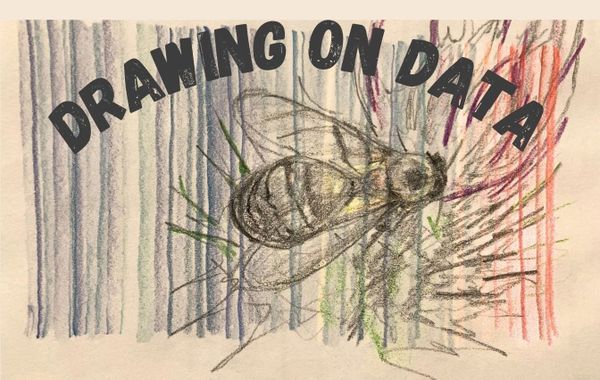
- Creatively visualise small and imperfect data (inspired by data humanism).
- Geopin audio along the High Street for walking tours e.g. prehistoric underwater sounds and oral stories
- Make a zine with a dream story for Dudley.
- Celebrate East African cultures on Dudley High Street.

These ideas led to action. Erica went on more walks around Dudley outside of the sessions, taking photos and talking to people. She has since taken a group of design students on a walking tour of Dudley, sharing her place-based knowledge from her research and lived experience, becoming a walking portal to the past. Dionne delved into learning about East African cultures, such as the colour meanings behind Maasai beading, to start experimenting with data humanism jewellery making. Lorna started to create a mini-archive of projects and platforms already experimented with over the past 10 years. Rick wrote a poem called ‘place’:
Somewhere between the inside and outside We see place from a myriad of stands Views form from space that does not coincide
Our starting point is always reapplied To help us understand before we choose Somewhere between the inside and outside
Yet even from this spot we can provide The insight that allows us to be sure Views form from space that does not coincide
Our playfulness allows us to reside Inside imaginary states of mind Somewhere between the inside and outside
Your coloured scarf invites us to decide How we will weather out the changes where Views form from space that does not coincide
So know that you may take this in your stride With confidence that places all exist Somewhere between the inside and outside Views form from space that does not coincide
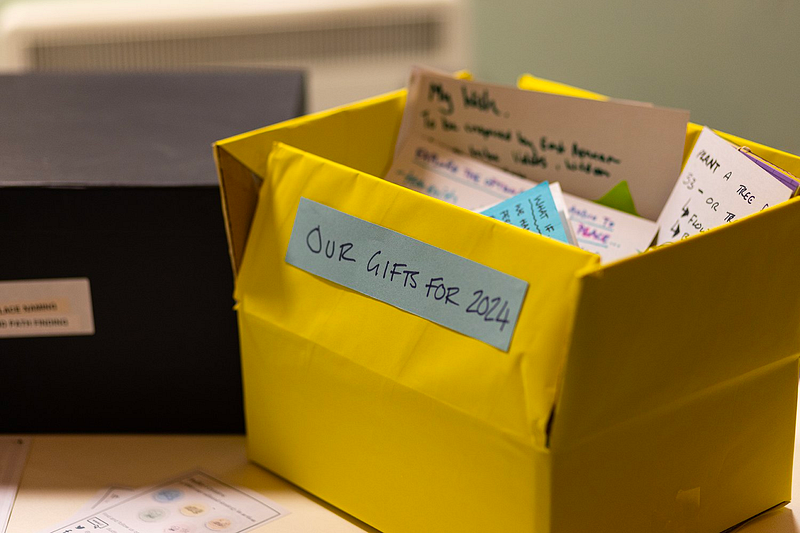
We drew 2023 to a close by curating gifts for Stories of Place in 2024: artefacts from the time portal, new ideas and reflections on how we would like Stories of Place to evolve with the Dudley People’s School for Climate Justice. We wondered whether these were collective acts of quiet activism.
Our invitation for future Stories of Place co-creators
We welcome people who have a change-making spirit to discover something new (and old!) each time you come to Stories of Place. It is a space to imagine, be inspired, take collective action with collective support. It is a safe space for people to test and evolve ideas together that bring us closer to Dudley, nature, climate action, and flourishing futures.
We will be welcoming, connecting and celebrating other emerging knowledge, imagination and artefacts across Dudley People’s School for Climate Justice. To help us do this, we will be co-designing a digital time portal with a Community Technologist.
Every session is free. Each session will be different and will evolve with our collective ideas and action, but there will always be an option for you to join a guided activity or have time to experiment with your ideas.
You don’t have to come to every session. We all have different commitments and our energy changes throughout the year. If you make one session and can’t return for another year, you will still be welcome and won’t feel left behind. There are lots of different ways you can be part of Stories of Place:

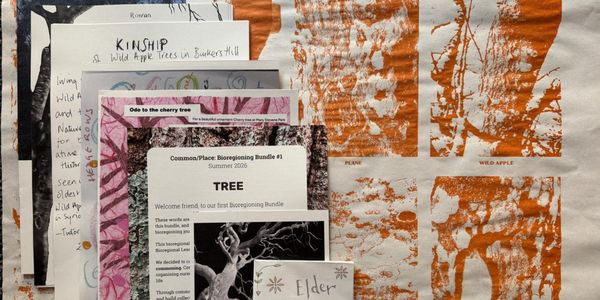
If you join us, you will be gifted a printed copy of our welcome pack, which will contain a background of how Stories of Place has evolved, dates for this year’s gatherings, information on what being a Stories of Place co-creator involves and the learning project it is part of, and an optional journal for you to keep a record of your ideas and reflections as the year goes on.