Time Rebels in practice
Notes from a shared enquiry by CoLab Dudley Time Rebels into what they are sensing and testing out in terms of what it means to be a…

Notes from a shared enquiry by CoLab Dudley Time Rebels into what they are sensing and testing out in terms of what it means to be a practising Time Rebel
The relationship between learning and doing experiments on the High Street is even more magical when that learning-doing is a shared experience enriched by many different perspectives all coming together to reflect, ask good questions, really listen to each other, and be curious about shared insights. So it has been a joy to collate some early stage notes from a shared enquiry amongst Dudley Time Rebels about the experience, values, connections, behaviours, platform infrastructure, processes and evolution of practice in their rebellion journey so far.
Some context for these seeds of curiosity
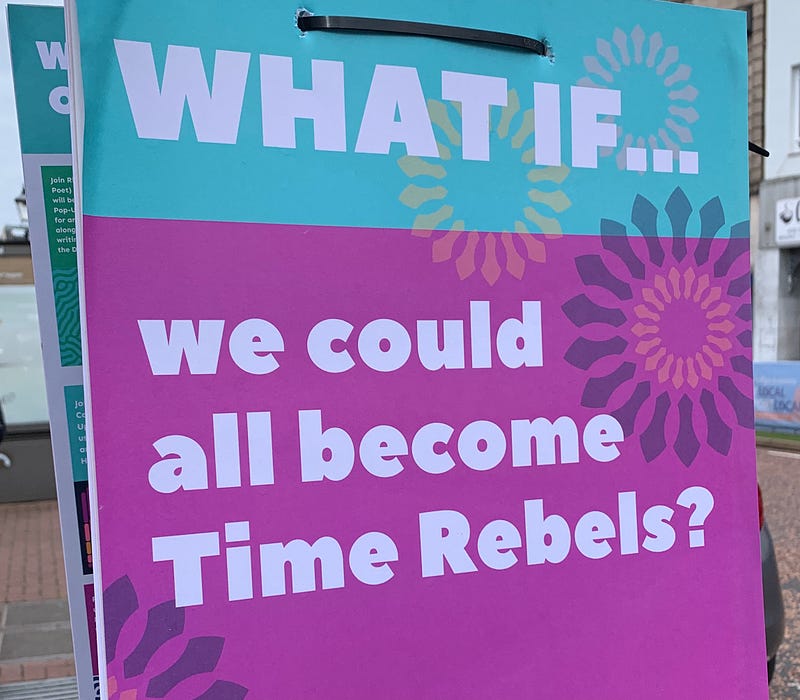
To begin with it helps to have a little context for this shared enquiry and why we feel these questions are worth digging into. Firstly, what are Time Rebels? In this lab note Lorna Prescott outlines “Why Dudley High Street needs Time Rebels.” She explains our intention as a social lab on the High Street to convene a network of Time Rebels who would use ideas around intergenerational justice, long term thinking and good ‘What If’ questions to reveal and inspire the imaginative capacity of Dudley folk so they might reimagine a kinder, more connected and creative future High Street. We believe these conceptual tools are critical in disrupting decaying, exploitative and unsustainable Business as Usual High Street narratives and in opening us all up to more regenerative High Street narratives and futures.
As part of the care and governance of the lab platform several lab team members are active network guardians. This involves sensing, observing and listening to the network, then responding with weaving connections of ideas, people, and resources where needed. As part of this sensing we note what behaviours and norms are manifest within the ecosystem and ask what does this mean in terms of a healthy, resilient and thriving network?
This shared enquiry emerged from patterns we noticed in things Dudley Time Rebels said — in their conversations in Food For Thought sessions; in ideas they shared in their Spring check-ins, on their Miro experiment boards and in the Birmingham City University Future High St process reflections. In this network guardian sensing data there was perhaps a hint of something that might be called Time Rebel practice. We understood this combination of behaviours, ideas, actions, intentions, worldviews, values, and ways of knowing were unlikely to be exclusive to a Time Rebel practice, but maybe taken in combination they might be recognisable as an emerging and evolving practice.
On reflection and in deep humility it is more accurate to say that perhaps we were sensing evidence of (re)connection to a very old practice loosely aligned to timefulness, entanglement, stories of place and future generation accountability. The Time Rebel framing we are borrowing from public philosopher Roman Krznaric (author of the The Good Ancestor) perhaps weaves these concepts/ ways of being together for a new generation to be played out in their places. We wanted to dig into this some more.
So as part of this shared enquiry we have been exploring with rebels: Is there such a thing as Time Rebel practice and what does it look, feel, sound, taste like? And of course every rebellion has a context, a backstory, conditions that create the spark, feed the flames, and determine the direction and outcomes of that rebellion. So we have also been wondering together: What are the conditions by which a time rebellion is enacted and realised across the town?
The enquiry is a gentle invitation to learn and reflect together and so a way of being true to our lab principle: ‘create the conditions for curiosity and experimentation’. We wanted to ask Time Rebels to draw upon their journey so far, the ideas that have been shared, thinking done, feelings, connections and reflections. In a shared learning session (co-created by CoLab Dudley team members Holly Doron and Jo) we used an open Miro canvas to ask the Time Rebels to use the questions below to pause and explore their practice — existing and emerging. We also revisited the enquiry after Do Fest (29–30 July) to capture new insights following the prototyping of experiments on Dudley High Street.
In this note on Time Rebel practice we share four core patterns from the Time Rebels’ insights:
- Processes used to support and nurture the emergence of this practice
- Building and revealing place-based knowledge and wisdom
- Relational practice — the supportive behaviours of a collective of rebels
- What we value and how we value through this practice

Theme one
Processes used to support and nurture the emergence of this practice
“Scaling initial conditions. Within the private sector there are a range of public and private mechanisms to support and scale innovation — access to capital, data, talent and connectivity (knowledge dissemination and networking). None of this infrastructure exists within the social sector, or at least, not in any sort of coherent way. If we want to see a verdant proliferation of solutions, and if we want to see them succeed, we need to attend to the ground that gives birth to them and that nourishes them.” (Gord Tulloch @ InWithForward)
In this enquiry, Time Rebels described practice and process being intertwined and reflected upon the need to “trust in the process”. The relationship rebels have pointed to regarding process and practice is perhaps critical in sustaining the work towards transitioning to a kinder and more creative High Street future for all. We know that status quo processes and associated practices actively design out the capacity to imagine alternative High Streets and even obstruct this urgent transition. Going forward we might usefully consider this process-practice relationship as part of the make-up of intangible imagination infrastructures we need to care about as new forms of social infrastructure respond to major community and environmental challenges (h/t Indy Johar)
Usual processes and practices are often shaped by managing risk, designing for greater cost-time efficiency, unconscious structural leveraging of power imbalances through extractive norms, and an evaluation approach that separates action from wider contexts and where the easily measurable quantifiable short term ‘wins’ are king.
From a practitioner perspective, (regardless of your role or skill) these processes create stressful environments that make being your authentic and whole self impossible, they close down openness and creative thinking, they force ahistorical and place agnostic interventions, whilst also discouraging more collective or collaborative mindsets.
Instead, we need infrastructure processes that support practices that enable greater comfort with the unknown and uncertainty, that acknowledge our interdependencies, and enable us to bring our whole self with all the gifts that then reveals. Such an infrastructure supports and nurtures wellbeing as a collective not individual concept.
As Time Rebels work to unlock the imaginative capacity and dreams of local people to transition to an alternative future for Dudley High Street, it feels important and responsible to document, question and critically reflect upon the processes Rebels have described as supporting the emergence of their practice. Below we describe these processes on the left and their contrasting ‘business as usual’ practices on the right acknowledging there is often an uneven continuum of practices in between.

Theme two
Building and revealing place-based knowledge and wisdom
“So how could we expand notions of intelligence to be more pluralistic and recognize multiple cultural and indigenous knowledge systems and evolve collective intelligence to collective wisdom? Because wisdom adds layers of meaning and spirituality and intuition and emotionality to cognition. And place-based wisdom recognizes relationships with land and spirit of place inherent in the nature and history of the setting.” (Jayne Engle)
What does it mean for your practice to be informed by being present in and entangled with a place not simply passively passing through? The enquiry and festival prototyping has shown that Time Rebel practice is about meaningfully locating ourselves in place — it has a place-based specificity to it that is experiential, embodied, or has an environmental materiality. Essentially, it involves nurturing new relationships with place that are in turn linked to building or revealing place-based knowledge and maybe even in time place-based wisdom. The different ways Time Rebels are inviting new relationships with place are explicit in their own lab notes and you can read and listen to these here. Time Rebel Juliet shares a really insightful reflection upon the role of practice and embodied creativty in nurturing that relationship between people and place here.
In many indigenous communities place-based wisdom, (a form of deep cultural and ecological understanding of and attachment to place) is often part of a more interconnected and respectful relationship with the more-than-human than the extractive and separate relationship with nature that dominates modern western societies. We have much to learn from this relationship with place and perhaps the nudges that Time Rebel practice offer are part of that journey of (un)learning?
“Creating regenerative cultures is a process of re-indigenization, of becoming deeply rooted in the unique condition of particular places again, of restoring and caring for a particular place over the long term.” (Daniel Christian Wahl)
In a related framing, the Brian Eno concept ‘the long now’ and ‘the big here’ also help us think about an expanded notion of place beyond the ‘small here’ and ‘short now’ that limits our sense of empathy for future generations and other species and peoples we share our places with. In addition, there is something in Time Rebel practice in exploring ways to reveal a place-based knowledge and wisdom that has a collective quality, not simply individual understandings of place:
“Thanks for that work Rick, not just the poem but spending the time in the High Street over so many weeks. The collective voice seems so much more powerful (in the hands of a poet) than the individuals’, an example perhaps of the wisdom of crowds and how those voices represent more accurately how things are than any single voice.” (Bill Laybourne, in reply to poetry of place shared by fellow Dudley Time Rebel Rick)
The emergence of a collective wisdom and shared dreaming about place is something we want to explore more as this experiment enters new phases.

Theme three
Relational practice — the supportive behaviours of a collective of rebels
Many rebels reflected upon how they often work alone, or as fixed pairs, and how it has been challenging, but ultimately rewarding to come together across a range of disciplines and work together. Time Rebels have shown increasingly empathetic and relational behaviours to their fellow rebels over the course of their journey which has manifested in openly sharing ideas, co-creating, cheerleading, gifting support, and actively weaving links between their respective experiments.
The Time Rebel journey has required an openness to new ideas and ways of being in relationship as a collective. We have seen that openness requires time and practice, must be supported through thoughtful convening and facilitation, and is evidenced in the behaviours rebels have described below. These relational qualities and behaviours aren’t inevitable, and business as usual environments can make them seem impossible or not even considered, which circles us back round to the lessons rebels shared above in Theme One about the critical relationship between process and practice.

Theme four
What we value and how we value through this practice
Time Rebel practice is in part about rejecting accepted norms concerning how we fail to properly value ourselves, our labour, others, our environment, the wisdom of our ancestors and the lives of future generations. Rebels drew attention in the shared enquiry to how and where these usual norms are disrupted through Time Rebel practice.

“Place and mind may interpenetrate till the nature of both is altered” (Nan Shepherd, The Living Mountain)
The Time Rebel journey has gently invited deeper questions about our legacy for future generations of all species, about social purpose in creative practice that nurtures new relationships with place, and how that reflects what, who and how we value in our work and in society more broadly. These questions are critical for new and existing High Street stewards when they are applied to the future of this civic space.
Time Rebel practice on the High street invites new perspectives and the chance to build new collective imaginings that disrupt the near universal UK High Street narrative of decay. In 2020 there were 48 shop closures a day on UK High Streets. Evidently we need a wholly radical new relationship with the High Street. Maybe in the future this won’t be defined by consumerism, individualism and growth at all costs — maybe this relationship will be one of stewardship towards collective and planetary wellbeing?
Time Rebel practice — acknowledging the shoulders of the wisdom of elders it draws upon — it seems is rooted in a very earnest and embodied journey to acquire, reveal, care for and build place-based knowledge and wisdom via new relationships to place. This is wisdom and ways of being that draws upon stories of the past, the lived experience of the present, and dreams of the future. It is normative in actively seeking to steward healthier and more empathetic relationships between us, the past, the future, and our more-than-human kin.
For more from the Time Rebels on nurturing new relationships with place you can read and listen to their lab notes here: https://medium.com/colab-dudley/dream-catchers-time-rebel-lab-notes-ccc89a4de39e