Visual composting
At the end of their second year of their practice based PhD with CoLab Dudley and Birmingham School of Architecture and Design, Holly shares experimentation with visual ways of sense-making through their learning journey, Stories of Place, and conversations.

This post shares how I am experimenting with visual ways of sense-making through my learning journey, Stories of Place, and conversations with wonderful people.
I’m at the end of my second year of the PhD stage of my learning journey, in the midst of learning through doing with Stories of Place co-creators: a monthly gathering of curious local people experimenting with ways to rehearse regenerative and flourishing futures in the present.

One of the regenerative principles informing the evolution of this learning journey is ‘imagining and acting collectively’. This means working in open and messy ways as I go along. Amongst all the learning through doing, I’ve realised I’ve been doing this with fellow Stories of Place co-creators and in conversations with our wider ecosystem, but I haven’t been sharing in ways that people can dip into whenever they like. I was in conversation with CoLab Dudley’s fellow learners-through-doing, Makespace Oxford, a few weeks ago, and they reminded me how handy it can be for people we’re not yet connected with to access our learning on here. This also reminded me that I use writing on Medium as a design tool. Everything I’ve published has helped to evolve my approaches. So I best get back to it.
Here, I share how I’ve been experimenting with visual composting so far to inform the evolution of Stories of Place and my learning journey. It’s an attempt to share my learning in an open, messy, incomplete (and quite lengthy) way in the hope that some of these approaches might spark something for you — let me know if they do!
Here’s a summary of each section to help you skim to the bits you might be interested in:
- Visual journalling — Using diagramming to map learning journeys and visual journalling to challenge and reframe Western concepts of time and individualistic mindsets, and reveal patterns, insights and possible futures.
- Seeking PhDish methods of visual analysis — Exploring the academic term of ‘critical visuality’, an ask for you to share any visual analysis methods you have used or discovered, and experimenting with ‘venturous practice’ (a way of visually mapping and analysing different projects) with design questions for a more regenerative approach.
- Visual analysis -> Visual composting — Beginning to evolve a more regenerative form of visual sense-making through composting gifts as a design tool, with examples of visualising conversations and seasonal working.
Visual journalling

When I started my PhD, I reflected on my transition between practice and academia by diagramming the curiosities, ideas and practices of my learning journey so far. This process not only helped me evolve the design of my research, it also reminded me: I am a visual learner. I couldn’t say whether this came before or during my architectural training, which encouraged visually exploring the world at different scales, planes and dimensions. Now, I can barely function in a conversation unless I am diagramming or writing it out, or fixating on a visual pattern (please don’t be offended if it looks like I’m not listening).
My PhD started with a course on how to actually research, which involved a lot of self reflection and planning for the future, alongside an invitation to be creative. As I shared back in 2019, I 🖤 diagramming, so I was naturally excited about resurfacing this and reigniting my creativity. I turned to Giorgia Lupi and Stefanie Posavec for inspiration, as I have previously for Stories of Place, particularly Lupi’s idea of data humanism:
‘The goal was to move away from a simple measurement of quantity; we transformed raw information into interconnected knowledge, presenting unexpected parallels and secondary tales to supplement the main story’, as a form of ‘nonlinear storytelling; people can get happily lost exploring individual elements, minor tales and larger trends within the greater visualization, while being naturally invited to engage with the visual on deeper levels’ (Lupi, 2017)

Giorgia Lupi + Stefanie Posavec (2015) Dear Data
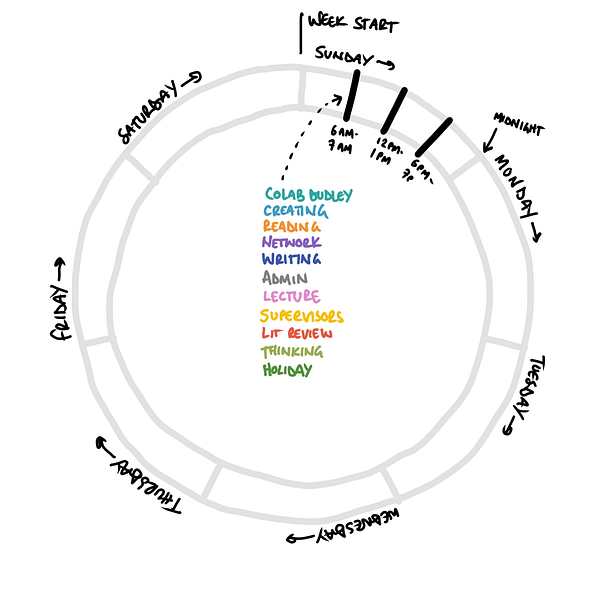
With the regenerative focus of my PhD, I was also curious about how I could recognise and even unlearn mindsets I have inherited. Part of regenerative practice is decolonising or re-Indigenising our relationship with land, our ancestors and future generations (Stout, 2022) as well as how we conceive time (Krznaric, 2020). My initial learning journey diagram revealed my Western concept of time (left to right). In Indigenous cultures around the world, time is perceived as helical rather than linear, or the past is in front, rather than behind (Núñez & Cooperrider, 2013). I don’t intend to extract these concepts out of context, but instead to learn from them and challenge my ‘cognitive patterns’ (Lent, 2017). So, I decided to create a helical weekly journal, in which I could zoom forward into the past as a form of nausea-inducing time travel.
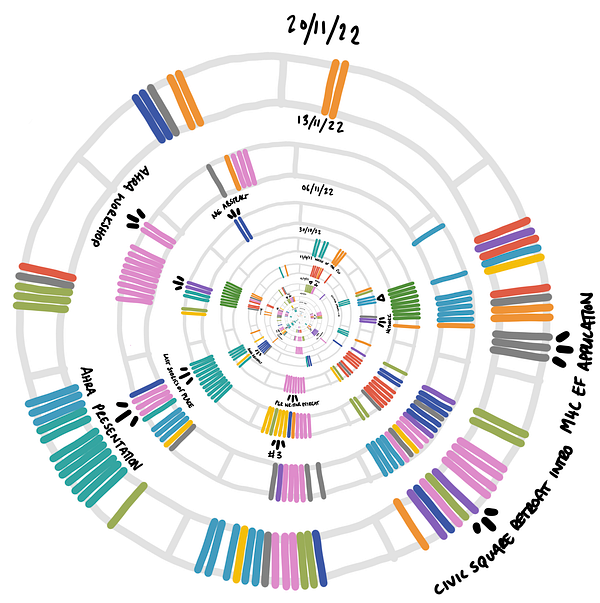
Holly Doron (2022) PhD journal
My previous learning journey diagram also revealed my Western egocentric perspective. There are so many people that have been part of and sparked my learning journey who are missing from that initial diagram, so I wanted my journal to include the fluctuating networks around the research.
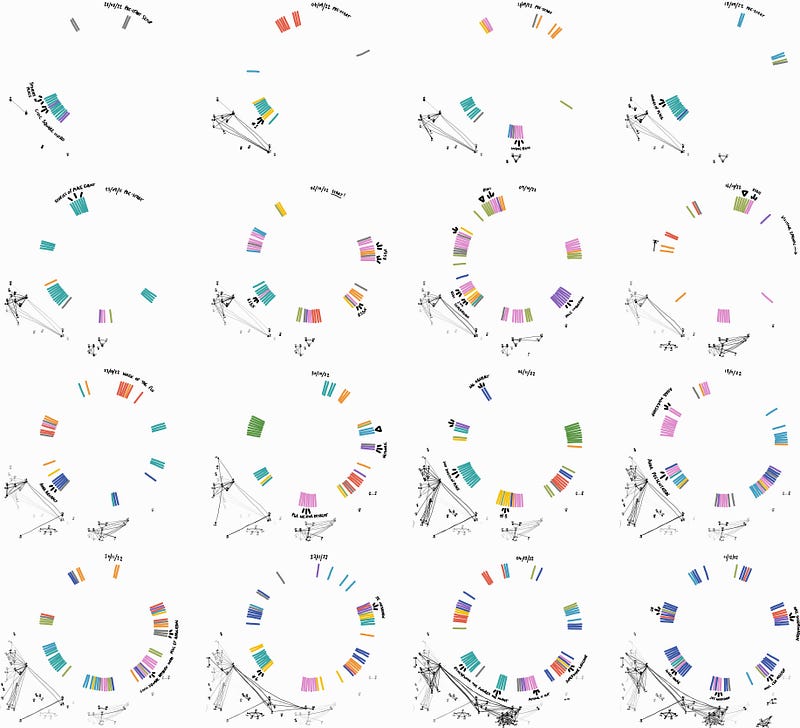
Helical journalling helped to:
- Remind me of the value of drawing with a pen in my hand (albeit a digital one).
- Disrupt cognitive patterns around time and individualism, encouraging layering of different levels of detail at different scales.
- Reveal patterns and insights in my working rhythms, which was especially valuable transitioning between working in architectural and research practice.
- Stir a feeling of exhilaration — there’s just something invigorating about looking forward into the immensity of what has happened in the past and imagining the scale of many possible futures looming behind you (recommended listening while doing this: Nautilus by Anna Meredith).
Although:
- It was VERY time consuming!
- Our digital platforms (and the places data centres are situated) aren’t built for infinite nesting.
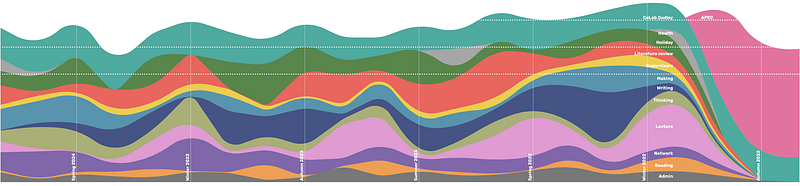
I have since kept a rhythm of drawing monthly strata of time to reflect on the ebb and flow of my working patterns across the seasons with past to the right, future to the left (don’t worry, I’m still honouring cyclical and networked ways of working elsewhere).
To look over my shoulder to the future, I turned to the futures cone: a tool for considering multiple possible futures that could happen ‘beyond our imagining and requiring imagination beyond our norms’ (McKenzie, 2020).
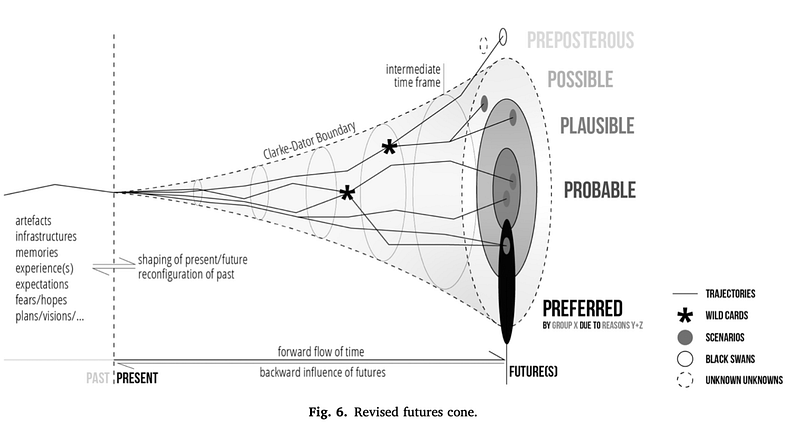
One of the criticisms of the futures cone is that it starts from a single point in time, which doesn’t invite us to consider how different past and present experiences and perspectives might affect just and equitable futures (Carey et al., 2021). With this in mind, I tested a way of adapting this tool to invite Time Rebels to collectively identify possible futures in Dudley.
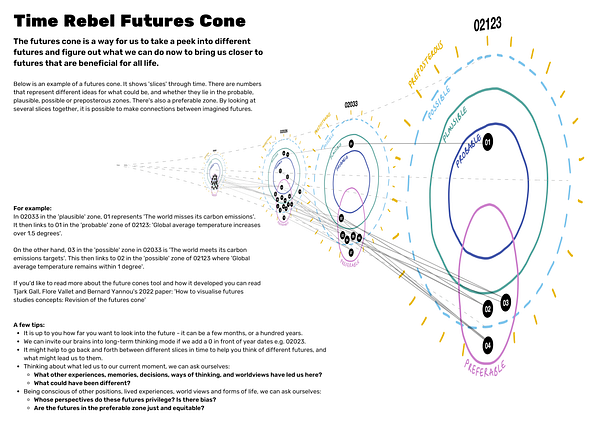
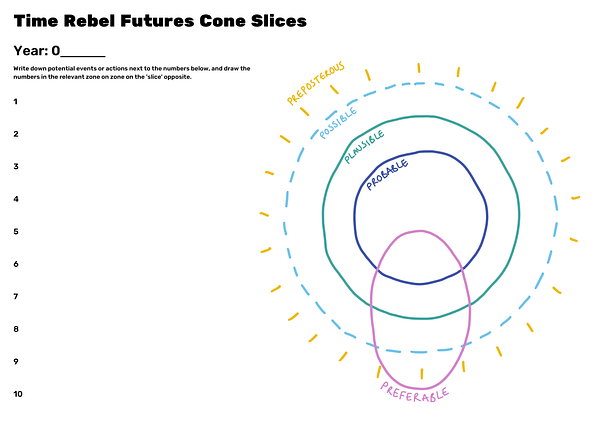
Holly Doron (2023) Dudley Time Rebels Futures Cone Canvas
Futures coning helped to:
- Situate and connect our present actions and ideas with long-term thinking and many possible futures.
- Create a snapshot in time that we can reflect on at later points, integrating what we’ve learnt since, highlighting shifting priorities and possibilities we missed, and updating it with new trajectories and imaginings.
Although:
- Collating and connecting the slices isn’t easily done collectively. I’d love to try a physical version of this in a space where we can walk through time between suspended slices, connecting possibilities with string, and ritually revisiting and updating it as a living tool. Let me know if you try this or other ideas.
Reinvigorated, I was left with the question:
What if… my PhD could emerge out of visual ways of sense-making?
I had already been using visual journalling in Stories of Place to record our conversations and the emerging connections, curiosities and experimentation, which we gathered around in autumn to forage learning and sparks for the next year. But, of course, in a PhD you need to find ‘academic’ ways of analysing. This brings into question what types or ways of knowing are valued in an academic setting, which I won’t go into here as Centric Lab have already done immense research on this through their work around radical learning infrastructures.
Seeking PhDish methods of visual analysis
I sought out academically recognised forms of visual ways of knowing and came across a helpful term in Troiani and Ewing’s book ‘Visual Research Methods in Architecture’. Critical visuality is described as a practice-based qualitative visual interpretation that uses different ways of seeing, imagining and articulating to:
- ‘deepen nuanced understanding of situated knowledge’
- reveal evidence
- enable exchanges around the ‘complexities and constructions of social life situated in culture and space’ that would otherwise be unattainable through alternative methods
- ‘enrich participatory and action research’ in ways that are ethical, ‘generative, analytical and culturally situated’ and as part of place-based action
- enable shifting back and forth between visual and written narratives to achieve distance
This all sounded wonderful, and they included some really interesting examples of how this has been emerging in architecture practice and education, but there wasn’t anything really definitive or practically applicable to my research context. I’m grateful for the framing of ‘critical visuality’ and it has highlighted a gap within the discipline of architecture. This is where I open up an ask to people from different disciplines:
What visual analysis methods have you looked for and discovered?
Mat Jones pointed me in the direction of Steve Larkin’s PhD thesis which has a fascinating way of visually analysing their practice as an architect. I feel it’s a common characteristic of architects to enjoy zooming in and out of different scales: from looking at a map, to a street, to a building, to a space, to piece of furniture, to how different materials come together. I feel like an unreasonable (and delightful) amount of my time in practice and education is zooming in and out to build an understanding of various things. So I was delighted to zoom in on Larkin’s huge drawings to discover layers of other drawings, sketches, models and photos and notes around their practice.

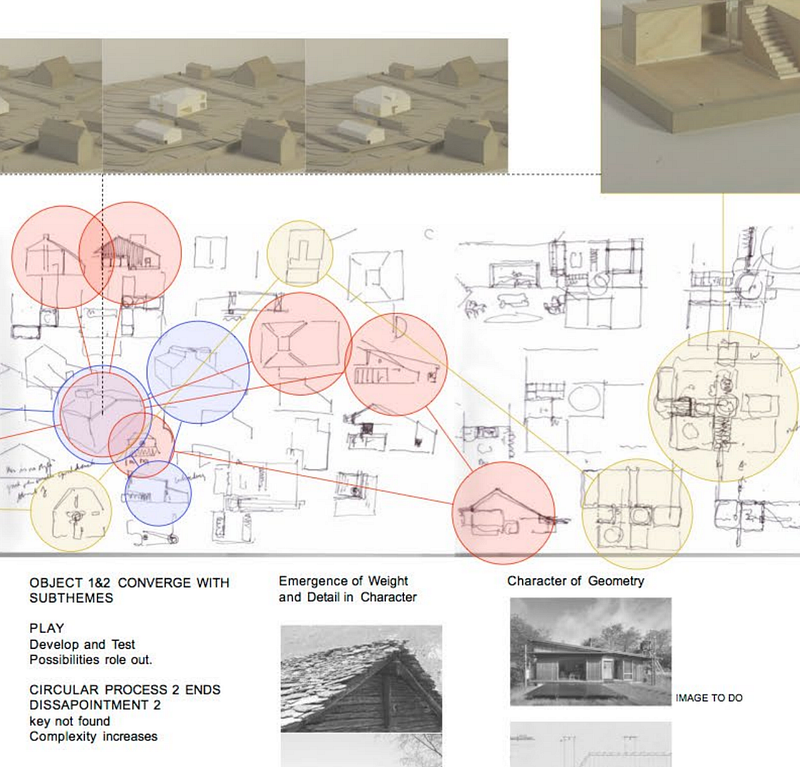
Larkin’s thesis explores different ways of compiling and theming their practice to reveal insights. Their supervisor, Richard Blythe, called this visual analysing process: venturous practice. You start by mapping your different projects, and joining the dots between them through what they call ‘urge lines’ — categorising projects by common intent.
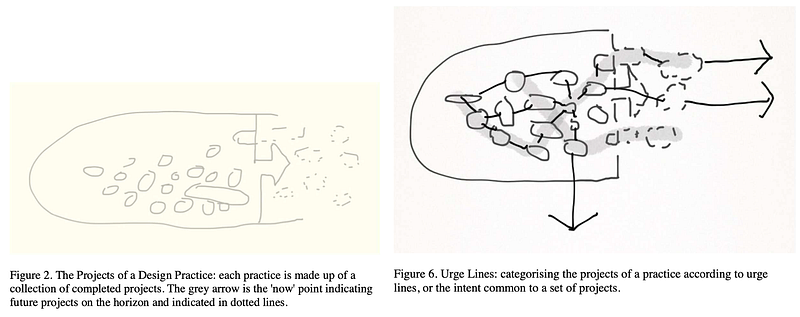
I realised this is what I had kind of already done with the learning journey diagram I did at the very beginning of my PhD. I was curious about trying this with Stories of Place — exploring the projects around it in our wider CoLab Dudley ecosystem and the experiments that have emerged from it . Part of my approach to regenerative research is resisting categorising things, which can be seen as a colonial form of research (Engle et al, 2022; Camrass, 2023; Sanford, 2023). A regenerative approach would be to not systematically divide things by difference imposed by my understanding and worldview, but to instead holistically look at the whole, and the relations and connections. This isn’t to say categorisation is necessarily all bad — Jo Orchard-Webb often reminds me that coding can invite us to immerse and entangle ourselves with details, experimenting with ‘order and disorder’ in ‘an open-ended and ongoing practice of making sense’ (Maclure, 2013 in Ruck and Mannion, 2019), similar to the approaches of data humanism.
Even if I wanted to, I couldn’t individually map the different experiments in CoLab Dudley’s ecosystem because they are so intrinsically interlinked. I had to merge the first two steps of venturous practice in order to remember what experiments exist, because they emerged from and influenced each other. Their narratives are so entangled I would have missed something if I tried to list them separately and then impose categories upon and between them. In addition, rather than opting for the Western perception of time from left to right, I visualised time on a vertical axis to invite a nature-inspired perspective of the experiments growing from various roots.
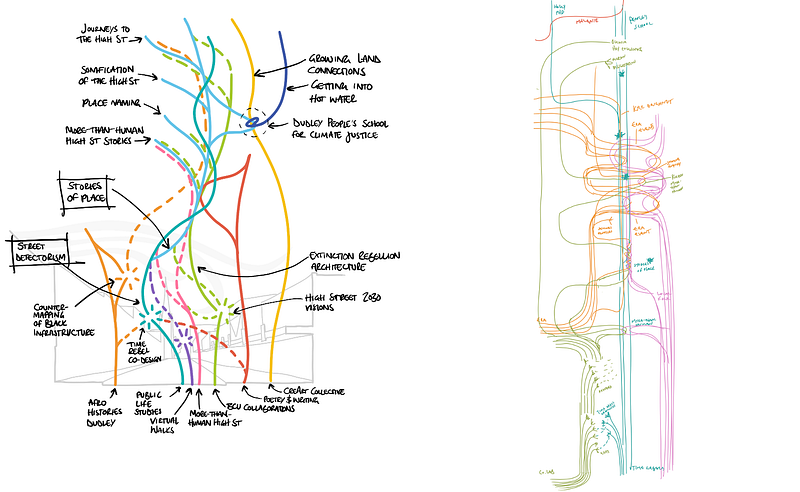
I took this into miro along with images of the different experiments as prompts, and defined where there were direct spin-offs, where individuals had cross-pollinated between experiments, and where artefacts created within these experiments had been lifted in others.
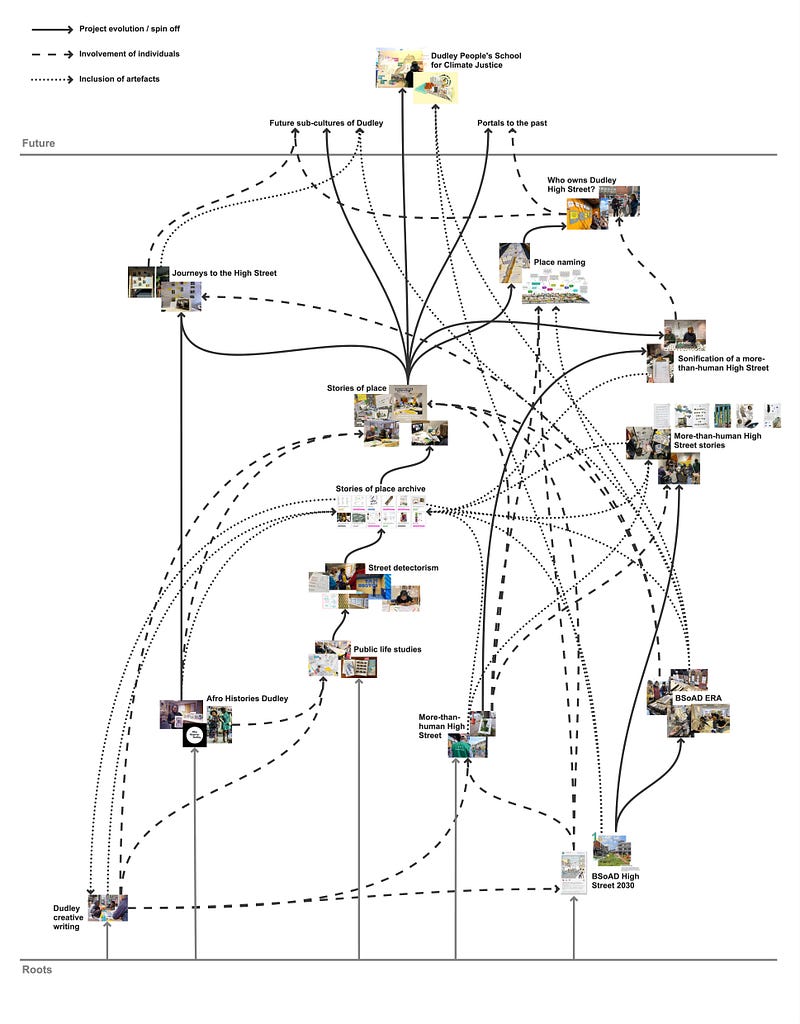
The next step of venturous practice is to explore your experience within a disciplinary context:

At the time, I was curious about how co-creative forms of architectural processes overlapped with Stories of Place so far. For example, in the diagram below:
- yellow = co-creative methods for understanding place
- orange = co-creative methods for imagining of alternative futures
- blue = co-creative methods for prototyping futures

Just the process of planning this diagram raised a critical question:
Why am I focusing on disciplinary processes when architectural processes overlap with so many other creative ways of knowing and doing?
It felt counter to the transdisciplinary (or even postdisciplinary) approach of regenerative practice to focus on one discipline. This has led to a significant shift in my research title (which probably deserves its own blog at some point) from:
Co-creating regenerative futures: The role of architectural processes and social labs in unlocking collective change
To:
Co-creating flourishing futures: The role of regenerative research practice within social infrastructure in inviting regenerative cultures
Back to Blythe, another step in venturous practice is reflecting on all of this to discover and articulate ascension moments:

For me, this was really interesting because by visually revisiting experiments that I had already thought about, reflected on individually and collectively, and written about, I discovered deeper insights.

The final steps of venturous practice, before and after the ascension moments, are integrating key reflections points across the phd lifecycle and rotating the diagram 90 degrees to explore it all from a different position whilst reflecting on ‘past practice, the creation of the current project and reflection toward future work’. Finally, all of this is communicated through the completion and dissemination of the PhD:

Venturous practicing helped to:
- Reveal connections and narratives between projects.
- Surface significant shifting questions that challenged my research focus.
- Discover deeper insights alongside written and spoken forms of sense-making.
Although:
- Elements of the approach felt counter to some of the regenerative research principles that have emerged from and are informing the evolution of my research.

This led me to a series of design questions to make this approach more regenerative:
- How might this be an emergent rather than prescribed process that adapts to the complexity around me and my specific context?
- How might the structure of this challenge colonial worldviews that I’ve inherited?
- How might this invite co-creators to be involved in this process, bringing their many different lived experiences and ways of knowing, rather than my individual perspective?
- How might this invite embeddness rather than separateness, from place and nature?
- How might this process be shared openly throughout the PhD through reciprocal and evolutionary or generative ways, rather than just telling people about it at symposia or completion of the PhD?
- How might this invite everyone involved to be accountable across time — to shift from seeing projects as standalone finite moments to transitional, relational and evolutionary?
This whole process left me with the question:
What if… my PhD could develop a form of regenerative visual analysis?
Visual analysis -> Visual composting
The first step in developing a form of regenerative analysis is to revisit a couple of terms:
- Analysis is rooted in dissecting and breaking apart something to find a solution. I feel this is in tension with the relational and holistic approaches of regenerative learning, so I instead opt for composting: layering and combining different knowledges and ways of being to nurture new learning to emerge (inspired by CoLab Dudley teammates, Jo Orchard-Webb and Lorna Prescott).
- Data has extractive connotations, especially with the phrases ‘data collection’ and ‘capturing data’. However, ‘data’ is actually rooted in words related to giving and gifting, rather than taking. So rather than talking about data, I talk about gifts.
In Stories of Place, I’ve been foraging gifts to form an initial layer of composting. The structure of each session is visualised and shared with Stories of Place co-creators before each gathering, and later added to with everyone’s gifts, including conversations, photos, plan drawings of how we use the space, initial reflections and emerging seeds of ideas. This compost is then re-gifted back to the co-creators with an added sprinkling of links to curiosities and potential connections between co-creator ideas.


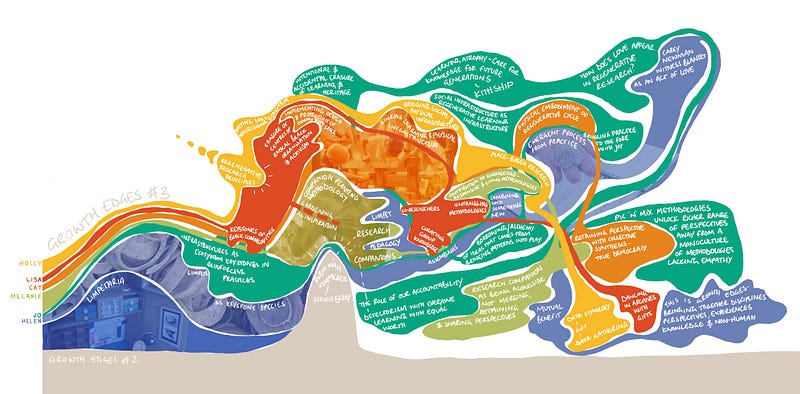
An aside: Every two months I co-convene a group of researchers interested in regenerative and decolonising approaches, called Growth Edges. We take turns being the storyteller to share our conversations more widely. Miro is useful for quick(ish) collation of gifts, but it’s not quite as joyful as hand-drawing the relationships and magnetism of conversations:
I have now started to gather all the Stories of Place gifts into one drawing for holistic reflection alongside a spiralling journal of insights and interactions with our wider ecosystem that are contributing to the evolution of the research design. The use of a spiral was inspired by Regenesis’ use of a spiral to represent the concurrent and cyclical processes of understanding place, designing for harmony and co-evolving with that place:

Spirals are also used in a nature-inspired reflexive tool for Transgressive Action Research:

At the beginning of my PhD, I was asked to create a Gantt chart to share the plan of my research. I wanted to integrate CoLab Dudley’s nature-inspired ways of working with the seasonal ebb and flow of activity and energy which we had previously visualised as waves (inspired by Kirsten Moegerlein’s timeline of activity in their PhD thesis):


Time waving helped to:
- Define different events and elements of our work (shared enquiries, welcome points and reseeding, creative-led experiments, local folk sharing creativity, rituals and lab space changes).
- Reveal seasonal rhythms and patterns of working.
- Situate our activity in context of our place and principles (and Covid).
- Communicate our story to different people that can be tricky to grasp with just writing.
Although:
- It doesn’t challenge Western concepts of time and therefore doesn’t invite drawing the relationships between the different events.
- We haven’t yet used this as an ongoing design tool and I’m not sure it would be able to communicate the increasing complexity and nestedness of our work.
I combined this seasonal focus within a spiral research plan (which has since evolved):

Spiral planning helped to:
- Design in and lift the transitional nature of the PhD.
- Realistically(ish) plan in seasonal working, breaking away from a pressure to constantly work at the same energy or to academic deadlines / academic years e.g. hibernating with books and writing over winter and being out and about in summer.
Although:
- It still remained quite linear and Gantt chart-y — it could communicate flexibility with multiple possible futures and spin offs and connections between cycles.
- It’s still egocentric — this research is evolving with others who might enter, leave and revisit at different points, impacting the design.
- It did not reflect my personal aversion to hot summer months — summer is my time to hibernate.
Since then, I have created a diagram that explores monthly spirals of reflection between each Stories of Place gathering, with (overlapping) periods of following up, initial gift gathering and composting, designing and preparation.


Holly Doron (2024) Visual composting spiral process sketch and key

At the moment, this is just an incomplete layer of compost retelling what is happening. I’ll return to the spiral with my evolving regenerative research principles and other lenses to holistically explore the patterns and connections of the gifts and the wider ecosystem within which this work is nested. In a recent conversation with Jo, we reflected that through visual composting I am trying to reveal:
- Where I’m walking the walk of the emerging principles
- What ripples this creates
- How these feed back into the regenerative design process
- Where different lenses, insights, practices, knowledge traditions / roots / lineages come into play at different parts of the journey, while honouring the labour of others.
I am doing this through various scales and nestedness that influence each other:
- Individual
- Stories of Place
- CoLab Dudley learning and doing infrastructure
- Our wider ecosystems of learners-through-doing, Pathfinders, and researchers

I will carry on messily composting while learning through doing / doing through learning. In conversations with my PhD supervisory team, I’m still gauging what to delve into and lift, whether this process is even appropriate or generative, what happens when it is combined with other forms of sense-making, whilst taking caution against misinterpretation. I will share the lessons that emerge here. In the meantime, I’d love to hear if any of this sparks anything for you.
My research is funded by the Arts and Humanities Research Council through Midlands4Cities. It is entangled with my work at CoLab Dudley funded by The National Lottery Community Fund’s Climate Action Fund and Joseph Rowntree Foundation as part of a network of Pathfinder organisations reimagining and redesigning the world we want to live in to achieve deep, transformative change.