What helps, or could help, us to act towards just change (… or existence)?
A deep dive into learning patterns, design questions, intentions and wisdom emerging around action for just futures. Generated through collective sensing and reflections of Stories of Place co-creators.

This is a deeper layer of learning behind Stories of Place 2024–2025 Composting #3 | Co-creators as earthworms, so this post will make much more sense if you start there. Our glossary might also help.

From previous years of Stories of Place, I recognised a pattern of collective imagination but perhaps less action towards becoming active and positive contributors to our ecosystems. This reminded me of Miriam, Lorna and Jo’s discussions around rethinking risk assessments with the risk of not acting.¹ Collective action became the focus of this composting question. When I shared this question with co-creators in October 2024, Rebekah reflected that ‘just change’ implies that change is a goal and stopping point, whereas ‘just existence’ feels like “a living thing” continually working towards justice for different beings. Just existence is a process, not a destination.² Luke emphasised the importance of a culture of enjoying the process, journey, and experience, inviting Helen to reflect, “the experience of trying is as important.”³ Rebekah later wondered how we might explore “how we might feel to be in creative processes” and celebrate “the development of our creativity over time.”⁴ Rick also recognised learning and doing as a creative process and valuing process over output. These co-creator reflections were a helpful reminder that action does not necessarily mean the creation of solutions or end-products. Action is a journey. Co-creators want to live change and not just act towards it.
Stories of Place is space we can practise living the change we want to see, in order to spread this to other areas in our lives. Dionne led a learning enquiry with colleagues at Dudley Metropolitan Borough Council and Dudley Group NHS Foundation Trust, in which they shared their values practice and regenerative ways of being:
“I have been on a mad mission to merge my day job with this world… and I think with the making hour, it’s happened, and I think there’s now more opportunities through just being in this space, coming to the workshops, testing and learning in a safe space… I feel quite confident now to go and do making values workshop with a group of… practitioners… because I’ve experienced it… I think this year will lay the foundation of that in terms of relationships… It starts with that safety… and connections, and then building that.” — Dionne Williams, October 2024
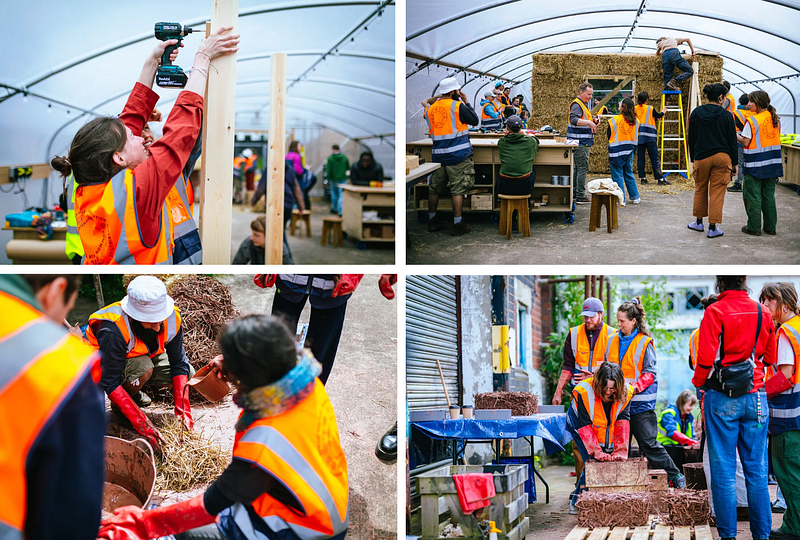
Dionne’s confidence to act is rooted in their experience and practice as a Time Rebel. In 2021, Lorna, Kerry and Jo from the CoLab team convened a Time Rebellion, inviting creatives and doers to inspire long-term thinking and collective imagination within systems in which both practices are scarce and actively suppressed. Stories of Place would not exist without the cultural infrastructure that it emerged from and is nurtured by: CoLab Dudley. Whenever CoLab Dudley team members Lorna and Jo join, they bring with them their lab learning, experiences, and practices, gifting another layer of criticality to our conversations and mindfulness to our actions. The Stories of Place archive emerged out of Time Rebel experiments and our first gathering in 2021 brought together several Time Rebels who are still Stories of Place co-creators today, bringing Time Rebel practices: sharing their lessons learnt from other experiments, shifting ideas of consumption to creation, and linking ideas to wider framing and learning in the ecosystem towards action.⁵ Slow and relational social infrastructure that invites collective learning feels critical to nurturing reflexive journeys with connected action.

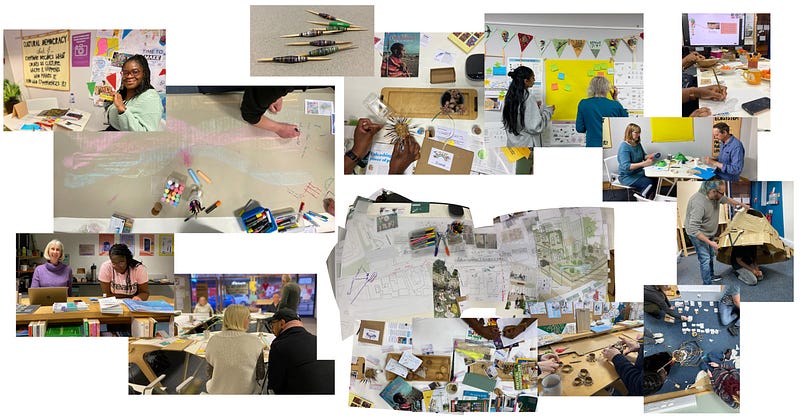
The flexible structure of Stories of Place is a condition that helps to nurture creative processes and non-linear imagining and making that invite action. Rick thought creatives have skills in being flexible, acting with immediacy, not waiting for permission, and bringing infectious enthusiasm that builds momentum.⁶ Dionne often reflects that having dedicated making time for planning and prototyping experiments “helps people to go a little bit deeper in a safe way.” Co-creators can test, prototype, and evolve activities with multiple people with different experiences, helping us move towards action.⁷ The idea for Making Hour emerged from the 2023 learning foraging session. This speaks to the impact that co-creators have on how Stories of Place itself evolves: our experimentation leads not just to ideas around what we do but how we do. The structure of Stories of Place flexes with our creative processes, creating more time for collective making and gentle, cumulative action, for example for Human Limpet and Jellimpet. As Lorna reflected while thinking about Sarah Corbett and Craftivism, perhaps “Time Rebels are gentle activists”.

Learning patterns:
- A process-focused culture might bring us closer to a culture of just existence.
- The social lab infrastructure that nurtures collective learning, creative processes and Time Rebel practices are a critical foundation for a horizontal exchange and deepening of knowledges, practices and relationships that shift imagining into action.
- Flexible structure is needed for non-linear imagining and making.
These help us to shift from being product or destination focused, away from the concept of making solely for productivity, and focusing on linear beginnings, middles and ends, which might limit possibilities or lead to action that perpetuates injustice.

Design questions these patterns reveal for how Stories of Place might evolve this year:
- How might we invite process-focused cultures through doing, rather than just imagining?
- What might we borrow from creative practices to build our capacity to act?
- How might Stories of Place invite Time Rebel practices shifting imagination to action?
- How might Stories of Place become a gateway to climate action?
- How might we create more welcoming invitations to imagine through making?
- What relationships can we build with our own creativity?
- How might it feel to imagine, create and make at different times between Stories of Place gatherings?
- How might play help to develop our creative processes?

Intentions for Stories of Place this year
- Make with seeds of ideas to think, rather than just thinking in order to make (we are now doing this!)
- Find potential see ds of Time Rebel practice in our everyday, sharing previous Time Rebel Tools.
- Explore how we might feel to be in creative processes, learn from each other and record and celeb rate our creativity journey over time through rituals of sharing our creative experiences.
- Embody our learning and support it to be transferrable across different pathways within our lives.
- Creatively document the ripples of our Stories of Place interactions, in our individual and collective journeys.
- Invite material knowledges into the ecosystem without teacher / student dynamics
- Connect to other projects in Dudley People’s School for Climate Justice (which we’ve now started with Ekho Collective!)
- Develop a library of group games that can supp ort our collective imagining, play and non-linear thinking.

Wisdom we might draw from:
- Making in order to imagine — Piers Taylor’s thesis explores how we might move away from only making when willing an idea into reality to revealing ideas through the process of making.
- Exchanging and connecting creative processes and tools — Mycorrhizal fungi create networks that transport nutrients and other resources across ecosystems. We could also be more like Salmon, connecting different ecosystems.
- Climate justice action through growing skills — Ekho Collective’s project, Tending People, Place and Planet, shared tools on climate activism, Nature journalling and Permaculture principles to build care and skills in wildlife friendly growing.
- Climate justice action through material skills — CIVIC SQUARE are exploring how neighbourhoods can retrofit their homes through learning and sharing skills in building in ways that “honour the reciprocal interrelation of land, materials, and people.”
- May, 2024
- Helen Garbett, October 2024
- Rebekah Warmington, October 2024
- March 2025
- Jan Norton, July 2024; Helen Garbett and Rick Sanders, August 2024; Dionne Williams, March 2024
- Rick Sanders, March 2025
- Dionne Williams, Jan Norton and Lorna Prescott, June 2024
Stories of Place Co-creators
Abby Staniland (Earthworm / Orkney Vole) grew up in Dudley, worked at the zoo and is now a budding landscape architect, bringing their connective imagination and visualisation talents. With other design students, Abby gifted dreams of local folk swapping waste plastic for Dudley pounds to mould into pop-up modular community tables for people to exchange goods, collaborate, create and learn together.
Alex Lui (Limpet)
Andy Edwards (Limpet)
Bill Laybourne (Sludge Worm) is full of fascinating facts and provocations, bringing laughter and inspiring disorder. Bill‘s sound-based social art practice led to co-creators noise making with more-than-human sounds of the High Street.
Caz Emery (Ginger) has a reputation for creating something out of nothing and getting stuff done, with curiosities around craft, nature and food. They are often found cooking plant-based meals on the campfire feeding and nurturing the Ekho Collective community.
Deb McDonald (Ant) is a network weaver, bringing knowledges and curiosities from Ekho Collective, and is particularly curious about how people can collectively engage with creativity, culture and heritage to co-create resilient communities.
Dena Khan (Bumblebee / Shark / Swift) brings an imagination that centres young people and how they can shape and renew places through creativity, connecting with multiple generations. They are curious about buildings being perceived as waste, and how we can bring life to them again through care and connection.
Dionne Williams (African Migrant Butterfly / Limpet / Mycelium / Northern Pool Frog / Red Squirrel) is a deep thinker and doer drawn to creativity and experimentation. Dionne has a gift for nurturing welcoming, safe and generous spaces, currently exploring how East African values might invite conversations and creativity that bring us closer to Nature-connected values in Dudley.
DKB (Dragonfly / Ginger) is curious about sharing sustainable farming and growing knowledges between different places across the world to help build hopeful resilience within the Earth crisis. This curiosity is rooted in their captivating childhood memories of running through their farm pausing to eat fresh mangos.
Erica Williams (Buddleia / Ginger) is a walking encyclopaedia of Black Country history, whose Storylines blog is rich with research connecting family history with wider systemic issues. Erica has a wonderful ability to connect ideas to inspiration from places across the world and knowledges gained from her background in teaching and training business communication, particularly in the marketing communications industry.
Helen Garbett (Little Whirlpool Ramshorn Snail / Limpet / Orkney Vole / Sludge Worm) always brings a contagious curiosity rooted in their social art practice exploring human entanglement with Limpets. Helen has a magical ability to shift us from imagining to making, inspiring us with their creations between our gatherings, and, of course, spark collective fascination in all things Limpet.
Holly Doron’s (Chiffchaff / Earthworm / Fountain Water / Great Diving Beetle / Limpet / Moth) favourite moments are watching people spark with others over a thought or idea so they try to create the conditions for this to happen while listening, note-taking and connecting learning and curiosities.
Jack Williams (Water Strider) brings their wildlife conservation knowledges from Dudley Zoo and is curious about what zoos might look in the future as spaces for community, nature connectedness and wellbeing.
Jan Norton (Hazel Dormouse / Peacock Butterfly / Robin / Zitting Cisticola) brings their creativity, stories with Nature, smiles and stunning skills and ideas with fabrics and stitching. Jan is a convenor of Stitchers in Time who research and create beautiful pieces connecting textiles, fabrics, stitching and other media with Nature, place, stories with heritage and futures.
Jasbinder Sangha (Puddle)
Jasbir (Water Strider)
Jhora Sangha (Pigeon)
Jo Orchard-Webb (Gorse / Hawthorn / Hedgehog / Mycelium) joins virtually from the Dorset seaside, bringing Nature perspectives and curiosities from Eric-the-dog walks along with their deep care for Dudley. Jo has a talent for absorbing and connecting everybody’s ideas with wider ecosystems and knowledge networks.
Laura Jane Round (Hammerhead Shark)
Laura Onions (Limpet) has an inspiring ability to get stuck in with making, gifting their creativity and curiosity to other co-creators. Laura’s art practice is rooted in printmaking and how this can take on new forms out and about with Nature across the Black Country.
Lorna Prescott (Barn Owl / Great Diving Beetle / Hedgehog / Nettle / Red Fox / Swift) brings years of lessons from doing in Dudley alongside deep thinking around systemic issues behind our everyday interactions. Lorna is full of curiosity and wonder around anything more-than-human and deep time.
Luke Hudson (Dragonfly / Great Mouse-Eared Bat / Limpet) brings their fascination and knowledges around green living, Nature and psychology, alongside their curiosity and laughter, diving into and co-evolving whatever unexpected activities co-creators are dreaming up.
Miriam Atikpo always brings deep reflections with critical thinking rooted in a stunning abundance of cultures and languages. If she’s not with us, it’s because she’s busy spreading care in the NHS.
Nat WB (Bumble Bee, Hedgehog, Little Egret)
Natalie Marsh (Snail)
Nichaela Reid (Bumble Bee)
Paul Burns (Hawthorn / Mycelium) brings invigorating perspectives and prose as a creative writer with a fascination in more-than-human folklore. Paul is generous in sharing photos and videos of their local wildlife in between gatherings and always has interesting Dudley memories to share.
Rachael Othala (Fountain Water / Great Diving Beetle) always arrives full of Dudley energy and curiosity, inspiring other co-creators with their creativity through making and poetry. They are curious about how the LBGTQIA+ community and allies can explore art together.
Rebekah Warmington (Badger / Bear / Buddleia / Ladybird) brings her gifts in creative making and thinking, with an extraordinary ability to weave deep reflections in the moment. Rebekah generously shares her experience in learning with and from Nature and Indigenous knowledges. She is also deeply inspired by play, and how experiential learning can enhance and guide the connections we make in our journeys of exploration and discovery.
Rick Sanders (Beaver / Limpet) brings their do-it-together spirit, gifting inspiration from their practice in poetry and breathing creativity into upcycling furniture and textiles.
This research is funded by the Arts and Humanities Research Council through Midlands4Cities. It is entangled with my work at CoLab Dudley funded by The National Lottery Community Fund’s Climate Action Fund and Joseph Rowntree Foundation as part of a network of Pathfinder organisations reimagining and redesigning the world we want to live in to achieve deep, transformative change.