What helps, or could help, us to connect as part of Nature and place?
A deep dive into learning patterns, design questions, intentions and wisdom emerging around nature connection and connection with place. Generated through collective sensing and reflections of Stories of Place co-creators.

This is a deeper layer of learning behind Stories of Place 2024–2025 Composting #3 | Co-creators as earthworms, so this post will make much more sense if you start there. Our glossary might also help.

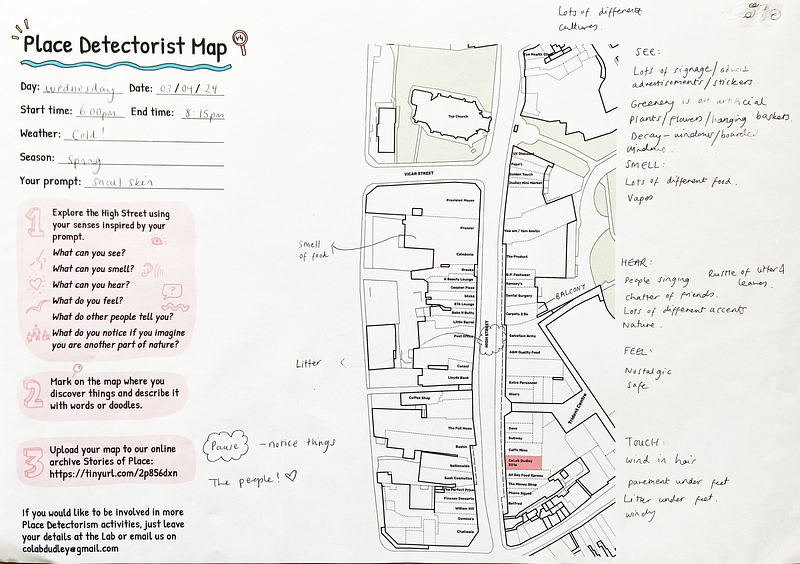
Natalie the Snail inched down Dudley High Street, tapping into their magnified senses. They smelled food and vapes, felt wind across their mollusc skin and litter below their ventral muscular foot. Accompanied by Jhora’s keen Pigeon ears, they savoured the sounds of singing and chatting in a kaleidoscope of languages and accents. Growing up in Dudley, Jhora rarely felt comfortable on this part of the High Street; it was somewhere you rush through. Jhora and Natalie’s natural companions, Snail and Pigeon, invited them to pause, focus their senses and notice things that made the High Street feel less threatening and more relaxing. They dreamt of graphics on the street that celebrate and welcome the diversity of dialects and languages in Dudley.¹ Ten months later, Jhora shared their suspicions that this experience made them comfortable enough on the High Street to talk with their barber about their lived experiences of other places, shifting conversations beyond business interactions. Their barber said they missed their home, revitalising Jhora’s own connection with Dudley.²
At the beginning of the Grounding in Place half of our gathering, Natalie and Jhora chose a natural companion from our Stories of Place more-than-human kith pool. Lyanda Fern Lynn Haupt explains that while kinship involves inherent connections, such as through blood, kithship is an intimate connection “with the landscape in which one dwells and is entangled, a knowing of its waymarks, its fragrance, the habits of its wildlings.” Unlike kinship, kithship is earned through being near, still, opening up and observing in our places, and crossing “dimensions of knowing.” In Stories of Place, co-creators choose from a growing pool of more-than-human kith prompt cards containing images and knowledge of flora, fauna and water to have in their minds with any observation, idea or prototype.
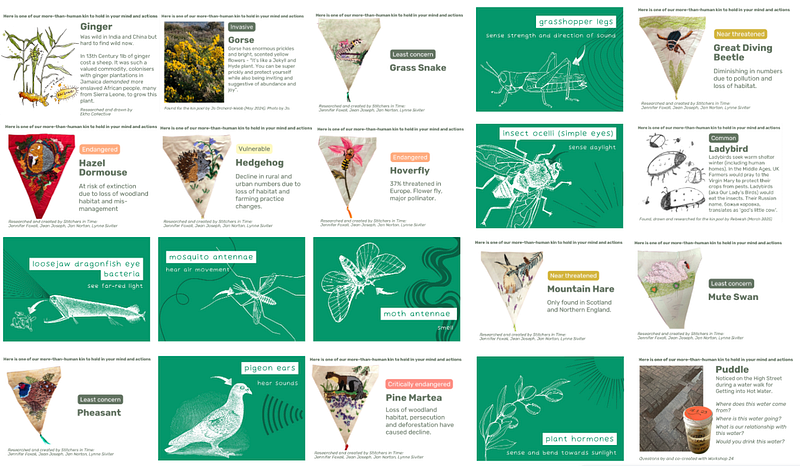
These natural companion cards started as post-its inviting people to embody more-than-human senses. By invitation of CIVIC SQUARE, I designed prompt cards they could use in their own place, Ladywood. These then evolved into prompts that share more-than-human research and creations from Dudley-based experiments and curiosities. Our more-than-human kith pool invites embodiment and relationships, or kithship, with life across our ecosystem. Helen’s long-term practice of engaging with and embodying Limpets in multiple ways inspired our ritual with kith. Our kith pool evolves with co-creators’ curiosities and research, inviting deeper and longer-term care and relationships.
“Immersing myself in other perspectives of the High Street has enabled me to improve my relationship with place, reawakening my awareness of our ecosystem and helping me to reconnect with nature” — Dionne Williams, 2024
The second half of our gatherings, Making Hour, creates space for deeper conversations around our connection to place and Nature to emerge through co-creation of experiments. Dionne’s project shared East African values rooted in Nature and invited us to make paper beads while we shared our place-based stories and reflected on what Dudley’s values might be. Lorna reflected that Dudley has not rejected inheriting “GDP as the measurement of a thriving economy… and not valuing… more-than-human life… or even human life.”³ Creating space for reflexive conversations gives us time to sit with and question our societal values and systems, as well as reflect on how Nature is valued (or not) in our neighbourhoods.
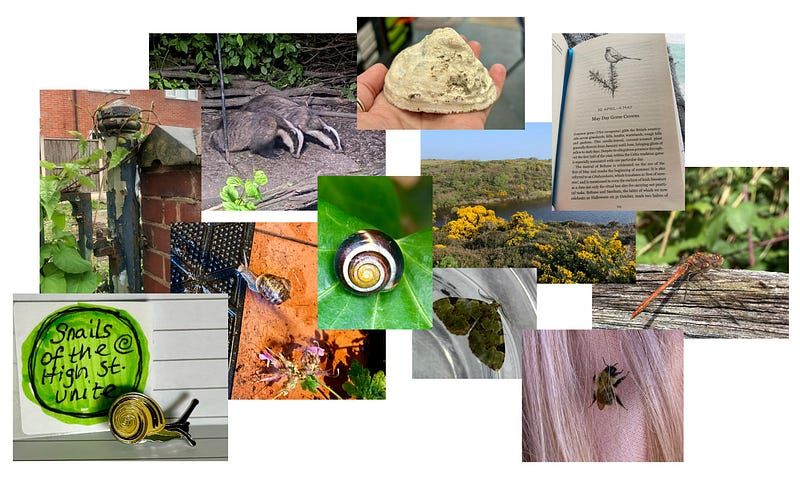
Engaging with more-than-human perspectives in multiple, creative ways can have long-lasting effects on our relationship with Nature and place.⁴ Our kith can unearth and connect memories of kithship, awaken our senses, reveal surprises at different speeds and heights, and ignite a wish to build and share our ecological knowledge.⁵ These experiences can be disheartening, drawing our attention to what is needed and exposing more-than-human deterrents,⁶ whilst revealing potential, imagination and motivation for change in which climate and Nature can thrive.⁷ As our more-than-human kith become more engrained in our activities, co-creators are noticing them in between our gatherings and even telling stories as their kith.⁸ Our WhatsApp group has become a space rich with images and stories of our Nature-connected ways of being and creating.
We have collectively discovered that the Dudley ecosystem is whoever is in that place at that time, whether you are a coastal mollusc; an African Migrant Butterfly dreamed into a future warmer Dudley; a human neighbour from beyond political place boundaries bringing knowledges from other places and cultures, and care by choosing to be in Dudley; or a regular co-creator contributing virtually to a gathering, inviting reciprocal relationships between individual habits and habitats and collective places and spaces.⁹ Our more-than-human kith have revealed our human-centric perspectives and impact in our places. Now, how might we shift from observers of our ecosystem to becoming reciprocal contributors to our ecosystem?

Learning patterns:
- Rituals of collective learning, reflection, imagining and making rooted in more-than-human perspectives can invite and deepen Nature connection and sharing of more-than-human and climate knowledges.
- Invitations, permission and recognition can help us shift from visitor and observer to being actively part of place.
These patterns differ from our everyday experiences and human-focused perspectives of seeing ourselves as separate from Nature and place, and extracting from Nature and place without reciprocity.

Design questions these patterns reveal for how Stories of Place might evolve this year:
- How might we think about our roles as part of our ecosystems and places?
- How might we act in reciprocity with our ecosystems and places?
- How might we invite and document reciprocal relationships with our ecosystems and places?
- How might we move towards action that centres more-than-human perspectives, healing and flourishing?
- How might we make the invitation to become part of place clear?
- How might we exchange learning between ecosystems and places?

Intentions for Stories of Place this year:
- Collectively name or reveal emerging roles in our ecosystems
- Find someone who can fix our 201bee hotel to our High Street sign!
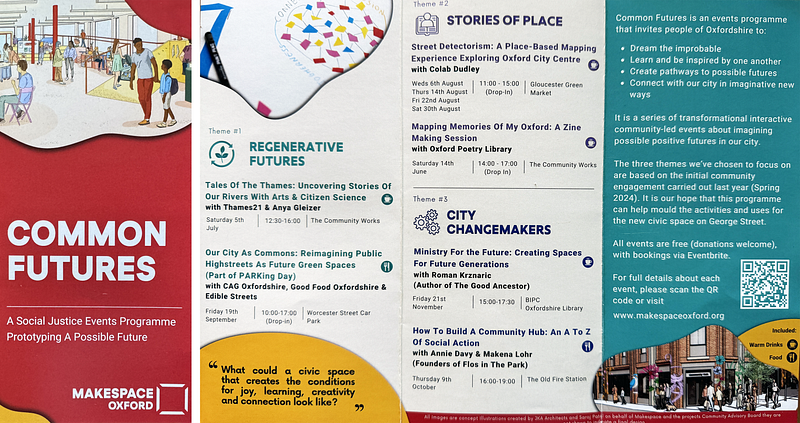
- Continue to share and evolve place detectorism and Stories of Place with other places through these lab notes and the resulting emerging relationships, like our friends at MakeSpace who are prototyping place detectorism in Oxford.

Wisdom we might draw from:
- More-than-human justice — Helen and Bill of Workshop 24 introduced the term ‘more-than-human’ to Dudley High Street in 2021, inviting people to seek the more-than-human, framing and naming them as art pieces, and experimenting with more-than-human sounds to co-create an exhibition. Their art and research have created lasting and rippling effects, rooting the lab’s work in more-than-human. They are now exploring more-than-human justice through working with a pond as a more-than-human entity.
- More-than-human imagining / prototyping — Our collaborations with architecture and design students over the years have nourished our archive with their imaginaries of a regenerative Dudley. How might their explorations lead to smaller actions in the present that could bring these imagined futures closer to reality?
- More-than-human knowledges — Ekho Collective’s Reclaim our Roots project explored medical herbalism, and how people might build confidence around creating things with herbs through accessible learning that people can apply immediately. Could these knowledges and what is created invite us to ground ourselves in Dudley through taste? (It’s taken me so long to write this post, this has now happened!)


Grounding in place with Cleavers water and Nettle tea, May 2025
- Natalie Marsh and Jhora Sangha, April 2024
- Jhora Sangha, February 2025
- Lorna Prescott, June 2024
- Dionne Williams, March 2024; Jhora Sangha, February 2025
- Lorna Prescott, March 2024; Jo Orchard-Webb and Paul Burns, April 2024; Helen Garbett, Jo Orchard-Webb and Lorna Prescott, May 2024; Dena Khan, July 2024; Helen Garbett, November 2024
- Jasbinder Sangha, April 2024
- Dionne Williams, June 2024; DKB, Jan Norton, Laura Jane Round, Nat WB, and Paul Burns, July 2024
- Lorna Prescott, March 2025; Helen Garbett, May 2024
- Dena Khan, DKB and Nat WB, July 2024; Dionne Williams and Rebekah Warmington, August 2024; Helen Garbett, October 2024; Jan Norton and Rebekah Warmington, March 2025
Stories of Place Co-creators
Abby Staniland (Earthworm / Orkney Vole) grew up in Dudley, worked at the zoo and is now a budding landscape architect, bringing their connective imagination and visualisation talents. With other design students, Abby gifted dreams of local folk swapping waste plastic for Dudley pounds to mould into pop-up modular community tables for people to exchange goods, collaborate, create and learn together.
Alex Lui (Limpet)
Andy Edwards (Limpet)
Bill Laybourne (Sludge Worm) is full of fascinating facts and provocations, bringing laughter and inspiring disorder. Bill‘s sound-based social art practice led to co-creators noise making with more-than-human sounds of the High Street.
Caz Emery (Ginger) has a reputation for creating something out of nothing and getting stuff done, with curiosities around craft, nature and food. They are often found cooking plant-based meals on the campfire feeding and nurturing the Ekho Collective community.
Deb McDonald (Ant) is a network weaver, bringing knowledges and curiosities from Ekho Collective, and is particularly curious about how people can collectively engage with creativity, culture and heritage to co-create resilient communities.
Dena Khan (Bumblebee / Shark / Swift) brings an imagination that centres young people and how they can shape and renew places through creativity, connecting with multiple generations. They are curious about buildings being perceived as waste, and how we can bring life to them again through care and connection.
Dionne Williams (African Migrant Butterfly / Limpet / Mycelium / Northern Pool Frog / Red Squirrel) is a deep thinker and doer drawn to creativity and experimentation. Dionne has a gift for nurturing welcoming, safe and generous spaces, currently exploring how East African values might invite conversations and creativity that bring us closer to Nature-connected values in Dudley.
DKB (Dragonfly / Ginger) is curious about sharing sustainable farming and growing knowledges between different places across the world to help build hopeful resilience within the Earth crisis. This curiosity is rooted in their captivating childhood memories of running through their farm pausing to eat fresh mangos.
Erica Williams (Buddleia / Ginger) is a walking encyclopaedia of Black Country history, whose Storylines blog is rich with research connecting family history with wider systemic issues. Erica has a wonderful ability to connect ideas to inspiration from places across the world and knowledges gained from her background in teaching and training business communication, particularly in the marketing communications industry.
Helen Garbett (Little Whirlpool Ramshorn Snail / Limpet / Orkney Vole / Sludge Worm) always brings a contagious curiosity rooted in their social art practice exploring human entanglement with Limpets. Helen has a magical ability to shift us from imagining to making, inspiring us with their creations between our gatherings, and, of course, spark collective fascination in all things Limpet.
Holly Doron’s (Chiffchaff / Earthworm / Fountain Water / Great Diving Beetle / Limpet / Moth) favourite moments are watching people spark with others over a thought or idea so they try to create the conditions for this to happen while listening, note-taking and connecting learning and curiosities.
Jack Williams (Water Strider) brings their wildlife conservation knowledges from Dudley Zoo and is curious about what zoos might look in the future as spaces for community, nature connectedness and wellbeing.
Jan Norton (Hazel Dormouse / Peacock Butterfly / Robin / Zitting Cisticola) brings their creativity, stories with Nature, smiles and stunning skills and ideas with fabrics and stitching. Jan is a convenor of Stitchers in Time who research and create beautiful pieces connecting textiles, fabrics, stitching and other media with Nature, place, stories with heritage and futures.
Jasbinder Sangha (Puddle)
Jasbir (Water Strider)
Jhora Sangha (Pigeon)
Jo Orchard-Webb (Gorse / Hawthorn / Hedgehog / Mycelium) joins virtually from the Dorset seaside, bringing Nature perspectives and curiosities from Eric-the-dog walks along with their deep care for Dudley. Jo has a talent for absorbing and connecting everybody’s ideas with wider ecosystems and knowledge networks.
Laura Jane Round (Hammerhead Shark)
Laura Onions (Limpet) has an inspiring ability to get stuck in with making, gifting their creativity and curiosity to other co-creators. Laura’s art practice is rooted in printmaking and how this can take on new forms out and about with Nature across the Black Country.
Lorna Prescott (Barn Owl / Great Diving Beetle / Hedgehog / Nettle / Red Fox / Swift) brings years of lessons from doing in Dudley alongside deep thinking around systemic issues behind our everyday interactions. Lorna is full of curiosity and wonder around anything more-than-human and deep time.
Luke Hudson (Dragonfly / Great Mouse-Eared Bat / Limpet) brings their fascination and knowledges around green living, Nature and psychology, alongside their curiosity and laughter, diving into and co-evolving whatever unexpected activities co-creators are dreaming up.
Miriam Atikpo always brings deep reflections with critical thinking rooted in a stunning abundance of cultures and languages. If she’s not with us, it’s because she’s busy spreading care in the NHS.
Nat WB (Bumble Bee, Hedgehog, Little Egret)
Natalie Marsh (Snail)
Nichaela Reid (Bumble Bee)
Paul Burns (Hawthorn / Mycelium) brings invigorating perspectives and prose as a creative writer with a fascination in more-than-human folklore. Paul is generous in sharing photos and videos of their local wildlife in between gatherings and always has interesting Dudley memories to share.
Rachael Othala (Fountain Water / Great Diving Beetle) always arrives full of Dudley energy and curiosity, inspiring other co-creators with their creativity through making and poetry. They are curious about how the LBGTQIA+ community and allies can explore art together.
Rebekah Warmington (Badger / Bear / Buddleia / Ladybird) brings her gifts in creative making and thinking, with an extraordinary ability to weave deep reflections in the moment. Rebekah generously shares her experience in learning with and from Nature and Indigenous knowledges. She is also deeply inspired by play, and how experiential learning can enhance and guide the connections we make in our journeys of exploration and discovery.
Rick Sanders (Beaver / Limpet) brings their do-it-together spirit, gifting inspiration from their practice in poetry and breathing creativity into upcycling furniture and textiles.
This research is funded by the Arts and Humanities Research Council through Midlands4Cities. It is entangled with my work at CoLab Dudley funded by The National Lottery Community Fund’s Climate Action Fund and Joseph Rowntree Foundation as part of a network of Pathfinder organisations reimagining and redesigning the world we want to live in to achieve deep, transformative change.