What IF … we shared our learning in a radically transparent and generous way?
Makespace and CoLab Dudley rehearse commoning our knowledges


Makespace and CoLab Dudley rehearse commoning knowledges
What IF … we shared our learning in a radically transparent and generous way? Commoning our knowledges, working out loud and sharing and cross-pollinating our practices as a learning-doing network of Fellow Travellers in service of flourishing futures for all kin?
A warm welcome at Makespace Oxford
This is a co-authored story of a generative learning exchange between Fellow Travellers Makespace Oxford and CoLab Dudley
“If knowledge is a relationship, then reciprocity is the practice that sustains and honors it. “ Sabrina Meherally
Collective learning is not a side function. It’s a different way of doing systems change. [Tatiana Fraser — The Systems Sanctuary]
We wanted to share this story because we feel it is important to honour the abundant exchange of learning gifts and practice cross-pollination that flows from a commitment to shared learning, reciprocity and knowledge commoning by transition practitioners that pay attention to regenerative ways of working.
But more than commoning the knowledge this is learning as a relational practice, and one of reciprocity as you will see below. This is more than literal exchange rather we try to practice what Sabrina Meherally describes as “reciprocity as a relational responsibility”. She reminds us this is a practice centred upon care, trust and accountability to knowledge origins, to context and place, to each other, and to all kin.
As our time together came to a close last week there were expressions of gratitude for the joy, the inspiration, the affirmation, the generative process, a call for more shared learning-doing together that helps bring ideas to life, and ultimately a sense of feeling less alone in this work when you connect to Fellow Travellers in this way.
With gratitude to the wisdom shared by all the learning companions in this story: (Human) Alex, Andy, Christiana, Claire, Holly, Jo, Kay, Lauren, Lorna, Jess, Ruth, Sarah; (More-Than-Human) Bat, Beetle, Blackbird, Earthworm, Fig leaves, Fossil, Hedgehog, Lime Tree, Long-grass, Mint, Moth, Narwhale, Ocean, Pigeon, Plant Hormones, Shells, Shrew, Song Thrush, Wagtail
First of all, a little potted history of our shared learning companionship
March 2024 — Bex Trevalyan of Platform Places is a Fellow Traveller who knows CoLab Dudley team members through her previous work with Library of Things and now through JRF’s Pathfinders, also collaborates with Makespace Oxford team members through her work. Andy had asked if she could connect us, which was a wonderfully warm way for us to come into relationship with Makespace. We were really invigorated to hear from a team who were interested in practices we’d been evolving, and we were curious to learn more about Makespace and the myriad of interesting ways that they connect and support people from different communities and backgrounds across Oxfordshire.
Spring and Autumn 2024 — We arranged some gentle lunchtime learning exchanges over Zoom. Getting to know each other off the page but still on screen! These early sessions were shaped by the energetic joy of meeting new Fellow Travellers. A Kinship began forged by shared regenerative and relational ways of working and showing up in the world for this work. Lorna from the CoLab Dudley team spotted an opportunity to connect with artist and educator Dionne Freeman (then in the Makespace Oxford team) and her work in South Abingdon while on a weekend away in Oxfordshire. In advance of the mini field trip, Dionne shared a link to Makespace’s Arts and Culture project in South Abingdon, which Lorna explored as a grounding for a learning exchange. Dionne shared that she was particularly keen to hear how CoLab Dudley embeds reflective practice approaches and how we might collaborate in resource sharing/live events/project storytelling and how to translate approaches into an open ongoing collaborative discussion for anyone to engage and connect with. Dionne led Lorna on a tour of spaces which local artists connected by Makespace have generated participatory cultural activities and projects with people of all ages in the neighbourhood. There were so many parallel experiences, approaches and challenges around working with and supporting networks of creatives in community contexts, the conversation could have lasted for weeks!
I so loved being introduced to South Abingdon and your work. What you’ve achieved, and more importantly how you’ve gone about it is absolutely fantastic. There is so much we can learn from your practices and experience. It was so uplifting to realise we were kind of trying to do the same things. ~ Lorna, in an email to Dionne

Dionne Freeman (previously Makespace Oxford’s Arts Programme Lead & Community Development Co-ordinator) and Lorna Prescott (CoLab Dudley’s regenerative governance steward) in Abingdon, April 2024
Dionne moved on to a role in another organisation in South Oxfordshire in November 2024, leaving lots of valuable offerings with Makespace, and is still in touch with us in Dudley, including as a member of Growth Edges, initiated by Holly in the CoLab Dudley team.
Winter 2024 — Makespace team members Andy and Alex travelled from Oxford to Dudley to join Growth Edges and Stories of Place in the lab space on Dudley High Street. They had read about Stories of Place from Holly’s lab notes and they were curious about the lab social learning infrastructures and the perspectives, practices and relationships with place and kin they invite. We also chatted about how CoLab Dudley use Principles Focussed Evaluation and what that invites. Andy and Alex went home wanting to try out Stories of Place in Oxford, and wondering how their journey with their own Principles might evolve as part of their evaluation practice.
Spring 2025 — CoLab Dudley team member Lorna traveled from Dudley to Oxford to join the spatial justice talk series hosted and convened by Makespace Oxford. This series shone a light on demonstrators, including Hastings Commons, who are testing more regenerative economic models and concepts. Lorna brought these knowledge gifts back to CoLab Dudley sowing seeds of different commoning practices we might explore in our own work.
Earth Day 2025 — Makespace Oxford shared their (re)founding story — this is an incredibly thoughtful, generous and detailed working out loud. CoLab Dudley team have taken a large slice of inspiration from their futures framing and the clarity of its commitment to multiple horizon working both in the present and for generations to come. This act of prefiguration by Makespace, inspired CoLab Dudley Network Guardians (Lorna, Jo, Holly and Deb) at their own grounding session in May 2025. The Makespace Oxford (re)founding, and the care with which it is being shared, ignited an energy to bring sharper critical intention to this area of our own work, and how we might articulate that. Prefiguration is contagious. Thank goodness — otherwise this would be a lonely journey.
Mid-Summer 2025 — after generative online conversations we co-designed a return visit for CoLab Dudley team members Holly and Jo to visit Oxford, meet the Makespace team, and for everyone to try out Detectorism in a Makespace home space The Community Works on Park End Street. We also took the chance while being together in person to chat more deeply about the agency and practicalities of principles focussed evaluation in the values led work we both practice. We both believe in learning by doing and then taking time to reflect — or what CoLab Dudley call socialising the Detectorism learning gathered. This note is part of that learning socialisation process and our mutual commitment to working out loud and honouring the origin of ideas that have catalysed these practices in place.
A more detailed storying of the mid-Summer exchange of learning practices in place.
In our time together, Holly and Jo wanted to share a thread of stories about a few of the practices and ideas that we have experimented with at CoLab Dudley to help reveal and forge new relationships to place that support us in taking action for flourishing futures.
So this is a story that weaves Detectorism, Place Detectorism, Time Rebels, long-term thinking and how to be a good ancestor.
We designed a rhythm for the morning learning exchange that includes idea seed sowing (i.e. Holly and Jo introduce the story of a practice), we then all go and try it out in place, and then this is followed by gentle reflection as a group so we can socialise our learning and reflect upon how these practices might come alive when shaped by local people.


Check in question- a shared relational knowledge practice
We share a convening ritual of using a check in Question to ground ourselves in the present and to help start weaving our relational knowledge. We started with grounding ourselves in curiosity.
“What has sparked your curiosity in your day or week so far? Can be anything from the tiny or everyday through to big stuff!! — and anything in between”.
Notes from curiosity related check in question and then Jo has added some of the Detectorism skills / superpowers they reflect
- Lauren — the intentional smelling of the fig tree and how that instantly transports you somewhere else in time/ place. [Detectorism Superpowers: Imagination across time and place, Multi-sensory noticing (smell), Paying attention to wisdom shared by our more-than-human kin, Reflexive practice and curiosity.]
- Sarah — having a thing that you begin to notice everywhere. Sparking questions of how does masculinity show up in the world? how am I modelling my values in relation to this. I have also been curious about how time is getting faster — I am reading Momo to my little boy about a little girl and superpower listen practice and the grey men who work for the time bank and police “wasting time”. [Detectorism Superpowers: Pattern recognition, Knowledges shared via creative practices, Zooming in and out, Multi-sensory noticing (listening), Reflexive practice and curiosity.]
- Claire — as a pregnant woman I am really curious about how my body is changing over the course of the pregnancy, and then thinking about practical things like what is a good pram?! [Detectorism Superpowers: Embodied knowledge and noticing. Reflexive practice and curiosity, Consideration of future generations, Zooming in and zooming out.]
- Ruth — noticing the presence of a hedgehog and the wagtail in the longgrass on my walk/ garden and then curious about a communication challenge we facePaying attention to expressions of human and more-than-human wellbeing. [Detectorism Superpowers: Pattern seeking, Noticing context, Reflexive practice and curiosity.]
- Jess - how to protect the ocean, living nature, us as nature, being nature, our lost relationship with the land and how we used to live. [Detectorism Superpowers: Ancestral knowledges / practices, Health of future generations of life, Human — More-than-human interconnection / entanglement, Reflexive practice and curiosity.]
- Christiana — after my birthday phone calls I have been thinking about does ageing affect how we relate to family and community? do we begin to re-prioritise time, energy, relations. [Detectorism Superpowers: Paying attention to patterns over time, Pattern seeking, Reflexive practice and curiosity, Zooming and zooming out.]
- Kay — the spiralling of shells, wondering do they always spiral the same way? just as we hear the open when we listen through a shell are they listening to us? Considerations of different approaches to time depending if it is history, present or future. [Detectorism Superpowers: Paying attention to wisdom shared by our more-than-human kin, Zooming and zooming out, Reflexive practice and curiosity, Pattern seeking, Paying attention to patterns over time, Imagination across time and beings, Multi-sensory noticing (observation/ listening).]
- Holly — I try and visit the canal everyday for a walk and now I will pay more attention to the smell of the leaves — thank you Lauren. I am curious about a gift of a fossilised shell that Deb gave me, it is a helpful thing to have with me to fiddle with, and it makes me wonder about micro-places and different perspectives. [Detectorism Superpowers: Responsive noticing, Zooming and zooming out, Embodied knowledges while walking and touching the fossil, Imagination across time and beings, Reflexive practice and curiosity.]
- Alex — what does it mean to know that someone is missing? my toddler is beginning to notice this. what does it mean for something to be missing — a memory, a time, a place? [Detectorism Superpowers: Zooming and zooming out, Reflexive practice and curiosity, Pattern seeking, Paying attention to patterns over time, Imagination across time and places.]
- Jo — related to Alex’s curiosity I was walking my Dog in the woods this morning and listening to the dawn chorus and wondering who is missing? Shifting baseline syndrome suggests we struggle to take action for ecological and biodiversity loss because we don’t remember / can’t know what it was like for previous generations. [Detectorism Superpowers: Reflexive practice and curiosity, Pattern seeking, Ancestral knowledges, Paying attention to patterns over time, Imagination across time and places, Paying attention to wisdom shared by our more-than-human kin.]
- Andy — It’s bin day today, and a creature scurried when I moved the bin. there was a little Shrew looking up at me. I was thinking that is lovely for us to notice them but it must be terrifying for them. Also thinking about how we stay together under pressure. how we navigate and avoid the trap of separation. [Detectorism Superpowers: Reflexive practice and curiosity, Pattern seeking, Paying attention to wisdom shared by our more-than-human kin, Zooming and zooming out.]
What is Detectorism?
Our check in question was chosen intentionally to help introduce everyone to Detectorism …
🤓 Detectorism is our way of learning together, it is curiosity in action, and we believe everyone has Detectorism Superpowers!
Detectorism is a made up word to try to make our shared learning less scary and more curiosity sparking. It is not a formal research method, more a way of being curious in the world to use that learning to inform our ecosystem experiments and dreams. Detectorism evolved to Detectorism in the wild, going beyond a CoLab Dudley team practice as we recognised an urgent need to design collective learning approaches and experiences to help encourage a community wide culture of curiosity, experimentation and shared learning.
Detectorism is premised upon our understanding that in transition work the learning, imagining and the action are entirely entangled and always relational.
Detectorism is a practice of noticing with care, zooming in and out, looking for patterns, sharing your detectorism findings, and then bringing them into relationship with data from other detectorists (warming them up) to see what What IF Qs they reveal.
Ultimately we see it as a way of coming into new relationship with place and all its beings, or sometimes remembering old ways of being in relation by paying attention differently and noticing with care.
While Dectectorism can take many forms its core components are:
- it is gathered with care as part of shared/ collective learning and ongoing meaningful consent by learning companions,
- it often involves a multiplicity of creativity practices and reflection,
- it has a dual purpose of improving experiments and encouraging a culture of curiosity and collective learning for common good,
- it seeks to look for patterns across many different types of data, from different sources and times,
- it joins the dots between experiment intentions — the co-creators/learners — place — and other ecosystem experiments,
- we like to place all our detectorism treasure in our principles* sorting hat to see what it tells us about where the principles are in practice and what happens when they are,
- finally, the learning is shared openly in knowledge commons in a way that Fellow Travellers (wherever they are, just down the road or across the world) can use it to inform their own experiments for change. Through commoning we are part of a bigger collective learning community seeking just and flourishing futures for all.
*CoLab Dudley have been experimenting with Principles-Focused Evaluation since 2019 as a way to approach learning and evaluation within complexity. (More about that journey here.)
Why learn like this?
Learning like this cultivates a network wide flow and socialisation of multiple knowledges to inform action for change. We have found that by adopting a more expansive sensing/ sensemaking practice it has enabled a richer understanding of the emerging practices and new possibilities across the Dudley ecosystem.
Learning like this offers us a much more inclusive and more enriched portrait of the many stories of place in Dudley. Detectorism in the wild helps with decentering power within our shared learning away from dominant white, anglo-european, academic research traditions and biases. Instead we embrace the diversity of knowledge making and ways of knowing in our team and wider ecosystem, and weave together a range of methods, disciplines, and worldviews as part of our collective learning. This intentional weaving seeks to make our shared insights more reflective of our complexity and diversity as natural beings. This is part of a practice of scaling deep.
As we continue to explore themes of scaling deep, funding, and evaluation, one pattern keeps rising to the surface: the growing shift from traditional measurement toward collective learning — not just as a buzzword, but as a real, grounded practice that redistributes power and reorients how change happens. [Tatiana Fraser — The Sanctuary]
There are lots of Detectorism tools we have co-created and tested out along the way including scrapbooks, festival lanyards and festival ethnographic diaries for visiting Detectorists and Street Detectorism maps as part of Place Detectorism developed by Holly.

Weaving long-term thinking and Time Rebellion into Detectorism
So if Detectorism is a way of paying attention and noticing differently in order to build new relationships with place, how do you encourage its use in service of alternative futures?

Since 2020 we have been inviting local people to join us on Time Rebel missions. We borrowed the term Time Rebel from Roman Krznaric whose inspirational book The Good Ancestor invites us to nurture six different ways of shifting from short term thinking to long term thinking in service of the wellbeing of future generations of humans and more-than-humans. He makes a call to action to join a growing group of Time Rebels — people all across the world — in all areas of life — using long term thinking to act in service of intergenerational justice. He reminds us that this is a practice integral to many Indigenous and traditional knowledge and governance systems. Long term thinking expands our circle of accountability to future generations of human and more-than-human whilst also drawing upon the wisdom of our own ancestors.
Being a Time Rebel requires us to practice long-term thinking and challenge the destructive dominance of short-termism in our world. A world currently shaped by widespread media driven attention deficit, 24hour news cycles, and buy now buttons that amplify and are a symptom of an extractive hyper-consumerism that is destroying our planet. Roman Krznaric argues that where short-term thinking and failing to consider the long-term social and ecological consequences of our actions has colonised the future with waste and technological risk, long term thinking invites to act with greater care for the lives of future generations. It invites us to repair and regenerate our only home.
Responding to this call to action, Dudley Time Rebels have been co-designing small creative experiments, with open learning (Detectorism) woven in. These experiments cultivate long-term thinking by using a range of What If Questions* that invite local communities to imagine better futures for future generations of humans and more-than-human kin in Dudley.
*Rob Hopkins in his book from What is to What if makes the case for local people asking What If? questions that help us cultivate collective imagination and critical imaginaries in unlocking pathways to flourishing futures. We love using What If Qs in all areas of our learning.
Building time consciousness through Detectorism
While we know long term thinking is needed to be a good ancestor, we also know it is really hard to practice in a world designed for short termism. We have realised that we need to explore new relationships with and ways of experiencing time if we are to begin to develop long-term thinking capabilities.
So we have started a practice of breaking it down to just paying attention to time in order to help us reframe and reimagine our relationship to time. Time Detectorism if you like. So to begin with we’ve been trying out first noticing how time shows up in our place. A bit like establishing baseline data. By noticing how it shows up currently and what behaviour that encourages we can imagine alternative manifestations of time that nudge long term thinking and action.
⏳ Time Detectorism Activity: We all went outside for a wander for 10 minutes, to engage in Time Detectorism and paying attention to time in the landscape, on the street, in the built environment, in the beings and how they move through the space — how we move through the space, in the materiality, in the geology, in the technology and anything else besides. We noted those down and then came back together to share and socialise our learning. We took time together to reflect upon the experience, what we noticed, what was missing, how/ what we felt, and what could be designed into that space to invite long term thinking.
As we repeat and extend this practice we begin to raise our consciousness of our 21st Century degenerative relationship with time and how we might begin rehearsing different relationships with time that engender long-term thinking and a focus upon how we can be good ancestors.


Notes from Time Detectorism reflections
- Time known through emotions — frustration, excitement, anticipation- Queues as “time wasted”
- Expired services — Victorian infrastructure — that now needs replacing and is linked to multi-year construction timetables. Landscapes that are imagined as one thing and rapidly become a patchwork
- Time as measured in evolving language
- Time on a tandem bicycle, co-ordinated time and motion
- How sound waves travel through time
- the difference between meteorological seasons and growing seasons — we create time, we shape and frame time out of sync with nature
- I was struck by the how this activity gives you permission to slow down and notice time,
- that time as motion looks differently depending upon the time of day outside on the busy street.
- how nice it was to be outside to notice the flower beds and how they have grown over just a year since we did guerrilla planting
- there is hard time and soft time
- the scooter moved past Ziiiiiiiippppppppp!!!!
- modes of transport and their associated timekeeping — walking times on maps, bus timetables, taxi time measured as money on the clock, train arrivals boards
- how people were experiencing time not in the space but in their phones following google maps
- the link between time and the economy — how long the construction work was taking and how that was affecting local businesses.
- cycles of the moon and the sun — our understanding of time as a social construct.
- time stretches with the shifting deadline for completion of the construction work
Question from Jo “How might these manifestations of time help us design for and practice new relationships with time and so cultivate long term thinking and care for this place we belong to?”
Stories of Place and Place Detectorism
🐛Place Detectorism includes an embodied practice of sensing and sense-making in place as more-than-human kin. A way of forging deeper connection to our more-than-human kin and opening up of new senses/ sensory interactions with place in our noticing.


Holly talked us through the evolution of Street Detectorism, Stories of Place and natural companions collection. Here is their slide deck.


Notes from Place Detectorism reflections
Kin: Pigeon/ sensing sound: there is soooooo much construction noise. It is disrupting, it is overwhelming, it is visceral, it drowns out so much, I mapped the soundscape.
Kin: Moth/ sensing smell: this was hard, I was struggling to wonder if I was bringing attention to different smells/ or smelling in a different way. but I could smell the food and blossom.
Kin: Narwhale/ noticing chemicals: it made me think there is so much changing in the streetscape at the moment and they are concentring the area for buses and heavy goods which emit lots of pollution. I thought about the river adn the visible and invisible waste there. I wondered what kin might reuse waste ?
Kin: smell and wondering if there was a network to collect our foods: this led to sharing a story about an intergenerational living bridge in India that is tended over generations and is living adaptable infrastructure.
Kin: Beetle, sensing heat: it was warm next to buildings, it made me think about internal and external warmth, I wondered about how More-Than-Human huddle or swarm,
Kin: Bat/ middle ear sensing: felt insight/ outside different noises pressure, cities offer so much variety, with areas of sensory overload but also trees as sites of calm
Kin: sensing plant hormone sensing light: observed the planter outside, not direct sunlight but very bright and open, plants inside were located out of the light and slows their growth. thinking about how in the wild plants grow where the conditions are right — how might we design in the same way?
Kin: Earth worm/ sensing light and vibrations: the city has so many vibrations but we have paved over areas they might want to emerge, though we still have cracks in the pavement?
Check out — a relational practice
“What ‘What IF question’ has your Detectorism sparked for you?”
Notes from check out question
Alex — What if we shifted from places of deficit to places of abundance?
Jess — What if our cities were balanced between cohabiting with and as nature?
Jo and Andy - what if as fellow travellers we radically kept showing up as learning companions, sharing practices in service of flourishing futures?Sarah - What is we didn’t say ‘we can’t do that’ or ‘we can’t do that in Oxford’?
Kay - What if we could be more playful?
Holly’s response - What if we were more PLAY-CEFUL?!
Chrissy - What if Place Detectorism was integrated into policy making?Ruth — AND What if councils and planners thought like kin and adopted these tools?
Claire - What is building grew like tress and composted like trees?
Working with principles-focussed evaluation — an evolving and relational journey with peers
Scaling deep asks us to challenge the power dynamics baked into traditional evaluation. Too often, evaluation is something performed for funders — used to assess the “worthiness” of grantees, projects, or partners. It becomes a checkbox, a backward-looking report, rather than a forward-looking tool for learning, reflection, or adaptation. [Tatiana Fraser — The Systems Sanctuary]
After our lovely nourishing lunch at Lula’s, and whole team check out, Alex, Andy and Jo sat down outside Community Works to chat all thing Principles-Focused Evaluation (PFE).
CoLab Dudley have been using PFE since 2019 to support our learning and evaluation in complexity. Back then it was a pretty lonely space with very few peers using this values led approach to evaluation. Wonderfully in 2025 we have several Fellow Travellers who are also testing out PFE, all of us tailoring it to our own contexts, but actively exchanging lessons, reflections and encouragement. We are so grateful for this growing network of learning companions, actively and intentionally evolving our evaluation practice together as part of a field of transition practitioners using collective learning as a critical element of scaling deep in our work for flourishing futures for all kin.
More on CoLab Dudley principles learning journey:
- Principles-Focused Evaluation is at the HEART of how we make sense of change
- Makespace Oxford 10 new guiding principles developed in 2025
Some snippets from our PFE conversation …
Jo — “We are both testing out PFE and are at different parts of our journey with them. We really value sharing learning from our respective journeys in reciprocal flows and rhythms between peers. It helps our mutual practice evolve, stay relevant, and work harder for the bigger mission of flourishing futures for all kin.
For example, our mutual Fellow Traveller WeCanMake loves PFE too, and after we shared some lessons, top tips and ideas they developed their own wonderful principles. We have since taken inspiration from them in the very relational way they have socialised their principles within their local community. In an exchange with Melissa from WeCanMake it was really clear that socialising the principles invited important values led conversations that help bring us into deeper relationship with each other and place. So we now plan to try socialising our revised principles in Dudley at our Summer Gathering on the River Stour.
While chatting to Alex and Andy I shared: some of the practical ways we use the Principles as a team on a monthly basis; how they have evolved recently to reflect our grounding session concentration upon repairing and restorying our relationship with land; and also how to bring more attention to the practice in place that animate the principles and the “Now what?” type analysis needed to create more forward looking insights. I also shared how we often use them to guide us in developing healthy relationships by holding and communicating our boundaries. For example, how to develop healthy regenerative learning collaborations and filtering out extractive or damaging intentions.
We both face challenges around business as usual monitoring and chatted about accountability in learning and evaluation. The tension that can exist between prescribed metrics and the value of collective learning.
Andy — Its very early days for Makespace in how we apply and bring our principles to life. Developed over a series of convenings with the teams they are gradually becoming more embedded, socialised and present in guiding our work. For example, we held an end of year reflection last year which explored our activities and impacts through the lens of our ten guiding principles. This helped us see which principles were showing up clearly in our work, and which needed more attention.
As a next step we really valued Jo and Holly’s guidance to create counter-principles and Adherence questionsand Outcomes questions — starting to map what when and how the principles are showing up in our work alongside, “So what? Now what?” questions.
Makespace Shared Learning Context
Makespace is a very action orientated organisation. We’re activists at heart and we’ve spent the last seven years adapting and developing a model for unlocking vacant buildings, refurbishing them, undertaking low carbon retrofits and bringing space back into use for purpose-driven and locally rooted groups.
We currently manage six hub spaces and five micro sites across seven towns, home to 82 organisations spread right the way across Oxfordshire.
All of this requires working within the constraints of the existing land and property system. We’re often deep in the practicalities and limitations of negotiating leases, working with contractors, renewing license and hire agreements whilst keeping spaces safe, welcoming and functional. It’s easy to get stuck in the day-to-day demands of keeping the lights on and the loo roll well stocked.
We recognise this tension in our (re)founding and new theory of change which sets out a path towards transformation. In response we’ve been working to build our capacity around core theories through a program we call ‘learning spaces’.
Across the last year we’ve been having bi- monthly deep-dives into theories and frameworks which can help guide us towards more long-term thinking and transformational change.
Our time with CoLab Dudley was a beautiful opportunity to open up our learning space for the first time and invite the skills and experience of a collaborator, to share and build our capacity in the open.
The focus on street detectorism and being a good ancestor is such a core part of our future thinking and ways of working. It speaks directly to our desire to bring in perspectives on deep time, curiosity and ways of learning and responding to place that make space for our more-than-human kin.
Other learning space sessions we’ve held this year have included,
- Regenerative design
- Spatial justice
- Commons and commoning
We’d be happy to share the content and conversations from these earlier sessions with any fellow journey travellers that would be interested to learn more.
This generative session with CoLab Dudley and our wider Learning spaces program sits within our theory of change as the ‘dream space’ that’s so important for us to step out of the ‘doing’ mode, and begin to dream and imagine ways of working and being otherwise that can inform our work in the ‘grounded space’ (practical reanimation of buildings) and start to affect the ‘dark matter’ root problems we’ve identified.

We offer deep gratitude to CoLab Dudley for sharing their time, curiosity and practices so generously with us and look forward to weaving more threads of shared learning together in collaboration over the years to come.
Gifting — a relational practice
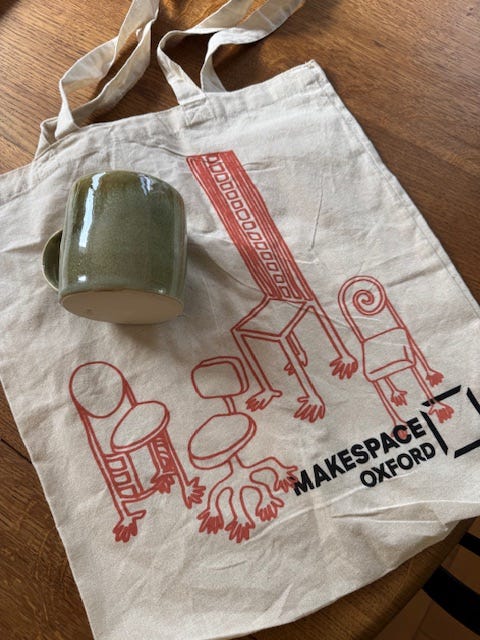
Beautiful gifts from the Makespace Oxford team

We were treated to delicious home made Ethiopian food at LuLa’s
🫐 Robin Wall Kimmerer asks us to reflect upon indigenous wisdom and insights from ecological systems to consider how we might practice alternative currencies of exchange centred upon the gift economy. She reminds us that all flourishing is mutual.
Both Makespace and CoLab Dudley have an established practice of knowledge gifting across the ecosystem.
In a world of information overwhelm, and false truths, the thoughtful sharing of knowledge gifts is essential nourishment and hope generating. These gifts shine a light upon and join the dots between the ideas and stories that we need to help us navigate the Earth crisis and co-create a better future for all kin.
Knowledge gifts shared between the teams
Our relationship to time
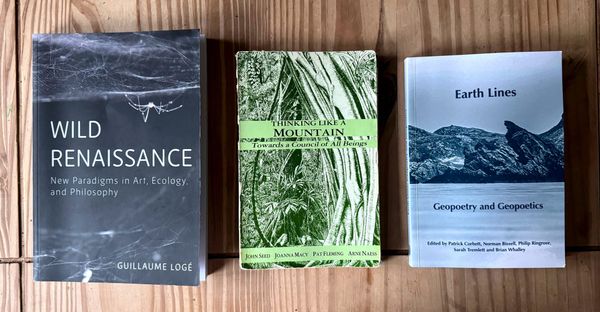
Gifted by Sarah … Momo a book by Michael Ende.
Gifted by Andy … Hospicing Modernity: Parting with Harmful Ways of Living a book by Vanessa Machado de Oliveira.
Gifted by Holly and Jo … The Good Ancestor: How to Think Long Term in a Short-Term World a book by Roman Krznaric AND From What Is to What If: Unleashing the Power of Imagination to Create the Future We Want a book by Rob Hopkins.
Transformational Governance
Gifted by Andy … Transformational Governance Universe — Medium AND ICCA Consortium
Gifted by Jo and Holly … Scale deep — The Systems Sanctuary
Creative practices and change
Gifted by Jo and Holly … CreaTures Framework
More-than-human interconnection
Gifted by Jess … Ocean with David Attenborough | Official Website | 8 May 2025
Gifted by Ruth … Ruth told a story of hearing a Blackbird and it being identical to a well known piece of classical music by Bach and that when she explored this it turned out the piece was indeed inspired by the Blackbird call!
Gifted by Holly … Innovation Inspired by Nature — AskNature
Finally future invitations to shared learning
An invitation from MakeSpace Oxford to their Common Futures series
Sign up here for more Street Detectorism in Oxford and our future events here.
An invitation from CoLab Dudley to Stories of Place
If you care about Dudley and would like to spend an evening with other curious co-creators, you can sign up to a future session here and find out more about previous gatherings here.