Collective learning is a liberatory practice that ripples through the cultural waters we swim in
The story of deep shifts invited through our collective learning that cultivate conditions for redistribution of power, rehearsing regenerative relationships with place, and expanding our circles of accountability.
A mini-series of lab notes from CoLab Dudley on nurturing a collective learning practice, and why we see this as integral to alternative futures building
“Collective learning is not a side function. It’s a different way of doing systems change.” [Tatiana Fraser — The Sanctuary]
“Learning has become synonymous with formal education, which is often entangled in flawed systems that perpetuate injustice. This has resulted in a distorted perception of the true power of learning. As we understand it, learning is inherently a liberating practice that often thrives beyond the confines of educational systems.” [Mohini Govender]
Preamble
This lab note is outrageously overdue! I’ve been marinating in this note for 8 whole months. My ‘stuck-ness’ I think is because this is a story about a live, messy, emergent shared practice that evolves and adapts to place, context and kin. So how to go about telling the story of emergent learning when we are busy paying attention to the doing? How to tell a story that is not MY story but OUR story, a story of collective learning where the learning is an act of relationality? I want to honour this collective labour, the ropes it weaves, the kinship and kithship it nurtures, and I want to be true to its emergent quality. I keep wanting to weave the latest collective learning experiences into the thinking for this note — how we are observing, paying attention to the ripples, the tensions, the possibilities of place it reveals, and most of all the relationships it nurtures.
Further, while I believe wholeheartedly in our commitment to working out loud as part of a practice of commoning knowledge — I also know we exist in a world where if work isn’t visible or documented on social media or other open platforms — perhaps we fear others asking is it real/ relevant/ worthwhile? I have been resisting that pressure, knowing that what we share in relation to collective learning is core to our practices in place, it has integrity, and deserves care and an honouring of the many many learning companions — human and more-than-human — that co-create it and evolve it daily. It demands what Sabrina Meherally powerfully describes as knowledge reciprocity and “[s]hifting from commodification towards relational responsibility.”
So emerging from this mental and moral marinade I have settled on telling the story of WHY and HOW we learn together the way we do. Trusting that WHAT we learn is shared in the story-telling, the doing, the conversations, the imaginings, the creative experiences and new experiments. I trust that these are shared and travel across the ecosystem of kin in a relational way because at the core of this collective learning practice is relationality. How we relate to each other, place, the land, the future, the past, our more-than-human kin and indeed the learning.
“To practice knowledge reciprocity is to reject the logics of extraction and commodification which dominate our current systems of research and learning. It is to reject the demand for content production and consumption — and to be with what we come to know, long enough for it to change us. We are being asked to slow down.” [Sabrina Meherally]
A story of co-evolving collective learning
“Scaling deep challenges dominant assumptions about who produces knowledge, and for what purpose. Traditional evaluation and research methods often extract insights from communities and “participants,” while retaining ownership and authority elsewhere. Collective learning invites a redistribution of that power — centering shared authorship, relational inquiry, and learning as something co-created, not harvested.” [Tatiana Fraser — The Sanctuary]
The story about why we learn the way we do is grounded in testing out what it takes to shift from the limiting, siloed and reductive quality of single project, prescriptive reporting towards a more interconnected and generative whole ecosystem commoning of knowledges for mutual flourishing of all life.

We bring intention to collective learning in this way in order to help cultivate an ecosystem-wide practice of curiosity, experimentation, and shared learning for common good. During our years of learning together we have come to understand that collective learning, if done with care, is a regenerative and liberatory practice. It goes well beyond exchange or growth of skills and knowledge, it generates ripples for the cultural waters we swim in.
In this note we tell the story of deep shifts invited through the collective learning that cultivate conditions for redistribution of power, rehearsing regenerative relationships with place, and expanding our circles of accountability.
Redistribution of power in service of mutual flourishing — through disrupting:
- hierarchies of knowledge — by re-prioritising creative, cultural, imaginaries, ancestral, land based, earth care, embodied, more-than-human knowledges;
- preferred sites of knowledge production — by celebrating learning outside, in community, in the future, in the open, in our imaginations, in ecosystems, and across disciplinary, organisational or geographical boundaries;
- a narrative of evaluation as an external, bounded exercise for project monitoring for funders — reclaiming ongoing whole team values led developmental learning as critical to sensing the landscape as part of regenerative learning infrastructuring and testing more distributed governance;
- a perception of learning as individualised advancement — instead collective learning nurtures regenerative resilience through co-evolving knowledges and sensing capabilities in place that help weave bonds of connection and belonging between all life — human and more-than-human.
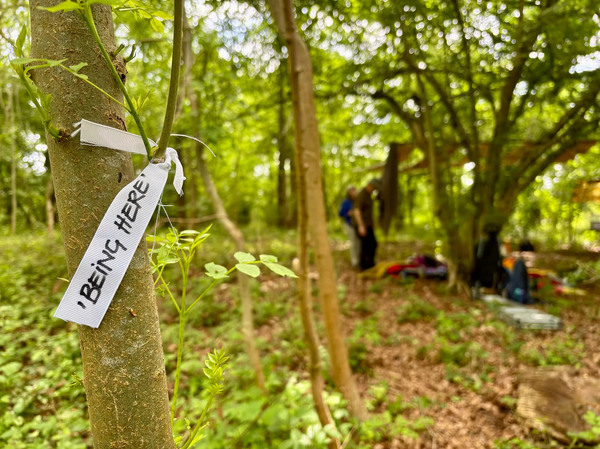
Rehearsing regenerative relationships with place and land — through embracing many ways of knowing that are more kin-centric and multi-sensory learning practices that nurture kithship
”.. kithship is an intimate connection ‘with the landscape in which one dwells and is entangled, a knowing of its waymarks, its fragrance, the habits of its wildlings’. Unlike kinship, kithship is earned through being near, still, opening up and observing in our places, and crossing ‘dimensions of knowing’… Kithship enlivens and complexifies kinship, and it is essential if the fullness of kinship’s wisdom is to be lived.” [Lyanda Fern Lynn Haupt]
Expanding our circles of accountability — through paying attention to time and the entanglement of life in our sensing and learning relationships, we can begin to include our ancestors, future generations and our more-than-human kin as learning companions.
For a decade now CoLab Dudley has been exploring learning and evaluation in complexity. For eight of those years we have nurtured a playful practice of collective learning across our network called ‘detectorism’.
Detectorism is premised upon our understanding that in transition and alternative futures work the learning, imagining and the action for change are entirely entangled and always relational.
The multi-modal data gathered through detectorism informs a values based approach to evaluation, developed by Michael Quinn Patton, called Principles-Focused Evaluation (PFE). PFE is a form of developmental evaluation we have made integral to our work at CoLab Dudley. Unbelievably, there are over a 100 different types of evaluation! Evaluation approaches — or how we make sense of change — range from highly technical, fixed brief, end of project monitoring types, all the way through to more critical learning framework, ‘improve not prove’, ‘evaluation as intervention’ types. PFE falls into the latter category and uses collectively developed principles and counter principles to GUIDE action and understand change. PFE is a type of evaluation that supports long term navigation and decision making in response to complex challenges by paying attention to HOW we work, not just WHAT we do. It guides our practice by foregrounding:
- contextualised sensing in place rather than fixed standard metrics,
- ongoing project improvement feedback loops throughout the lifetime of projects,
- long term knowledge stewardship via interconnected ecosystem learning flows between projects,
- a default to sharing process and learning insights out loud,
- values based practices in place.
In all our experimenting with our learning practices — with the detectorism evolving (i.e. how we gather data and engage in collective enquiry), and PFE evolving (i.e how we use that data to make sense of change and inform practice and action) — we have noticed critical shifts that point to an altogether more regenerative relationship with learning with place, with time, and with our fellow learning companions. Specifically this includes:
How we gather data and relate to the learning
- by paying attention differently in a multi-sensory, often embodied, creative, and layered way across spatial zones of possibility (from our inner person, circling out to projects, community, bioregion and planet); and across temporal zones: (drawing upon our multiple pasts, present and futures);
- by adopting a values-led ethics and consent process grounded in care for learning companions and respect for their knowledges;
- as a social and cultural process of shared learning called ‘detectorism’ that is underpinned by curiosity in action;
- as a reflective practice with human and More-Than-Human kin that deepens relations and cultivates kin-centric behaviours;
- by bringing criticality and asking good ‘What If’ questions to aid our subversion of Business As Usual narratives and practices;
- via energetic engagement of imagination as a learning and modelling of futures tool;
- as a collective practice that is often messy and emergent, slow and meandering, trying things out, learning from what we get wrong, and sharing openly as we go.
Who gathers data and collaborates in the learning
- this is not restricted to a single expert evaluator or academic researcher — instead multiple learning companions weave together their insights, openly sharing and inviting more kin to come into relationship through the learning as an open social process;
- weaving the generous knowledge gifts of our more-than-human kin into our learning through slowing down and paying attention to their lessons and stories;
- in this way many ways of knowing are interwoven and embraced including sensory, kinaesthetic, embodied, imagination, spiritual and heart led,
- we honour knowledge generation and so bring care to illustrating the multiplicity of knowledges that inform action taken via the flows and cross pollination of knowledges.
What data we gather and what data we don’t gather
- this decision is emergent and evolving through collective enquiries and rarely pre-determined;
- the data gathered is grounded in practices in place and place based knowledges, as well as being rooted in a living systems worldview of interdependence;
- using Principles-Focused Evaluation to GUIDE our work means we gather data to explore change relating to what we value, not imposed or retrofitted metrics.
How we share data
- data is always framed in terms of collective cultural storytelling, connectivity and accountability, because its purpose is to disrupt cultural meta narratives of individualism, separation, extraction and growth at all costs;
- data is situated instead within a story of place based potential and mutual flourishing;
- data is shared with consent and understanding of why we share, honour, express gratitude and celebrate the learning as a collective endeavour with ripples for our shared future;
- it is shared within the knowledge commons for open access — knowledge enclosure or hoarding is harmful and disempowering;
- it is also shared as part of an intentionally relational practice of knowledge weaving within the local ecosystem and within the field of Fellow Travellers as a process of connection and co-creation.
- it is shared on open digital platforms to erode barriers to access, encourage interaction and co-production/authoring. In time as part of Dudley People’s School for Climate Justice it will be shared on an open access digital archive called Dudley Time Portal. This archive is being co-designed prioritising long term thinking and a 100 year time frame in mind.
- the learning is also shared through our Seasonal Gatherings, in the lab space on the High Street. Here it is co-curated to spark conversations, questions, inspiration and connections as well as making visible alternative world narratives through the learning creative documentation. These gatherings are a time of celebration of the work and learning, the relationships they forge, and the ideas they give life to.
Lab note mini-series context
For curious souls we offer a deeper dive into how we learn together in the rest of this lab note mini-series.
This lab note is part of a series offering a deeper dive into our co-evolving collective learning or how we learn together.
- The first note (this one) offers a summary of critical shifts in power, connection and accountability this way of collective learning cultivates.
- The second note offers a little bit more detail about “detectorism” as the foundation to our collective learning and why we learn like this.
The following notes take a look at ‘What does disruption of business as usual project learning look like in practice?’
These mini lab notes cover nine different practical strategies we use to diversify evidence and value in our collective learning. They are grouped into four bundles for ease of exploration:
↗ Values led developmental evaluation
↗ Commoning knowledge, knowledge weaving and relational ethics
↗ Diversifying data gathering to cultivate inhabitancy
(Inhabitancy and kithship. Diversifying data gathering and multi-species learning. Accountability to future generations and Languages.)
↗ Decolonising our learning practices and the role of semi-permeable boundary holding
(Semi-permeable boundary holding in regenerative learning infrastructuring. Decolonising our learning practices.)
As we continue to explore themes of scaling deep, funding, and evaluation, one pattern keeps rising to the surface: the growing shift from traditional measurement toward collective learning — not just as a buzzword, but as a real, grounded practice that redistributes power and reorients how change happens. [Tatiana Fraser — The Sanctuary]