detectorism: a co-evolving story
Part of a mini-series about our co-evolving collective learning practice, focusing on “detectorism” as the foundation to our collective learning and why we learn like this.
This lab note is part of a series offering a deeper dive into our co-evolving collective learning or how we learn together.
- The first note offers a summary of critical shifts in power, connection and accountability this way of collective learning cultivates.
- The second note (this one) offers a little bit more detail about “detectorism” as the foundation to our collective learning and why we learn like this.
- The following notes take a look at ‘What does disruption of business as usual project learning look like in practice?’ These mini lab notes cover nine different practical strategies we use to diversify evidence and value in our collective learning. They are grouped into four bundles for ease of exploration:
↗ Values led developmental evaluation
↗ Commoning knowledge, knowledge weaving and relational ethics
↗ Diversifying data gathering to cultivate inhabitancy
(Inhabitancy and kithship. Diversifying data gathering and multi-species learning. Accountability to future generations and Languages.)
↗ Decolonising our learning practices and the role of semi-permeable boundary holding
(Semi-permeable boundary holding in regenerative learning infrastructuring. Decolonising our learning practices.)
As we continue to explore themes of scaling deep, funding, and evaluation, one pattern keeps rising to the surface: the growing shift from traditional measurement toward collective learning — not just as a buzzword, but as a real, grounded practice that redistributes power and reorients how change happens. [Tatiana Fraser — The Sanctuary]
Detectorism — a co-evolving story
Our practice of collective learning is called detectorism. It is a made up word to help make learning together less scary, more playful, and more curiosity sparking.
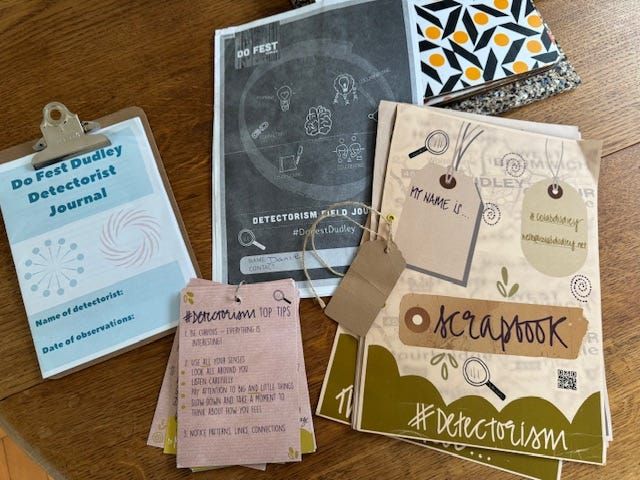
We made this word/way of learning up in a community cafe on Dudley High Street in 2017. We have been testing, evolving, sharing, and playing with it ever since. There have been detectorism journals with time machines, badges for visiting detectorists, detectorism scrapbooks, festival detectorism lanyards, detectorism maps, counter-maps, portraits, celebrations, lab notes, sense-making chapter chews, food for thought sessions, and much much more.
Most importantly, the thing about detectorism is that everyone has detectorism Superpowers so everyone is welcome and able to take part!
Detectorism is a practice of noticing with care, of zooming in and out, looking for patterns and connections, sharing your detectorism findings, and then weaving them into relationship with data from other detectorists. Socialising the data gathered with peers helps us to reveal What IF questions*. These What If questions then become the next layer of collective enquiry for those that want to explore them. We see detectorism as another pathway to coming into ‘right relationship’ with place by really paying attention so that you nurture bonds of kithship. Our take on Kithship (inspired by Lyanda Fern Lynn Haupt), is that it is a form of intimate relational knowledge of place that invites a deeper reciprocal relationship with that place, its beings and stories; and in doing so expands the possibilities and fullness of kinship.
Detectorism is premised upon our understanding that in transition and alternative futures work the learning, imagining and the action for change are entirely entangled and always relational.
And so detectorism is not a formal research method, more a way of being curious in the world, and using the learning that emerges from that curiosity, noticing and sensing in place to inform ecosystem experiments, weave connections and fuel our dreaming. It is so much more than a feedback loop — though it is that as well. It brings focus to tending to capabilities that support us to pay attention to the world around us in more thoughtful ways that dissolve disciplinary, organisational, project, funding stream, sensory, modality, temporal or kin based boundaries.
Like a living organism, detectorism is always evolving, and in 2020 it evolved a generative new layer: detectorism in the wild. This was an intentional rewilding evolution to take detectorism beyond team and project boundaries/ perspectives, in order to nurture a much wider ecosystem approach to learning that helps encourage a culture of curiosity, noticing, experimentation and relational learning. Through this rewilding we have seen the emergence of creative detectorists (with a focus upon poetry), place detectorism (with a focus upon grounding in place through kin embodiment/ companionship) and time detectorism (sensing and reframing our relationship to time).
It is gathered with care as part of collective learning and ongoing meaningful consent by learning companions.
It involves reflection and a multiplicity of creative practices.
It has a dual purpose of improving experiments and encouraging a culture of curiosity, sensing in place and collective learning for common good.
It seeks to look for patterns across many different types of data, from different sources and times.
It joins the dots between experiment intentions, learning companions, place, and other ecosystem experiments.
We like to flow all our detectorism treasure through our principles matrix to see what it tells us about where the principles are in practice and what happens when they are.
Finally, the learning is shared openly in knowledge commons in a way that Fellow Travellers (wherever they are, just down the road or across the world) can use it to inform their own experiments for change. Through commoning we are part of a bigger collective learning community seeking just and flourishing futures for all life.
*Rob Hopkins in his book “From What Is to What If: Unleashing the Power of Imagination to Create the Future We Want” makes the case for local people asking What If? questions that help us cultivate collective imagination and critical imaginaries in unlocking pathways to flourishing futures. We love using What If Questions in all areas of our learning and are grateful to Rob for all his inspiring storytelling and time travel practice. We love that our convening of Dudley’s Time Rebellion is featured in his new book: How to Fall in Love with the Future : A Time Traveller’s Guide to Changing the World.
Why learn like this?
We believe diversifying evidence and value is critical to transition and mutual flourishing
We continue to take inspiration from the deep and generous thinking done by Good Shifts around repatterning in systems change. In particular, their clear-eyed call to diversify evidence and value. Our reading of this call to action — viewed through our lens of years of reporting requirements existing in sharp contrast to our detectorism approach to learning — is that too often dominant or default modes of measuring value prioritise standardised and prescriptive metrics in relation to scale, social impact and value for money outcomes. Further, these are nearly always embedded by the end of project external evaluators with a brief to focus upon impact and outcomes outlined in funder proposals, within short-term project timelines, and fixed boundaries.
This approach limits our capacity to respond meaningfully within our ecosystem to the dynamic, but deep rooted context and complex reality of Earth Crisis. This way of measuring feels reductive, joyless, extractive, abstracted, imposed, retrospective and most of all, inadequately relational or liberating for the moment we face. Perhaps more worryingly the universality of these metrics:
“[o]pens up a perspective that data, measurement and evidence can actually reinforce inequity and the status quo, rather than shifting it or seeking to transform it.” [Good Shifts]
Tatiana Fraser describes the systems of learning and evaluation we find ourselves seeking to disrupt as:
“systems that continue to privilege metrics over meaning, compliance over curiosity, and control over emergence.” [Tatiana Fraser — The Sanctuary]
This business as usual mode of data gathering undermines our collective learning and dreaming, while concentrating power through control of what types of data, learning and sites of knowledge production are legitimate and valued.
This approach fails to value the full diversity of knowledges and ways of knowing within our gathering evidence for change. Without these knowledges the learning does not reflect the multiplicity of past and present experiences in our human and more-than-human communities. Without these knowledges coming into relationship and co-evolved for this moment, our learning processes risk embedding existing injustices and limiting the potential of place.
In contrast, detectorism seeks to redistribute power via disrupting hierarchies of knowledge and sites of knowledge production. It prioritises paying attention differently — rooted in curiosity, creativity and care — in order to reweave our relationships to place and so cultivate conditions for reinhabitance. It is a relational practice seeking to deepen and extend our circles of accountability.