Values led developmental evaluation
Part of a mini-series about our co-evolving collective learning practice, focusing on values led developmental evaluation - a practice that supports diversifying evidence and value in our collective learning.
This lab note is part of a series offering a deeper dive into our co-evolving collective learning or how we learn together.
- The first note offers a summary of critical shifts in power, connection and accountability this way of collective learning cultivates.
- The second note (this one) offers a little bit more detail about “detectorism” as the foundation to our collective learning and why we learn like this.
- The following notes take a look at ‘What does disruption of business as usual project learning look like in practice?’ These mini lab notes cover nine different practical strategies we use to diversify evidence and value in our collective learning. They are grouped into four bundles for ease of exploration:
Values led developmental evaluation (this note)
↗ Commoning knowledge, knowledge weaving and relational ethics
↗ Diversifying data gathering to cultivate inhabitancy
(Inhabitancy and kithship. Diversifying data gathering and multi-species learning. Accountability to future generations and Languages.)
↗ Decolonising our learning practices and the role of semi-permeable boundary holding
(Semi-permeable boundary holding in regenerative learning infrastructuring. Decolonising our learning practices.)
As we continue to explore themes of scaling deep, funding, and evaluation, one pattern keeps rising to the surface: the growing shift from traditional measurement toward collective learning — not just as a buzzword, but as a real, grounded practice that redistributes power and reorients how change happens. [Tatiana Fraser — The Sanctuary]
Values led developmental evaluation: a practice that supports diversifying evidence and value in our collective learning
“Scaling deep asks us to challenge the power dynamics baked into traditional evaluation. Too often, evaluation is something performed for funders — used to assess the “worthiness” of grantees, projects, or partners. It becomes a checkbox, a backward-looking report, rather than a forward-looking tool for learning, reflection, or adaptation”. [Tatiana Fraser — The Systems Sanctuary]
Our entire approach to evaluation is developmental not summative. Specifically, it is a values-based approach called Principles-Focused Evaluation (PFE) developed by Michael Quinn Patton. We learn in order to improve and to inform new creative/ cultural action. We learn in order to deepen our relationship with place, and each other. We are interested in paying attention to process and practice, not just the tangible action and outputs of our work (you’ll hear us stress ‘how we do, not just what we do’, an approach that is central to Principles-Focused Evaluation).
We have come to understand this way of evaluating is shaped by rhythms of collective sense-making and collaborative design for cultural animation and activism for alternatives futures.
The regenerative futures we seek are emergent and rooted in cultures, and as such ill suited to linear impact logic models, or prediction-orientated theories of change. Culture change is collective, uneven, messy, ambiguous, contextual and dynamic. Instead of evaluating against fixed outcomes we have to be comfortable with not knowing, with experimenting, and collectively sensing, imagining, co-creating and sensemaking our way together into those new futures. There will be expected and unexpected outcomes to observe. The outcomes are multiple and will evolve with unexpected ripples of possibilities.
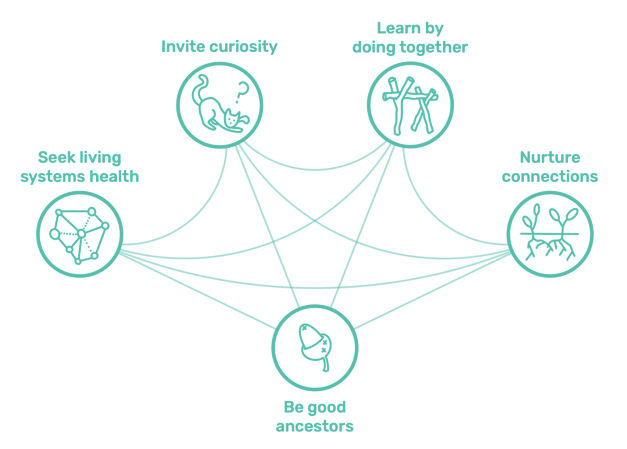
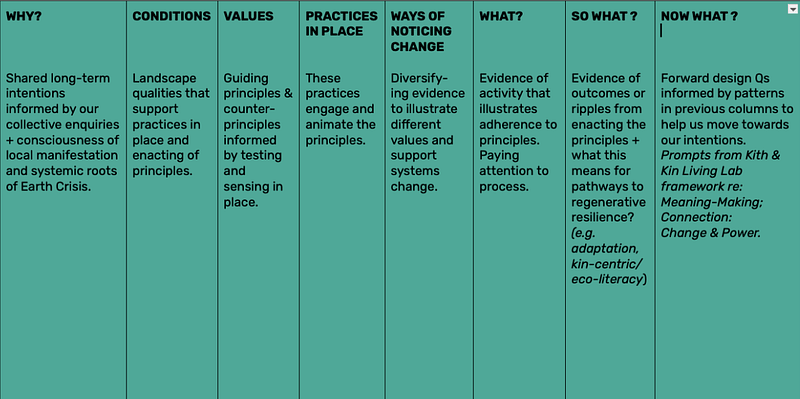
So how does this manifest in practice? We explore the data gathered through detectorism (our collective learning practice) via the lens of five co-created and evolving guiding principles. You can read more about this ever evolving journey here. Our principles have been iterated again this year to support us in being more critically engaged and intentional in our response to the Earth Crisis through re-storying our relationship with land. We have developed a matrix of questions for each principle to help us surface evidence in relation to principles adherence (walking the walk) and principles outcomes (ripples of walking the walk).
Sometimes that evidence is clear and bright, sometimes it is gentle signals we now know to pay attention to.
We have also been evolving the data analysis matrix in the last few months to include NOW WHAT design questions in order to give the principles more explicit forward momentum. We have also aligned our various ‘practices in place’ to each principle to give a greater depth to our attention to process, but also to honour the practices, knowledge lineages and labour that animate the principles.
This last point emerged as a direct result of an experiment in our developmental evaluation that we called the Kith and Kin Living Lab. The table header below shows our evolved PFE data analysis categories.
The Kith and Kin Living Lab emerged from this What If question:
What If … our sense-making was grounded in our interrelatedness with all kin, and the intimate knowledges of the places we dwell (our kith)?
What if we co-created a generative, joyful and creative space to reflect, sense, connect, care, question, design, and spark imaginings based upon our first year as Dudley People’s School for Climate Justice? Through the Kith and Kin Living Lab we are holding ourselves accountable to the prefigurative process, or rehearsal, of regenerative learning infrastructures and all that makes possible for just transition and futures building.
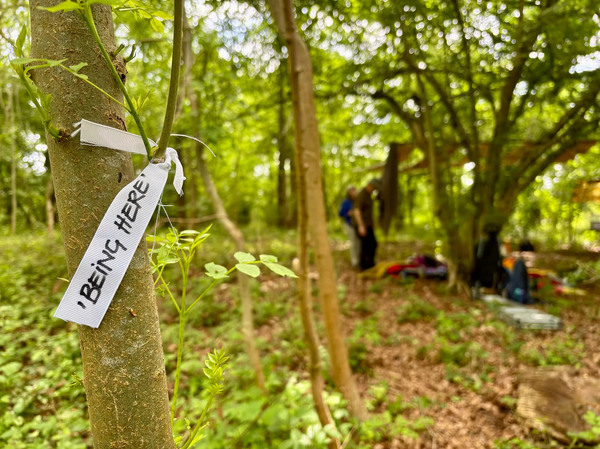
In March 2025, we co-created the Kith and Kin Living Lab as part of our collective learning process in Dudley People’s School for Climate Justice. Rather than work with an external evaluator using traditional methods that are orientated towards the funder’s needs for our end of year reporting, we wanted to create the conditions to deepen our own collective understanding of the impact of our work and the open ended, rhizomatic learning which our work is supporting. We saw this as an opportunity to reframe evaluation in regenerative learning infrastructures as a collective endeavour and relational responsibility in our knowledge sharing.
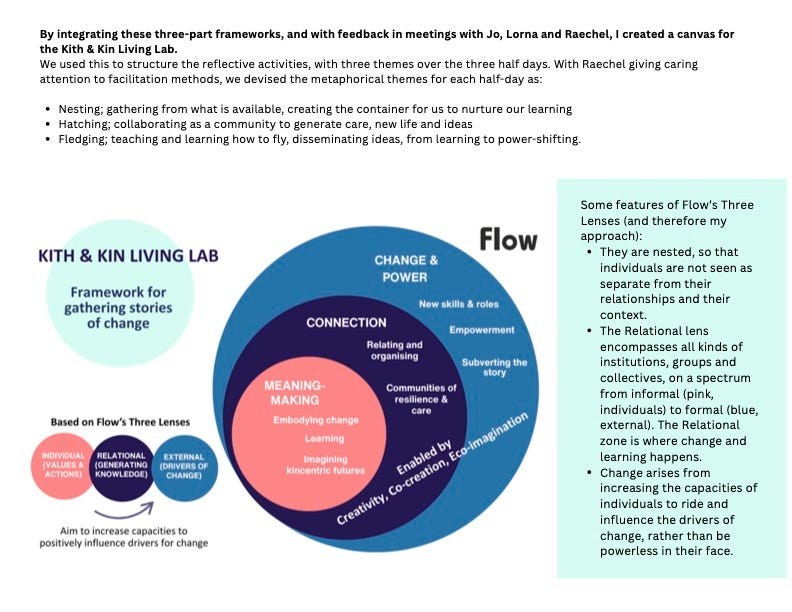
The Kith and Kin Living lab was a 1.5 day collective learning process for School partners (WorkShop 24, Ekho Collective CIC and CoLab Dudley) facilitated with immense care by fellow climate justice practitioners Raechel Kelly and Bridget McKenzie. The Living Lab was intentionally co-designed by Bridget and Raechel to spark connections across knowledges, invite questioning, cultivate ideas, and encourage action for change. Bridget designed a framework for gathering stories of change in the Living Lab using the CreaTures Framework as her starting point.
Together we made, explored, conversed, reflected, moved, planted, connected and felt our way into surfacing the learnings and change from the School’s first year. These learnings were organised in terms of Meaning-Making, Connection, Change and Power (you can see the framework below). Raechel and Bridget brought ecological metaphors alongside this framework to encourage the collective learning, including building nests as a container for gathering learning, and fledging and murmurations for seeing the big picture to support change in the face of Earth Crisis induced disruption.
It is rare to invest this much time and resource in collective project learning. It would be much simpler and less time/resource intensive to recruit an external evaluator to interview partners separately, review the data collected and write a report for the funder. Instead this was a relational learning experience that embraced multiple knowledges, deepened bonds of care, and encouraged flows of knowledge cross-pollination across the partnership, whilst still introducing more critical questioning to inform future School design and action. It surfaced actionable insights relating to:
- our care for modelling, co-evolving practices and generating memories in place that invite re-storying our relationship with place and land;
- our emphasis upon collaborating with more-than-human companions (with sensing, sensitising, representation, connection and co-creation methods) that is part of the re-storying, and so the collective learning is part of a prefigurative practice for kin-centric futures;
- noting the different zones of climate justice activism present within the School with an emphasis upon change within the Meaning making zone (embodied learning and imagining of kin-centric futures through nature connection) and the Connection zone (community organising for change, resilience and care);
- which revealed the potential to lean even more in year two and three into the shifting Power zone through nurturing new climate justice skills, roles, agency while continuing to subvert the meta narrative of what is possible in Dudley.
We see this approach to learning as part of the School being a type of regenerative learning infrastructure, and as such a micro intervention for systems change in and of itself. It is worth repeating that our decade of learning in complexity has shown us that what and how we measure has critical implications for what we bring attention and energy to in this work. Co-creating the Kith and Kin Living Lab as part of our developmental evaluation process as a collective learning endeavour is part of testing an alternative form of distributed governance within the realm of collective learning and shared accountability for alternative futures.
As well as deep care in the co-design and facilitation Bridget and Raechel created knowledge gifts for the School Partners based upon their experience and observations of the Kith and Kin Living Lab. We went on to spend time together online in July as they ‘unwrapped their gifts’ through conversational learning. We are incredibly grateful for their different practices of noticing and creative documentation as part of this alternative approach evaluation that is grounded in relational learning.
Their gifts will now form part of a semi-permanent exhibition in the lab space on the High Street where they can invite curiosity and conversation about learning together in complexity with values led developmental evaluation.
We are grateful for inspiration and wisdom from these knowledge elders
- Gifts from Kith and Kin Living Lab co-creators/ facilitators: Bridget McKenzie gifted this report and Raechel Kelly gifted these complimentary portraits documenting the Living Lab.
- Peer learning and living lab convening demonstrated by Impact Hub Birmingham/ now Civic Square.
- CreaTures Framework
- Michael Quinn Patton originator of Principles-Focused Evaluation