Commoning knowledge, knowledge weaving and relational ethics
We urgently need new ways of learning together, and ways of diversifying the data we gather and how we relate to it. We should be commoning knowledge for intergenerational and interspecies justice, not extracting, hoarding, and enclosing it.
This lab note is part of a series offering a deeper dive into our co-evolving collective learning or how we learn together.
- The first note offers a summary of critical shifts in power, connection and accountability this way of collective learning cultivates.
- The second note offers a little bit more detail about “detectorism” as the foundation to our collective learning and why we learn like this.
- The following notes take a look at ‘What does disruption of business as usual project learning look like in practice?’ These mini lab notes cover nine different practical strategies we use to diversify evidence and value in our collective learning. They are grouped into four bundles for ease of exploration:
↗ Values led developmental evaluation
Commoning knowledge, knowledge weaving and relational ethics (this note)
↗ Diversifying data gathering to cultivate inhabitancy
(Inhabitancy and kithship. Diversifying data gathering and multi-species learning. Accountability to future generations and Languages.)
↗ Decolonising our learning practices and the role of semi-permeable boundary holding
(Semi-permeable boundary holding in regenerative learning infrastructuring. Decolonising our learning practices.)
As we continue to explore themes of scaling deep, funding, and evaluation, one pattern keeps rising to the surface: the growing shift from traditional measurement toward collective learning — not just as a buzzword, but as a real, grounded practice that redistributes power and reorients how change happens. [Tatiana Fraser — The Sanctuary]
Commoning knowledge and knowledge weaving
We urgently need new ways of learning together, and ways of diversifying the data we gather and how we relate to it. We should be commoning knowledge for intergenerational and interspecies justice, not extracting, hoarding, and enclosing it.
We continue to witness knowledge enclosure, and even erasure through lack of care, system generated scarcity, acts of power holding, or an upside down sense of risk all around us across sectors from philanthropy, research, and civic bodies. Knowledge is not an agent for change behind paywalls; when it is inaccessible; when it is fixed and non-malleable; when people engage in transactional consent processes; so long as we have a consultation industry that lacks relational ethics; or when it simply remains stagnant in a corner because the system instructs us to learn within project/ organisational boundaries, not in community, and not in kith/kinship.
We co-created detectorism (our practice of collective learning) partly as a rejection of this unintended outcome of projectivisation of transition work that bakes in short-termism, myopic analysis, decontextualisation, external power, and isolating silos of knowledge.
We advocate instead for long term care of knowledge by openly working out loud in the knowledge commons and practicing knowledge weaving.
We work together to weave and connect the threads of different individual, group and project insights over time to tell a longer, richer and ecosystem wide story of change, as well as celebrating the relationships and practices in place that cultivate that change. By learning like this we are trying to cultivate an ecosystem wide flow and socialisation of multiple knowledges to inform action for change. We have found that by adopting a more expansive open sensing/ sensemaking practice like detectorism it has enabled a richer understanding of the emerging practices and new possibilities across the Dudley ecosystem, as well as creating multiple spaces for cross-pollination and co-creation of knowledge locally and further afield.
Ensuring the knowledge does not become stuck in a corner of the ecosystem is critical to knowledge commons. To avoid this we consciously model and cultivate knowledge weaving to unblock and meaningfully connect learning across boundaries and contribute to a knowledge gift economy. Robin Wall Kimmerer asks us to reflect upon Indigenous wisdom and insights from ecological systems to consider how we might practice alternative currencies of exchange centred upon the gift economy. She reminds us that all flourishing is mutual and that:
“The currency of the gift economy is relationship.” [Robin Wall Kimmerer]
So, like many of our Fellow Travellers, we have an established practice of intentional knowledge gifting or weaving as part of our network weaving practice across the ecosystem (see the generous knowledge gifting of Civic Square, MAIA/Hood Futures Studio, Makespace, WeCanMake, Onion Collective, Dark Matter Labs, Bioregional Learning Centre, Make/Shift and Centric Lab).
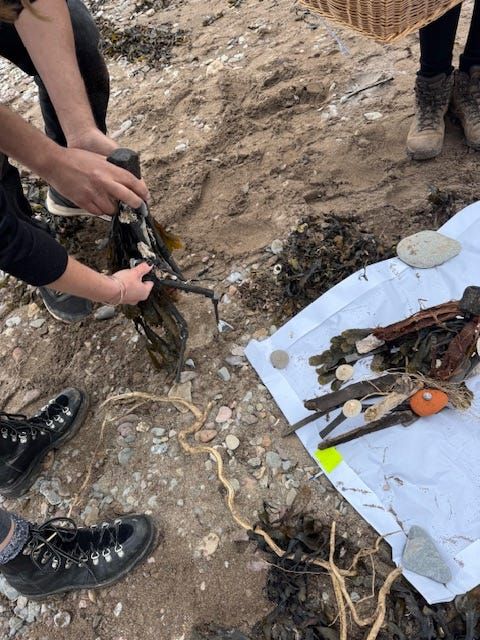
The knowledge weaving process for us can involve tailored sharing of insights to different groups/ individuals with specific sign-posting; convening intentional group reflection spaces in real life and online; curating knowledges in patterns and narratives that support post-disciplinary interconnection; inviting creative documentation and participatory sensing processes that invite new interactions with insights; and sharing physical gifts and knowledge artefacts that act as a memento or carrier of the wisdom they signify.
This practice, like any gift economy, yields an abundance of return gifts that flow back in indirect, complex, but always relational ways that grow bonds of solidarity and deepens our collective resilience through shared knowledge making and stewarding.
Knowledge weaving as a practice and as a critical role within transition work is outlined in detail in this brilliant and generous recent working out loud by The Weaving Lab:
“The stakes couldn’t be higher. In our polarised, post-truth landscape, where trust in institutions is eroding, complex challenges demand unprecedented collaboration. The question of “What information do you trust?” inevitably becomes “Who do you trust and why?” Against this backdrop, the emergent role of knowledge weavers — those who connect insights across events, communities, disciplines and divides — takes on critical importance. …Leaning into the principle of Community Stewardship of knowledge, the ancient Andean “ayllu” principle shows how knowledge belongs to the community collectively, with individuals serving as temporary stewards rather than owners — challenging Western intellectual property frameworks by prioritising community responsibility over individual rights.” The Weaving Lab
In a world of information overwhelm, and proliferation of false truths, the thoughtful sharing and weaving of knowledge gifts can be essential inspirational nourishment, offer timely course corrections, unstick a practical challenge and create sites of collaboration.
Through practicing knowledge weaving these gifts shine a light upon and join the dots between the ideas and stories that we need to help us navigate the Earth Crisis and co-create a better future for all kin.
For example, Fellow traveller WeCanMake were curious about our practice of Principles-Focused Evaluation (PFE), and after we shared lessons and ways to create and locate theirs they developed their own wonderful principles. We have since taken return inspiration from them in the very relational way they have socialised their principles within their local community. In a moving knowledge gifting exchange I had with Melissa from WeCanMake it was clear that socialising the principles invited important values led conversations that help bring community into deeper relationship with each other and place.
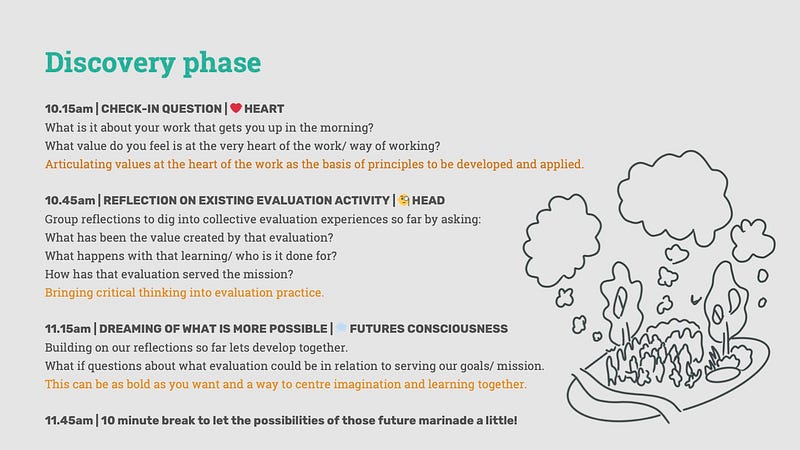
Folding this gift into our own practice we now plan to try socialising our revised principles in Dudley at our autumn and winter Gatherings. This flow of exchange around PFE and detectorism practice was further amplified in our recent knowledge weaving with Fellow Travellers Makespace Oxford. You can read all about this weaving in our co-authored lab note: What IF … we shared our learning in a radically transparent and generous way? Commoning our knowledges, working out loud and sharing and cross-pollinating our practices as a learning-doing network of Fellow Travellers in service of flourishing futures for all kin?
Meanwhile, from early 2025 our knowledge weaving gained a joyful focus upon the role of story in collective learning. We have joined Fellow Travellers in Watchet, Minehead, and Amber Valley, convened by Onion Collective and alongside community technologists Free Ice Cream/Parlour, to be part of the second chapter of Understory. Together we are exploring, researching and rehearsing the role of creatively surfacing and mapping stories, collective dreaming and networks in cultivating social and rest of nature connections to animate change. This interaction of network, cultural (dreams and stories) and knowledge weaving is a particularly potent mix with the Understory partner collective learning already generating ripples of change:
… together we’re going deeper, to understand the ‘warm data’ of the maps — the information that is alive and always learning. Fleshing out what the networks really mean, how they can be deepened and broadened to support the entangled webs of our more than human worlds, our stories, our commons, and our imaginations — and help support those relationships and connections to build a better future together. [Onion Collective]
We are grateful for the inspiration and wisdom from these knowledge elders
- Fellow travellers in the alternative futures field who actively and openly share, signpost and lift up knowledge gifts — links above.
- Robin Wall Kimmerer’s wisdom shared in Braiding Sweetgrass and The Serviceberry
- Bridging Communities, Events and Insights in a Fragmented World — The Essential Role of Knowledge Weavers by The Weaving Lab
Relational ethics
Commoning knowledge demands a more relational ethics framing with meaningful and care-full consent. This is an ongoing journey of unlearning for us, moving away from the business as usual, overly long, technocratic, or cut and paste standard consent forms, towards a more creative and relational process that cultivates the conditions for enthusiastic and informed sharing of knowledge for common good (where this is supported). Sometimes we get it wrong, missing the thought needed, not least of all because this process done right takes time, and often feels disruptive in the context of faster paced doing spaces. However, we also know this is about rehearsal and making relational ethics a cultural norm, not just in knowledge commoning, but all areas of the work. We find slowing down helps.
In practice this involves honouring authorship and knowledge lineages, thoughtful sharing where learning companions have meaningfully consented, creating conditions for ongoing learning companionship and ultimately a care for common knowledge by sharing only what is needed for common wealth.
In our annual knowledge composting we reflect upon and celebrate knowledge lineages as well as naming and expressing gratitude for the labour of our learning companions — both human and more-than-human. For us these are very practical manifestations of a relational practice that is informed by what Lauren Tynan describes as a relational ontology, and what Sabrina Meherally describes as relational responsibility in our knowledge gathering and sharing. There is an expansive understanding of reciprocity that underpins this relational ethics that is also manifest in our active practice of knowledge weaving, gifting and commoning while also being mindful of our responsibility when sharing the knowledge:
“How do we protect the integrity of what we carry? To be in relationship with knowledge is to protect it from misuse, distortion, and commodification. It means asking not just can I share this? — but should I share it? And what is my responsibility if I do?” [Sabrina Meherally]
We are grateful for the inspiration and wisdom from these knowledge elders:
- Sabrina Meherally’s writings on knowledge reciprocity
- Lauren Tynan’s experience, practice and writing on relational ontologies in research
- Holly Doron’s relational ethics experimentation in their doctoral practice.